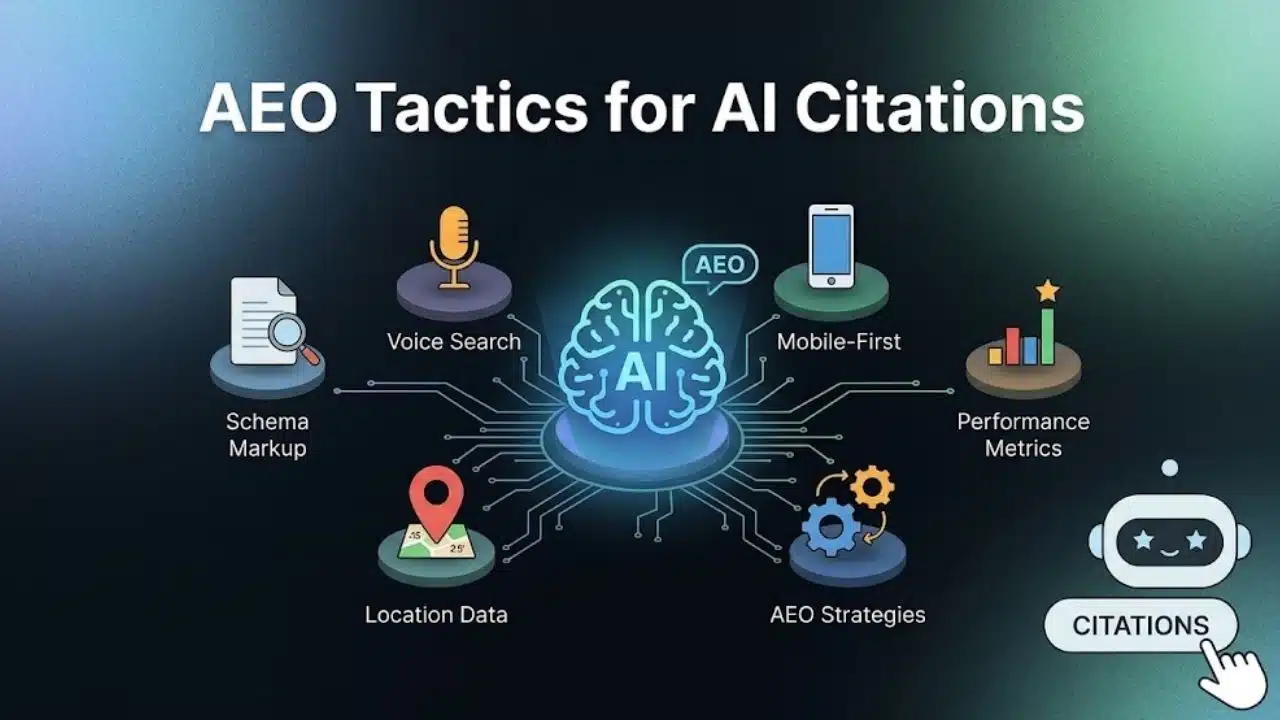
Ranking for a high-volume keyword no longer guarantees visibility in generative search. AI models bypass generic pages, pulling directly from content built with clear AEO tactics for AI citations.
To earn citations in platforms like Google AI Overviews, ChatGPT, and Perplexity, your content must do three things: make facts easily retrievable, deliver unique information, and present verifiable evidence that prevents machine misinterpretation.
Answer Engine Optimization (AEO) shifts focus from target keywords to semantic clarity and direct value. Prioritizing structured insights, technical markup, and original research ensures your content isn’t just indexed by search engines—it gets cited as the authoritative answer.
What Most AEO Advice Gets Wrong
No publisher can force an AI product to cite a page. Sources may change with the prompt, the searcher’s location, the freshness required, the available index, and the system generating the answer.
There is also no universal AI markup. Google says its generative search features do not require special schema, tiny “content chunks,” or an AI text file. It currently ignores llms.txt for Search. That file may have a purpose with another service, but maintaining it should not take priority over fixing indexing, weak evidence, or stale pages.
A useful AEO change should also improve the page for someone who needs a dependable answer. If the edit makes the article repetitive, thinner, or awkward to read, the optimization has become the problem.
9 Practical AEO Tactics for AI Citations
These tactics are arranged by practical priority, not novelty. The early items focus on creating answers and evidence worth citing. The later ones deal with technical access, structured data, freshness, and measurement. Together, they provide a realistic starting point without relying on unsupported tricks or treating every AI platform identically.
1. Put a Direct Answer Where the Question Is Asked
When a section promises an answer, deliver it in the opening sentences. A reader should not have to pass through a history lesson, sales pitch, or five paragraphs of setup before reaching the useful part.
The answer also needs enough context to stand on its own. Instead of opening with “It depends on several factors,” state the likely decision and its limits: “For a small editorial site, weekly content audits are usually unnecessary; a monthly review is more realistic unless prices, policies, or product details change frequently.” The explanation can follow.
Do not force every answer into the same length. Two to four sentences may be enough for a straightforward definition. Legal, medical, financial, and technical questions often need conditions, geography, dates, or exceptions to remain accurate. A short passage that loses those details is easier to quote but less safe to use.
2. Cover the Decision Around the Query
Google calls this process query fan-out: its AI features may issue related searches before composing an answer. A page about migrating from one CRM to another becomes more useful when it covers data export, field mapping, permissions, downtime, rollback, and post-migration checks. A definition alone will not carry that decision.
Map the questions that follow the main query, then keep the related ones together. Split out a supporting article only when the subtopic has a genuinely different intent and enough substance to stand alone. Producing 20 near-duplicate pages for slight prompt variations is busywork, not coverage. When separate pages are justified, use descriptive internal links such as “CRM migration checklist,” not “learn more.”
3. Publish Evidence That Gives the Source a Reason to Be Named
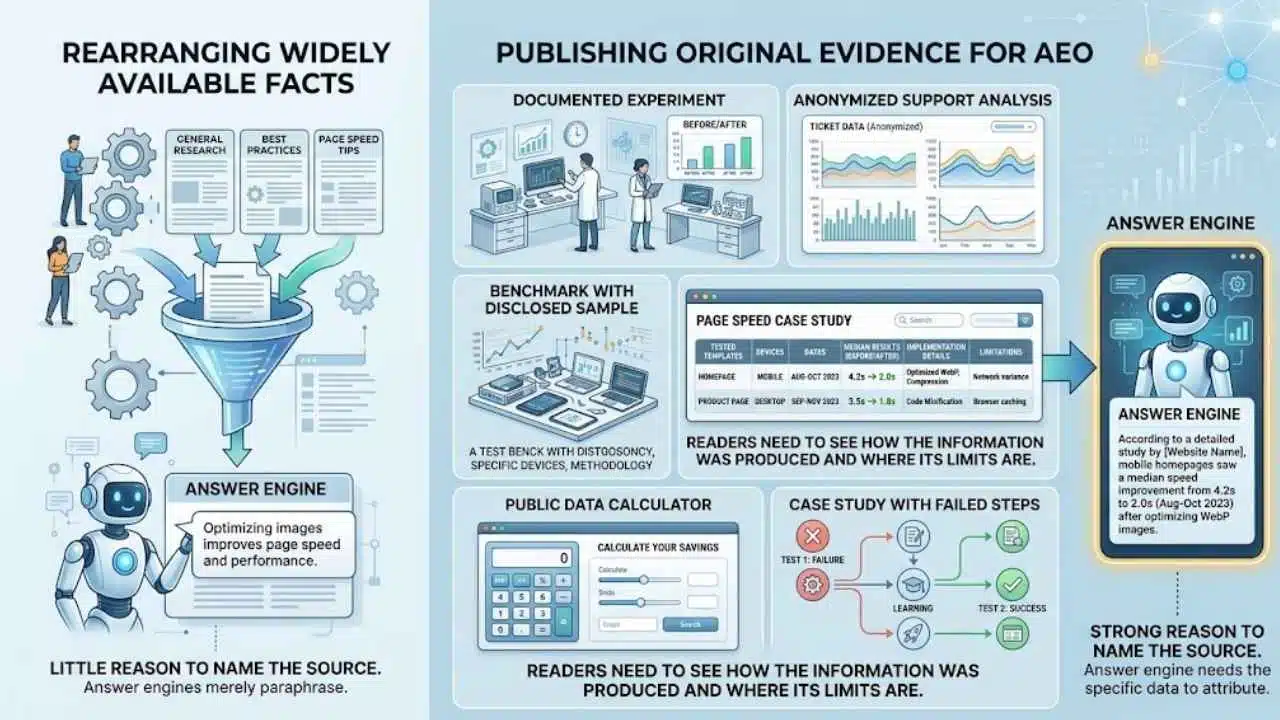
A page that merely rearranges widely available facts gives an answer engine little reason to name it. Original evidence provides a clearer reason.
That evidence might be a documented experiment, an anonymized support analysis, a benchmark with a disclosed sample, a calculator built from public data, or a case study that includes failed steps. Calling something “research” is not enough. Readers need to see how the information was produced and where its limits are.
Suppose an agency compares page speed before and after converting its images. The citable asset is not the claim that the site became faster. It is the table showing tested templates, devices, dates, median results, implementation details, and limitations. Without that context, the number proves little.
For most publishers, this deserves more attention than another round of heading changes. It is one of the strongest AEO tactics for AI citations because it creates information an answer may need to attribute rather than simply paraphrase.
4. Make Every Important Claim Traceable
Original work is not required for every article. Careful verification still separates a dependable source from a rewritten summary.
Link factual claims to primary documentation wherever possible. Name the organization, report, date, geography, sample, and unit when those details affect interpretation. If the publication’s house style keeps links or references at the end, maintain a source log that still maps each claim to its evidence.
A widely repeated statistic can become misleading after its time frame or survey population disappears. Do not present a 2022 consumer survey as a current global benchmark. If newer data is unavailable, state the date and scope plainly.
The original GEO research preprint found that citations, relevant quotations, and statistics improved source visibility within its benchmark and tests. That is useful early evidence, but it does not establish a universal ranking formula or guarantee organic discovery. Adding weak statistics to every paragraph will not manufacture authority.
5. Use Page Structure to Clarify Relationships
Clean structure helps readers scan and makes the relationship between a question and its answer easier to interpret. Use one descriptive H1, a logical H2 and H3 hierarchy, numbered steps for sequences, bullets for genuine lists, and tables only when comparison is clearer than prose.
Do not turn every sentence into a heading or every paragraph into a 40-word “AI chunk.” Critical information must also be available in the rendered page without requiring a click, swipe, or form entry to load it. Google’s mobile-indexing guidance warns against loading primary content only after user interaction.
Check a few representative templates in URL Inspection rather than assuming one successful page proves the whole CMS works. Tabs, accordions, comparison tools, and client-side filters are common places for important content to disappear from the rendered HTML.
6. Remove Doubt About People, Brands, and Products
An article becomes harder to trust and interpret when the author has no profile, the company uses several names, or a product description conflicts with its pricing and help pages. Entity clarity starts with ordinary editorial housekeeping:
- Use consistent names for the organization, products, and authors.
- Add accurate bylines and author pages with relevant credentials.
- Maintain About, contact, corrections, and editorial-policy pages.
- Show publication and meaningful update dates.
- Explain the method behind reviews, tests, or original research.
These elements do not create an automatic authority score. Google explicitly says E-E-A-T is not one specific ranking factor. They do give readers and search systems clearer evidence about who produced the work and how it was created. A thin author page stuffed with vague credentials is not a substitute for that evidence.
7. Apply Structured Data With Restraint
Structured data is useful housekeeping and one of the more overrated AEO fixes when treated as a shortcut. It labels information; it does not submit a citation request.
Use types that match the visible page, such as Article, Organization, Person, or an appropriate product type. Google recommends JSON-LD for supported rich-result markup. The author, dates, product details, ratings, and other properties must agree with what a visitor can see. Validate eligible markup with Google’s Rich Results Test and use the Schema Markup Validator for broader Schema.org syntax. There is no special “AEO schema,” and valid markup guarantees neither a rich result nor an AI citation.
8. Audit Crawler Access One Engine at a Time
This is the boring check that can invalidate everything above. Review robots.txt, canonical tags, noindex, snippet controls, authentication, paywalls, CDN rules, and web-application firewalls. A bot allowed in robots.txt can still receive a 403, a 429, an empty JavaScript shell, or a CDN challenge page. Server logs reveal failures an on-page audit will miss.
The controls are not identical across providers. OpenAI uses OAI-SearchBot for search visibility and GPTBot for potential model training, so a publisher can manage those purposes separately. Perplexity documents PerplexityBot for surfacing pages in search results and Perplexity-User for visits made in response to user requests. Google requires a page to be indexed and eligible for a snippet to appear as a supporting link. Its separate generative-AI inclusion control is currently rolling out to a subset of Search Console properties.
Do not copy a generic robots file without reviewing the business, licensing, privacy, and infrastructure consequences. Allowing a crawler creates eligibility, not a promise of inclusion. Blocking direct access may still leave an engine able to show a URL or title discovered elsewhere, but it can prevent use in summaries or snippets under that provider’s rules.
9. Refresh Meaningful Facts and Measure Citation Outcomes
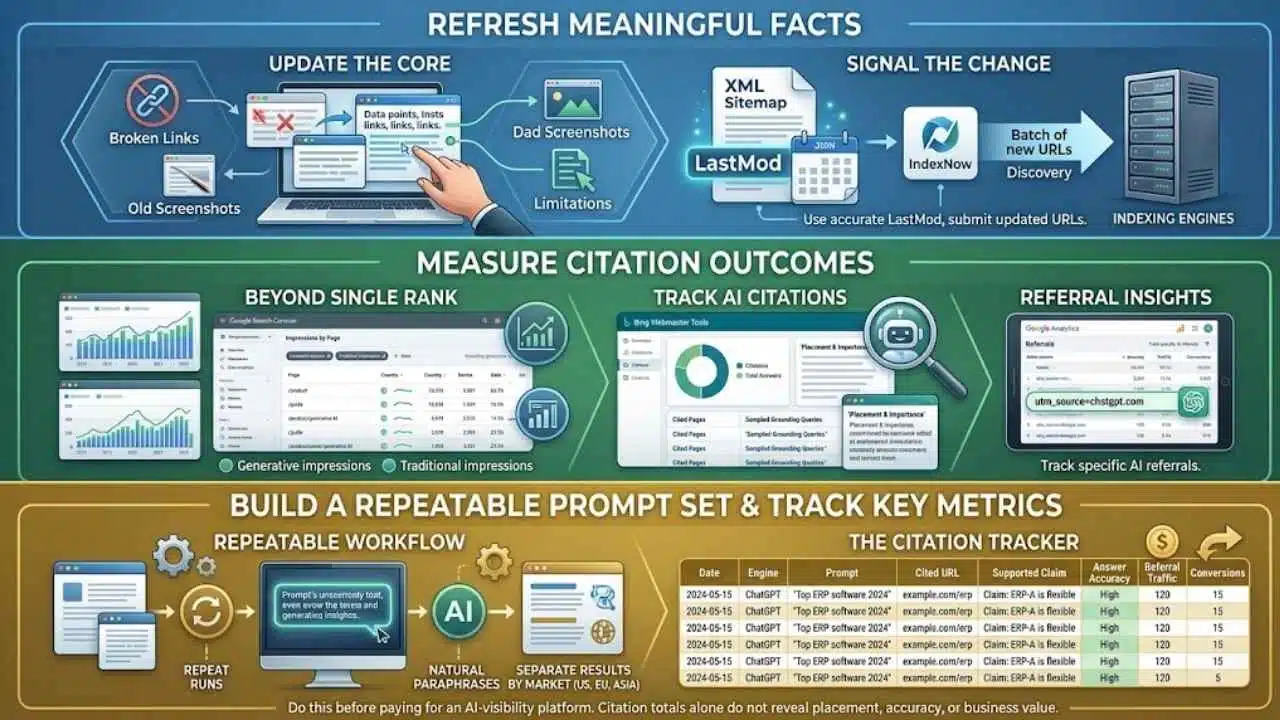
Freshness is not a matter of changing the date at the top of an unchanged article. Update the facts, links, screenshots, limitations, and recommendations that have materially changed. Use an accurate lastmod value in the XML sitemap; Google advises reserving it for significant page updates. For engines participating in IndexNow, submit new, updated, or removed URLs so they can discover the change sooner. Submission does not guarantee indexing.
Measurement needs to move beyond a single rank position. Google Search Console’s generative AI report, currently rolling out to some properties, shows impressions by page, country, device, and date. Bing Webmaster Tools’ public-preview AI Performance report includes citations, cited pages, and sampled grounding queries. Its totals do not show a page’s placement or importance within an answer. ChatGPT search referrals include utm_source=chatgpt.com for analytics tracking.
Build a repeatable prompt set around commercially important topics. Run each prompt more than once, include natural paraphrases, and separate results by market. Track the date, engine, prompt, cited URL, supported claim, answer accuracy, referral traffic, and conversions.
Do this before paying for an AI-visibility platform. Citation totals alone do not reveal placement, accuracy, or business value.
A Practical Starting Point
Start with ten pages that already have impressions, backlinks, conversions, or first-party knowledge behind them. Check access and indexing first. Then improve the direct answers, add missing evidence, clarify authorship, correct the markup, and connect each page to the decisions readers are actually making.
If those pages show no movement, revisit topic relevance and source quality before scaling the process. More optimized pages will not repair a weak premise.
Do not redesign the entire site around a handful of prompts. Watch several recrawl and reporting cycles, compare query groups, and keep the changes that improve reader usefulness as well as measurable visibility. The most durable AEO tactics for AI citations make a source easier to trust, retrieve, and quote while leaving the article better than it was before the optimization began.