
White label SaaS sounds almost suspiciously convenient. A company builds the software, another business puts its name on it, and customers pay a recurring subscription. No engineering team, no years of product development, and no panicked midnight calls about a database migration.
That is the attractive version. The complete version includes customer acquisition, onboarding, support, usage costs, vendor dependence, and margins that may look much less exciting once every expense is counted.
I see white-label SaaS as a distribution model, not a shortcut to owning a software company. One business develops and operates the technology. Another packages it for a particular audience, sells it under its own brand, and adds enough value to justify the price.
That can become a credible recurring-revenue business. Simply changing the logo on a generic dashboard rarely does.
What Is White-Label SaaS?
White-label SaaS is cloud-based software developed and operated by one company but licensed to another business that rebrands and resells it.
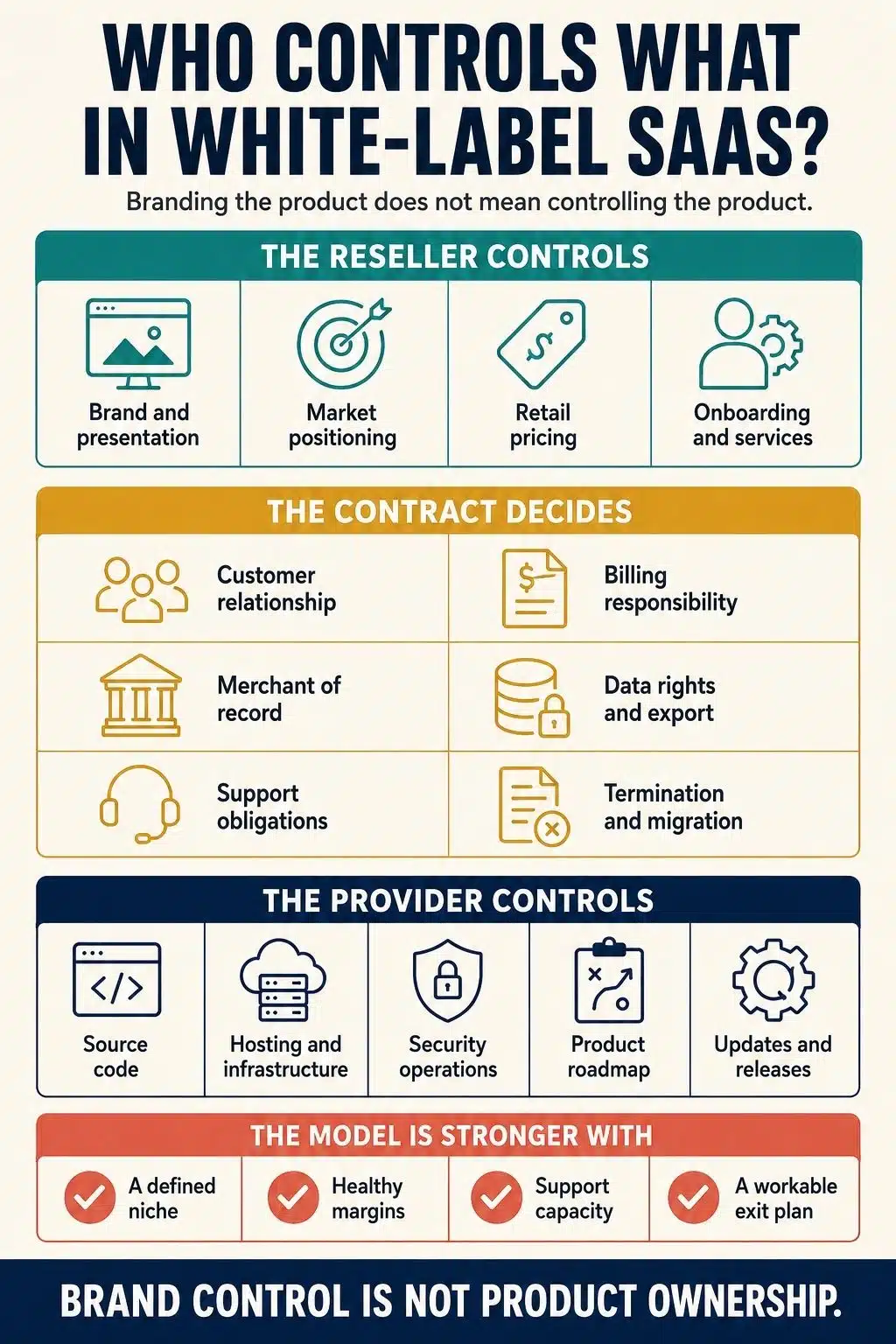
The original provider usually retains control of:
- Source code and intellectual property
- Hosting and infrastructure
- Product development
- Security maintenance
- Bug fixes and updates
- Core technical operations
The reseller usually controls:
- Customer-facing branding
- Market positioning
- Retail pricing
- Sales and marketing
- Client onboarding
- First-line support
- Additional services and packages
Consider a company that develops a CRM for managing leads, appointments, email campaigns, and sales pipelines. It could sell the platform directly under its own name, but it could also license it to marketing agencies.
An agency might add its own logo, colors, domain, subscription plans, templates, and automated workflows. It then sells the CRM to clients as part of its own service. The clients interact mainly with the agency, while the original provider continues operating the technology behind the scenes.
The precise arrangement varies. Some providers handle nearly everything except sales. Others expect the reseller to manage billing, configuration, onboarding, and most customer support.
How Is White-Label SaaS Different From Reselling?
The terms are often mixed together, but the differences matter.
| Business model | Whose brand customers see | Who manages the customer relationship? | How the partner earns |
| White-label SaaS | Reseller’s brand | Usually the reseller | Subscription margin, services, and add-ons |
| Traditional reseller | Original provider’s brand | Reseller or provider | Discount, markup, or commission |
| Affiliate program | Original provider’s brand | Provider | Referral commission |
| Embedded software | Host product’s brand | Host business | Subscription, usage, or bundled product revenue |
An affiliate sends customers to the provider and receives a commission. The provider usually controls checkout, billing, onboarding, and support.
A traditional reseller sells another company’s recognizable product, sometimes at a discounted rate. Customers still know which company developed it.
A white-label reseller presents the software under its own brand and normally takes greater responsibility for pricing, sales, onboarding, and support.
There is no universal standard for what qualifies as “fully white label.” One provider may allow only a logo and color change. Another may support a custom domain, branded emails, reports, billing, mobile apps, and a largely invisible backend provider.
The name of the program matters less than the rights and controls written into the agreement.
How White-Label SaaS Makes Money
There are two sides to the model. The original software provider earns money from resellers, while resellers earn money from end customers.
How the software provider earns
The provider may charge a fixed monthly or annual licensing fee for access to the platform. Higher plans might unlock more customer accounts, advanced branding, API access, priority support, or mobile applications.
Other common revenue sources include:
- Per-customer, per-location, or per-seat charges
- Usage fees for email, SMS, storage, AI, phone calls, or API requests
- Paid integrations and premium features
- Additional brands or subaccounts
- Setup, migration, and training
- Payment or transaction-related fees
This model gives the provider more than subscription revenue. Agencies, consultants, and other resellers become outside distribution channels, bringing customers the provider might not reach through direct sales.
How the reseller earns
The reseller has more ways to make money than simply marking up a license.
Subscription markup
The simplest model is to charge customers more than the underlying software costs.
A reseller might pay a fixed platform fee plus a smaller amount for each client account. It can then create retail plans and keep what remains after vendor charges, usage, billing, support, and other expenses. That difference is margin, not automatic profit.
Setup and onboarding
Most business software needs configuration before it becomes useful. A reseller can charge separately for:
- Data migration
- Account setup
- Workflow creation
- Template configuration
- Domain and email setup
- Team training
- Third-party integrations
A setup fee prevents the monthly subscription from having to absorb all the work completed during the customer’s first few weeks.
Tiered packages
The reseller can create different plans for different levels of need.
A basic package might provide the core platform. A higher tier could add automation, reporting, integrations, more users, or faster support. A premium offer might combine the software with implementation and ongoing management.
The tiers should reflect meaningful differences in value. Randomly locking features behind higher prices may increase short-term upgrades, but it can also make the product unnecessarily frustrating.
Managed services
This is often the stronger opportunity. Instead of selling access to a branded CRM, a marketing agency could sell a lead-management system that includes CRM access, appointment workflows, automated follow-ups, monthly reporting, and campaign support.
A reputation platform could be packaged with review monitoring and response management. A website builder could include design, hosting, maintenance, analytics, and content updates.
In each case, customers are paying for a business outcome rather than one more login.
Customization and integration
Industry-specific dashboards, workflows, templates, reports, and integrations can command additional fees. They also make the offer harder to compare with a generic version of the same software.
Customization needs disciplined pricing, however. Every bespoke workflow can create future maintenance and support work.
What the Profit Can Look Like
White-label SaaS can look extremely profitable when someone compares only the retail price with the wholesale license. That calculation leaves out most of the business.
Here is a purely hypothetical example:
- Customer subscription: $99 per month
- Variable platform cost: $15 per account
- Payment and billing cost: $4 per account
- Estimated frontline support cost: $10 per account
- Fixed white-label platform fee: $500 per month
After the variable costs, each active customer contributes $70 toward the fixed platform fee and the rest of the business.
At that rate, the reseller needs eight active customers to cover the $500 platform subscription.
With 20 customers:
- Subscription revenue would be $1,980
- Variable costs would total $580
- The fixed platform fee would cost $500
- The remaining monthly contribution would be $900
That $900 is not final profit. Marketing, salaries, taxes, software overhead, refunds, failed payments, and general administration still need to be deducted.
Before choosing a platform, I would calculate at least three scenarios:
- The expected case, based on realistic sales and usage.
- A difficult case, with slower growth and more support.
- A high-growth case, where usage and overage charges rise quickly.
A model that works only in the third scenario is not a healthy model.
What You Are Really Buying
A white-label license gives you the right to brand and resell software within agreed limits. It does not usually give you ownership of the product.
Unless the agreement states otherwise, the original provider still controls the code, infrastructure, development priorities, integrations, and release schedule. It can change features, update the interface, revise its pricing, or discontinue parts of the platform.
White labeling also does not automatically provide:
- Exclusive access to the software
- Permanent or protected pricing
- Control over product updates
- Ownership of customer data
- A right to migrate accounts elsewhere
- Protection from competing resellers
- A completely invisible provider
A platform may use your logo on the login page while revealing the original vendor through payment descriptions, password-reset emails, integration screens, help documentation, browser metadata, error messages, status pages, or app-store information.
I would test the entire customer journey before calling any product fully white label. The login screen is only one small part of that journey.
Where the Model Works Best
White-label SaaS makes the most sense when a business already understands its audience and repeatedly encounters a problem that software can help solve.
It can work well for:
- Agencies building recurring revenue around client services
- Consultants serving a defined industry
- Managed service providers
- Franchisors standardizing systems across locations
- Associations offering tools to members
- Hosting companies adding websites or ecommerce services
- SaaS companies adding an adjacent capability without building it internally
The strongest reseller does not merely rename a platform. It adapts the platform to a particular customer. Imagine two agencies using the same underlying CRM. The first sells an “all-in-one business platform” and promotes a long list of features.
The second sells a lead-management system for independent dental practices. It includes appointment reminders, missed-call follow-up, lead tracking, staff training, and monthly reporting.
The second offer is easier to understand and harder to replace. Its advantage comes from industry knowledge, configuration, and service, not the identity of the underlying software.
This is the commercial test I would use: if another reseller can copy the offer by uploading a different logo, the offer is not differentiated enough.
The Risks That Can Undo the Business
The convenience of white-label SaaS comes with a trade-off: your brand becomes responsible for a product you do not fully control. Provider changes, support bottlenecks, unclear data rights, unexpected costs, and a difficult exit can quickly weaken an otherwise promising business. These risks deserve attention before the first customer signs up, not after problems appear.
The provider controls the product
The reseller may influence the roadmap, but it rarely controls it. A removed feature, redesigned interface, broken integration, or price increase can affect every customer at once. The customer will still associate that disruption with the reseller’s brand.
Support can consume the apparent margin
If your name is on the platform, customers will normally contact you when something stops working. You may then have to escalate the problem to a provider the customer cannot see.
This creates an uncomfortable gap between responsibility and control. The reseller owns the customer conversation but may have no ability to fix the underlying problem.
Support hours, escalation paths, response targets, and outage communication should be clear before any customer is onboarded.
“Owning the customer” is not a simple promise
A reseller might control the contract and billing relationship while the provider stores the data and operates the account. Those are different forms of control.
The agreement should explain:
- Whether the provider can contact or market to customers
- Who owns customer-provided data
- How data may be used
- Which outside companies process it
- Whether complete exports are available
- What happens after cancellation
- When live data and backups are deleted
A logo does not change privacy or security responsibilities. The actual roles of the reseller and provider depend on how customer data is collected, controlled, and processed.
Billing brings responsibilities with it
The business identified as the seller may be responsible for refunds, disputes, fraud, consumer obligations, and applicable sales taxes, VAT, or GST.
A payment processor can calculate or collect money without becoming legally responsible for the sale. The checkout, receipt, customer agreement, refund policy, and card statement should clearly identify the responsible business.
Mobile apps add another layer
A branded mobile app may require developer accounts, legal-business verification, privacy disclosures, screenshots, testing, store listings, and ongoing updates.
App stores also expect useful, distinct experiences. Producing numerous near-identical apps with different logos can create approval and policy problems. A “mobile app included” promise therefore deserves much closer inspection than it usually receives.
Leaving may be expensive
The most serious problem may appear when the relationship ends.
Customer records might be exportable, while workflows, templates, reports, integrations, and historical activity are not. Even when data can be downloaded, rebuilding accounts on another platform can be slow and expensive.
The exit plan should be examined before launch, not after the provider raises its price or removes a critical feature.
What I Would Check Before Signing
I would begin with the product rather than the reseller sales presentation. Test the platform as both an administrator and an end customer.
Then investigate four areas.
Branding
- Which screens, emails, reports, and notifications can be branded?
- Can you use your own platform and email domains?
- Where might the original provider’s name still appear?
- Is mobile branding included or separately priced?
Economics
- Is pricing fixed, per account, per seat, or usage-based?
- Which features create overage charges?
- Are there minimum commitments?
- How can the provider change prices?
- What happens to inactive accounts?
Operations
- Who handles each level of support?
- What response targets apply?
- How are outages communicated?
- Can features be removed without notice?
- Is migration or implementation assistance available?
Customers and data
- Who signs the customer contract?
- Who bills the customer?
- Can the provider approach the customer directly?
- Who controls and processes customer data?
- What can be exported?
- What happens to the data after termination?
I would also test the offer with a small number of suitable customers before committing to a large annual plan. A pilot reveals onboarding time, support demand, feature gaps, real usage costs, and willingness to pay.
Those numbers are far more useful than a projected-revenue calculator on a reseller landing page.
Is White-Label SaaS Worth It?
White-label SaaS can be worth it when it helps an established business solve a repeated customer problem without funding years of software development.
It is much less convincing when the entire strategy is to add a logo and resell access. That creates little differentiation and leaves the reseller competing on price, features, or promises it cannot fully control.
White-label SaaS reduces the burden of building technology, but it does not remove the work of building a business. The strongest offers combine reliable software with a clear audience, useful implementation, responsive support, and expertise customers cannot get by purchasing a generic tool themselves.
Frequently Asked Questions on White Label SaaS
1. Is white-label SaaS legal?
Yes, provided the software owner grants the necessary licensing, branding, and resale rights. The reseller must still comply with applicable contract, privacy, advertising, payment, tax, and industry-specific requirements.
2. Can I sell white-label software as my own?
You can present and sell it under your brand if the agreement permits it. That does not mean you should claim to have developed or own the underlying technology when you did not. Your marketing claims still need to be accurate.
3. Is white-label SaaS passive income?
Not usually. The subscription revenue may recur, but customer acquisition, onboarding, billing, support, retention, and vendor management require continuing work.
4. How profitable is a white-label SaaS business?
There is no dependable average. Profitability depends on platform fees, retail pricing, customer count, usage, support volume, acquisition costs, churn, and the value of any services bundled with the software.
5. Can customers discover the original software provider?
Possibly. The provider may appear in integration permissions, payment records, email infrastructure, help content, error messages, status pages, or app-store information. Anyone promising complete invisibility should be able to demonstrate it across the full customer journey.