
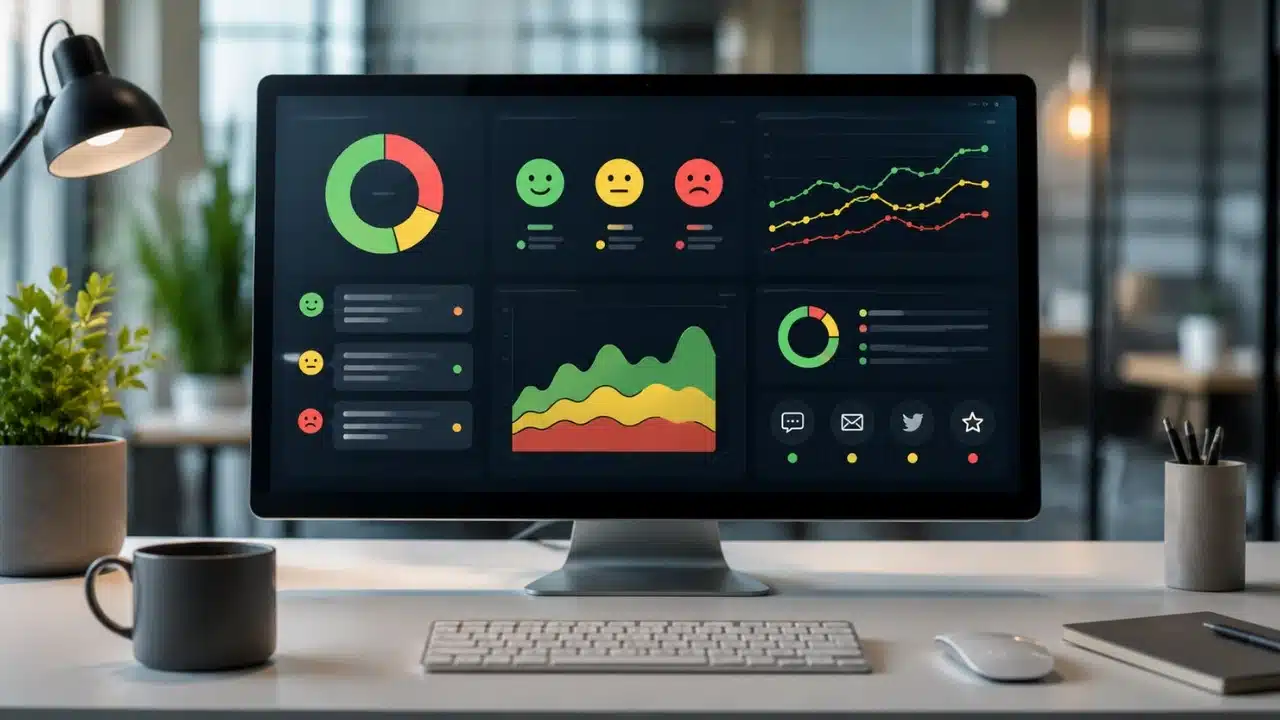
Sentiment analysis for business is an automated natural language processing (NLP) technique that classifies customer emotions, opinions, and intent from unstructured text data like product reviews, support tickets, and social media posts.
By applying machine learning models to incoming communication channels, organizations convert qualitative text into structured metrics to reduce customer churn, protect brand reputation, and accelerate product development.
| Business Application | Primary Data Input | Core Sentiment Method | Primary Metric Impact |
| 1. PR Crisis Detection | Social media, public forums | Real-time polarity & anomaly alerts | Brand Reputation Score & PR risk reduction |
| 2. Ticket Escalation | Helpdesk tickets, live chats | Frustration & intent classification | Reduced Churn & lower MTTR (Mean Time to Resolution) |
| 3. Voice of Customer (VoC) | NPS verbatims, open surveys | Hybrid NLP (Lexicons + ML) | Higher CSAT & unified feedback scoring |
| 4. Feature Prioritization | App reviews, feature requests | Aspect-Based Sentiment Analysis (ABSA) | Increased Product Adoption & reduced dev waste |
| 5. Competitive Intelligence | Rival reviews, market forums | Entity extraction & benchmark scoring | Market share capture & positioning accuracy |
| 6. Campaign Resonance | Ad comments, social replies | Emotion profiling & intent scoring | Optimized Ad Spend & conversion rate growth |
| 7. Sales Intelligence | Call recordings, CRM notes | Speech-to-text tone analysis | Higher Deal Win Rates & objection handling |
| 8. Financial Risk Tracking | Earnings calls, market news | Natural Language Understanding (NLU) | Enhanced risk management & stock trend analysis |
8 Practical Ways to Apply Sentiment Analysis for Business
1. Real-Time Brand Risk Mitigation and PR Monitoring
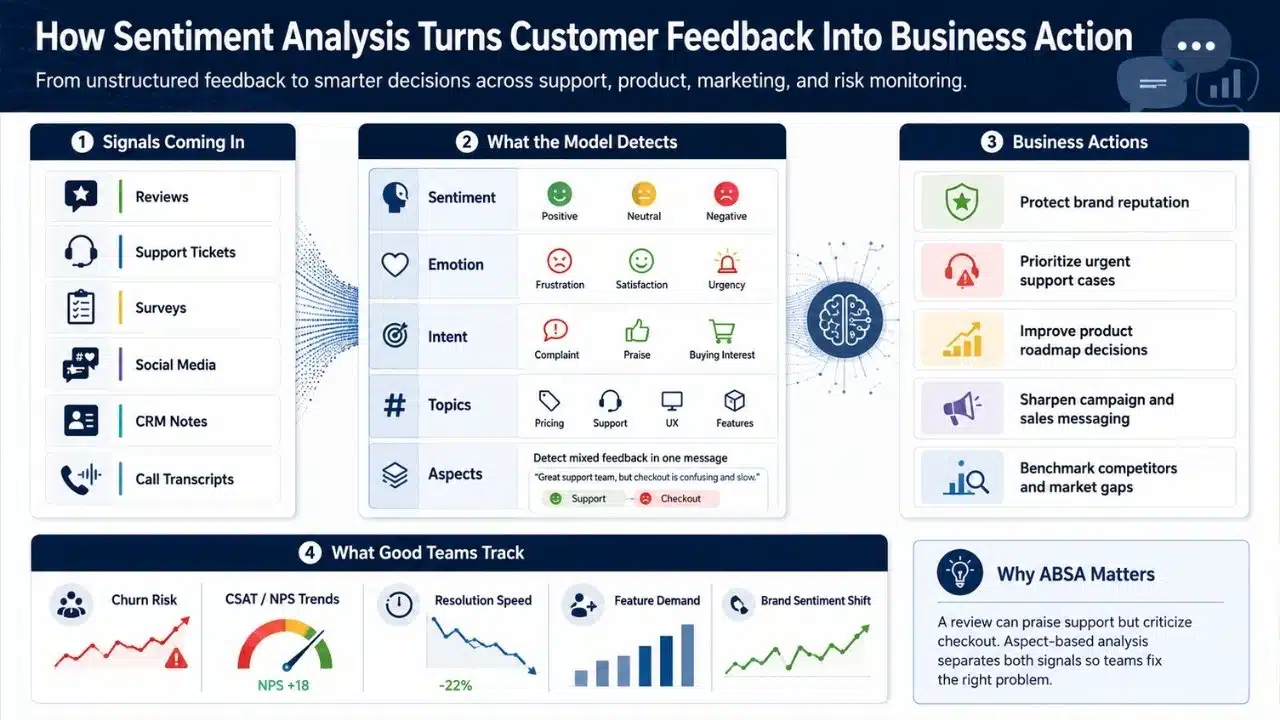
Public opinion turns in seconds across digital channels. Automated sentiment tools continuously process brand mentions, categorizing incoming posts into positive, neutral, or negative sentiment buckets. When an unexpected surge in negative emotion is detected (for instance, after a service outage or controversial marketing launch), the system flags PR and social media teams instantly to de-escalate the issue before it damages brand equity.
2. Emotion-Aware Support Routing to Reduce Customer Churn
Standard helpdesk software organizes incoming requests based solely on arrival time or subscription level. Integrating sentiment analysis allows artificial intelligence engines to evaluate the emotional severity of incoming text. Messages expressing extreme frustration, urgency, or explicit threats to switch to a competitor are prioritized automatically and routed to specialized retention agents, directly protecting customer lifetime value (LTV).
3. Scalable Voice of Customer (VoC) Intelligence
Reading open-ended Net Promoter Score (NPS) comments or customer satisfaction (CSAT) verbatims manually is slow and introduces personal reviewer bias. Sentiment analysis aggregates unstructured feedback across thousands of customer touchpoints simultaneously. When evaluating enterprise feedback software, executives gain a clean, unbiased view of overall customer perception across regions and demographics.
4. Aspect-Based Product Roadmap Optimization
Broad sentiment scores only reveal whether an overall review is positive or negative, hiding actionable specifics. Aspect-Based Sentiment Analysis (ABSA) isolates individual entities within a sentence to evaluate them independently. For example, if a user writes, “The customer service team was helpful, but the software checkout process is terrible,” ABSA registers positive sentiment for support staff and negative sentiment for checkout UI. Product teams use these granular insights to pinpoint specific software bugs and usability bottlenecks without overhauling functioning components.
5. Competitive Benchmarking and Market Gap Identification
Businesses must look beyond their own customer base to understand their position in the market. Running sentiment analysis on public competitor reviews, industry subreddits, and third-party software boards highlights rival product weaknesses. When algorithms detect widespread user frustration regarding a competitor’s pricing model or missing feature set, marketing and sales teams can tailor their messaging to address those exact market gaps.
6. Ad Campaign Optimization and Purchase Intent Scoring
Modern sentiment models look beyond basic polarity to evaluate consumer intent. Intent detection algorithms analyze social media replies and advertisement comment sections to distinguish between general praise, technical questions, and active buying interest. Marketing teams use these insights to tweak ad messaging mid-campaign and automatically pass high-intent leads straight to sales reps.
7. Sales Conversation Intelligence and Pitch Refinement
Combining speech-to-text transcription with Natural Language Understanding (NLU) gives revenue teams visibility into sales calls and product demos. Sentiment algorithms measure changes in prospect tone when specific topics (such as contract duration, implementation timelines, or pricing tiers) are discussed. Revenue operations teams analyze these micro-moments to refine sales scripts, address common objections, and train underperforming representatives.
8. Financial Sentiment Analysis and Market Forecasting
Financial analysts, venture funds, and algorithmic trading desks use sentiment engines to evaluate market mood toward publicly traded companies. By applying contextual language models to news headlines, regulatory filings, and executive transcripts during earnings calls, systems assess leadership confidence and public trust to build qualitative datasets for broader financial risk models.
How Sentiment Analysis for Business Models Work
To select the right tool, it helps to understand the three primary technological frameworks used by enterprise software:
-
Rule-Based Systems: Rely on predefined human-built dictionaries (lexicons) where words are assigned positive or negative values. They are fast and cheap to build, but frequently struggle with slang, double negatives, and sarcasm.
-
Machine Learning / Deep Learning Models: Utilize statistical classifiers (such as Support Vector Machines, Naive Bayes, or modern Transformer/LLM architectures like BERT) trained on massive labeled datasets. They understand contextual syntax, sentence structure, and implied meaning with high precision.
-
Hybrid Frameworks: Combine rule-based domain dictionaries (to capture specific industry jargon or product names) with deep learning engines to deliver maximum speed, contextual accuracy, and customizability.
Implementing Sentiment Analysis for Business
To maximize return on investment, begin by integrating sentiment analysis into a single, high-volume customer channel such as helpdesk tickets or app store reviews. Starting with an aspect-based model on your primary touchpoint yields immediate clarity on operational bottlenecks, giving your team actionable insights before expanding text analytics across the rest of the enterprise.
Frequently Asked Questions (FAQs) Sentiment Analysis for Business
What is sentiment analysis for business?
Sentiment analysis for business is the process of using AI and Natural Language Processing to analyze customer text data across channels (reviews, tickets, social media) to determine public perception, measure emotional tone, and drive operational decisions.
What is the difference between sentiment analysis and text analytics?
Text analytics is the broad process of extracting structure, topics, and patterns from raw text (such as word counts or topic modeling). Sentiment analysis is a specialized branch of text analytics focused specifically on identifying emotional tone, intent, and polarity (positive, negative, neutral).
How accurate is sentiment analysis software in real-world settings?
Modern deep learning models trained on domain-specific data achieve 80% to 90% accuracy. Accuracy depends heavily on whether the model has been fine-tuned to recognize industry-specific terminology, regional slang, and subtle context.
What is Aspect-Based Sentiment Analysis (ABSA) and why does it matter?
Aspect-Based Sentiment Analysis separates a single sentence into distinct topic-sentiment pairs. It matters because real customer feedback is rarely one-dimensional: a single review often contains praise for one feature alongside criticism of another. ABSA prevents useful feedback from being lost in a generic overall score.