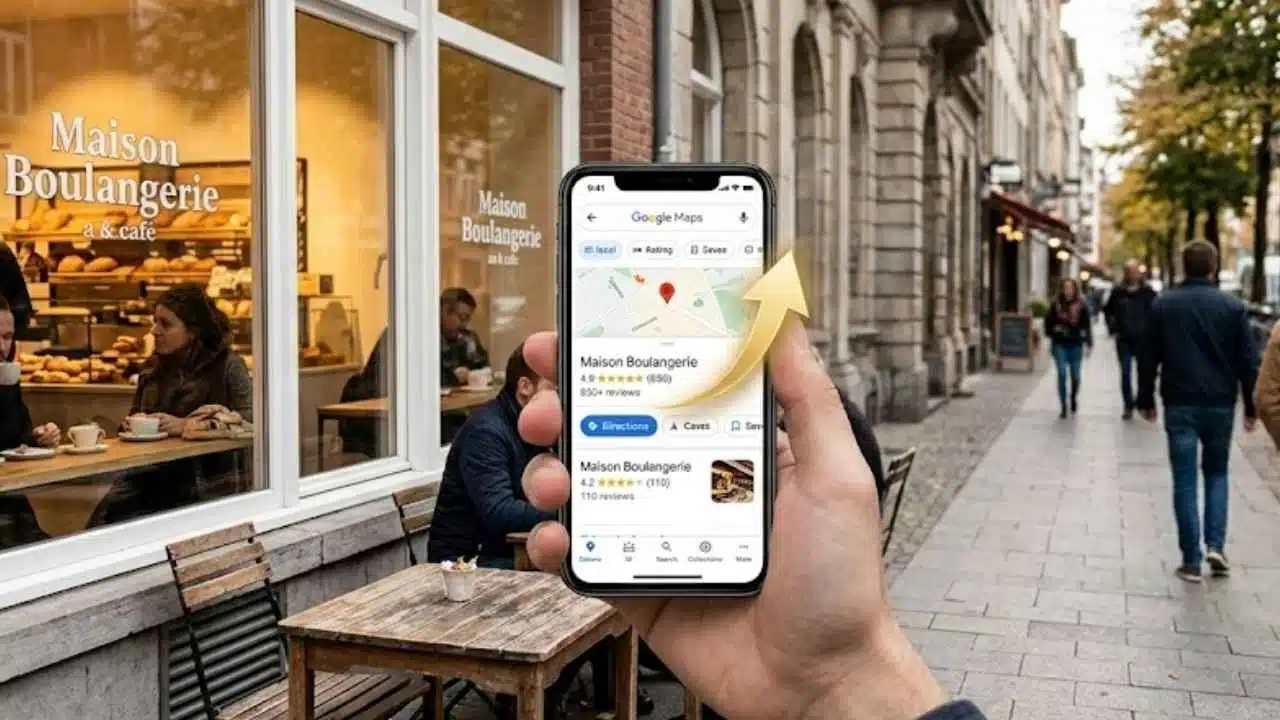
Customer reviews play a critical role in local discovery because how reviews influence local rankings directly impacts both algorithmic visibility and user trust. Google’s local search system evaluates review volume, star ratings, and review recency under its prominence ranking factor to determine Map Pack placements.
Concurrently, Generative Engine Optimization (GEO) and Answer Engine Optimization (AEO) rely on review sentiment and natural language text to answer conversational voice and AI queries. A steady stream of recent, authentic feedback confirms business entity credibility for search algorithms while assuring prospective customers that a local business is active, reliable, and worth contacting. Focusing on continuous, high-quality customer experiences builds a strong review profile that drives both rankings and real-world conversions.
What Google Actually Confirms About Reviews and Local Rankings
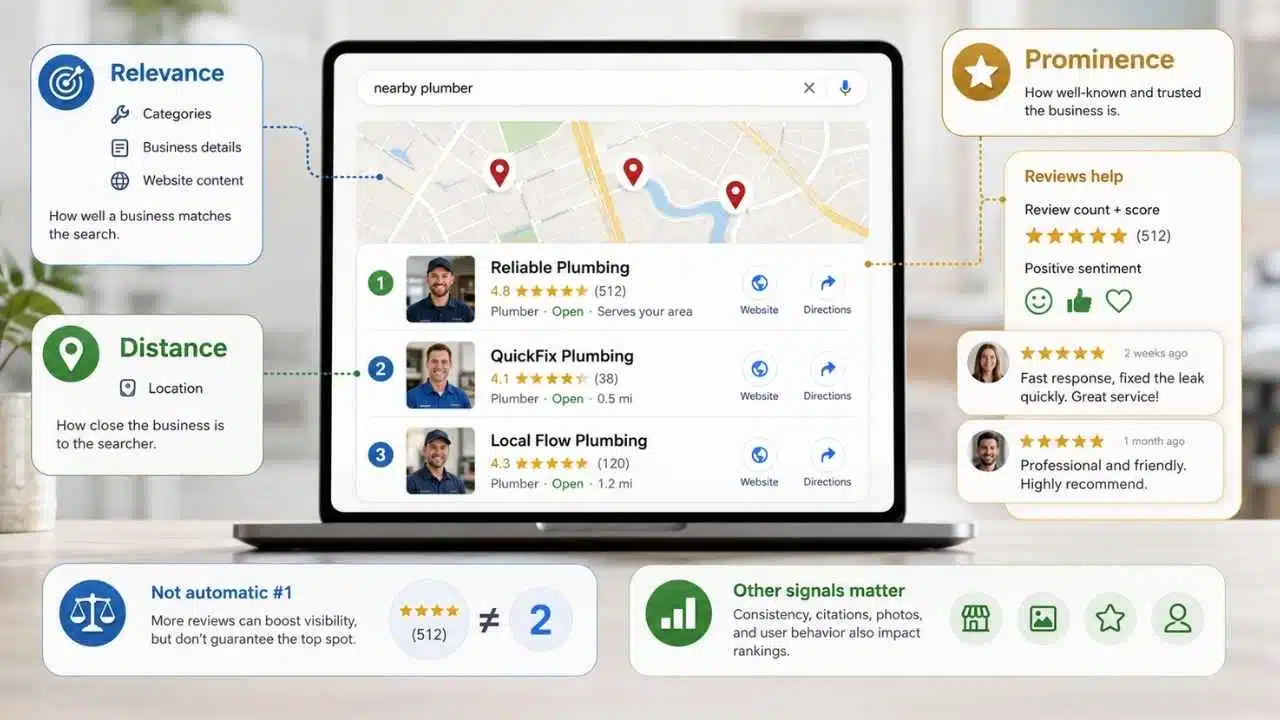
Google describes local results through three broad factors: relevance, distance, and prominence.
Reviews sit most naturally within prominence, which Google uses to describe how well known a business is. Its published guidance specifically says that review count and review score are considered and that more reviews and positive ratings can help local ranking.
That does not mean the business with the largest review total automatically takes the top Map Pack position.
A plumber with 600 reviews and a 4.9 rating may still appear below another company that is closer to the searcher and more relevant to the exact query. Categories, website information, links, business details, location, and other prominence signals still matter.
This is why advice such as “get 100 reviews and you will rank in the top three” should be treated as sales copy, not a dependable SEO rule. Google publishes no universal review threshold.
Reviews improve the strength of a local presence. They do not override the rest of local search.
Review Count Only Makes Sense in Context
The number of reviews that looks strong for one business can look weak for another.
A specialist building surveyor in a small town may appear established with 35 detailed reviews. A restaurant competing in a city centre may look under-reviewed with the same number because nearby venues have accumulated hundreds.
The useful comparison is not a generic industry benchmark. It is the businesses that repeatedly appear for the searches that matter to you.
Look at the local result set and ask:
- How large is the review gap?
- Are competitors adding reviews regularly or living on old totals?
- Are their ratings materially stronger?
- Do the written reviews discuss the services customers are searching for?
- Does one competitor have much more evidence than everyone else?
That gives a business a realistic reference point without turning the process into a race.
Trying to erase a 400-review gap in a few weeks is usually a bad target. It creates pressure to request reviews too aggressively, filter customers by expected sentiment, or hire dubious reputation services.
A better system connects review requests to normal completed transactions. A dentist can ask after an appointment. A home-services company can trigger a request when the job closes. A hotel can follow up after checkout.
That produces slower growth, but the profile looks like what it should be: the record of an operating business, not a short-lived marketing campaign.
Star Ratings Matter Most at the Moment of Comparison
Google confirms that positive ratings can support local ranking, but the commercial effect of a rating is often more immediate than its SEO effect.
Customers can see ratings before they open the business website.
Someone comparing three nearby electricians might see:
- 4.8 from 342 reviews;
- 4.6 from 181 reviews;
- 3.7 from 49 reviews.
That information becomes a fast filter. The third business now has to overcome a visible trust disadvantage before the customer knows anything about its pricing, qualifications, or service process.
BrightLocal’s 2026 Local Consumer Review Survey found that 85% of its US respondents said positive reviews made them more likely to use a business, while 77% said negative reviews made them less likely to do so.
Those figures come from 1,002 US adults and should not be treated as universal behaviour across every market. The broader point is less controversial: customers use review scores as a shortcut when several local options look similar.
A perfect 5.0 is not necessarily the strongest-looking profile either.
A 4.8 supported by hundreds of detailed reviews may look more convincing than a flawless score based on eight short comments. Customers can understand that established businesses occasionally receive criticism. What matters is whether the overall pattern suggests competent service and whether negative experiences appear isolated or recurring.
Old Reviews Cannot Fully Describe the Business Customers See Today
A business can accumulate a strong reputation and then stop collecting feedback. The average rating still looks good, but the latest visible review may be a year old. Google does not identify recency as a standalone ranking factor. There is no published rule that says one new review every week produces a ranking increase.
Recency has a much clearer role in customer trust.
BrightLocal’s 2026 US survey found that 74% of respondents paid attention only to reviews from the previous three months when assessing a local business. It also found that 44% considered a review posted within the previous month an important trust signal.
That matters because businesses change.
A restaurant changes chefs. A dental practice hires new staff. A hotel renovates its rooms. A contractor replaces its project manager. A company moves location or changes ownership. Five-star feedback from three years ago may still be reassuring, but it says less about the service someone is likely to receive next week.
Review generation should therefore be continuous enough to reflect the current business. The sensible target is not a fixed number every month. It is avoiding long periods in which the public reputation stops updating while the company continues operating.
Written Reviews Often Matter More Than the Average Score
The star rating gives customers a quick summary. The review text explains what actually happened.
That is particularly valuable for services where quality is hard to judge before purchase. Someone choosing a roofer may look for comments about punctuality, cleanup, unexpected costs, communication, and what happened when something went wrong.
A hotel guest may care about noise, parking, breakfast, room condition, or whether the photographs are realistic. A patient may focus on appointment delays and front-desk communication rather than the overall clinic score.
Repeated themes deserve more attention than isolated comments. One complaint about waiting time may be an unusual day. Ten recent complaints pointing to the same problem indicate something the business should investigate.
This is also where review data becomes operationally useful.
If customers repeatedly praise a service the website barely mentions, that may reveal an opportunity for a stronger service page. If one location receives recurring complaints about unanswered calls while the rest do not, the issue is probably local operations rather than brand reputation.
Do not try to manufacture these useful details by giving customers SEO keywords to include.
Asking people to mention “emergency plumber in Birmingham” or “best dentist in Austin” because someone believes review keywords will improve rankings produces awkward feedback and weakens credibility.
Ask for an honest description of the experience. Genuine customers usually mention the service, staff member, product, location, or problem naturally when those details mattered.
Review Responses Are Reputation Work, Not a Ranking Ritual
Google encourages businesses to respond to reviews. It does not publicly say that answering every review creates a direct ranking benefit.
That distinction should influence how businesses handle responses. The objective is not to reach a 100% response rate at any cost. It is to show customers that the business pays attention when a response is useful.
BrightLocal’s 2026 US survey found that 89% of respondents expected businesses to reply to reviews, while 42% said they were unlikely to use a business that never responds. The same survey found that half of respondents were less likely to choose businesses that relied on generic or templated responses.
That last result is worth paying attention to.
Posting “Thank you for your kind words. We value your feedback” under 200 different reviews may satisfy an internal response-rate target while making the business look automated.
A one-sentence positive review may need only a brief thank-you. A customer who describes a complex project deserves a more specific acknowledgment. A complaint requires more care.
Response quality matters more than length.
Negative Reviews Are Visible Customer Service
A bad review is already public. A hostile response creates a second reputation problem.
Potential customers are often reading both sides of the exchange. They want to know whether the business listens, becomes defensive, takes responsibility where appropriate, and knows how to resolve a problem professionally.
For an ordinary complaint, a useful response usually:
- acknowledges the concern;
- avoids debating every detail publicly;
- does not expose private customer information;
- corrects a material factual error only when necessary;
- provides a sensible route for further resolution.
Do not try to “win” the argument.
Regulated businesses need additional caution. Healthcare providers, financial firms, lawyers, and other organisations handling confidential information may be unable to explain publicly what happened without creating privacy or liability problems. Their response process should follow the appropriate internal and legal rules.
Businesses should also resist reporting every negative review in the hope that Google will remove it. A review is eligible for removal when it violates Google’s policies, not simply because the owner believes it is unfair.
Ask for Reviews, but Do Not Script the Outcome
Google allows businesses to request reviews and provides review links and QR codes specifically for that purpose.
The request can sit naturally within the customer journey:
- after an appointment;
- after a completed service;
- in a post-purchase email;
- after hotel checkout;
- through an SMS follow-up;
- through an in-store or printed QR code.
Timing matters.
A contractor should normally wait until the job is complete. A hotel should not request a review before the guest has experienced the stay. A restaurant may be able to ask much sooner because the transaction is finished quickly.
Keep the request neutral.
“Tell us how we did” is safer than “Please leave us a five-star review.”
The first asks for feedback. The second attempts to control the result.
Incentives and Review Manipulation Are Not Worth the Risk
Google prohibits incentives for Google reviews. Businesses should not offer discounts, free items, services, competition entries, or other benefits in exchange for someone posting, changing, or removing a review.
This is worth separating from US federal law because the rules are not identical. The FTC’s Consumer Reviews and Testimonials Rule does not ban every incentivised consumer review, but it does prohibit incentives that are expressly or implicitly conditioned on a particular positive or negative sentiment. Disclosure rules can also apply.
Google’s own platform policy is stricter. If the objective is a Google review, do not offer an incentive.
Selective solicitation deserves similar caution. Some businesses first ask customers whether they were satisfied. Happy customers receive the public Google review link; unhappy customers are sent to a private feedback form.
That process may produce a prettier rating, but it also produces a distorted sample of customer experiences. Google’s policies prohibit fake engagement and rating manipulation, and businesses should not design review systems around filtering out likely criticism.
A straightforward process is easier to defend: use a consistent trigger based on a real completed interaction and allow the customer to decide what to write.
Buying Fake Reviews Creates a Larger Problem Than a Low Rating
A new business looking at competitors with hundreds of reviews may be tempted by services offering instant five-star feedback.
That is one of the weakest shortcuts in local SEO. Google expects reviews to represent genuine experiences. Fabricated or purchased feedback falls under its fake-engagement policies.
Possible consequences go beyond losing individual reviews. Google can temporarily restrict new reviews, temporarily unpublish existing ratings or reviews, or display a warning when it determines that fake-review activity occurred.
There is also a simpler commercial problem: fake reviews often look fake. They arrive in unnatural bursts, repeat generic praise, contain little service detail, and may come from accounts with no plausible connection to the business.
A genuine 4.4 rating can be improved by better service and steady review collection. A profile customers suspect has been manipulated is much harder to repair.
Multi-Location Businesses Need Location-Specific Review Systems
A business with 80 branches does not have one reputation. It has 80 local reputations under one brand. Review requests should therefore lead customers to the Business Profile for the location they actually visited. That sounds obvious, but mistakes happen when one national email template uses the headquarters review link, a QR-code batch is printed incorrectly, or CRM data does not identify the branch that completed the transaction.
The result is a profile full of reviews from customers who never visited that location, while other branches appear under-reviewed. Location-specific review routing also makes the feedback far more useful internally.
If three branches consistently receive complaints about queues but the rest do not, management has an operational signal. If one branch receives unusually strong praise for staff helpfulness, there may be something worth learning from. Review strategy at scale should therefore connect Business Profile IDs, store IDs, CRM records, and customer communications rather than relying on one generic review link for the whole brand.
Measure What Helps You Make Decisions
A reputation dashboard does not need 40 metrics.
For most local businesses, track:
- review count by location;
- average rating;
- review growth over time;
- recurring positive themes;
- recurring complaints;
- important reviews that still need a response;
- suspicious or policy-violating reviews;
- nearby competitor review profiles.
Response rate and response time can be useful customer-service measures. Do not turn them into invented SEO KPIs.
The written feedback often provides more value than another graph. If people repeatedly complain about unanswered phones, fixing the phone system matters more than collecting another 50 reviews.
If customers repeatedly praise same-day service but the website barely mentions it, that may deserve stronger prominence in the company’s marketing.
Review management is at its most useful when the feedback reaches operations, not when it stays inside a marketing dashboard.
Final Thoughts
Understanding how reviews influence local rankings means knowing where the evidence stops. Google confirms that more reviews and positive ratings can help local ranking. It does not publish a magic review total, recency formula, response-rate target, or keyword recipe. Reviews still operate alongside relevance, distance, website signals, and the wider prominence of the business.
For most local businesses, the priority order is simpler than many reputation-management systems make it seem. Deliver an experience worth reviewing. Ask real customers for honest feedback at an appropriate point. Keep the process running so the profile reflects the business people can visit today. Respond when a reply adds something useful. Investigate repeated complaints rather than hiding them.