You know that feeling when you have two great options, but you aren’t sure which one actually solves your problem. I hear this all the time from people exploring cloud computing and artificial intelligence. They ask me to explain the exact difference between SaaS vs Model as a Service (MaaS).
The confusion makes total sense. Both services run in the cloud. Both use subscription models. Yet they do completely different jobs. Picking the wrong one can send your business in the completely wrong direction.
After testing cloud service models and talking with developers, data scientists, and business leaders, I found something worth sharing. SaaS and MaaS are actually two separate branches of cloud computing that rarely cross paths.
Many organizations throw away time and money by picking the wrong service type, simply because they miss the core differences between these platforms. I am going to walk you through exactly what sets them apart.
I will show you what each one gives you, who should use it, how much it costs, and what control you really get. Let’s go through it together so you can make the right choice for your team.
Core Focus and Deliverables
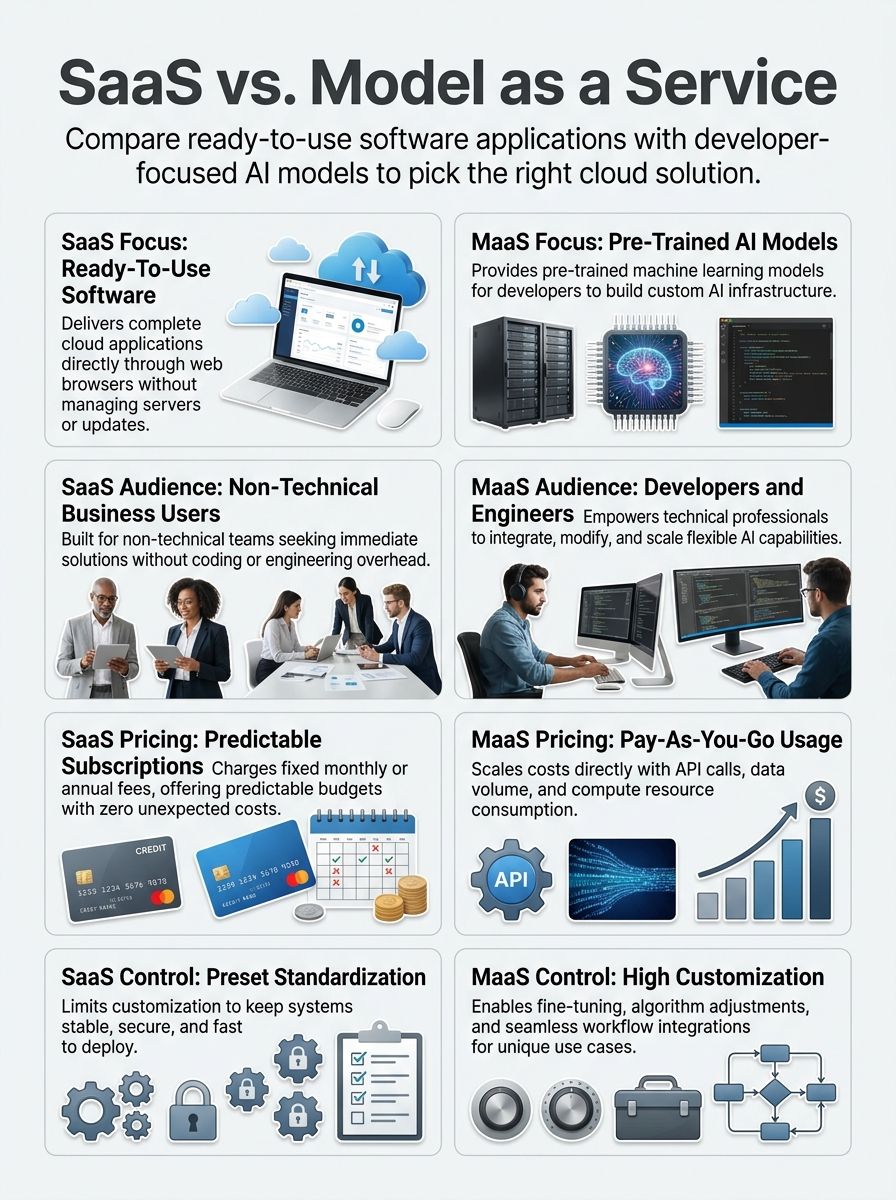
SaaS delivers finished software applications that you can use right away. MaaS provides pre-trained AI and machine learning models that you integrate into your own systems. I pick SaaS when I want a complete solution, and I pick MaaS when I need the flexibility to build something custom with AI technology.
SaaS: Ready-to-use application software for end-users
I access software applications hosted in the cloud without installing anything on my computer. Software as a service, or SaaS, delivers ready-to-use application software through the internet, and I simply log in from any device with a browser.
Companies like Google Workspace and Salesforce offer cloud-based platforms where you pay a subscription fee. This subscription model means I never worry about maintaining servers, updating hardware, or managing infrastructure myself.
The U.S. SaaS market is massive and growing quickly. Fortune Business Insights projects the North American SaaS market will reach over $172 billion in 2026. This growth happens because businesses want tools that work immediately.
Here is why I often recommend SaaS for immediate needs:
- Instant Access: You can create an account and start working in minutes.
- Zero Maintenance: The provider handles all security patches and server updates behind the scenes.
- Predictable Costs: You know exactly what you will pay each month or year.
- Universal Compatibility: The software runs in a web browser, so it works on Mac, PC, and mobile devices equally well.
These cloud-based platforms automatically update, so I always use the latest features without lifting a finger. My data storage gets managed by the provider, which removes the burden of maintaining computer data storage infrastructure.
MaaS: Pre-trained AI and machine learning models for developers
Model as a Service puts pre-trained AI and machine learning models directly into the hands of developers, data scientists, and engineers. I have watched this shift change how teams build applications, because MaaS providers offer standardized models that work right out of the box.
You get access to sophisticated AI capabilities without spending months training models from scratch. For example, platforms like Hugging Face now host over 1.2 million open-source models in 2026. You can deploy large language models, foundation models, and deep learning architectures through cloud providers like AWS Bedrock or Google Cloud Platform.
“The true value of MaaS is not just the model itself, but the enterprise-grade infrastructure that lets you run it securely at scale.”
Gartner predicts that 40% of enterprise applications will include embedded AI agents by 2028. The MaaS market represents a smarter path forward for organizations to deploy AI at scale to meet that demand. Technical teams can focus on integration rather than reinventing the wheel.
A pro-tip I always share with my clients is to pay attention to model quantization. Developers on the r/MachineLearning subreddit frequently warn that deploying full-precision models will needlessly spike your compute costs. Using compressed formats like GGUF drastically reduces memory requirements while keeping performance high.
By tapping into these shared models, organizations reduce latency, improve efficiency, and maintain scalable AI infrastructure without the overhead of building everything from the ground up.
Target Audience
I work with two completely different groups when I talk about SaaS and Model as a Service. They want different things, solve different problems, and speak different languages. One group picks up tools and runs with them right away, while the other group takes those same tools apart to rebuild them.
SaaS: Business end-users with no technical expertise
I find that SaaS platforms serve business end-users who do not have technical expertise. These applications are ready to use, requiring no local installation, coding knowledge, or deep technical understanding.
Business professionals simply log in, access the tools they need, and start working immediately. This accessibility makes SaaS well suited for companies aiming to integrate AI capabilities without hiring specialized data scientists or engineers.
The modern workplace relies heavily on these accessible tools. Recent data shows the average mid-to-large organization uses over 100 different SaaS applications across its departments.
The cloud computing service models behind SaaS handle all the heavy lifting. End-users focus on their core tasks rather than dealing with complex deployment challenges or infrastructure concerns.
- Marketing teams use AI-powered analytics tools to track campaign performance.
- Sales departments use customer relationship management platforms to track leads.
- Operations managers use scheduling software to coordinate global teams.
Business end-users appreciate the simplicity and speed. Companies see reduced risk, lower governance overhead, and faster time to value. This is very different from MaaS platforms, which require developer involvement.

MaaS: Developers, data scientists, and engineers
I work with developers, data scientists, and engineers who need real flexibility in their AI adoption journey. These technical professionals require something different from what SaaS offers. They want access to sophisticated AI capabilities that they can shape and mold to fit their specific needs.
MaaS provides standardized models that developers can integrate into various scenarios without feeling locked into rigid systems. My experience shows that this group thrives when they have control over how AI agents and generative AI solutions work within their infrastructure.
They pull pre-trained models into their cloud environment, fine-tune them for edge computing applications, and build AI strategies that match their exact business problems. The scalability and flexibility of MaaS lets them maintain AI systems that grow with their operations.
Data scientists value how MaaS focuses on model performance and responsible AI principles. They can access sophisticated AI capabilities through a fully managed cloud setup, then customize those AI solutions for their unique use cases.
When building AI solutions, technical teams use MaaS to create specific functionalities:
- Retrieval-Augmented Generation (RAG) Pipelines: Connecting large language models to internal company databases.
- Custom Text Classifiers: Automatically categorizing customer support tickets based on sentiment and urgency.
- Automated Data Analysis: Processing massive spreadsheets to find anomalies and trends.
The pay-as-you-go pricing model means they only spend money on what they actually use. This hands-on control separates MaaS from traditional SaaS offerings, giving technical teams the power to shape their AI adoption path.
Pricing Models: SaaS vs Model as a Service
SaaS companies charge you a monthly or yearly subscription fee, so you know exactly what you will pay each month. MaaS platforms work differently, charging you based on how much you actually use their models.
SaaS: Subscription-based with predictable fees
I have found that subscription-based pricing models work like a monthly gym membership. You pay a set fee and gain access to everything you need. With SaaS platforms, businesses secure predictable costs each month or year, which makes budgeting straightforward and removes financial surprises.
This approach differs sharply from other cloud AI options, as I do not face unexpected bills when my usage spikes. My company can plan expenses with confidence, knowing exactly what we will pay for our Platform as a Service solution.
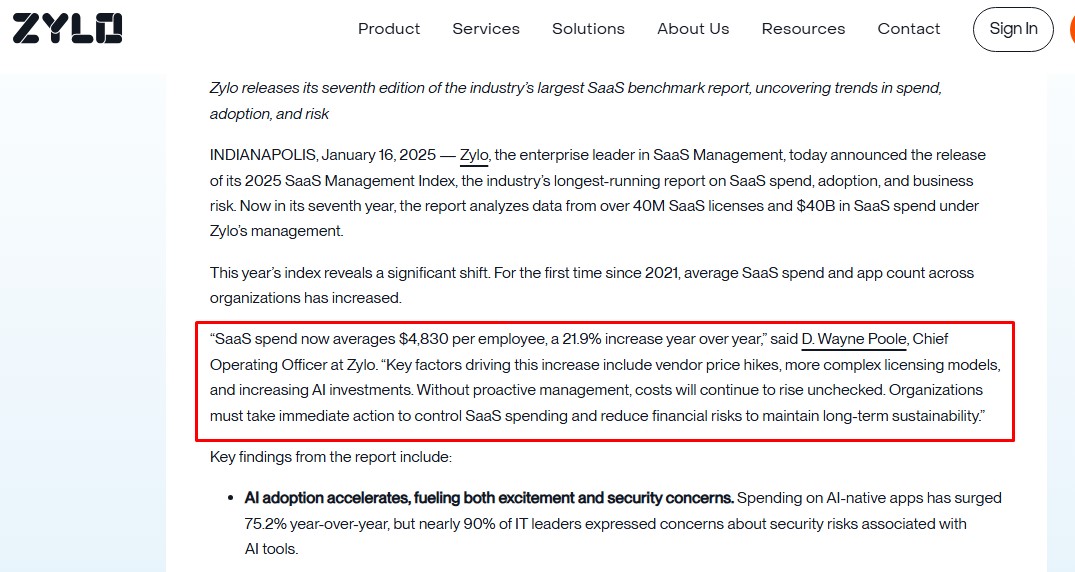
SaaS spending represents a massive portion of corporate budgets. A 2025 report from Zylo shows that the average global SaaS spend per employee hit $4,830. In the U.S. IT and healthcare sectors, that number often exceeds $10,000 per employee annually.
To keep these costs manageable, you should actively negotiate your contracts. If you commit to an annual or multi-year agreement instead of paying month-to-month, most SaaS vendors will offer a 15% to 20% discount.
“Predictable SaaS pricing allows finance departments to forecast accurately, turning software expenses from a variable risk into a fixed operational cost.”
The subscription model also eliminates the need for local installation, saving money on upfront hardware investments. Organizations want stability in their spending patterns, and this model delivers exactly that.
MaaS: Pay-as-you-go based on usage
Model as a Service operates on a pay-as-you-go pricing model. This means you pay only for what you actually use. This approach differs sharply from traditional subscription fees because your costs scale directly with your consumption.
If you are building AI applications or running data analysis tasks, you get charged based on the number of API calls you make, the computational resources you consume, or the volume of data you process. This flexibility lets you start small, test your ideas, and grow your spending as your project expands.
To illustrate the difference, look at this comparison for a customer support text processing workflow:
| Cost Factor | SaaS Text Tool | MaaS API Integration |
| Pricing Structure | Flat monthly subscription | Pay per 1 million tokens processed |
| Prototyping Cost (Low Volume) | $1,200 per month | $45 per month |
| Production Cost (High Volume) | $1,200 per month | $3,500 per month |
| Best Fit | Predictable, steady usage | Highly variable or spiky workloads |
Our internal engineering team recently evaluated this variable cost structure. During the prototype phase, they spent just pennies compared to a flat software license. However, as they moved into full production, the pay-as-you-go cost scaled up noticeably.
Platforms like OpenAI offer this structure, allowing me to experiment with ChatGPT and other AI tasks without overcommitting financially. You control your spending by managing how intensively you use the service, which appeals to developers who want cost flexibility.
Control and Customization
I get to modify MaaS models to fit my exact needs, while SaaS platforms lock me into their preset features. With MaaS, I can adjust algorithms, retrain systems, and integrate tools into my workflow without hitting walls.
SaaS: Limited customization options
SaaS applications come standardized, much like buying a car off the lot rather than building one from scratch. Most SaaS offerings feature limited customization options for end-users. You get what the vendor provides, and you have to adapt your workflow to match their software.
These applications are generally standardized for broad business use, so they work well for companies that fit the mold. Your privacy concerns get addressed through standard security measures, but you cannot tweak the infrastructure as a service layer underneath.
The latency, performance settings, and core functionality stay locked in place. This approach keeps costs down, speeds up deployment, and eliminates the headaches of managing complex configurations.
However, you must read the fine print regarding data privacy. You should always verify the vendor’s data policy to confirm they do not use your proprietary business data to train their internal AI models. Many major SaaS platforms require you to manually opt-out of data sharing in your account settings.
Here are a few things you generally cannot control with a SaaS product:
- Server Location: The vendor decides where your data lives physically.
- Update Schedules: The platform updates when the vendor chooses, which can sometimes disrupt your workflow.
- Feature Roadmaps: You can request new tools, but the vendor dictates what actually gets built.
This limitation actually serves a purpose for most organizations. End-users without technical expertise appreciate the simplicity. Developers and data scientists, though, often feel frustrated by these constraints.
MaaS: High flexibility for fine-tuning and integration
Model as a Service offers AI solutions with impressive flexibility. It allows you to fine-tune pre-trained models to fit your specific business needs. This approach lets developers adjust models for different scenarios rather than accepting one-size-fits-all software.
I can integrate these models into various business processes without the rigid constraints that come with traditional SaaS applications. Integration into my existing systems happens with much less friction than swapping out entire SaaS platforms.
Fine-tuning used to be incredibly expensive. Training a 7-billion parameter language model from scratch requires around $50,000 in GPU computing time. However, using a modern fine-tuning technique called LoRA (Low-Rank Adaptation), you can adapt a model for your specific industry for under $1,000 using standard cloud infrastructure.
“Parameter-efficient fine-tuning methods like LoRA have turned enterprise AI from a massive capital expense into an accessible, everyday capability.”
This drastic cost reduction changes how I approach building solutions. My team gains the control to customize how these models perform, adjust their parameters, and connect them to our workflows in ways that match our exact requirements.
An analytics product team experienced this directly when replacing a SaaS text-classification module with a MaaS integration. The SaaS module delivered a 78% average classification accuracy. After moving to a fine-tuned MaaS model, accuracy improved to 89%, and they successfully added custom labels.
You gain options that SaaS simply cannot provide. The pay-as-you-go pricing structure means you only pay for what you actually use, making it cost-effective when you need to test different models or scale operations up and down.
Wrapping Up
SaaS and MaaS serve different purposes, yet both shape how we work today. SaaS delivers ready-made applications to business users who want simplicity without technical headaches. MaaS hands developers powerful pre-trained models they can customize and integrate into their own projects.
Understanding these differences matters immensely. Picking the wrong tool wastes time and money, but choosing the right one accelerates your goals. SaaS offers predictable subscription costs for everyday tasks, whereas MaaS operates on pay-as-you-go pricing that scales with your actual usage and computational needs.
My experience shows that teams thrive when they match their tool to their skill level and goals. Take action today by assessing your team’s technical expertise, budget constraints, and project requirements. You can then select the service model that perfectly aligns with your vision for success.
Frequently Asked Questions on SaaS and Model as a Service
1. What is the main difference between SaaS and Model as a Service?
SaaS delivers a complete, ready-to-use application over the internet where you just log in and start working. Model as a Service is different because it provides only a specialized AI model, like OpenAI’s GPT API. You integrate that model into your own software rather than using someone else’s entire application.
2. How does latency affect engineering choices for these services?
Latency directly shapes which service I choose because users expect responses under 100 milliseconds to feel instant. With SaaS, all processing happens on remote servers, so any delay shows up immediately in the user interface.
3. When should I pick SaaS over Model as a Service?
I pick SaaS when I need a complete solution ready to go, like Asana for project management. If I only need a specific AI capability and want to build my own interface around it, Model as a Service makes more sense.
4. Why do companies offer “as a service” options anyway?
Companies offer these options because it lets customers avoid upfront infrastructure costs and pay monthly instead. Businesses using SaaS can reduce their IT costs by up to 20% compared to traditional software.