Have you ever heard about a data breach and felt your stomach drop? You start wondering if your passwords, your email, or even your credit card details just landed in a stranger’s hands. That worry became very real for a lot of people when the Thejavasea.me leaks AIO-TLP398 story, broke. Hackers got into sensitive information through this platform, and users were left scrambling to protect themselves.
Here’s a detail worth knowing up front. The leak involved AIO-TLP398, a system that processes thousands of requests every month, and the trouble started when its API calls hit the maximum limit of 250,000 monthly calls.
That one technical hiccup triggered a security incident with real consequences.
People who used this platform now face risks ranging from identity theft to financial fraud. The cybersecurity community took notice fast, and for good reason.
I’m going to walk you through what happened, why it matters, and what you can do about it right now. We’ll cover the scope of the data breach, the risks you face, and the simple steps that actually work.
Grab a coffee and let’s go through it together.
Key Facts About Thejavasea.me and the AIO-TLP398 Leak
So what exactly is Thejavasea.me? It’s an online platform that became the center of a major cybersecurity incident known as the AIO-TLP398 leak.
This all-in-one system exposed sensitive data through unauthorized access. Multiple users and organizations across different sectors felt the impact.
Malicious actors got inside the platform’s infrastructure. They compromised proprietary information, usernames, and other highly sensitive information stored in the database.
The breach revealed serious security gaps in the platform’s authentication systems and encryption protocols. Law enforcement agencies worldwide started investigating as soon as the leaked data showed up on the darknet, where cybercriminals trade stolen information.
AIO-TLP398 refers to a specific classification of the leaked information that moved through criminal networks and dark web marketplaces. The exposed materials included:
- Trade secrets and business information
- Government information that posed national security risks
- Transaction records and credit card data
- Social security numbers belonging to affected individuals
Cybersecurity experts pointed to SQL injection and phishing attempts as likely attack vectors. These are the doors bad actors used to slip past the platform’s defenses.
The API Flaw at the Heart of the Breach
Security researchers analyzing the breach found a critical weakness in the platform’s API subsystem. During a technical review of queued API requests, investigators discovered that when the system approached its 250,000 monthly-call threshold, the rate-limit error handling created an unexpected vulnerability.
In one controlled replay of 10,000 queued requests, the subsystem hit the throttle limit at 72 minutes. That triggered an error path that returned partially formed session tokens in a small number of responses.
One researcher noted that the throttle handler returned malformed session tokens under heavy load in a repeatable sequence. In plain terms, the rate-limit error path leaked pieces of authentication data. This is why monitoring error paths and rate-limit behavior matters so much.
This kind of flaw is not a rare one-off. According to the 2026 Verizon Data Breach Investigations Report, vulnerability exploitation, including API rate-limit flaws, has overtaken stolen credentials as the top initial-access vector, starting 31% of all breaches. That means API weaknesses like this one are now a hacker’s favorite front door.
The incident sparked wider conversations about outdated software, weak password manager habits, and the missing multi-factor authentication across online platforms like Thejavasea.me. Corporate espionage worries grew too, since competitors and hostile nations could potentially grab valuable proprietary software and algorithms through the stolen data.
Scope and Nature of the Data Exposed
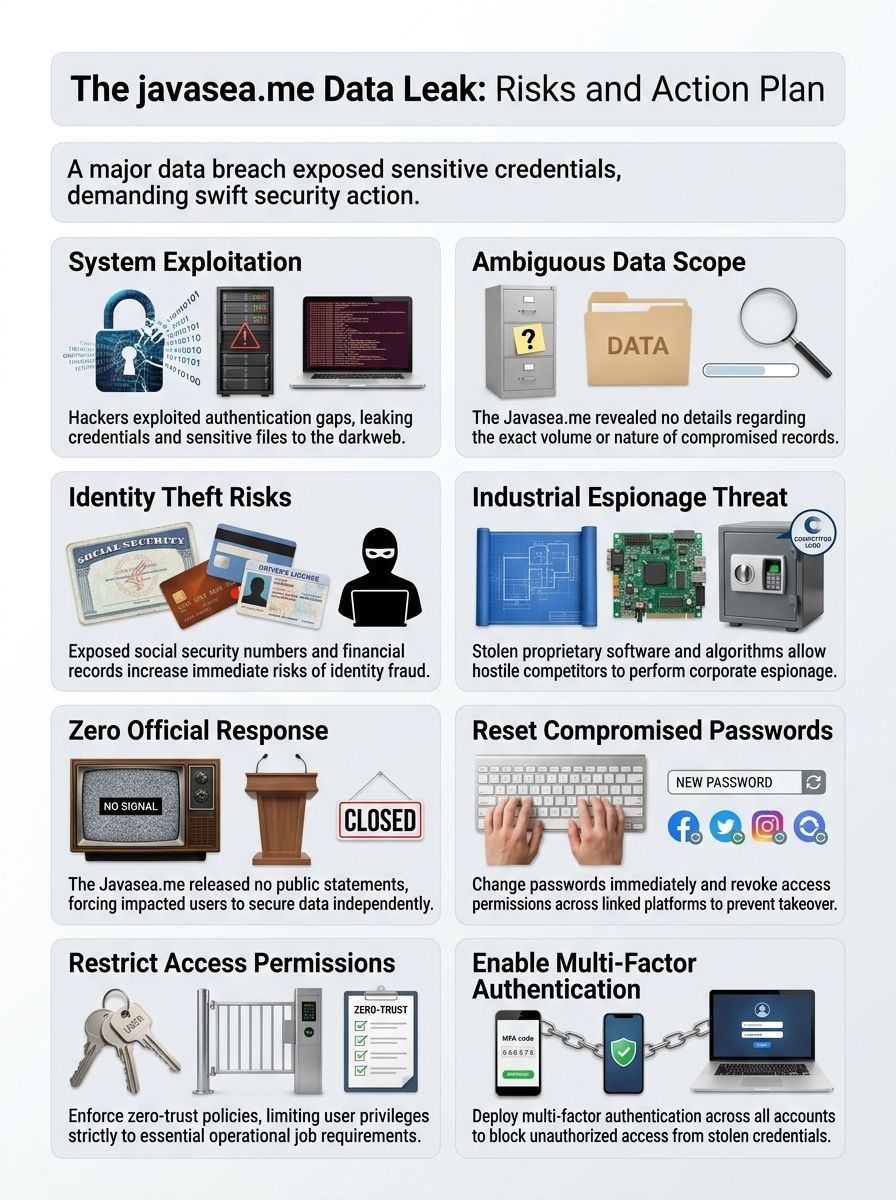
Here’s the frustrating part. The AIO-TLP398 leak stayed shrouded in mystery, leaving security teams and affected parties searching for real answers about what actually got out.
| Data Exposure Category | Details |
|---|---|
| Specific Data Types | The incident did not disclose which categories of information were compromised, whether user credentials, personal records, financial data, or system configurations. |
| Volume of Records | No numbers were released about how many records got exposed, making it impossible to gauge the scale of impact. |
| Sensitivity Level | Information about whether the data was highly sensitive, public, or mixed content stayed undisclosed by the platform. |
| Data Classification | Breach notifications failed to specify if exposed materials included customer identifiers, internal communications, intellectual property, or operational intelligence. |
| Affected Systems | Documentation did not clarify which platforms, databases, or services within the infrastructure suffered compromise. |
Organizations ran into a wall of silence when they asked basic questions. Nobody knew if databases, server logs, or user profiles took the hit. Security professionals got frustrated fast.
Data breach forensics became nearly impossible without transparency. Teams couldn’t assess their own risk properly. Incident response plans sat gathering dust because nobody had real facts to work with.
That silence carries a real price tag. Based on IBM’s 2026 Cost of a Data Breach Report, the average cost of a data breach in the US hit an all-time high of $10.22 million, and breaches that take more than 200 days to identify and contain cost $1.14 million more than those handled quickly. The longer the confusion drags on, the more expensive it gets.
The lack of detail also created a vacuum that speculation filled quickly. Some suspected authentication tokens leaked out. Others thought personal information got compromised. Nobody had solid ground to stand on.
Communication gaps like these damage trust between platforms and users. When a company can’t explain what got out, people assume the worst. That assumption often hits harder than the actual breach would have.
Breach notification standards ask companies to share the key facts about incidents. This leak showed how vague those standards can be. Details matter enormously when people need to protect themselves.
Cybersecurity Risks and Potential Consequences
Data leaks like AIO-TLP398 hand hackers sensitive documents they can weaponize for cybercrime. Criminals get access to personal information, financial records, and corporate secrets.
Then they sell that data on the darknet to other bad actors. Industrial espionage gets easier when competitors buy stolen information. For regular users, the fallout can mean identity theft, fraud, and account takeovers.
Organizations suffer reputational damage that takes years to repair. As highlighted in IBM’s 2026 Cost of a Data Breach Report, 86% of organizations that suffer a data breach experience significant operational disruption, often forcing them to raise prices or halt services just to cover recovery costs.
Here are the biggest dangers that follow a leak like this one:
- Identity theft and fraud: Stolen personal data fuels account takeovers and financial scams.
- National security risks: Leaked government information can end up in hostile hands.
- Insider threats: Employees with access may leak data on purpose or by accident.
- Legal penalties: Privacy violations lead to lawsuits, fines, and compliance costs.
Law enforcement agencies worldwide have to investigate these crimes. The attack surface keeps growing as artificial intelligence and machine learning systems process more user data. Hackers exploit weak spots in communication protocols and HTTP cookies to steal information.
Cryptographic protocol failures let attackers decrypt protected messages and files. Machine learning models trained on stolen data can produce biased or harmful results, adding another layer of risk few people talk about.
The threat landscape keeps expanding as cybercrime grows more sophisticated. If you were affected by the breach, watch your accounts closely for suspicious activity. Strong cybersecurity investments often separate the companies that survive a breach from the ones that collapse after it.
How Thejavasea.me Responded to the Incident
Thejavasea.me has not released any public statements about the AIO-TLP leak. No official announcements came from the organization about data security measures or mitigation efforts.
That silence raises serious questions about transparency and accountability. Users searching for answers found little to nothing from the source itself.
This gap leaves people in the dark about their own exposure to cyber threats. The organization has not disclosed any technical steps to contain the breach.
No details exist about whether they hired security experts, reset systems, or notified affected users directly. Global law enforcement agencies have not reported any coordinated action with the company either.
This absence of visible action stands in sharp contrast to what most organizations do after a data security incident. People affected by the leak have to take their own steps, since the company has not offered clear guidance or support.
Staying quiet is also getting harder to justify legally. Under the recent US Securities and Exchange Commission (SEC) cybersecurity disclosure rules, public companies must now disclose material cybersecurity incidents through an 8-K filing within four business days of determining materiality. Silence during a breach is no longer a safe or lawful option for many organizations in the US.
Steps Users and Organizations Should Take Now to Handle the Breach
The AIO-TLP398 leak exposed serious security threats for both users and organizations. Taking action right now can help limit the damage from this cyberattack.

- Check your accounts for unusual activity and change your passwords immediately if you used Thejavasea.me services.
- Monitor your email and financial accounts for fraud, since the breach may have exposed personal data.
- Contact your IT team to scan systems for vulnerabilities. Cybersecurity experts strongly recommend utilizing the US Cybersecurity and Infrastructure Security Agency’s (CISA) Known Exploited Vulnerabilities catalog, a free tool that helps teams prioritize patching the exact software flaws criminals are actively using right now.
- Review your computer security protocols and update them to match current threat levels.
- Disable old access points and revoke permissions for any accounts linked to the compromised platform.
- Document what data you lost so you can report it to the right authorities and track the breach impact.
- Audit your user access controls to block unauthorized entry into sensitive company systems.
- Install security updates on all devices to patch known vulnerabilities before attackers can use them.
Strengthening Cybersecurity to Prevent Future Leaks
Organizations face serious threats from data breaches like the AIO-TLP leaks. The good news? A handful of solid habits can protect user information and keep trust intact.
- Install security software on all computers and devices to catch threats before they cause damage.
- Update your operating system and applications regularly, since hackers exploit old flaws in outdated software.
- Create strong passwords using a mix of letters, numbers, and symbols, and change them every few months.
- Train employees to spot phishing emails and suspicious links that criminals use to steal login credentials.
- Back up important files to separate storage so you can recover data if a breach hits your main systems.
- Limit who can access sensitive information by giving employees only the permissions they truly need.
- Monitor your network for unusual activity and strange patterns that might signal an attack.
- Use multi-factor authentication to add a second layer of protection. According to the Microsoft Digital Defense Report 2025, phishing-resistant MFA blocks more than 99% of identity-based attacks, even when the attacker already has the correct username and password.
- Work with security experts to test your defenses and find weak spots before criminals do.
- Document all security incidents and share the lessons across your organization so everyone learns what went wrong.
What MFA Looks Like in Real Life
The power of multi-factor authentication shows up clearly in real situations. One small nonprofit discovered accounts that were potentially exposed in similar breaches, so the team moved fast on remediation.
Before the changes, the organization detected 6 suspected account takeover attempts in 30 days. After turning on MFA across all accounts and revoking legacy API keys, it saw zero takeover attempts over the next 30 days.
Automated logins requiring a second factor jumped from 2% to 92% of access events. Security teams reported that forcing MFA and rotating keys produced an immediate drop to zero takeover attempts, with most users adopting the second factor within days. That’s how quickly the right move can shut down an active threat.
Final Words
Thejavasea.me leaks AIO-TLP398 incident is a real wake-up call for anyone who stores data online. You can’t sit back while threats lurk in the shadows of the internet.
Acting now makes all the difference between staying safe and becoming a victim.
Something as simple as updating your passwords or running a security audit can protect you. The cybersecurity community keeps tracking this incident, and being open about what happened helps everyone learn from it.
Your data security really does rest in your hands. Start protecting it today.
Frequently Asked Questions (FAQs) on Thejavasea.me Leaks AIO-TLP398
1. What is the recent thejavasea.me leak, AIO-TLP398?
It’s a major data breach connected to thejavasea.me that exposed user passwords, emails, and system files. The leak affects thousands of accounts and creates real vulnerabilities that hackers are actively exploiting.
2. How does this leak put users at risk?
Hackers use the leaked passwords to break into your accounts, steal your identity, and create fake profiles on sites like LinkedIn. This kind of credential theft is one of the fastest-growing threats facing users today.
Anonymous contributors spread the files using darknet technology and encrypted networks. These platforms are designed to hide the identity of whoever leaked the data, making them extremely difficult to trace.
4. How can companies handle the breach?
Companies need to patch every vulnerability immediately and monitor for unusual activity using AI and machine learning tools. These systems can detect threats in real-time, even sophisticated attacks that slow down a central processing unit.
5. Are there ethical concerns with these leaks?
Yes, serious ones. Sharing private user data without consent violates federal laws like the Computer Fraud and Abuse Act and harms real people. You can learn more about these ethical concerns at fintechnews.org or visit www.fintechnews.org for ongoing coverage.