Choosing the right AI writing assistant can feel like comparing two talented writers with completely different styles. Claude and ChatGPT are among the most popular AI tools available today, but which one is actually better for writers?
The answer depends on what you write, how you work, and what you expect from an AI assistant. One may excel at producing natural, thoughtful long-form content, while the other may stand out for brainstorming, research, editing, versatility, and creative workflows. Both can help with everything from generating ideas and creating outlines to polishing drafts and overcoming writer’s block—but they don’t always approach these tasks in the same way.
In this Claude vs ChatGPT comparison, we’ll put both AI assistants side by side to see how they perform for writers. We’ll compare their writing quality, creativity, editing abilities, research features, ease of use, consistency, and overall value. Whether you’re a blogger, copywriter, journalist, content marketer, or novelist, this guide will help you decide which AI tool better fits your writing workflow.
The Claude Discovery: How Writers Are Finding a Better Fit
Claude became a serious alternative to ChatGPT when writers started noticing something specific: the writing didn’t sound like AI. That discovery spread through writing communities, Substack newsletters, and Reddit threads throughout 2025 and into 2026. Claude felt different in a way that was hard to pin down at first, but became obvious after running both tools on the same prompt.
The shift shows up in the data. ChatGPT’s share among power users dropped from 99.91% in 2023 to 74.71% in early 2026, while Claude’s usage climbed to 8.56%. That’s not a rounding error. That’s a real behavioral shift among the people who use these tools every day.
Claude became the go-to for writers who prioritized voice and coherence. ChatGPT stayed dominant for writers who needed a full content system with more tools baked in.
What’s the Difference Between Claude and ChatGPT for Writing?
Claude and ChatGPT both generate text, but they approach writing differently at a fundamental level. Claude prioritizes tonal consistency and long-context coherence, while ChatGPT prioritizes versatility and integration with other tools.
Here’s how the two compare across the dimensions that matter most to writers:
| Feature | Claude | ChatGPT |
|---|---|---|
| Long-form coherence | Stronger | Good, but drifts more |
| Natural writing tone | More human-sounding | Can feel formulaic |
| Image generation | Not built-in | Yes (DALL-E integration) |
| Web browsing | Available | Available |
| Context window | Up to 200K tokens | Up to 128K tokens |
| Paid plan price | $20/month | $20/month |
| Third-party integrations | Growing | Extensive |
Claude excels in writing voice, reasoning, and long-context document handling, while ChatGPT leads in ecosystem integrations. For writers who just need better prose, Claude is the cleaner choice. For writers who need everything in one system, ChatGPT still holds an edge.
The Real Test: Running Both Through the Same Prompt
The fastest way to understand the Claude vs ChatGPT difference is to run both through the same prompt and read the results back-to-back. Think of it like a Gordon Ramsay test: you don’t just read a menu, you taste the food. This is how the chatgpt claude ran gordon ramsay test approach works in practice. You run the same input, see actually what comes out, and let the output decide.
When writers do this test, a pattern shows up quickly. Claude writing tends to feel like something actually written by a person, with varied sentence rhythm and transitions that don’t feel mechanical. ChatGPT writing is often cleaner in structure but can feel like every paragraph follows the same template.
What to test:
- A 600-word blog post introduction on the same topic
- A rewrite of a paragraph you already wrote
- A Substack post opener for a newsletter you publish
- A content brief for a piece you’re already planning
Run the exact same prompt through both. Don’t edit the prompt between tools. Save both outputs and read them as if you didn’t know which was which.
The Writing Reads Like Writing: Claude’s Biggest Advantage
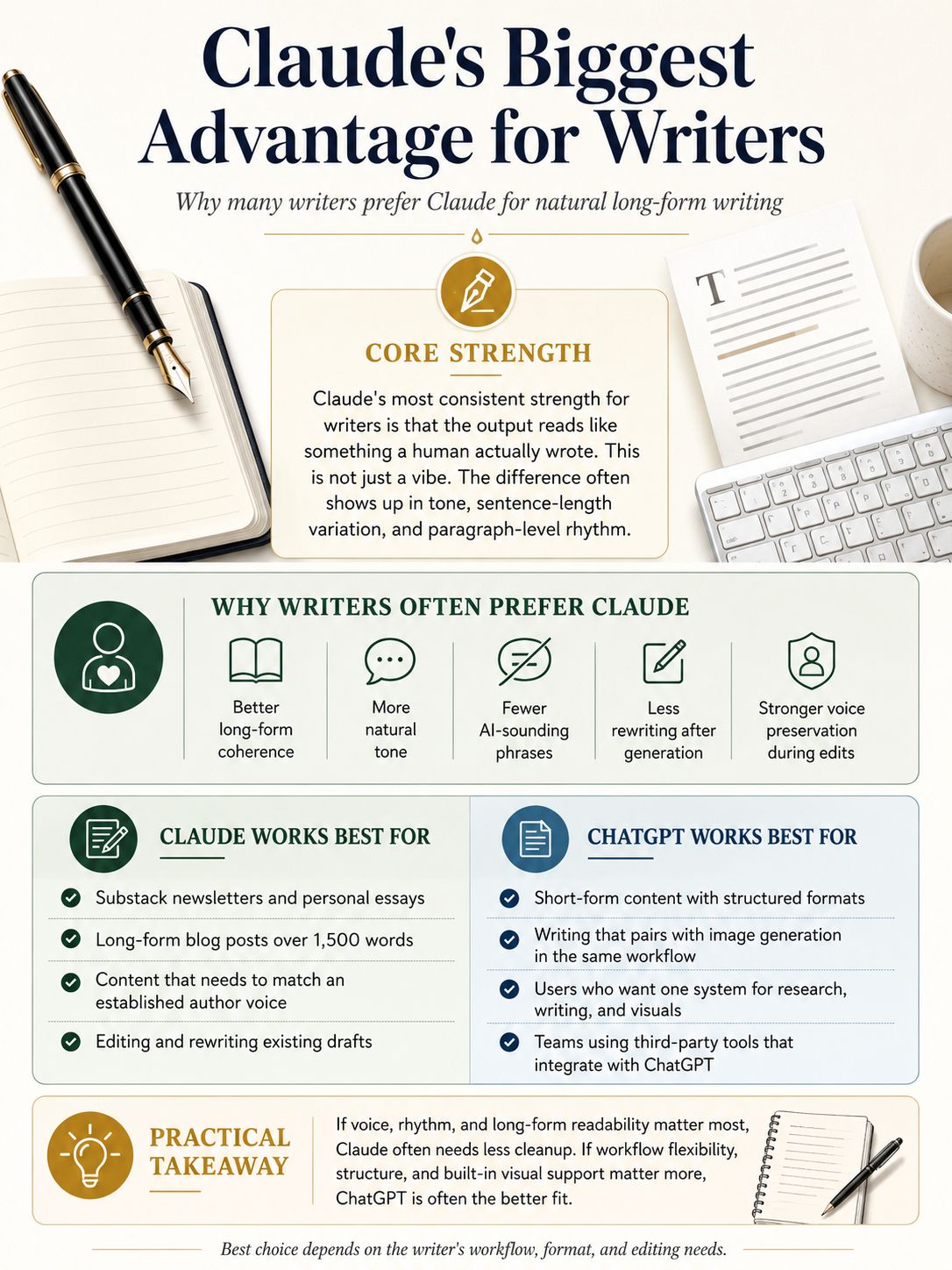
Claude’s most consistent strength for writers is that the output reads like something a human actually wrote. This isn’t just a vibe; it’s a structural difference in how Claude approaches tone, sentence length variation, and paragraph-level rhythm.
Claude is preferred for tasks requiring long-form coherence and a natural tone. Writers using Claude for Substack posts, blog content, and essays report fewer “AI-sounding” phrases and less need to rewrite entire sections after generation.
ChatGPT write outputs can still be excellent, but they often require more post-editing to remove formulaic transitions and overly structured paragraph patterns. Claude writing requires less cleanup for writers who prioritize voice.
Claude is better for:
- Substack newsletters and personal essays
- Long-form blog posts over 1,500 words
- Content that needs to match an established author voice
- Editing and rewriting existing drafts
ChatGPT is better for:
- Short-form content with structured formats
- Content that pairs with image generation in the same workflow
- Writers who need a single system for research, writing, and visuals
- Teams using third-party tools that integrate with ChatGPT
The Messy Transition: What Switching Actually Looks Like
Switching from using ChatGPT to Claude isn’t instant. Migration is always the hard part, and that’s true here too. Writers who built entire content system workflows around ChatGPT, including custom GPTs, saved prompts, and integrations, don’t just flip a switch.
The real challenge is that both tools respond differently to the same prompts. A system prompt that worked perfectly in ChatGPT may produce weaker results in Claude, and vice versa. Writers who tried to copy their entire content system into Claude without adjusting their prompts often didn’t see the improvement they expected at first.
Common transition mistakes:
- Copying ChatGPT prompts word-for-word into Claude without adjusting the framing
- Expecting Claude to handle every workflow ChatGPT handled, including image generation
- Abandoning Claude after one or two weak outputs instead of refining the prompt
The better approach is to migrate one workflow at a time. Start with the task where you’re most frustrated with ChatGPT’s output, move just that workflow into Claude, and test it for two weeks before deciding anything else.
My Split System: How to Use Both Tools Together
Using both Claude and ChatGPT in a split system is actually the most practical approach for working writers. This isn’t about picking a winner; it’s about matching each tool to the tasks it handles better.
Claude is preferred for long-form coherence, while ChatGPT is favored for creative and versatile writing needs. A split workflow takes advantage of both strengths without forcing either tool into tasks it handles poorly.
A practical split system for writers:
- Claude: Long-form drafts, Substack posts, essay writing, editing and rewriting, voice-matching tasks
- ChatGPT: Research summaries, content briefs with visual components, short social copy, tasks that need image generation in the same session
This system claude approach doesn’t require a premium subscription to both simultaneously. Many writers use the free tier of one and the paid tier of the other, depending on which tool they use more heavily.
The 5-Step Comparison Playbook: Run This in 10 Minutes
This plus 5-step playbook lets you test both tools on your actual writing workflow. The 5-step playbook run takes about 10 minutes and gives you a real answer based on your specific use case, not someone else’s opinion.
Step 1: Pick one AI workflow you’re already using
Choose a single, repeatable writing task: a blog post introduction, a newsletter section, a content outline. Don’t test everything at once. Pick the one task where AI saves you the most time or frustrates you the most.
Step 2: Duplicate this workflow in both AIs
Open Claude and ChatGPT side by side. Use the same system prompt in both. If you don’t have a system prompt, write a one-paragraph description of your writing style and paste it into both tools before starting.
Step 3: Run the exact same input through both
Paste the same prompt, same context, same instructions into both Claude and ChatGPT. Don’t tweak the prompt between tools. The playbook run minutes should be identical on both sides.
Step 4: Save both outputs and compare side-by-side
Copy both outputs into a blank document. Read them without knowing which is which if you can manage it. Mark which one you’d actually publish with less editing. This minutes test yourself approach removes bias from the comparison.
Step 5: Make a decision and commit to it for that workflow
Pick the tool that produced the better output for that specific task. Commit to using it for that workflow for at least two weeks. Then run the same test on your next most-used workflow.
This is how you actually write way wealth into your content system instead of wasting time debating tools in the abstract.
How Much Does Claude Cost vs ChatGPT?
Both Claude and ChatGPT offer free tiers and paid plans at the same price point. Both tools offer consumer entry tiers at $20/month, making cost a non-factor for most individual writers choosing between them.
Pricing breakdown:
- Claude Free: Access to Claude’s base model with usage limits
- Claude Pro: $20/month, includes Claude’s most capable models and higher usage limits
- ChatGPT Free: Access to GPT-4o with usage limits
- ChatGPT Plus: $20/month, includes GPT-4o, image generation, and advanced features
For teams and API users, pricing differs significantly. Claude’s API pricing is competitive for long-context tasks, which matters for writers building automated content workflows. ChatGPT’s API is more widely integrated into third-party tools, which can reduce per-task costs through existing platforms.
The short answer: if you’re an individual writer choosing based on price, the cost is the same. Choose based on output quality for your specific workflow.
Does Claude or ChatGPT Handle Research Better for Writers?
For research tasks, ChatGPT has a broader integration advantage, but Claude’s larger context window makes it better for analyzing long documents. Both tools now offer web browsing, so the gap has narrowed for general research.
Where Claude wins on research: feeding it a full 50-page PDF or a long transcript and asking it to pull specific information. Claude’s 200K token context window means it can actually read the full document without summarizing away the details you need.
Where ChatGPT wins on research: pulling together information from multiple web sources quickly, especially when paired with its browsing tool and the ability to generate charts or visuals from that research in the same session.
What the Market Is Saying About Claude vs ChatGPT in 2026
The market data in 2026 tells a clear story. As of June 2026, ChatGPT’s market share in the global AI assistant space dropped to 46.4%, with Google’s Gemini at 27.7% and Claude capturing 10.3%. This is the first time ChatGPT has fallen below 50% market share.
Anthropic, the company behind Claude, filed for an IPO in 2026 at a valuation of $965 billion, having secured a $65 billion funding round with annualized revenue reaching $47 billion. That’s not a startup story anymore. That’s a company with the resources to keep improving Claude at scale.
Claude Opus 4.8 outperformed ChatGPT in ethical and psychological response testing across seven benchmarks, which matters for writers who need AI tools that push back on bad ideas rather than just agreeing with everything.
The trend among everyone using AI for content work is clear: Claude is no longer a niche alternative. It’s a primary tool for a growing share of writers.
What I Would Actually Recommend for Writers
For most writers, the right answer is to start with Claude for your core writing workflow and keep ChatGPT available for tasks that need its ecosystem. This isn’t a loyalty decision; it’s a practical one based on what each tool actually does better.
If you’re a Substack writer, blogger, or long-form content creator, Claude is likely the better daily driver. If you’re a content marketer who needs writing, images, and research in a single system, ChatGPT still has the edge.
Don’t stay loyal to the wrong tool just because you built your workflow around it. The wasted year loyal wrong approach costs more than the time it takes to run a 10-minute test.
Final Thoughts
The Claude vs ChatGPT debate doesn’t have a single right answer, but it does have a practical one. For writers who prioritize natural-sounding prose, long-form coherence, and tonal consistency, Claude is the stronger tool in 2026. For writers who need a full content system with image generation, extensive integrations, and a massive third-party ecosystem, ChatGPT still leads.
The most important thing is to stop debating and start testing. Run the 5-step playbook on one workflow this week. Read both outputs. Pick the one you’d actually publish. That’s the only comparison that matters for your specific writing work.
Both tools are better than they were a year ago. Both will continue to improve. The writers who get the most out of AI are the ones who test systematically, commit to the tool that works, and keep their editing judgment sharp regardless of which system they use.
FAQs about Claude vs ChatGPT for Writers
Is Claude more accurate than ChatGPT?
Claude and ChatGPT have comparable accuracy on most factual tasks, but Claude tends to be more cautious about making claims it can’t support. In head-to-head testing, Claude Opus 4.8 outperformed ChatGPT across seven benchmark tests, particularly in honesty and ethical reasoning. For writing tasks, Claude is less likely to confidently produce incorrect information without flagging uncertainty.
What can Claude do that ChatGPT cannot?
Claude handles significantly longer documents in a single session, with a context window of up to 200K tokens compared to ChatGPT’s 128K. Claude also tends to maintain tonal consistency across very long pieces of writing better than ChatGPT does. For writers feeding in full manuscripts, long transcripts, or large research documents, Claude’s context capacity is a practical advantage that ChatGPT doesn’t match at the same tier.
Why is everyone leaving ChatGPT?
Not everyone is leaving, but a meaningful share of power users have shifted. ChatGPT’s share among power users dropped from 99.91% in 2023 to 74.71% in early 2026, with Claude and Gemini picking up the difference. Writers specifically cite Claude’s more natural writing tone and better long-form coherence as reasons for switching their primary writing workflow.
Why are people using Claude instead of ChatGPT?
Writers are choosing Claude because the output reads more like something a human actually wrote. Claude writing produces fewer formulaic transitions, better paragraph rhythm, and more consistent voice across long documents. For Substack posts, essays, and blog content where tone matters, Claude feels like a better fit. The same $20/month price point means there’s no cost reason to stay with ChatGPT if Claude produces better results for your specific workflow.
Claude is generally the stronger choice for Substack and newsletter writing. Its ability to maintain a consistent voice across a full post, combined with writing that doesn’t read like every other AI-generated newsletter, makes it the preferred tool among writers who publish regularly. ChatGPT can produce good newsletter content too, but typically requires more post-editing to remove structural patterns that feel templated.