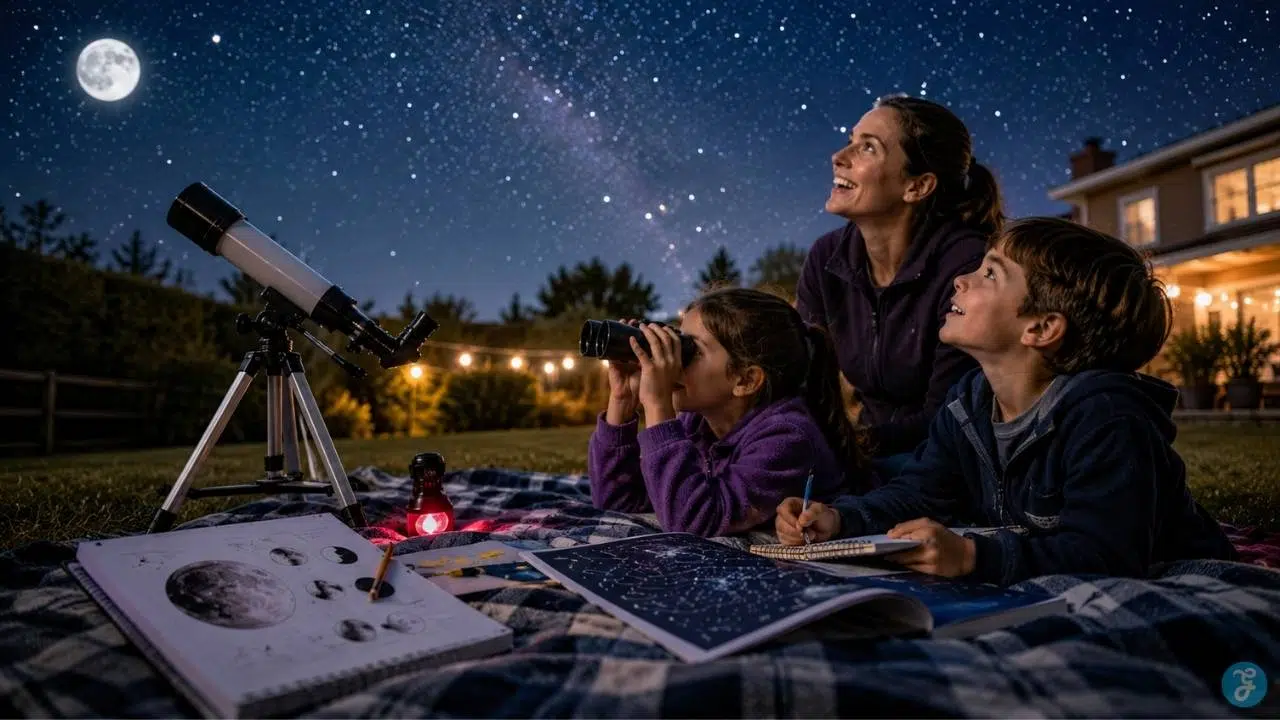
Good astronomy activities kids can actually learn from should do more than make a paper planet mobile and call it science. Space is already fascinating. Children do not need much convincing there. The challenge is helping them understand what they are seeing, not just decorating a wall with stars.
Why does the Moon change shape? Why do some “stars” look brighter and steadier than others? Why are planets so far apart? Why does the Sun make shadows move? Why are there craters on the Moon? Why do comets have tails? Why does the night sky look different from one season to another? Those questions are where astronomy becomes real.
The best space activities help children observe, model, compare, record, and test ideas. Some happen outside under the night sky. Some work at the kitchen table. Some need only paper, balls, flashlights, flour, sidewalk chalk, notebooks, and patience.
This guide covers 9 astronomy activities for children that are practical for parents, teachers, homeschoolers, libraries, camps, and after-school STEM programs.
What Makes Astronomy Activities Useful for Children?
A useful astronomy activity should help kids understand a real space concept.
It does not need to be complicated. In fact, the best astronomy lessons are often simple models that make invisible or huge ideas easier to grasp. A flashlight and a ball can explain Moon phases. A long sidewalk can show the scale of the solar system. A tray of flour can show why impact craters form. A notebook can turn stargazing into observation instead of just “looking up.”
Strong astronomy activities usually include:
- A clear space question
- A simple model or observation
- A chance to predict what will happen
- Something children can record or compare
- A short explanation afterward
- Safe boundaries, especially around night outings and solar viewing
The goal is not to make kids memorize planet facts. The goal is to help them think like young observers of the sky.
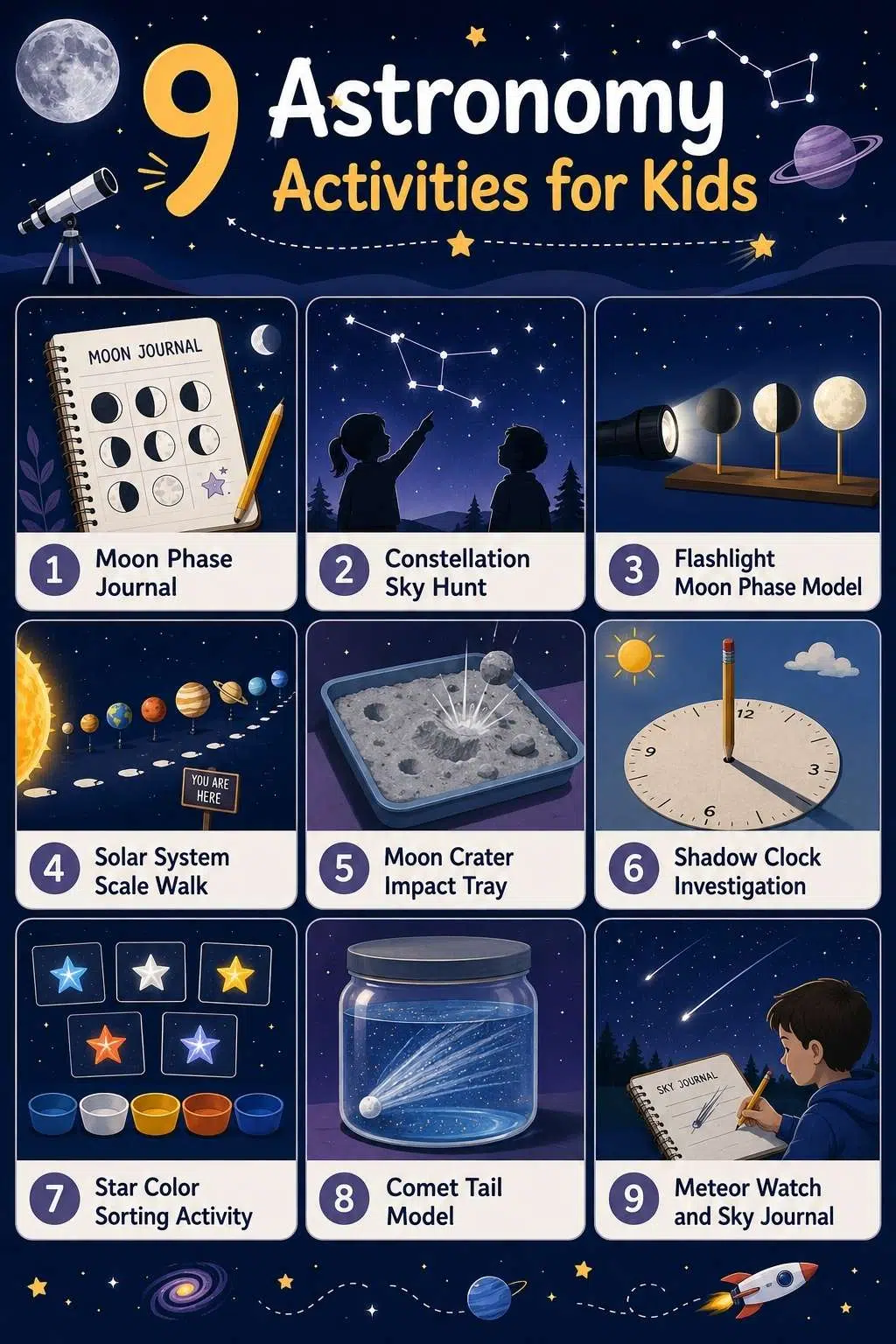
9 Astronomy Activities Kids Can Try
These activities work best when children make a prediction first, observe carefully, and then explain what changed. Astronomy teaches patience because the sky does not move on a child’s schedule.
1. Moon Phase Journal
A Moon phase journal is one of the best beginner astronomy activities because children can do it with their own eyes.
Ask kids to observe the Moon for two to four weeks. Each time they see it, they draw its shape, note the date, time, and direction in the sky, and write one sentence about what changed. They do not need to use perfect scientific language at first. “Banana Moon,” “half Moon,” and “almost full” are good starting points.
Over time, children begin to notice that the Moon does not randomly change shape. It follows a repeating cycle as different parts of the Moon’s sunlit half become visible from Earth.
This activity is especially useful because it teaches real observation. Kids learn that science can mean watching the same thing carefully over time.
What kids learn: Moon phases, observation, patterns, sky direction, and data recording.
You’ll need: Notebook, pencil, clear sky view, and adult supervision outdoors.
Try this: Ask kids to predict what the Moon will look like the next time they see it.
Helpful note: The Moon is not visible at the same time every day, so missing a few nights is normal.
2. Constellation Sky Hunt
Constellations give children an easy way to start reading the night sky.
Choose one or two simple patterns first, such as the Big Dipper, Orion, Cassiopeia, or Scorpius depending on your location and season. Use a printed sky map, astronomy app with adult help, or children’s star guide. Then go outside and help kids match the map to the sky.
The key is not to overwhelm them. A sky full of stars can feel confusing. One constellation found well is better than ten names memorized badly.
Kids can sketch the pattern in a notebook and mark bright stars, nearby planets, or the Moon if visible. This turns stargazing kids into active observers.
What kids learn: Star patterns, constellations, seasonal sky changes, direction, and observation.
You’ll need: Sky map, notebook, pencil, flashlight with red paper over it, and safe viewing spot.
Try this: Let kids invent their own constellation after finding a real one.
Safety note: Stay in a familiar, safe area with an adult. Do not wander in the dark.
3. Flashlight Moon Phase Model
Moon phases can be hard to understand until kids model them physically.
Use a flashlight as the Sun, a ball as the Moon, and the child’s head or body as Earth. In a dim room, shine the flashlight on the ball while the child slowly turns, holding the Moon ball at arm’s length. As the ball moves around the child, different parts of its lit half become visible.
This helps children see that the Moon is not changing shape. Our view of the lit side changes as the Moon orbits Earth.
This is more effective than simply showing a diagram because kids can move through the model themselves.
What kids learn: Moon phases, orbit, sunlight, perspective, and Sun-Earth-Moon geometry.
You’ll need: Flashlight, small ball, dim room, and open space.
Try this: Pause at new Moon, first quarter, full Moon, and last quarter positions.
Make it stronger: After modeling, ask kids to compare the activity with their Moon phase journal.
4. Solar System Scale Walk
Most children see the solar system in pictures where planets sit close together. That makes space look crowded. It is not. A solar system scale walk helps kids feel the distances.
Choose a long hallway, driveway, playground, field, or sidewalk. Use beads, balls, paper circles, or chalk marks to represent the planets. Then space them out using a simplified scale. The inner planets will cluster close to the Sun, while the outer planets will spread far away.
The first big lesson usually comes when children realize how far Jupiter, Saturn, Uranus, and Neptune are compared with Earth and Mars. This is one of the best astronomy activities kids can do when they need movement and scale, not another worksheet.
What kids learn: Planet distance, scale, solar system structure, and model limitations.
You’ll need: Beads or paper planets, string or measuring tape, chalk, labels, and open space.
Try this: Make one model for planet size and another for planet distance. Explain why both are hard to show accurately in one small picture.
Teacher tip: Older kids can calculate their own scale distances.
5. Moon Crater Impact Tray
The Moon’s surface is covered with craters, and this activity shows why. Fill a tray with flour and sprinkle a thin layer of cocoa powder or darker powder on top. Drop small balls, marbles, or pebbles from different heights into the tray. Kids can observe the crater shape, ejecta pattern, and how crater size changes with object size or drop height.
This activity is messy but memorable. It helps children understand that craters form when space rocks hit surfaces at high speed.
The best learning happens when kids change one variable at a time. Drop height, object size, and angle can all affect the result.
What kids learn: Impact craters, surface features, force, ejecta, and variables.
You’ll need: Tray, flour, cocoa powder, small balls or pebbles, ruler, and newspaper or outdoor setup.
Try this: Compare a small marble dropped from low height with a larger ball dropped from higher up.
Cleanup note: Do this on a tray or outside. Flour travels farther than expected.
6. Shadow Clock Investigation
This activity uses the Sun safely without looking at it. Place a stick upright in the ground or use a pencil in modeling clay on a flat surface. Mark the tip of the shadow every hour during the day. Kids will see the shadow move and change length as Earth rotates and the Sun appears to move across the sky.
This is a powerful activity because it connects everyday shadows to astronomy. Children learn that the Sun’s changing position in the sky can be measured.
It can also lead to simple discussions about timekeeping, sundials, day length, and Earth’s rotation.
What kids learn: Earth rotation, apparent Sun motion, shadows, time, and measurement.
You’ll need: Stick or pencil, clay or soil, chalk or paper, ruler, and sunny outdoor space.
Try this: Mark shadows in the morning, noon, and afternoon, then compare length and direction.
Safety note: Never look directly at the Sun. This activity uses shadows only.
7. Star Color Sorting Activity
Stars are not all the same color, and color can tell astronomers something important.
Start indoors with colored beads, paper dots, or star cutouts in blue, white, yellow, orange, and red. Explain that stars have different colors because of temperature. Blue-white stars are generally hotter, while red stars are cooler.
Then, during a night sky session, ask children to look for subtle star colors. Bright stars such as Sirius, Betelgeuse, Rigel, Antares, or Arcturus may show color differences depending on season and location.
This activity works best when children first practice with colored objects, then try careful observation outdoors.
What kids learn: Star color, temperature, observation, classification, and comparison.
You’ll need: Colored beads or paper stars, notebook, and optional sky guide.
Try this: Sort paper stars from hottest to coolest, then look for real stars that seem slightly different in color.
Important note: Star colors can be subtle to the eye, especially in cities or hazy skies.
8. Comet Tail Model
Comets are easier to understand when kids can build and move one.
Make a comet using a small foil ball, craft stick, ribbon, tissue paper, or streamers. The foil ball represents the comet nucleus, and the ribbon represents the tail. Explain that comets are icy, dusty bodies that orbit the Sun. When they get close to the Sun, they heat up and release gas and dust, forming a tail.
The important concept is tail direction. A comet’s tail does not simply trail behind like a car’s exhaust. It generally points away from the Sun because of sunlight and the solar wind.
Kids can place a lamp or paper Sun in the room and move the comet model around it, keeping the tail pointed away from the Sun.
What kids learn: Comets, tails, solar wind, orbits, and Sun-comet interaction.
You’ll need: Aluminum foil, craft stick, ribbons or tissue paper, tape, and paper Sun.
Try this: Move the comet around the Sun and ask kids which way the tail should point.
Make it fun: Let younger children “fly” the comet around the room while keeping the tail direction correct.
9. Meteor Watch and Sky Journal
A meteor watch teaches patience, attention, and data recording.
Pick a safe, dark viewing spot and choose a night when the sky is clear. A known meteor shower date can help, but kids can still practice sky watching on ordinary nights. Have them lie back or sit comfortably, look at a wide area of sky, and record what they see: meteors, satellites, airplanes, bright planets, Moon phase, clouds, and sky conditions.
The goal is not to promise a dramatic meteor shower. Some nights are quiet. That is still science because children learn to record conditions and results honestly.
This activity is best for older children because it requires waiting.
What kids learn: Meteors, observation, patience, sky conditions, and data recording.
You’ll need: Blanket or reclining chair, notebook, pencil, warm clothes, adult supervision, and safe location.
Try this: Count how many moving lights kids see in 20 minutes and sort them into airplanes, satellites, and possible meteors.
Safety note: Choose a safe viewing area and stay with an adult the entire time.
Best Astronomy Activities by Age
| Age Group | Best Activities |
| Ages 4-5 | Constellation stories, comet model, simple Moon drawings |
| Ages 6-7 | Moon journal, crater tray, shadow clock, constellation hunt |
| Ages 8-10 | Moon phase model, solar system scale walk, meteor journal |
| Ages 11+ | Scale calculations, detailed sky logs, star color observation, extended Moon tracking |
Age ranges are flexible. Younger children can join harder activities with help, and older children can make simple activities more advanced by measuring, calculating, graphing, and comparing observations.
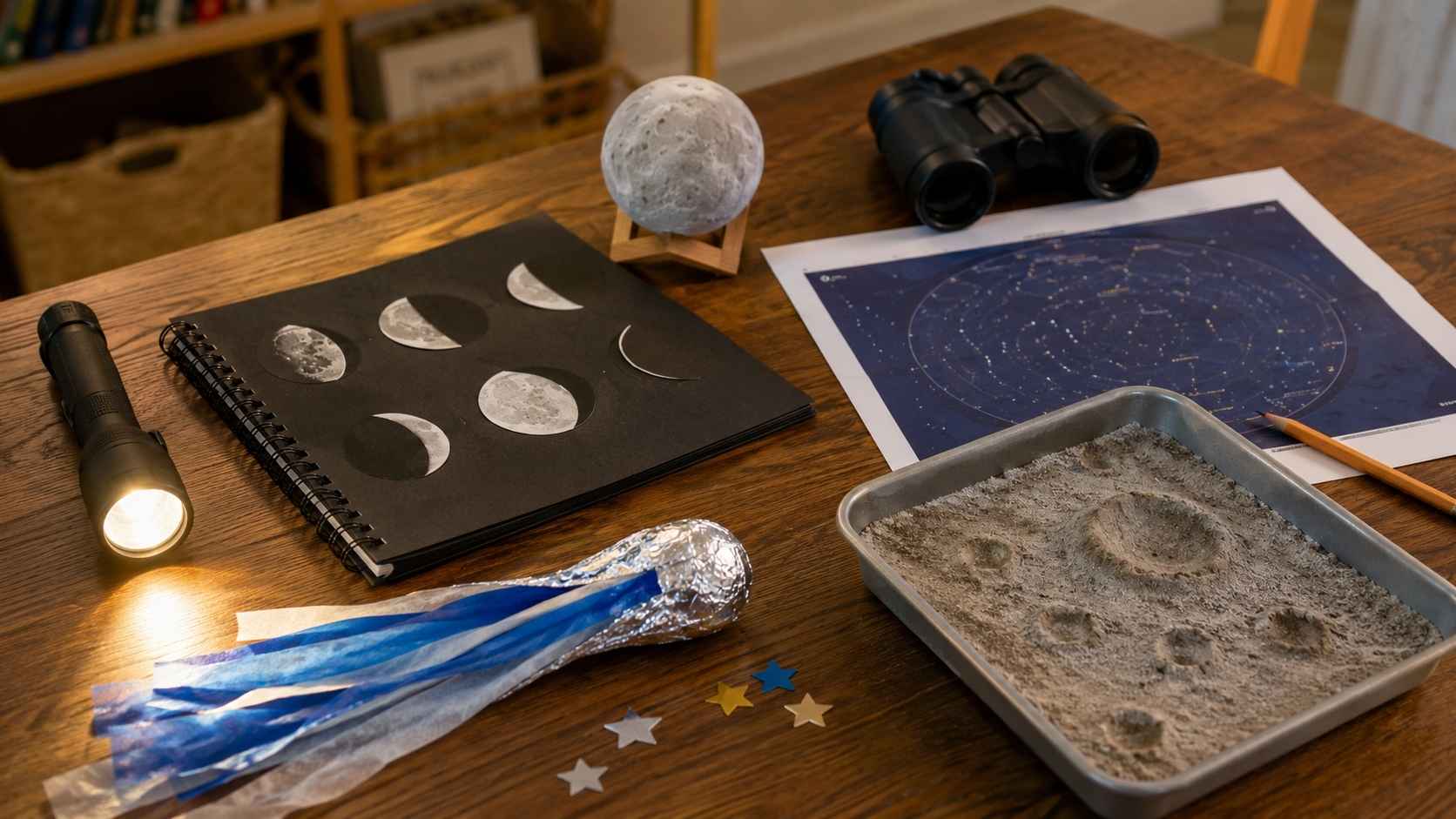
Simple Supplies for Astronomy for Children
You do not need a telescope to start astronomy with kids.
Useful supplies include:
- Notebook
- Pencil
- Clipboard
- Flashlight with red paper or red filter
- Printed sky map
- Small ball
- Flashlight for Moon phase model
- Flour and tray for crater activity
- Chalk
- Measuring tape
- Sidewalk or open field
- Colored paper or beads
- Aluminum foil
- Ribbon or tissue paper
- Blanket for stargazing
- Warm clothes
- Optional binoculars with adult supervision
A telescope can be exciting, but it is not required. Many great astronomy activities begin with the unaided eye.
Safety Tips for Stargazing Kids
Stargazing should feel calm and exciting, not risky. Use a familiar safe location, stay with an adult, bring warm clothing, use a dim red light to protect night vision, and avoid roads, water edges, steep areas, and unfamiliar fields. Check the weather before going out. If children are tired, cold, or restless, end the session early.
For solar activities, the rule is stricter: never look directly at the Sun. Regular sunglasses are not enough for solar viewing. Use shadows, indirect projection, or properly rated solar viewers only when appropriate and supervised.
Night sky learning should build wonder, not create danger.
Common Mistakes to Avoid
- Making astronomy too fact-heavy. Children do not need to memorize every moon of Jupiter before they understand why the Moon changes shape.
- Starting with a telescope too soon. Telescopes can frustrate kids if they are hard to aim, blurry, or uncomfortable. Start with naked-eye observing first.
- Expecting perfect viewing. Clouds, city lights, moonlight, haze, and bedtime can all interfere. That is normal.
- Skipping safety around the Sun. Solar viewing is not casual. Do not improvise.
- Turning every space activity into a craft. Crafts are fine, but the activity should still teach a space concept.
Final Takeaway
Astronomy activities kids remember are the ones that make space feel connected to their own world. They can watch the Moon change, find a constellation, model Moon phases, walk the solar system, make impact craters, track shadows, compare star colors, build a comet, and record a meteor watch. None of these require expensive equipment. They require curiosity, patience, and a little guidance.
That is the best way to introduce astronomy for children. Start with the sky they can see. Then help them ask bigger questions.
Frequently Asked Questions About Astronomy Activities Kids Can Try
1. What are easy astronomy activities for kids?
Easy astronomy activities for kids include keeping a Moon phase journal, finding constellations, making a flashlight Moon phase model, building a comet model, creating Moon craters in a tray, tracking shadows, and doing a simple meteor watch.
2. Do kids need a telescope to learn astronomy?
No. Kids can learn a lot of astronomy without a telescope. The Moon, bright planets, constellations, shadows, meteors, and star patterns can all be explored with the naked eye, notebooks, simple models, and safe adult guidance.
3. What is a good first stargazing activity for children?
A good first stargazing activity is finding one easy constellation and drawing it in a sky journal. Keep the session short, use a safe viewing spot, and help children notice the Moon, bright stars, planets, and moving lights such as satellites or airplanes.
4. How can kids learn Moon phases at home?
Kids can learn Moon phases by keeping a Moon journal, using a flashlight and ball model, or making a simple Moon phase chart. The key idea is that the Moon itself is not changing shape. We see different parts of its sunlit side as it orbits Earth.
5. Are astronomy activities safe for young children?
Most astronomy activities are safe with adult supervision. Night activities need safe locations, weather awareness, and close supervision. Solar activities require special caution because children should never look directly at the Sun without proper certified protection.
6. What are the best space activities for classrooms?
Good classroom space activities include Moon crater trays, solar system scale walks, Moon phase models, comet tail models, shadow tracking, star color sorting, and sky journals. These activities teach real astronomy concepts with simple materials.