Crowdfunding for startups sounds wonderfully democratic until you actually try to run a campaign. Then it stops looking like free money from strangers and starts looking like launch strategy, legal prep, community building, fulfillment risk, customer support, and public pressure all arriving at once.
That is not a reason to avoid it. It is a reason to respect it.
A strong crowdfunding campaign can validate demand, finance early production, turn customers into evangelists, and prove that people care before an investor does. A weak campaign does the opposite in public. It shows the market that nobody showed up, or worse, that people showed up and you could not deliver.
The mistake founders make is treating crowdfunding like a shortcut around hard fundraising. It is not. It is a different kind of fundraising with its own burden. Instead of convincing five investors in private, you are asking hundreds or thousands of people to trust you in public. That trust has to be earned before the campaign goes live.
What Crowdfunding for Startups Really Means
Crowdfunding for startups means raising money from a large group of individual backers or investors instead of relying only on venture capital, angel checks, bank debt, or personal savings.
The model changes depending on what the crowd receives in return.
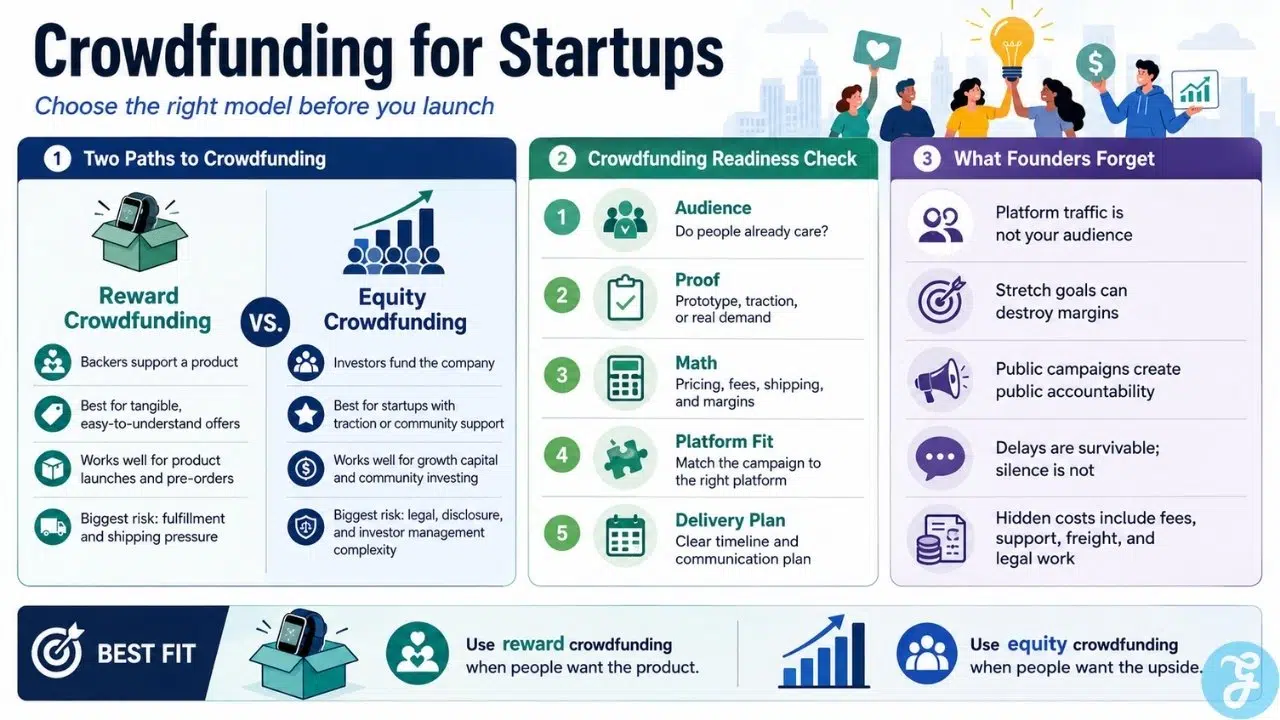
Some campaigns give backers early access to a product, a discount, a limited edition, or another reward. That is reward-based crowdfunding, and it is where a startup Kickstarter campaign or an Indiegogo campaign fits. The backer is not buying equity. They are supporting a project and expecting the promised reward if the campaign succeeds.
Equity crowdfunding is different. People invest money in exchange for securities, which may mean shares, SAFEs, debt, revenue share, or another investment structure depending on the deal. That puts the campaign inside securities rules, investor disclosures, platform requirements, and legal review.
Donation crowdfunding exists too, but it rarely fits a serious startup unless the project has a social, medical, nonprofit, or community purpose. A startup selling a product should not pretend it is a charity just because “support us” sounds softer than “buy this.”
The first decision is not which crowdfunding platforms look popular. The first decision is what kind of promise you are making to the crowd.
Reward Crowdfunding Works Best When the Product Is Easy to Understand
Reward crowdfunding works when the product can be shown, explained, priced, and delivered without making backers solve a puzzle.
A startup Kickstarter campaign can work beautifully for a hardware gadget, game, design product, creative tool, book, film, or consumer product with a clear use case. The backer sees the thing, understands why it exists, chooses a reward tier, and waits for delivery.
That is why reward crowdfunding punishes vague startups. If the product needs six enterprise demos, a procurement process, and a technical integration before anyone understands the value, Kickstarter is probably the wrong room. A founder selling SOC 2 automation to mid-market SaaS companies may be better off with founder-led sales, partner channels, or equity crowdfunding than a reward campaign aimed at casual backers.
Reward crowdfunding asks one blunt question: can a stranger understand the product fast enough to care?
If the answer is yes, the campaign still has to survive the next question: can you deliver what you promised?
That second question is where many founders get hurt. A campaign can validate demand and create cash, but it can also expose weak manufacturing, bad shipping assumptions, refund pressure, support overload, and cost overruns. If your margin only works when every supplier behaves, every freight cost stays stable, and no customer asks for help, the campaign is not ready.
Equity Crowdfunding Is Fundraising With a Crowd Watching
Equity crowdfunding gives startups access to a wider investor base, including people who may already believe in the company, product, founder, or community.
This can be powerful. A consumer brand with loyal customers, a local business with deep community support, or a startup with a passionate audience may turn users into investors. That creates more than capital. It creates social proof, public momentum, and a base of supporters with financial reasons to help the company win.
It also creates baggage.
Equity crowdfunding means disclosure, platform review, legal documents, investor updates, securities compliance, cap table planning, and a much more public fundraising process. You are not just asking people to pre-order a backpack or board game. You are asking them to invest in a risky private company.
That changes the tone. Hype gets dangerous. Loose claims get expensive. “We’re going to be the next Tesla” sounds silly in a reward campaign. In equity crowdfunding, it can become a disclosure problem if the rest of the materials do not support the claim.
Founders also need to think about how equity crowdfunding affects future funding. Some venture investors are comfortable with it. Others will look hard at the cap table, investor structure, reporting burden, and whether the campaign created thousands of small investors with expectations the company is not prepared to manage.
Equity crowdfunding can be real startup capital. Treat it like real startup capital.
Startup Kickstarter Campaigns Are Not Just Product Pages
A startup Kickstarter campaign is closer to a public launch than a donation page.
The campaign page has to sell the product, explain the story, prove credibility, remove delivery anxiety, and make reward tiers feel worth backing. It needs a strong video, clear visuals, believable production details, thoughtful pricing, and a launch audience that already exists before day one.
Founders who launch cold usually learn a painful lesson: crowdfunding platforms do not magically bring a crowd. They can amplify momentum, but they rarely create it from nothing.
The campaign needs a pre-launch list. It needs early backers ready to move quickly. It needs press, community, creator partnerships, social proof, and a reason for people to care now. If the first 48 hours are silent, the campaign starts to look weak, and weak campaigns make hesitant backers even more hesitant.
A startup Kickstarter campaign also needs ruthless reward math. Every tier should account for manufacturing cost, packaging, payment fees, platform fees, shipping, taxes, defects, replacements, and support time. Founders love stretch goals until the stretch goal turns into a margin killer.
A campaign that raises $300,000 can still become a mess if the founder priced rewards like a marketer and fulfilled them like an optimist.
Crowdfunding Platforms Are Not Interchangeable
Crowdfunding platforms shape the campaign more than founders want to admit.
Kickstarter is known for creative projects and uses an all-or-nothing funding model. That structure can build urgency because backers know the campaign only moves forward if the goal is reached. It also forces founders to set a goal they can actually defend. Set the goal too high and you risk missing it. Set it too low and you may raise the money but lack enough cash to deliver properly.
Indiegogo has historically attracted product launches, gadgets, and hardware campaigns, and platform rules have shifted over time. That matters because funding models, fulfillment expectations, review processes, and backer protections affect how founders plan a campaign.
Equity crowdfunding platforms such as Wefunder, StartEngine, Republic, and others sit in a different category. They are not product pre-order engines. They are investor-facing platforms where the company raises under securities rules. The right fit depends on the company stage, audience, minimum raise, legal structure, investor communication needs, and platform support.
Do not pick a platform because another founder raised there. Pick it because the backer or investor behavior matches your campaign.
A design product may belong on Kickstarter. A consumer brand with a loyal audience may fit equity crowdfunding. A local food business with customers who want to own a piece of the company may need a community round. A B2B SaaS startup with no public audience may get more value from targeted angel outreach than from a public campaign page that sits quietly for 45 days.
The Real Work Starts Before the Campaign Goes Live
The campaign is only the visible part.
Before launch, you need to know who will back, why they will back, and what proof will make them trust you. That means building the audience before asking for money.
For reward crowdfunding, the prep work usually includes product photography, prototype footage, manufacturing quotes, supplier conversations, reward pricing, shipping estimates, landing pages, email capture, early community building, press outreach, creator partnerships, and a launch calendar.
For equity crowdfunding, the prep is heavier. You need a credible business story, financials, use of funds, investor materials, legal documents, platform approval, disclosures, cap table planning, and a communication plan for investors who may be new to startup risk.
The worst time to build trust is after the campaign is already live.
If you need 1,000 people to back the campaign, you cannot start by posting “we launched” to an empty LinkedIn page and hoping the internet feels generous. Crowdfunding rewards preparation. It punishes founders who confuse platform access with demand.
Crowdfunding for Startups Works Only When the Crowd Already Has a Reason to Care
The crowd is not random.
Backers support campaigns because they want the product, believe in the founder, identify with the mission, trust the proof, or want access before everyone else. Investors join equity crowdfunding campaigns because they understand the company, like the upside, believe in the community, or want to support something they already use.
That means the audience has to be specific.
“Everyone who cares about productivity” is not an audience. “Freelance designers who lose billable hours chasing client feedback across Slack, email, and Google Docs” is closer. “People who like sustainability” is too broad. “Apartment renters who want a countertop composting system that does not smell and does not require outdoor space” gives the campaign something to grip.
Crowdfunding platforms reward clarity because the backer has no patience for founder fog. The page either makes the promise easy to understand, or people leave.
A strong campaign knows exactly who it is calling into the room.
The Campaign Page Needs Proof, Not Just Emotion
Story matters in crowdfunding, but proof does the heavy lifting.
A founder story can explain why the product exists. It can create warmth, trust, and momentum. But the campaign still needs evidence that the team can deliver.
For a reward campaign, proof may include working prototypes, manufacturing partners, realistic timelines, product testing, customer quotes, press mentions, prior shipping experience, or a clear explanation of what still needs to happen.
For equity crowdfunding, proof may include revenue, retention, customer growth, gross margin, repeat purchase behavior, signed contracts, waitlists that convert, partnerships, team experience, financial discipline, or a believable path to the next milestone.
The more ambitious the promise, the stronger the proof needs to be.
If you are launching a simple notebook, the proof burden is lower. If you are launching a connected fitness device with custom hardware, mobile software, sensors, overseas manufacturing, and delivery to 20 countries, the burden is much higher. Backers may love the idea. They still need to believe you can ship it.
Crowdfunding Creates Public Accountability
Private fundraising lets you miss quietly. Crowdfunding does not.
If the campaign struggles, people can see it. If rewards are late, backers can comment. If communication goes silent, frustration builds in public. If equity investors feel misled, the problem becomes more serious than angry comments.
This visibility is part of the bargain. Crowdfunding turns supporters into a public audience with expectations.
That can work in your favor. Strong updates, honest timelines, and transparent problem-solving can build trust even when things get delayed. Backers do not love delays, but they hate silence more. Investors do not expect a startup to move perfectly, but they expect the founder to communicate like an adult.
A founder who disappears after raising money teaches the crowd one thing: never trust this company again.
How to Choose Between Reward Crowdfunding and Equity Crowdfunding
Choose reward crowdfunding when the product is tangible, easy to explain, emotionally appealing, and close enough to production that delivery risk is manageable.
A startup Kickstarter campaign makes sense when the backer wants the thing itself. The product is the reward. The campaign is part launch, part validation, part early sales engine.
Choose equity crowdfunding when the community wants to invest in the company, not just buy the product. This fits better when the company has traction, a loyal audience, growth potential, and a story that can survive investor scrutiny.
The wrong choice creates weird incentives. If you run a reward campaign for something that should really be an investment, backers may feel like they funded company growth without sharing in the upside. If you run equity crowdfunding for a product that only needs pre-orders, you may add legal complexity and investor obligations you did not need.
The cleanest question is this: are people backing because they want the product, or because they want exposure to the company’s upside?
Answer that before choosing the platform.
What Founders Should Prepare Before Using Crowdfunding Platforms
Crowdfunding platforms give you infrastructure. They do not give you credibility for free.
Before launching, prepare the campaign as if skeptical strangers will read every line and look for the weak spot.
For reward crowdfunding, prepare the product story, reward tiers, prototype evidence, production plan, shipping math, refund policy, campaign video, customer support plan, and launch audience. Know what happens if demand is higher than expected. A campaign that goes viral can break a founder who only planned for moderate success.
For equity crowdfunding, prepare the investor story, financials, use of funds, legal documents, disclosures, founder bios, risk factors, cap table, investor updates, and post-raise communication process. Know what you can claim and what you cannot. Public fundraising punishes sloppy language.
The platform is the stage. The work is everything that makes you worth watching.
The Hidden Costs Founders Forget
Crowdfunding money is not the same as cash sitting peacefully in a bank account.
Reward crowdfunding brings platform fees, payment processing, production costs, packaging, freight, taxes, failed payments, customer service, returns, replacements, and months of operational pressure. If the product is physical, shipping can quietly eat the campaign alive.
Equity crowdfunding brings legal fees, accounting work, platform fees, marketing costs, investor relations, compliance responsibilities, and the distraction of running a public raise while still operating the company.
The campaign also has an opportunity cost. The founder’s time goes into audience building, content, updates, investor calls, comments, campaign optimization, and post-campaign delivery. That may be worth it. It may also be the wrong use of focus if the company needs product development, enterprise sales, or a narrow set of strategic investors.
Crowdfunding looks cheaper than venture capital because you are not giving up board control in a reward campaign or pitching the same room of VCs. That does not make it easy capital. The cost just shows up in different places.
Common Crowdfunding Mistakes That Hurt Startups
Crowdfunding campaigns usually fail before launch, not during launch.
The founder has no real audience, but assumes the platform will supply one. The product story sounds exciting to insiders and confusing to everyone else. The funding goal is based on vibes, not delivery math. The campaign video looks polished but avoids the hard questions. The reward tiers create margin problems. The founder promises stretch goals before understanding fulfillment risk.
Equity campaigns add another layer of mistakes. The company launches before the financial story is clean. The valuation feels detached from traction. The founder treats everyday investors like fans instead of investors. The campaign copy makes claims the numbers cannot support. The post-raise communication plan is basically “we’ll figure it out later.”
Bad crowdfunding does not just fail to raise money. It leaves evidence.
A failed private investor pitch disappears into someone’s inbox. A weak crowdfunding campaign can sit online as a public record of poor demand, messy communication, or unrealistic planning.
When Crowdfunding Is the Wrong Move
Crowdfunding is the wrong move when the startup has no audience, no clear product promise, no delivery plan, or no patience for public communication.
It is also a bad fit when the product is too complex for a cold visitor to understand quickly. Some startups need targeted sales conversations, not a public campaign page. Enterprise software, regulated healthcare tools, deep infrastructure, and technical products with long buying cycles can struggle in reward crowdfunding unless the audience is already educated and deeply motivated.
Equity crowdfunding is the wrong move when the founder is not ready for disclosure, investor communication, legal review, or cap table consequences. Raising from the crowd sounds attractive until you realize the crowd does not disappear after the money clears.
If the company needs quiet iteration, private customer discovery, or a few strategic checks from people who understand the market, crowdfunding may create more noise than value.
Not every funding path needs an audience. Some need precision.
The Practical Way to Approach Crowdfunding for Startups
Crowdfunding for startups works best when founders treat it as a campaign, not a payment link.
Start by choosing the right model. Reward crowdfunding sells a promise to deliver a product. Equity crowdfunding sells a belief in the company’s future. Those are different promises, and they need different preparation.
Then pressure-test the basics. Who is the audience? Why do they care now? What proof do they need? What happens if the campaign barely hits the goal? What happens if it raises three times more than expected? Can the team communicate clearly when timelines slip? Can the unit economics survive the rewards, fees, shipping, and support work?
A startup Kickstarter campaign can turn early demand into momentum. Equity crowdfunding can turn customers and community members into investors. Crowdfunding platforms can give the raise a home, structure, and visibility.
None of that replaces trust.
Before you launch, build the audience, clean the numbers, know the delivery math, and write the campaign like skeptical strangers are reading it. Because they are.