The way people plan trips is changing. Not everyone wants the fastest flight, the busiest itinerary, or a weekend built around airport stress. More travelers are looking for slower routes, better public transport, longer stays, walkable cities, bike-friendly days, rail journeys, and local places that do not feel copied from every other travel feed. That is where low-impact travel planning apps are becoming more useful.
These apps do not make travel impact-free. No app can do that. But they can make better choices more easily. They help travelers compare trains instead of flights, find buses and ferries, move through cities without cars, plan walking or cycling routes, and discover local places that support communities more directly.
This article focuses only on real apps or mobile-first travel tools. That matters. Some slow travel companies are excellent, but they are not really apps. Some sustainability platforms are useful, but they are not strong planning tools. For this list, the priority is practical app-based travel planning for the 2027 slow travel era.
How I Selected These Apps
This list is not a random roundup of “green travel” names. Each app had to meet a practical standard.
To be included, the app needed to:
- Have an active mobile app or mobile-first travel-planning experience
- Help travelers plan lower-impact routes, city movement, local exploration, or sustainable discovery
- Support at least one slow-travel behavior, such as rail travel, buses, ferries, public transport, walking, cycling, or local-first travel
- Have a real company or organization behind it
- Offer publicly verifiable business information
- Be useful for actual travelers, not just interesting from a sustainability angle
This is also not a list of carbon-offset apps. Offsetting has its place, but slow travel starts earlier than that. It starts when a traveler chooses the route, the transport mode, the place to stay, and how to move once they arrive.
Why Low-Impact Travel Planning Apps Matter Now
Slow travel sounds simple until someone tries to plan it. A traveler may want to avoid a short-haul flight, but then they face scattered rail websites, confusing ferry schedules, long bus routes, language barriers, and uncertain local transit options. They may want to explore by bike, but they do not know which routes are safe. They may want to support local businesses, but the usual travel platforms often push the same crowded attractions.
Good apps reduce that friction.
The best low-impact travel planning apps do not preach. They make the better option easier to compare, book, or follow. That is why this category matters. Sustainable travel will not scale through guilt. It will scale when the slower, lower-impact option becomes easier to plan.
1. Trainline
Trainline is one of the most practical apps for low-impact travel planning, especially in the UK and Europe. It helps travelers search, compare, and book train and coach journeys across many operators.
It is not a niche eco-travel startup. It is a large public travel technology company. That gives it a different role in the slow travel space. Trainline helps make rail and coach travel feel normal, digital, and convenient.
For travelers trying to avoid short flights between European cities, that matters.
Business Snapshot
| Field | Verified Detail |
| Company Origin | Set up by Virgin Group, no single individual founder is usually presented |
| Founded Year | 1997 |
| Funding Stage / Status | Public company listed on the London Stock Exchange |
| Main Product / Service | Train and coach ticket search, booking, mobile tickets, live travel information |
| Target Customers | Rail travelers, coach travelers, commuters, leisure travelers, business travelers |
| B2B or B2C | Mainly B2C, with business and partner solutions |
| Low-Impact Role | Makes rail and coach travel easier to search and book |
What the App Does
Trainline gathers routes, prices, and travel times from rail and coach operators so users can search and book tickets in one place. For slow travel, its main value is practical convenience.
A traveler planning from London to Edinburgh, Paris to Lyon, Milan to Venice, or Madrid to Barcelona can often use rail instead of flying. Trainline makes that choice easier because the app handles search, tickets, live updates, and mobile access.
This is not glamorous, but it is important. Slow travel depends on infrastructure. If trains and coaches are hard to book, many travelers will go back to flights.
Where It Fits in the 2027 Slow Travel Era
Trainline is strongest for travelers who already know they want to move by train or coach. It is less about inspiration and more about execution.
Its biggest advantage is scale. The more rail routes become searchable and bookable on phones, the more normal rail-first travel becomes.
The limitation is that Trainline is not a full slow-travel planner. It will not design your whole route, choose your neighborhood, or tell you which local businesses to support. It is a transport app. But for low-impact travel, that transport layer is often the most important starting point.
2. Omio
Omio is useful because it lets travelers compare different transport modes in one app. It covers trains, buses, ferries, and flights. For a low-impact list, that last part may sound like a problem. But in practice, the comparison is exactly why Omio belongs here.
Many travelers choose flights because they are easy to find. Omio can make train, bus, and ferry options visible in the same search flow. That helps people see when a lower-impact route is realistic.
Business Snapshot
| Field | Verified Detail |
| Founder | Naren Shaam |
| Founded Year | Commonly cited as 2013; official timeline notes the app went live in 2015 |
| Funding Stage / Status | Private, venture-backed company; raised a major $80 million round in 2022 |
| Main Product / Service | Multimodal booking for trains, buses, ferries, and flights |
| Target Customers | Leisure travelers, cross-border travelers, business travelers, transport partners |
| B2B or B2C | B2C app with B2B and partner-distribution elements |
| Low-Impact Role | Helps users compare surface transport options against flights |
What the App Does
Omio brings multiple transport options into one travel search. Users can compare and book trains, buses, ferries, and flights, depending on the route and market.
For slow travel, the key benefit is comparison. A traveler may discover that a train is not much slower than a flight once airport transfers, security lines, and waiting time are included. Or they may find that a bus or ferry combination works better than expected. That visibility can change decisions.
Business Reality Check
Omio is not a pure sustainability app. It still sells flights. So the right editorial framing is not “Omio is green.” The better framing is this: Omio can help travelers compare modes and choose lower-impact options when those options make sense.
That is a more honest way to position it. Its strength is breadth. Its weakness is that travelers still need to make the low-impact choice themselves. The app can show the options, but it does not automatically turn every trip into a slow travel itinerary.
3. Rome2Rio
Rome2Rio is one of the best apps for the early planning stage. It answers a basic but powerful question: how can I get from one place to another?
That question becomes more important in slow travel. A traveler may want to avoid flying, visit smaller towns, connect islands by ferry, or move across regions by bus and train. Rome2Rio helps uncover routes that are not always obvious.
Business Snapshot
| Field | Verified Detail |
| Founders | Michael Cameron and Bernhard Tschirren |
| Founded Year | Project began around 2010; beta launched in 2011 |
| Funding Stage / Status | Acquired by Omio in 2019 |
| Main Product / Service | Multimodal route discovery across trains, buses, ferries, flights, cars, and more |
| Target Customers | Independent travelers, route planners, backpackers, cross-border travelers, travel researchers |
| B2B or B2C | Mainly B2C, with partner and advertising elements |
| Low-Impact Role | Helps travelers discover train, bus, and ferry alternatives before booking |
What Makes It Useful
Rome2Rio is not mainly a booking app. It is a discovery app. That is why many travelers use it before they decide which transport provider to book with.
It can show combinations of train, bus, ferry, car, and flight routes. It is especially helpful for places where transport is not obvious: islands, rural regions, secondary cities, border crossings, and multi-country trips.
For slow travel, this is valuable because the lower-impact route may exist, but the traveler may not know how to find it.
Where the Model Is Limited
Rome2Rio should not be described as a dedicated sustainable travel app. It shows options. It does not guarantee that the best environmental choice is ranked first. It also includes flights and car routes.
Still, it belongs in this list because low-impact planning often starts with visibility. If a traveler cannot see the train, ferry, or bus route, they are less likely to choose it.
The best way to use Rome2Rio is simple: find possible routes first, then compare the lower-impact options more carefully before booking.
4. Komoot
Komoot brings slow travel down to the ground level. It is not mainly about moving between countries. It is about how travelers explore once they arrive.
The app helps users plan cycling, hiking, walking, mountain biking, running, and outdoor routes. That makes it one of the most useful low-impact travel planning apps for travelers who want to experience a destination at human speed.
Business Snapshot
| Field | Verified Detail |
| Founders | Jonas Spengler, Markus Hallermann, Tobias Hallermann, Christoph Lingg, Daniel Gard, and Jan Heuer |
| Founded Year | 2010 |
| Funding Stage / Status | Funding stage not clearly confirmed on official sources; operates as a commercial app with paid maps, premium tools, and partner products |
| Main Product / Service | Outdoor route planning, navigation, offline maps, and route discovery |
| Target Customers | Cyclists, hikers, walkers, runners, outdoor travelers, tourism boards, outdoor brands |
| B2B or B2C | Mainly B2C, with B2B destination and brand partnership opportunities |
| Low-Impact Role | Supports walking, cycling, hiking, and local outdoor exploration |
What the App Does
Komoot helps travelers plan and follow routes based on activity, distance, difficulty, surface, elevation, and local highlights. It is especially useful for people who want to include cycling days, walking routes, hiking trails, or scenic outdoor plans in a trip.
This matters because slow travel is not only about replacing a flight with a train. It is also about staying longer and moving more intentionally once you are there.
A traveler might take the train into a region, then use Komoot to plan a village-to-village walk, a bike route between small towns, or a nature day without renting a car.
Why It Belongs in a Business Listicle
Komoot has built a strong product around outdoor mobility and route confidence. It turns local exploration into something easier to plan. That is useful for travelers and also valuable for tourism boards, outdoor brands, and destinations trying to attract visitors without pushing only car-based itineraries.
Its limitation is clear. Komoot does not book your train, hotel, ferry, or full itinerary. It works best as the local experience layer inside a slower trip.
That is still a serious role. The 2027 slow travel era will not only be about how people arrive. It will also be about how they move after arrival.
5. Citymapper
Citymapper is a strong fit for low-impact urban travel. Once travelers arrive in a city, the question becomes simple: can they move around without defaulting to taxis, rental cars, or ride-hailing every time?
Citymapper helps answer that. The app combines public transport, walking, cycling, scooters, ferries, trains, buses, subways, and other city mobility options, depending on the market.
Business Snapshot
| Field | Verified Detail |
| Founder | Azmat Yusuf |
| Founded Year | 2011 |
| Funding Stage / Status | Acquired by Via in 2023 |
| Main Product / Service | Urban transport planning across public transport, walking, cycling, scooters, and shared mobility |
| Target Customers | City travelers, commuters, tourists, urban residents, cities, agencies, advertisers |
| B2B or B2C | B2C app with B2B city, agency, and advertising services |
| Low-Impact Role | Helps travelers move through cities using public and active transport |
What the App Does
Citymapper is built for city movement. It compares real-time options across transport modes and helps users navigate with turn-by-turn directions.
For slow travel, this is especially useful in large or unfamiliar cities. Many tourists waste time and money because they do not understand local transport. Citymapper reduces that uncertainty.
It can help a traveler choose the metro instead of a taxi, walk a short route instead of calling a car, or combine bus, train, cycling, and walking in a practical way.
Why It Matters for Slow Travel
A trip can start with good intentions and still become car-heavy once the traveler reaches the destination. Citymapper helps prevent that.
It is not a sustainability-branded app, and that may actually be part of its strength. It does not need to market itself as “green” to support lower-impact behavior. It simply makes public and active transport easier to use.
The limitation is coverage. Citymapper is strongest in supported cities. For rural slow travel, island routes, or regional rail planning, other apps on this list are more useful.
6. FairTrip
FairTrip is the most sustainability-specific app in this list. It is not a rail planner or a route engine. It is a sustainable travel guide focused on authentic, local, and positive-impact places. That makes it useful for the discovery side of slow travel.
Slow travel is not only about transport. It is also about where money goes. A trip feels more meaningful when travelers support local accommodation, restaurants, activities, NGOs, and community-based experiences rather than only the most crowded tourist channels.
Business Snapshot
| Field | Verified Detail |
| Founder / Leadership | FairTrip’s own story names Brian as co-founder; Brian Corrieri is publicly listed as CEO |
| Founded Year | Origin story begins in 2016 |
| Funding Stage / Status | The public funding stage is not clearly confirmed |
| Main Product / Service | Sustainable travel guide app for local, authentic, positive-impact places |
| Target Customers | Conscious travelers, local businesses, accommodations, restaurants, activities, NGOs, and impact-focused communities |
| B2B or B2C | Mainly a B2C discovery app with business/community listing value |
| Low-Impact Role | Helps travelers find local and sustainable places beyond mass tourism |
What the App Does
FairTrip helps users discover accommodations, restaurants, activities, NGOs, and local places selected for authenticity and positive impact. The app also allows users to suggest places, which are reviewed before being added.
That community layer is important. Sustainable travel discovery can be messy. Many platforms make broad claims, but travelers often struggle to know which places are genuinely local, fair, or positive for the community.
FairTrip’s strength is curation around values.
Where It Fits in the 2027 Slow Travel Era
FairTrip is not the app you use to book a train across Europe. It is the app you use when you want the trip to feel less exhausting and more connected to the place.
Its strongest fit is for travelers who already care about local impact. It can help them find places that do not always rank at the top of mainstream travel platforms.
The limitation is scale and coverage. It may not be equally useful in every destination. But as a sustainable discovery tool, it adds something that the transport-heavy apps do not.
Quick Comparison of the 6 Low-Impact Travel Planning Apps
| App | Main Role | Strongest Slow Travel Use | Business Model | B2B or B2C |
| Trainline | Rail and coach booking | Booking train and coach journeys in Europe | Public travel technology and ticket marketplace | Mainly B2C with B2B services |
| Omio | Multimodal booking | Comparing trains, buses, ferries, and flights | Venture-backed travel marketplace | B2C + B2B |
| Rome2Rio | Route discovery | Finding possible routes before booking | Acquired travel discovery platform | Mainly B2C |
| Komoot | Outdoor route planning | Walking, cycling, hiking, and local exploration | Commercial app with premium tools and partnerships | B2C + B2B |
| Citymapper | Urban mobility | Public transport, walking, cycling, and city navigation | Acquired transit-tech app with city and advertising services | B2C + B2B |
| FairTrip | Sustainable local discovery | Finding authentic, local, positive-impact places | Sustainable travel guide app; funding stage not clearly public | Mainly B2C |
What These Apps Tell Us About the 2027 Slow Travel Market
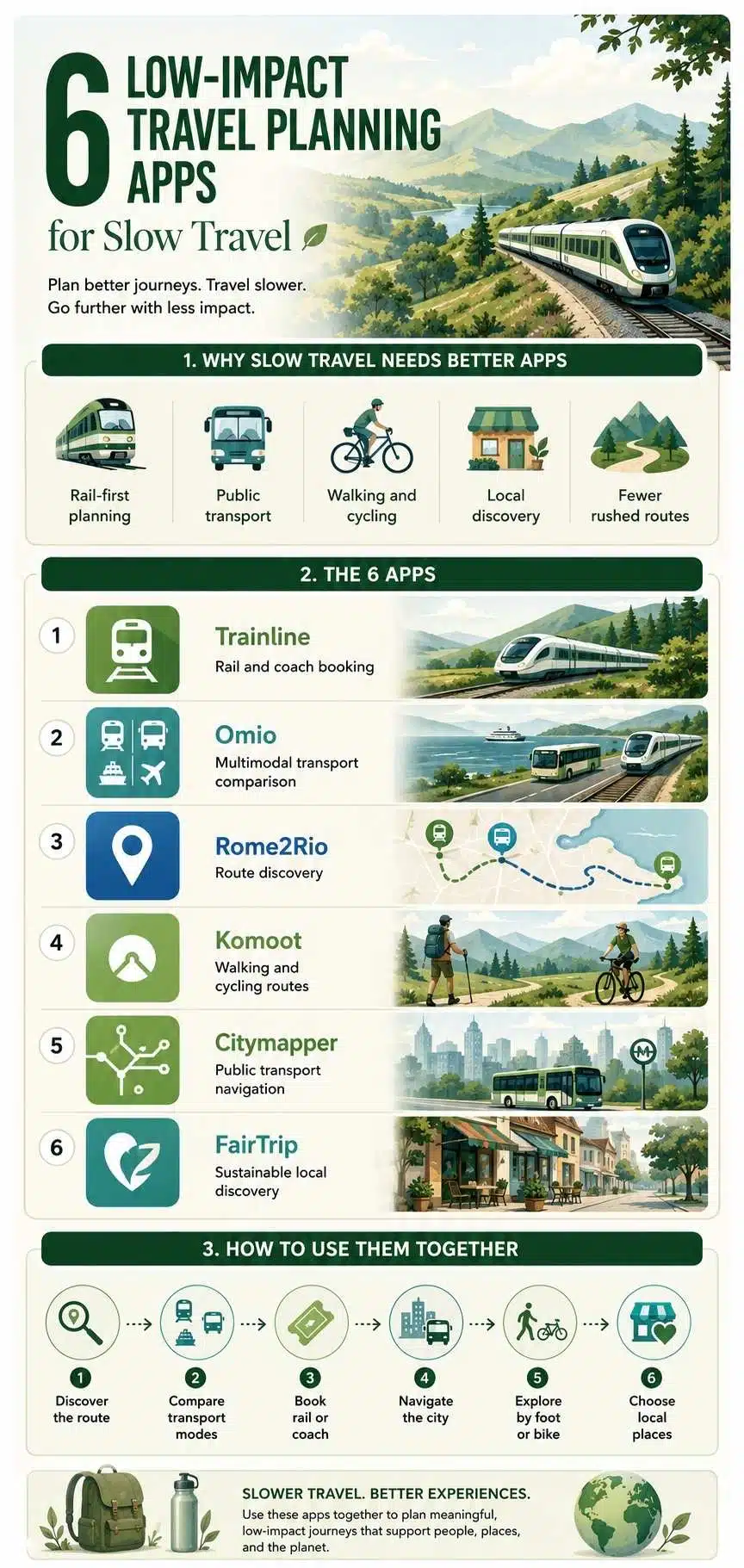
The slow travel market is not being shaped by one kind of app. Trainline and Omio support transport booking. Rome2Rio helps with route discovery. Komoot helps travelers explore slowly once they arrive. Citymapper helps them move through cities without depending on cars. FairTrip helps them find local and positive-impact places.
Together, they show the real direction of low-impact travel planning: it is becoming a stack.
A thoughtful traveler may use several apps for one trip:
- Rome2Rio to see if a route is possible
- Trainline or Omio to book rail, bus, or ferry tickets
- Citymapper to move through major cities
- Komoot to plan walking or cycling days
- FairTrip to find local and sustainable places
That is more realistic than pretending one app does everything. It also shows where the business opportunity is. The winning apps will not simply call themselves sustainable. They will remove friction from better travel decisions.

How to Choose the Right App
The right app depends on the trip:
- Choose Trainline if the main need is train or coach booking in the UK and Europe.
- Choose Omio if you want to compare multiple transport modes in one app, including trains, buses, ferries, and flights.
- Choose Rome2Rio if you are still figuring out how to get from one place to another.
- Choose Komoot if your trip includes walking, cycling, hiking, or outdoor route planning.
- Choose Citymapper if you are visiting a major city and want to use public transport, walking, cycling, or scooters more confidently.
- Choose FairTrip if you want to find more local, authentic, and positive-impact places.
A strong slow travel plan often uses more than one tool. That is not a weakness. It is how modern travel planning actually works.
The Business Opportunity Behind Low-Impact Travel Apps
Low-impact travel is no longer just a values conversation. It is becoming a product-design challenge. Most travelers will not choose the slower route if it feels confusing, risky, or difficult. They need clear schedules, mobile tickets, route confidence, live updates, trusted maps, local recommendations, and support when plans change.
That is where these apps matter. The market will likely split into two groups. The serious apps will help people make better travel decisions through real utility. The weaker ones will use sustainability language without changing the planning experience.
The serious opportunity sits in:
- Better rail and coach booking
- Easier ferry and bus discovery
- Multimodal trip planning
- Public transport navigation
- Walking and cycling route confidence
- Sustainable local discovery
- Longer-stay itinerary planning
- Better integration between transport, accommodation, and local experience
The next generation of low-impact travel planning apps will need to do more than inspire people. They will need to make slower choices easier than the default high-impact ones.
A Slower Way to Plan Better Trips
The best low-impact travel planning apps are not asking people to stop traveling. They are helping people travel with more attention.
A slower trip can still be comfortable. It can still include beautiful hotels, good food, culture, cities, landscapes, and family memories. The difference is pace and intention.
Instead of treating the journey as wasted time, slow travel makes the journey part of the experience. Instead of rushing through five places in a week, it gives one region more room. Instead of moving through a destination like a consumer, it gives the traveler a better chance to notice where they are.
Trainline, Omio, Rome2Rio, Komoot, Citymapper, and FairTrip each support that shift in a different way. None of them is perfect. But together, they give travelers a practical toolkit for the 2027 slow travel era.
That is the real value. Not perfection. Better choices, made easier.
Frequently Asked Questions About Low-Impact Travel Planning Apps
1. What Are Low-Impact Travel Planning Apps?
Low-impact travel planning apps help travelers choose routes, transport modes, and local experiences that may reduce environmental or social impact. They often support trains, buses, ferries, walking, cycling, public transport, and local-first travel.
2. Are These Apps Completely Sustainable?
No. No travel app makes a trip impact-free. These apps simply help travelers plan better options, such as rail instead of short-haul flights, public transport instead of taxis, or local places instead of mass-tourism defaults.
3. Which App Is Best for Train Travel?
Trainline is one of the strongest choices for train and coach booking, especially in the UK and Europe. Omio is also useful when travelers want to compare trains with buses, ferries, and flights.
4. Which App Is Best for Finding Routes Between Cities or Countries?
Rome2Rio is especially useful at the route discovery stage. It helps travelers see possible combinations of trains, buses, ferries, flights, and cars before they choose how to book.
5. Which App Is Best for Walking and Cycling Trips?
Komoot is the strongest fit for walking, cycling, hiking, running, and outdoor route planning. It is useful for slow travelers who want to explore a destination beyond the usual tourist path.
6. Which App Is Best for Public Transport in Cities?
Citymapper is one of the strongest apps for navigating supported cities using public transport, walking, cycling, scooters, and other urban mobility options.
7. Which App Is Best for Sustainable Local Discovery?
FairTrip is the strongest fit in this list for finding local, authentic, and positive-impact places, including accommodations, restaurants, activities, and NGOs.