Teenagers are often asked to make educational and career decisions before they have seen enough of the working world to make those decisions well. A student may be choosing advanced school subjects, college tracks, technical programs, internships, or extracurriculars while their picture of STEM is still limited to doctors, engineers, coders, astronauts, and scientists in lab coats. Those careers matter, but they are only a small part of the field.
STEM also reaches into climate work, agriculture, cybersecurity, robotics, data analysis, medical technology, manufacturing, product design, game development, transportation, renewable energy, and skilled technical work. Some paths require advanced degrees. Others can begin through certificates, apprenticeships, associate degrees, technical education, entry-level support roles, or portfolio projects.
That is why STEM career exploration teens should not begin with the pressure-filled question, “What do you want to be?” Most teenagers are not ready to answer that with confidence.
A better starting point is simpler: What kinds of problems are you willing to understand, test, build, improve, or solve?
Parents, teachers, and edtech programs can make STEM feel less intimidating by helping teens explore options before college, training, or early career choices become expensive. This does not mean pushing every teenager toward STEM. It means helping them see the field clearly enough to decide whether a STEM path fits their interests, strengths, values, and learning style.
Why STEM Career Exploration Matters Before Teens Choose a Path
Many students judge careers through school subjects alone. A teen who likes biology may assume medicine is the obvious destination. Someone who enjoys computers may think software engineering is the only serious technology route.
A student who struggles with math may quietly rule out STEM altogether, even though many STEM-linked careers depend heavily on troubleshooting, design thinking, communication, fieldwork, safety judgment, equipment handling, and teamwork.
That narrow view can lead to rushed choices. It can also push students away from fields they might have enjoyed if they had seen more examples earlier.
Strong career exploration widens the lens. It helps teens connect classroom learning with real tools, real workplaces, and real problems. It also shows that STEM is not one ladder. It is a network of academic, technical, creative, analytical, and practical pathways.
A useful exploration process gives teens three things:
- A clearer understanding of what STEM work actually looks like
- A practical way to compare different pathways
- Permission to change direction after learning more
That last point matters. A teen who tries a coding project and dislikes it has not failed. They have learned something useful. A student who enjoys environmental science but dislikes lab work may still find a place in policy, mapping, field monitoring, data analysis, or sustainability planning.
Career exploration works best when it lowers the cost of being wrong early.
What Counts as STEM Today?
STEM stands for science, technology, engineering, and mathematics. In practice, the boundaries are often blended.
A renewable energy technician may use physics, electrical systems, safety procedures, and field troubleshooting. A health data analyst may combine statistics, public health, software tools, and communication. A robotics student may work with coding, sensors, mechanics, testing, and design. A food systems researcher may use biology, chemistry, logistics, climate data, and agricultural technology.
This matters because many teens assume STEM means advanced math, university research, or high-pressure professional degrees. Some STEM careers do require deep theoretical study. Others are applied, technical, hands-on, or design-based.
A practical STEM conversation should include several kinds of routes:
- Academic routes, such as engineering, medicine, computer science, data science, research, and advanced science fields
- Technical routes, such as lab technology, network support, advanced manufacturing, renewable energy systems, electronics, automation, and medical equipment support
- Creative and design-linked routes, such as product design, user experience, game systems, architecture technology, digital media tools, and accessibility design
- Public-service and impact-driven routes, such as environmental monitoring, public health, disaster resilience, infrastructure planning, and science education
When teens see this range, STEM becomes less like a locked door and more like a map with several possible entry points.
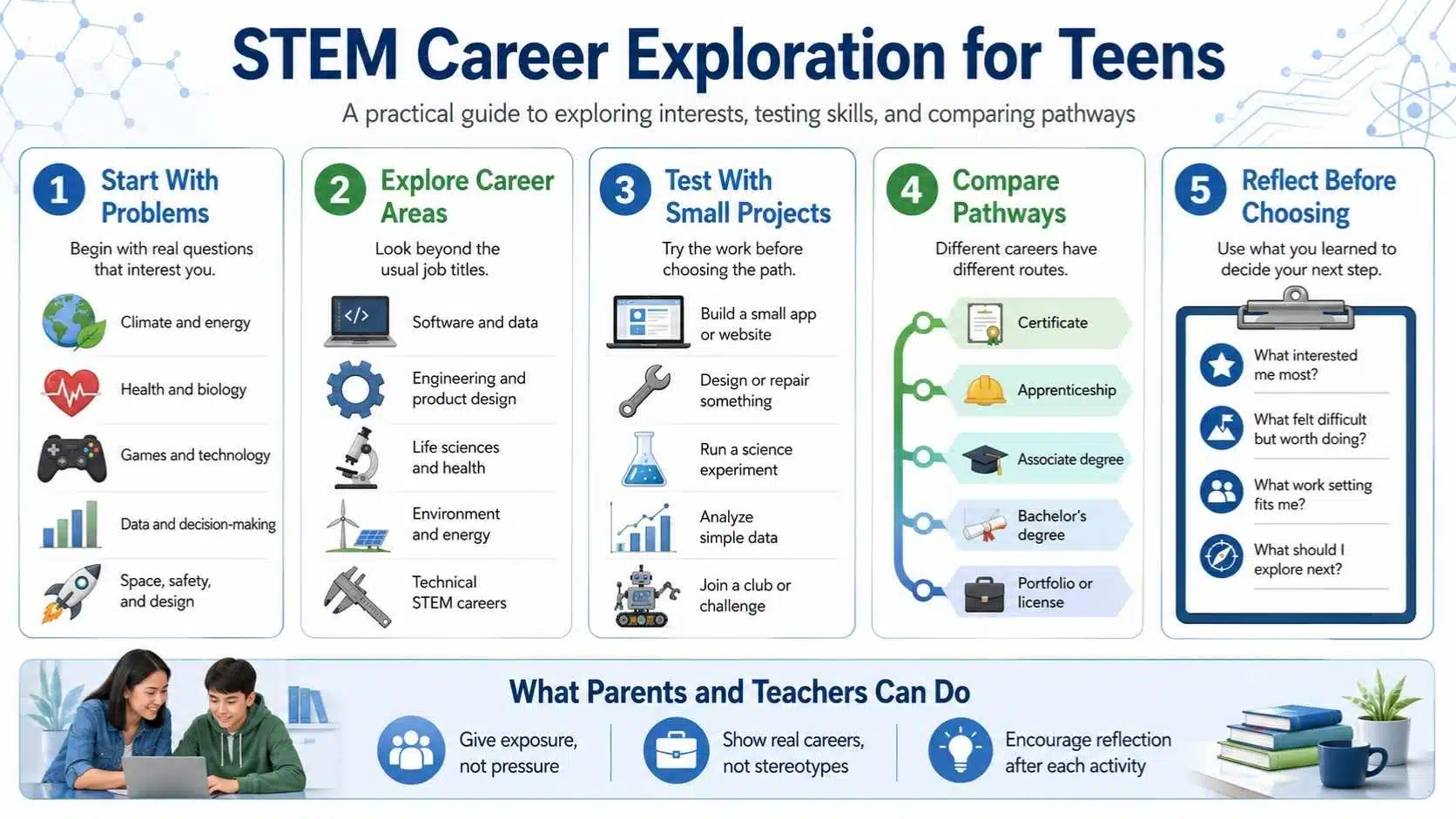
Start With Problems, Not Job Titles
Job titles change. Problems last longer. Instead of asking a teen to pick a career from a list, start with the kinds of problems that naturally pull their attention.
A teenager might be curious about questions like these:
- How can cities reduce pollution and heat?
- How do apps protect personal data?
- Why do some diseases spread faster than others?
- How can games feel more realistic?
- What makes bridges, buildings, and roads safer?
- How can farms grow more food with less water?
- How can technology help people with disabilities?
- How do satellites, sensors, and maps help us understand the planet?
Each question can lead to several careers.
A teen interested in pollution might explore environmental science, chemical engineering, urban planning, climate data, water systems, green construction, public health, or sustainability consulting. A teen interested in games might explore software development, physics simulation, sound design, user experience, graphics programming, hardware testing, animation tools, or interactive storytelling systems.
This approach keeps exploration open. It also helps students understand that STEM is not only about being “good at science.” It is about using structured thinking to understand problems and build better solutions.
A Practical Framework for Comparing STEM Options
A good framework does not need to feel like homework. Teens can begin with four filters: interest, ability, work style, and pathway.
| Exploration Filter | Question To Ask | Why It Matters |
| Interest | What topics, tools, or problems keep catching my attention? | Interest helps teens stay motivated when learning gets difficult. |
| Ability | What skills am I already building, and which ones am I willing to improve? | STEM careers require growth, not instant talent. |
| Work Style | Do I prefer building, researching, analyzing, designing, testing, explaining, or helping people directly? | Two STEM careers may use similar knowledge but feel very different day to day. |
| Pathway | What education, training, portfolio, license, or certification is usually expected? | Teens need realistic next steps, not vague inspiration. |
This keeps career exploration from turning into random guessing. It also prevents adults from reducing guidance to grades alone.
A student with strong math grades may not enjoy a highly theoretical path. A student with average science grades may be excellent at troubleshooting machines, building prototypes, managing technical tools, or explaining complex ideas clearly.
Good exploration looks for patterns across interests, effort, frustration, curiosity, and follow-through. One report card is not enough.
STEM Career Areas Worth Exploring
STEM careers are easier to understand when grouped into broad areas. These categories are not rigid. Many real jobs sit between them, which is often where the most interesting work happens.
Computer Science, Software, and Data
This area includes software development, cybersecurity, data analysis, artificial intelligence, cloud systems, game development, web engineering, IT infrastructure, and digital product support.
Teens who enjoy logic, systems, puzzles, automation, or digital tools may find this area worth exploring. Still, the first step should not simply be “learn to code.” That advice is too vague.
A better first step is to build something small and real:
- A basic website
- A simple app
- A spreadsheet model
- A small game level
- A data dashboard
- A chatbot prototype
- A script that automates one repetitive task
Small projects reveal whether a teen enjoys the thinking behind the work. They also expose the less glamorous parts: debugging, unclear instructions, broken tools, version problems, and the patience needed to keep testing.
That friction is useful. A teen who enjoys solving the messy parts may be suited to deeper technical work. A teen who likes the idea but hates the process may prefer digital design, product strategy, content technology, or another adjacent path.
Engineering and Product Design
Engineering is about designing, building, testing, improving, and maintaining systems. It can involve bridges, machines, electronics, medical devices, aircraft, energy systems, consumer products, manufacturing processes, or public infrastructure.
Teens who often ask “How does this work?” or “How could this be made better?” may enjoy engineering exploration. Robotics clubs, maker projects, CAD tools, electronics kits, 3D modeling, repair projects, science fairs, and design challenges can all give a useful preview.
The part students often miss is that engineering is not only about invention. Real engineering involves testing, documentation, safety rules, budgets, failure analysis, teamwork, and patience. A bridge, medical device, or aircraft part cannot simply “look good.” It has to work under constraints.
Some teens will enjoy that discipline. Others may discover they prefer industrial design, technical support, skilled trades, architecture, technology, research, or hands-on fabrication. That is exactly why exploration matters.
Health, Biology, and Life Sciences
A teen who likes biology does not automatically have to become a doctor. Life science pathways include biotechnology, lab science, genetics, pharmacology, neuroscience, public health, nutrition science, biomedical engineering, health informatics, and medical laboratory work.
This area needs careful comparison because the work environments vary widely. Patient-facing care, lab work, clinical research, public health analysis, medical device design, and health data work can feel completely different.
A student interested in health should ask:
- Do I want direct contact with patients?
- Am I comfortable with long training routes?
- Do I prefer lab work, field research, data, devices, or care delivery?
- Am I interested in prevention, diagnosis, treatment, technology, or policy?
- Can I handle high-responsibility environments, strict procedures, or emotional situations?
Prestige alone is a poor guide here. A health career may be meaningful, but some routes involve long education, licensing, difficult schedules, or intense responsibility. Other routes are less visible but may fit a student better.
Environment, Energy, and Climate
Climate and sustainability work is increasingly connected to STEM. Careers may involve renewable energy, water systems, environmental monitoring, green building, waste management, agriculture technology, climate modeling, conservation science, or disaster resilience.
This area may fit teens who care about real-world impact and enjoy fieldwork, data, policy, design, or community problem-solving.
Local projects are especially useful. A teen can test water quality, map neighborhood heat, compare home energy use, study plant growth, analyze school waste, help with a rooftop garden, or join a community science project.
One warning is worth adding: passion for the environment is not the same as liking the daily work. Some environmental roles are heavy on data, regulation, field conditions, grant writing, or slow-moving public systems. Teens should explore both the mission and the method.
A student may care deeply about climate but prefer engineering, communications, policy, urban planning, finance, agriculture technology, or product design as the practical route into that work.
Mathematics, Analytics, and Decision Science
Math-based careers are not limited to teaching or academic research. They appear in finance, logistics, sports analytics, insurance, operations research, economics, artificial intelligence, public policy, and business strategy.
A teen who enjoys patterns, probabilities, planning, optimization, or decision-making may enjoy analytics. Practical exploration can include spreadsheet modeling, statistics projects, financial simulations, sports data analysis, election data analysis, supply-chain puzzles, or simple forecasting exercises. The key is to show math as a decision tool, not only as a school subject.
A student who dislikes abstract math may still enjoy using data to answer practical questions: Which bus route is more efficient? Which product is selling faster? Which team changed strategy after halftime? Which neighborhood has a higher flood risk? Which habit improves sleep?
That kind of work requires accuracy, patience, and skepticism. Teens should learn early that data can be useful and misleading at the same time. A chart does not automatically tell the truth. Someone has to ask where the data came from, what was excluded, and what the numbers cannot show.
Skilled Technical STEM Careers Deserve More Respect
This area is often overlooked in family career conversations, but it should not be. Many technical roles involve electronics, robotics maintenance, advanced manufacturing, aviation systems, lab equipment, renewable energy installation, network support, medical devices, and industrial automation. These jobs may suit teens who prefer hands-on work, tools, systems, and applied problem-solving.
Parents should be careful not to treat technical pathways as second-best. A strong STEM workforce needs technicians, technologists, engineers, researchers, designers, operators, safety specialists, and managers.
A teen who enjoys fixing, assembling, measuring, calibrating, testing, or troubleshooting may find a technical STEM route more satisfying than a purely academic one.
The practical question is not, “Is this route prestigious?” A better question is, “What training does it require, what does the work actually involve, and where can it lead over time?”
How Parents Can Help Without Taking Over
Parents can shape career exploration in a healthy way, but the approach matters. Teens rarely respond well to lectures about safe careers, family expectations, or salary alone. They need guidance that helps them think.
Useful questions include:
- What did you enjoy about that project?
- Which part felt difficult but still interesting?
- Would you rather work with people, machines, data, nature, or ideas?
- Do you like fast feedback, or do you enjoy long-term research?
- What kind of work environment sounds uncomfortable to you?
- What would you like to test before deciding?
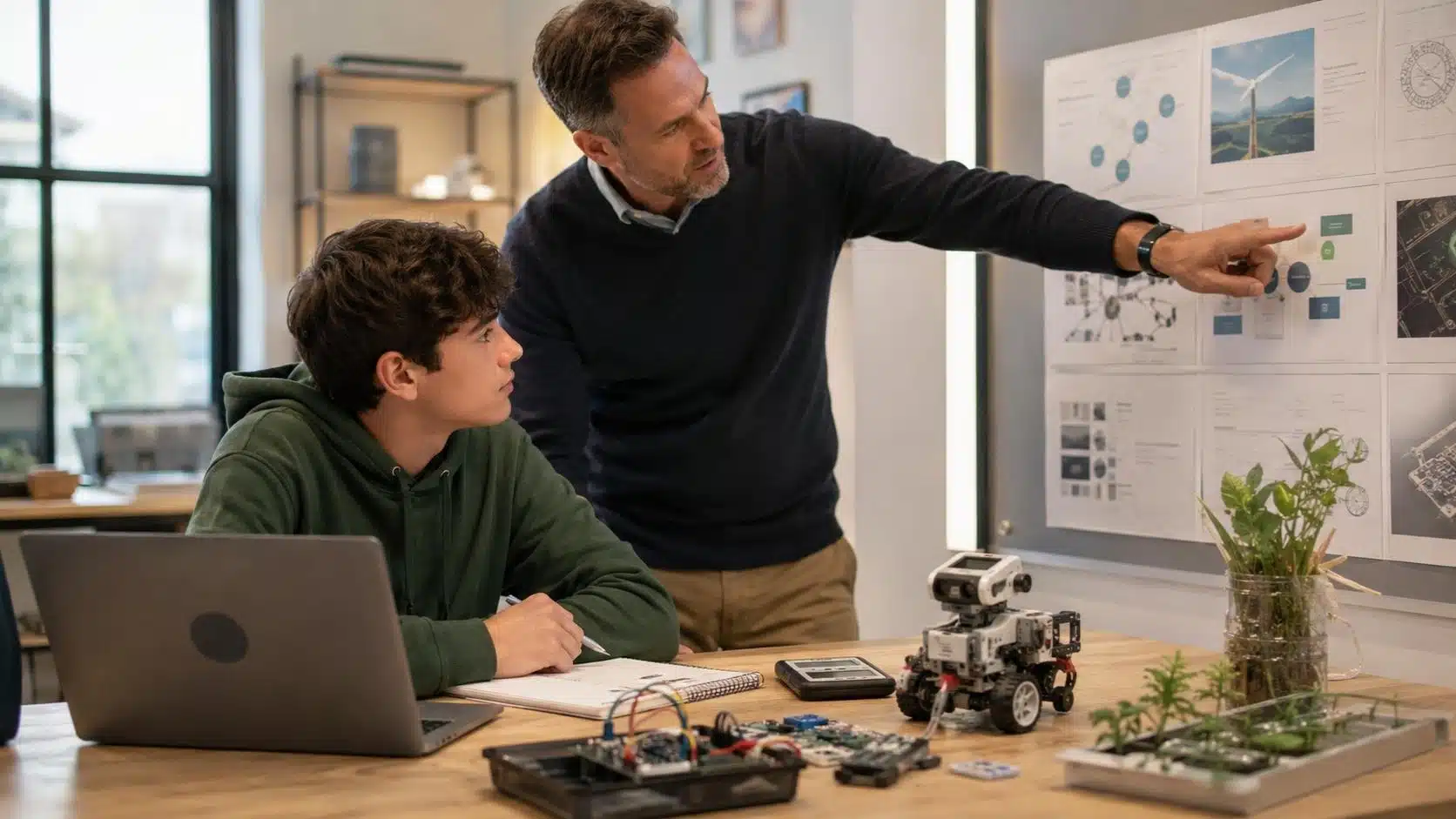
Parents can also help by arranging exposure. That may mean visiting a science center, watching credible career interviews, encouraging a short online course, helping a teen join a robotics club, finding a local mentor, supporting a home project, or asking a professional friend to explain their work.
The tone matters more than many adults realize. A teen should be allowed to dislike a pathway after trying it. That is not a waste of time. It is information.
A parent’s job is not to extract a final answer. It is to help the teen gather enough evidence to make the next decision more wisely.
What Schools and Edtech Programs Should Do Better
Career guidance often arrives too late. By the time students receive serious advice, many have already chosen courses, exams, or applications. Schools and edtech programs can improve STEM career exploration in practical ways.
First, show real work, not just career names. Students need to see what a civil engineer, lab technician, cybersecurity analyst, data journalist, renewable energy specialist, or biomedical equipment technician actually does during a normal week.
Second, connect subjects to careers without making lazy links. Math is not only for mathematicians. Biology is not only for doctors. Computer science is not only for app developers.
Third, include technical and vocational routes besides university routes. A complete career map should show certificates, apprenticeships, associate degrees, undergraduate degrees, graduate study, licensing requirements, and portfolio-based entry points where relevant.
Fourth, build reflection into every activity. A career quiz, coding lesson, robotics activity, or virtual lab becomes more useful when students are asked what they liked, what frustrated them, what surprised them, and what they want to test next.
AI tools need special care. They can help students generate career questions, compare pathways, summarize occupation information, or prepare for informational interviews. They should not be treated as career counselors, and they should not present job-market predictions as guaranteed outcomes.
Digital tools are useful when they support exploration. They become weak when they replace human conversation, mentoring, reflection, and real-world exposure.
Practical STEM Exploration Activities by Age Group
Teens do not need a perfect career plan at 13. They need age-appropriate exposure that becomes more focused over time.
| Stage | Best Exploration Focus | Useful Activities |
| Ages 12-14 | Curiosity and exposure | Science museums, coding games, nature projects, maker kits, documentaries, simple experiments, and school clubs |
| Ages 15-16 | Skill testing and comparison | Robotics, beginner coding projects, lab activities, career interviews, technical workshops, and short online courses |
| Ages 17-19 | Pathway planning | Internships, portfolio projects, college or training research, mentorship, job shadowing, scholarship research, certification research |
The shift should be gradual: from watching, to trying, to comparing, to planning.
Watching a video about robotics is useful. Building a small robot, debugging it, and explaining what went wrong teaches much more. Reading about cybersecurity can spark interest. Trying to secure accounts, understand phishing, or compare password practices makes the idea practical. Exposure matters, but active testing matters more.
How Teens Can Compare STEM Pathways Realistically
A career that sounds exciting may not fit a teen’s strengths, values, or preferred lifestyle. Comparison should go beyond salary and prestige.
Teens can compare pathways using practical questions:
- What level of education or training is usually expected?
- How much math, coding, writing, lab work, fieldwork, or equipment use is involved?
- Is the work mostly independent or team-based?
- Does the career require licensing, safety training, or professional exams?
- Can I build a portfolio before college or employment?
- Are there local opportunities, or would relocation likely be necessary?
- Does the field change quickly, requiring constant reskilling?
- What ethical issues are connected to this work?
These questions reveal trade-offs. Cybersecurity may sound exciting, but it requires patience, constant learning, and attention to detail. Medicine may feel meaningful, but many routes require long training and comfort with high responsibility.
Engineering may appeal to builders, but some branches involve more documentation, regulation, and testing than students expect. Environmental careers may offer purpose, but some roles involve field conditions, policy limits, or slow project timelines. None of this should discourage teens. It should help them choose with open eyes.
Common Mistakes To Avoid in STEM Career Exploration Teens
The first mistake is treating STEM as one personality type. Not every STEM person is a coder, inventor, math champion, or quiet lab worker. STEM needs communicators, designers, field workers, analysts, teachers, managers, safety-minded technicians, and practical troubleshooters.
The second mistake is chasing only the highest-paying roles. Income matters, but a teen also needs to understand workload, education cost, stress, competition, location, licensing, and long-term interest.
Another mistake is ignoring communication skills. Many STEM careers require writing reports, explaining findings, presenting ideas, documenting systems, working with clients, or collaborating across teams. A student who can explain technical ideas clearly has an advantage in many fields.
Parents should also avoid using fear as motivation. “You will have no future unless you choose STEM” is not guidance. It is pressure. A teen who feels trapped may resist exploration entirely. The final mistake is waiting too long. Career exploration works best when it is gradual. A few small projects, conversations, and comparisons each year can prevent rushed decisions later.
A One-Month STEM Exploration Plan
A short plan can help teens move from vague interest to useful clarity.
Week 1: Map Interests
Choose three problems or topics that feel interesting. They can be broad: climate, games, health, space, animals, apps, buildings, crime investigation, food systems, transportation, accessibility, or cybersecurity.
Then list five careers connected to each topic. The list does not have to be perfect. The point is to discover range.
A teen interested in space, for example, might list aerospace engineering, satellite data analysis, astronomy, materials science, robotics, science communication, or mission operations. Not all of those require the same education, skills, or work environment.
Week 2: Research Real Work
Pick three careers from the list and research what people in those jobs actually do. Look for daily tasks, required skills, education routes, tools used, work settings, and common entry points.
Teens should write down what sounds appealing and what sounds unpleasant. Dislikes are useful because they narrow the field.
A career that looks impressive from the outside may involve tasks a student does not enjoy. That discovery is better made early.
Week 3: Try a Small Project
Choose one pathway and complete a small project. A teen could build a webpage, analyze a dataset, test water quality, design a bridge model, create a basic budget calculator, run a plant-growth experiment, repair a device, make a simple game mechanic, or compare how different passwords resist guessing.
The project should be small enough to finish, but real enough to create friction. Friction is where learning happens.
Week 4: Talk and Reflect
Find one person connected to the field. That could be a teacher, older student, professional, university adviser, technician, club mentor, or speaker from a credible career program.
Ask practical questions:
- What do you actually do during a normal week?
- What skills mattered more than you expected?
- What part of the work is difficult?
- What training helped you most?
- What would you tell a teen exploring this path?
Then reflect using three prompts:
- What did I enjoy enough to try again?
- What surprised me?
- What should I explore next?
This process will not produce a final career answer. It will produce a better next step, which is usually what a teen needs most.
A Smarter Way To Think About STEM Futures
STEM career exploration teens can benefit from is not about locking in a life plan before adulthood. It is about building direction through exposure, practice, reflection, and honest comparison.
Some teens will discover a clear passion early. Many will not. That is normal. A teenager does not need to know their final job title to make smart decisions. They need to know which problems interest them, which skills they are willing to build, which environments suit them, and which pathways are realistic.
Parents can help by reducing pressure and increasing exposure. Schools can help by connecting classroom learning to real work. Edtech programs can help by making exploration interactive, practical, and reflective instead of turning career guidance into another quiz.
The best STEM path is not always the most famous one. It is the one a teen understands well enough to test, adjust, and grow into with confidence.