The E-E-A-T and GEO Connection is where modern SEO stops being just a rankings game and starts becoming a credibility game. Lovely. As if content teams did not already have enough acronyms to survive.
For years, SEO people obsessed over ranking positions, keyword gaps, backlinks, and technical fixes. Those still matter. Nobody sensible is throwing internal links into the sea. But AI search has changed the visibility equation. Now the question is not only, “Can this page rank?” It is also, “Can this page be trusted enough to be cited, summarized, or referenced by an AI answer?”
That is where E-E-A-T becomes more than a quality framework. Experience, expertise, authoritativeness, and trustworthiness are no longer just nice signals for human readers. They are the kind of signals that make content easier for search and AI systems to understand, verify, and confidently surface.
Google says its AI features, including AI Overviews and AI Mode, use the same broad SEO fundamentals as traditional Search, with no separate magic requirement to appear. It also says AI Overviews and AI Mode surface relevant links and may use query fan-out, meaning multiple related searches across subtopics and data sources can help build an AI response. In plain English: AI search is hungry for clear, useful, reliable source material. Thin content is not exactly a five-star meal.
Why The E-E-A-T And GEO Connection Matters Now
GEO, or Generative Engine Optimization, is about making content visible inside AI-generated answers. That does not mean tricking AI systems. That is the cheap version, and cheap SEO tricks have a wonderful habit of aging like milk.
The serious version of GEO is about becoming citation-worthy. It means creating content that AI systems can retrieve, understand, trust, and use as a supporting source. Google’s AI search guidance says creators should focus on unique, non-commodity content that satisfies people’s needs, especially as users ask longer, more specific questions and follow-up queries.
That is basically GEO without the circus hat: useful content, clear structure, original value, and trustworthy signals.
The original GEO research paper also argued that generative engines create a new kind of visibility because answers may include inline citations, source mentions, and different levels of source influence. The paper found that adding citations, quotations from relevant sources, and statistics could improve source visibility by more than 40% across tested queries. Important note: that does not mean stuffing random statistics into every paragraph like SEO confetti. It means evidence-backed content is easier to cite than vague content wearing a confident tone.
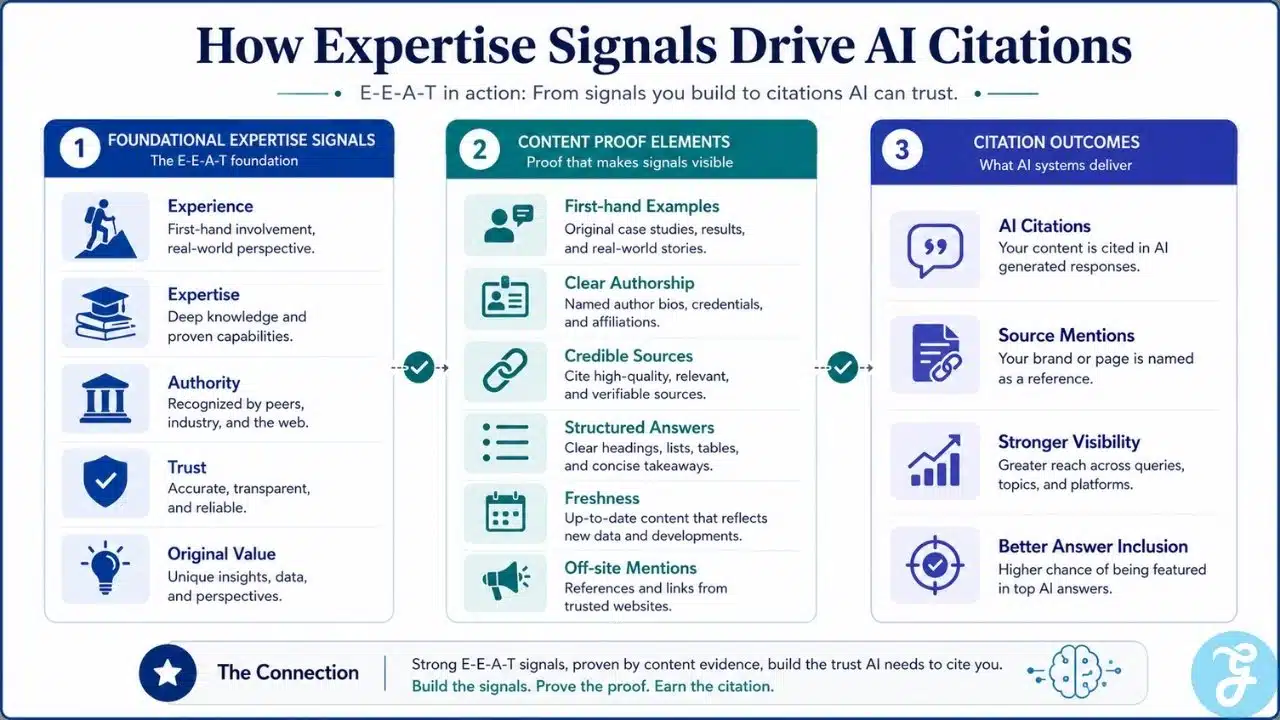
How Expertise Signals Drive AI Citations
Expertise signals help because AI search systems need sources that reduce uncertainty. A model can summarize many things, but when it needs to support an answer with links, it has to choose sources that look relevant, clear, and dependable.
Strong expertise signals include:
- First-hand experience that shows the creator has actually done the thing.
- Clear author identity and topical background.
- Original examples, testing, research, or analysis.
- Proper citations from credible sources.
- Updated information where freshness matters.
- Specific explanations instead of vague recycled advice.
- Transparent limitations and careful wording.
- Content that answers the exact user question, not just the keyword.
Google’s helpful content guidance says its systems identify a mix of factors that help determine whether content demonstrates E-E-A-T after identifying relevant content. It also says people-first content should be created primarily for users, not to manipulate rankings. That is boring, sensible, and apparently still too difficult for half the internet.
The E-E-A-T and GEO Connection In Practice
In practice, the E-E-A-T and GEO Connection looks like this: E-E-A-T makes your content more trustworthy, and GEO makes that trust easier for AI systems to retrieve and cite.
Here is the clean breakdown:
| E-E-A-T Signal | GEO Impact | Why It Helps Citations |
|---|---|---|
| Experience | Adds first-hand proof | AI answers can reference real examples, not generic claims |
| Expertise | Improves confidence | The source appears more qualified for the topic |
| Authoritativeness | Builds source reputation | Strong brands and experts are easier to trust |
| Trustworthiness | Reduces citation risk | Accurate, transparent content is safer to surface |
| Original value | Creates citation-worthy material | AI needs sources that add something new |
| Clear sourcing | Supports verification | Claims are easier to check and quote |
| Good structure | Improves extractability | AI can understand the page in smaller useful chunks |
This is why thin content struggles. A generic article may rank briefly if the keyword competition is weak, but it has little citation gravity. It gives AI systems nothing special to hold onto.
GEO Is Not Just SEO With A Trendy Hat
A lot of people are trying to sell GEO as if it is a secret new machine. It is not. It overlaps heavily with strong SEO, content strategy, digital PR, and brand authority.
But GEO is different in one important way: it shifts the goal from ranking a page to being selected as a source.
Traditional SEO often asks:
- Did we rank?
- Did we get clicks?
- Did the page match intent?
- Did the page earn links?
GEO adds new questions:
- Did AI systems cite us?
- Are we mentioned in the generated answers?
- Do we appear as a supporting source?
- Are our claims clear enough to be extracted?
- Is our expertise visible beyond our own site?
- Do third-party sources reinforce our authority?
Semrush research on AI search found that ChatGPT Search cited pages ranking in traditional organic positions 21+ almost 90% of the time for related queries, while also noting that some LLMs cite top-ranking pages more often than mid-ranking pages. The useful takeaway is not “rankings no longer matter.” The useful takeaway is that AI citation visibility can come from both traditional SEO strength and passage-level relevance or source usefulness.
So no, GEO does not replace SEO. It exposes lazy SEO.
What Makes Content Citation-Worthy In AI Search
AI citations usually favor content that is easy to understand, easy to verify, and useful in small sections. That means the old habit of writing giant walls of “comprehensive” content with no original insight is not enough.
A citation-worthy page usually has these qualities:
| Content Quality | What It Looks Like |
|---|---|
| Clear answer blocks | Short sections that directly answer specific questions |
| Original insight | First-hand examples, expert commentary, data, or testing |
| Strong sourcing | Links to official, academic, or credible industry sources |
| Topical depth | Related pages that show subject coverage beyond one article |
| Updated information | Fresh dates, current screenshots, revised claims |
| Entity clarity | Clear author, brand, organization, and topic identity |
| Extractable structure | Headings, summaries, bullets, definitions, and comparisons |
| Balanced claims | Avoids exaggeration and explains limits |
This is where E-E-A-T becomes practical. It is not just “add author bio.” It is “make every important claim easier to believe.”
The Wrong Way To Do GEO
Here is where things get spicy.
Some marketers are already trying to manipulate AI citations with fake best-of lists, synthetic mentions, spammy citations, and recommendation poisoning. Because apparently, we learned nothing from 20 years of SEO shortcuts exploding in people’s faces.
Google updated its spam policies to clarify that spam includes attempts to manipulate generative AI responses in Google Search, not just traditional rankings. Sites violating spam policies may rank lower or disappear from results. So yes, trying to game AI Overviews with garbage content is not clever. It is just old spam wearing new shoes.
Avoid these GEO mistakes:
- Publishing fake expert content with no real author credibility.
- Adding irrelevant citations just to look authoritative.
- Creating biased “best” lists to manipulate AI recommendations.
- Mass-producing shallow AI content across many similar topics.
- Hiding promotional intent behind fake educational content.
- Using statistics without context or source quality.
- Over-optimizing for AI systems while ignoring human usefulness.
If the content would embarrass you in front of a real expert, it probably should not be your GEO strategy.
How To Build Expertise Signals That AI Can Actually Use
The best GEO strategy is not mysterious. It is disciplined publishing.
Start with topics where you have real authority or can earn it. Then create content that proves expertise instead of merely announcing it. AI systems cannot magically know you are credible if the page gives them no evidence.
Use this framework:
| Step | What To Do |
|---|---|
| Define expertise zones | Focus on topics where your brand or author has real knowledge |
| Add first-hand input | Include testing, experience, examples, screenshots, or expert notes |
| Strengthen source quality | Support factual claims with reliable references |
| Build entity clarity | Make authors, reviewers, company details, and editorial standards visible |
| Structure for extraction | Use clear headings, definitions, summaries, and concise explanations |
| Earn third-party validation | Get mentioned by credible industry publications, podcasts, studies, and communities |
| Refresh often | Update fast-changing topics before they become stale |
| Avoid fake authority | Do not pretend expertise; prove it |
The goal is not to “trick” AI into citing you. The goal is to become the kind of source AI can safely cite without looking foolish. Big difference.
Why Off-Site Authority Matters More In GEO
Your website matters, but GEO is not only about your website. AI systems often pull from multiple sources across the web, and brand/entity mentions can matter even when they are not traditional backlinks.
That means your expertise signals should appear across:
- Industry publications.
- Expert roundups.
- Podcasts.
- YouTube interviews.
- Research citations.
- Community discussions.
- LinkedIn thought leadership.
- Review platforms.
- Conference pages.
- Partner sites.
- Author profiles.
This is where SEO, PR, and brand marketing start merging. Terrible news for teams that still keep everything in separate little boxes and then wonder why visibility feels fragmented.
A strong GEO footprint says: this brand or person is repeatedly associated with this topic across credible places. That is more powerful than one lonely blog post trying to carry the entire authority burden like a tired intern.
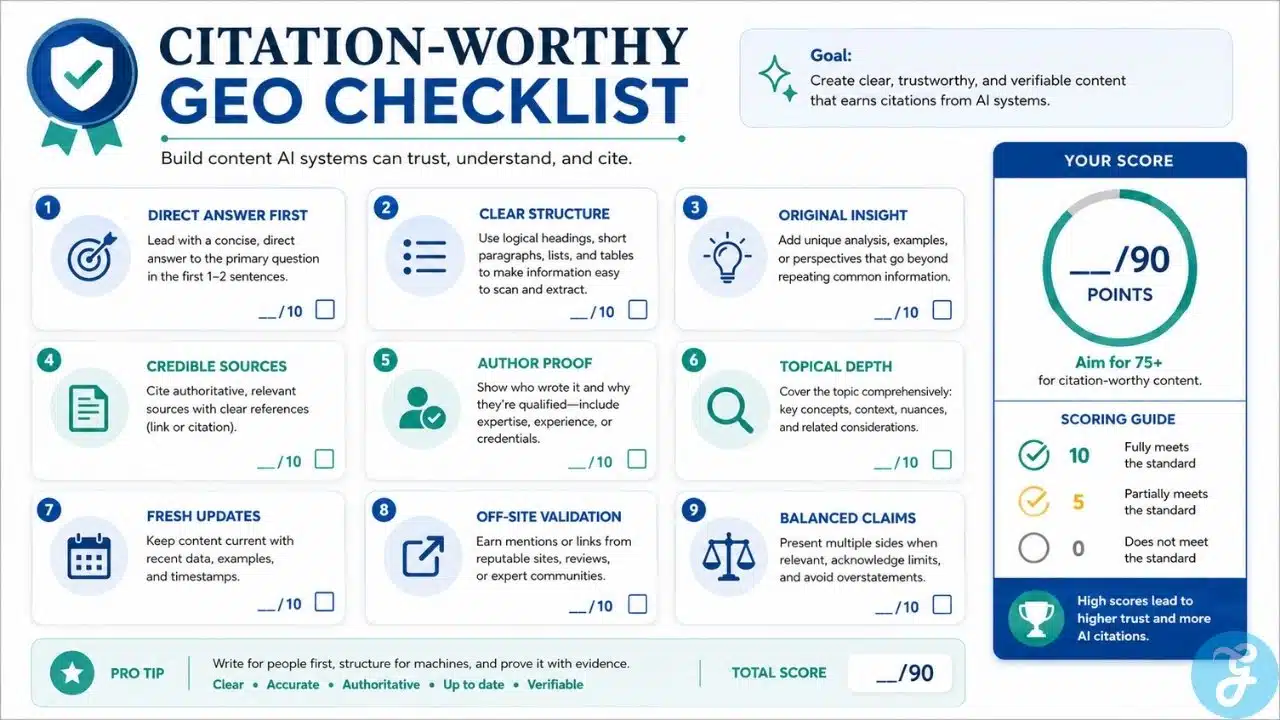
How To Optimize A Page For E-E-A-T And GEO Together
A strong page should satisfy both readers and retrieval systems. That means it needs human usefulness and machine clarity.
Use this structure:
- Start with a direct answer to the main query.
- Define key terms clearly.
- Add expert context early.
- Use examples from real experience.
- Support claims with credible sources.
- Break complex ideas into clear sections.
- Include concise comparison blocks.
- Add original analysis, not just summaries.
- Make author and brand credibility visible.
- Keep information fresh.
- Avoid vague claims and fake certainty.
For example, a weak sentence says:
“GEO is important for brands that want visibility.”
A better sentence says:
“GEO matters because AI answers often select supporting sources, so content with clear expertise, original evidence, and verifiable claims has a better chance of being cited than generic keyword-matched pages.”
One sounds like a brochure. The other gives the reader an actual reason to care.
The Metrics That Matter For The E-E-A-T And GEO Connection
Traditional SEO metrics still matter, but they do not tell the whole story anymore. Rankings, impressions, clicks, and backlinks are useful. But AI citation visibility needs additional tracking.
Here is what teams should monitor:
| Metric | Why It Matters |
|---|---|
| AI citations | Shows whether your pages are being used as supporting sources |
| Brand mentions in AI answers | Shows whether your entity is being recognized |
| Query-level visibility | Tracks which prompts or questions trigger your brand |
| Source overlap | Compares AI citations with traditional organic rankings |
| Referral traffic from AI/search features | Measures real user movement where available |
| Branded search growth | Indicates rising authority and recognition |
| Third-party mentions | Builds off-site credibility |
| Content freshness | Protects citation quality in changing topics |
This is still an immature measurement space. Anyone claiming perfect GEO attribution in 2026 deserves a suspicious look and possibly a chair far away from your budget.
The Real Takeaway: GEO Rewards Proof, Not Posturing
The E-E-A-T and GEO Connection is simple once we strip away the buzzwords: AI systems need sources they can trust, and E-E-A-T helps content earn that trust.
Expertise signals drive citations because they make content more usable, verifiable, and safe to reference. A page with real experience, clear author identity, credible sources, original analysis, and clean structure gives AI search a stronger reason to cite it. A page that says the same thing as everyone else, with a few keyword tweaks, gives AI search a stronger reason to ignore it. Brutal, but fair.
The future of search visibility will not belong to brands that publish the most content. It will belong to brands that publish the most useful, trustworthy, source-worthy content in their category.
So no, GEO is not a cheat code. It is not a shortcut. It is not a new way to avoid doing the hard work.
It is the hard work, finally becoming harder to fake.