Providing the most comprehensive Oscars 2026 Updates, the 98th Academy Awards, held at the Dolby Theatre in Los Angeles on March 15, 2026, served as a definitive turning point for the film industry. Rewarding bold, auteur-driven narratives over safe franchise bets, the ceremony provided a wealth of historical milestones that signal a massive shift in Hollywood’s trajectory. Hosted by Conan O’Brien, the night was less a celebration of the comfortable status quo and more a triumphant rebellion against it.
In an era plagued by anxieties over studio contraction and the looming spectre of artificial intelligence, the Academy chose to honour immense, original visions that could only be realised through human ingenuity. At the absolute centre of this cinematic rebellion were two massive, wholly original epics that completely dominated the evening’s major categories, offering a masterclass in modern storytelling.
Echoes of a Rebellion: The Bigger Questions Behind the Wins
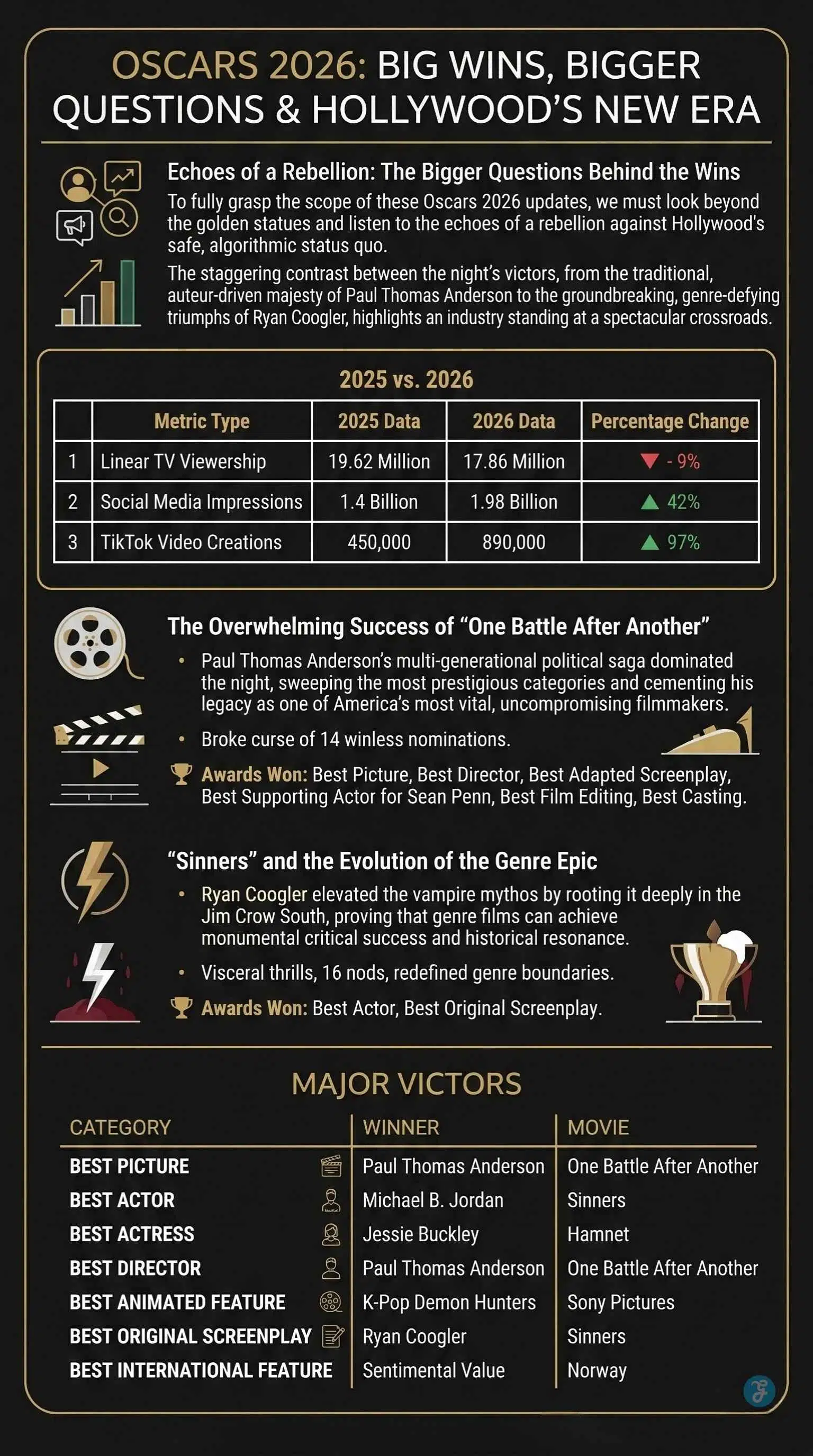
To fully grasp the scope of these Oscars 2026 updates, we must look beyond the golden statues and listen to the echoes of a rebellion against Hollywood’s safe, algorithmic status quo. The staggering contrast between the night’s victors, from the traditional, auteur-driven majesty of Paul Thomas Anderson to the groundbreaking, genre-defying triumphs of Ryan Coogler, highlights an industry standing at a spectacular crossroads.
These big wins are undeniably historic, yet they provoke even bigger questions about the survival of theatrical distribution, the shifting definition of prestige, and whether the Academy can genuinely adapt to a rapidly modernising global audience. This is not merely a recap of an awards programme; it is a vital diagnosis of a cinematic landscape fighting to redefine its identity for the next decade.
The data below illustrates this stark contrast between traditional decline and digital explosion.
| Metric Type | 2025 Data | 2026 Data | Percentage Change |
| Linear TV Viewership | 19.62 Million | 17.86 Million | – 9% |
| Social Media Impressions | 1.4 Billion | 1.98 Billion | + 42% |
| TikTok Video Creations | 450,000 | 890,000 | + 97% |
The Overwhelming Success of “One Battle After Another”
Paul Thomas Anderson’s multi-generational political saga dominated the night, sweeping the most prestigious categories and cementing his legacy as one of America’s most vital, uncompromising filmmakers.
Anderson’s triumph was the definition of a long-awaited coronation. Prior to the 98th Academy Awards, the San Fernando Valley native had endured a winless streak spanning 14 Academy Award nominations across three decades of legendary filmmaking. With One Battle After Another, an anarchic comedy of endless conflict and feverish political paranoia, Anderson finally broke the curse.
The film took home Best Picture, Best Director, Best Adapted Screenplay, Best Supporting Actor for Sean Penn, Best Film Editing, and the newly minted award for Best Casting. Taking the stage, Anderson’s victory symbolised a collective sigh of relief from an industry desperate to prove that grand, complex, star-studded cinema still holds immense cultural capital.
While Anderson’s political epic commanded the traditional prestige categories, another film entirely rewrote the rulebook for how the Academy views and values genre cinema.
“Sinners” and the Evolution of the Genre Epic
Ryan Coogler elevated the vampire mythos by rooting it deeply in the Jim Crow South, proving that genre films can achieve monumental critical success and historical resonance.
Sinners was the undeniable heavyweight champion of the nomination phase, storming into the Dolby Theatre with 16 nods. Coogler, whose unblemished career stretches back to his indie roots, took home the Oscar for Best Original Screenplay. By marrying the visceral thrills of vampire lore with the deeply ingrained historical trauma of the Jim Crow era, Coogler managed to transcend the typical boundaries of horror.
The film did not merely frighten; it examined the bloodletting of American history through a razor-sharp, atmospheric lens, earning the deep respect of an Academy that has historically shunned the horror genre.
To properly contextualise the distribution of the major awards for our readers, the following table provides a comprehensive overview of the evening’s most decorated films, demonstrating the heavy concentration of victories among a few major studios and visionary directors.
| Category | Winner | Movie |
| Best Picture | Paul Thomas Anderson | One Battle After Another |
| Best Actor | Michael B. Jordan | Sinners |
| Best Actress | Jessie Buckley | Hamnet |
| Best Director | Paul Thomas Anderson | One Battle After Another |
| Best Animated Feature | K-Pop Demon Hunters | Sony Pictures |
| Best Original Screenplay | Ryan Coogler | Sinners |
| Best International Feature | Sentimental Value | Norway |
While the winners’ circle was dominated by these titans of cinema, the films that were left entirely empty-handed tell an equally compelling story about the Academy’s rapidly evolving tastes.
The Snubs That Signal a Changing Academy
Despite immense awards-season momentum, several highly anticipated films were entirely shut out by the voting body, leaving industry analysts and seasoned pundits stunned.
Timothée Chalamet’s Marty Supreme, despite boasting nine nominations and heavy studio backing, failed to convert a single nod into a victory. Similarly, acclaimed projects like Bugonia and Train Dreams found themselves entirely sidelined. In years past, the meticulously crafted, actor-driven biopic or the gentle historical drama would have been guaranteed at least a handful of technical statues.
However, the 2026 results heavily suggest that the Academy, now boasting its most diverse, international voting body in history, is aggressively pivoting away from safe, algorithmic “Oscar bait” in favour of cinematic risk-taking. This dramatic shift away from traditional awards fare was also heavily reflected in the acting categories, which brought historic firsts and long-overdue standing ovations.
The New Guard of Acting Royalty
The acting categories were beautifully defined by long-overdue coronations, historic international victories, and a highly surprising embrace of genre performances that defied long-standing historical biases within the actors’ branch. Leading the charge was a performance that anchored the year’s most ambitious and successful horror epic.
Michael B. Jordan’s Long-Awaited Recognition
After years of delivering powerful, culturally defining performances, Michael B. Jordan finally secured the Academy’s highest acting honour, bringing the Dolby Theatre to its feet in a thunderous standing ovation.
Jordan’s victory for Best Actor was one of the night’s most emotionally resonant moments. Beating out heavyweights like Leonardo DiCaprio, Timothée Chalamet, Ethan Hawke, and Wagner Moura, Jordan cemented his status as a generational talent. He follows in the legendary footsteps of Sidney Poitier, Denzel Washington, Jamie Foxx, Forest Whitaker, and Will Smith as one of the few Black men to win the award.
His staggered, emotional walk to the stage, opening his speech with a heartfelt “Yo, momma, what’s up?”, underscored the deeply personal journey of an actor who has been a Hollywood staple since his breakout in Coogler’s Fruitvale Station over a decade ago. Across the aisle in the Best Actress category, the Academy looked across the Atlantic to reward a staggering emotional tour de force.
Jessie Buckley and the Irish Ascendancy
The Best Actress category saw a historic victory that perfectly underscored the growing, undeniable dominance of European talent in Hollywood’s most competitive races.
Jessie Buckley has long been a critics’ darling, but her win over a fierce lineup that included Emma Stone and Rose Byrne signals a full embrace by the mainstream industry. Her performance in Hamnet was a masterclass in quiet devastation and maternal grief, proving that the Academy is highly willing to reward subtle, internalised acting over loud, theatrical showmanship when the emotional truth is undeniable. The supporting categories similarly blended deep historical reverence with an undeniable appetite for the unexpected.
Triumphs in Supporting Categories
The supporting actor races celebrated enduring industry veterans while simultaneously breaking long-standing biases against horror and genre films.
Sean Penn took home his third Academy Award for his supporting role in One Battle After Another, further cementing his legacy as one of the most decorated actors of his generation. Conversely, Amy Madigan’s Best Supporting Actress win for Weapons was a massive shock to the system. It is incredibly rare for the Academy to reward pure horror performances, and Madigan’s victory at age 75 proves that voters are finally scrutinising the actual work rather than the genre packaging it comes in.
But the actors were only part of the story; the below-the-line categories delivered some of the night’s most vital, necessary structural changes.
Shattering Glass Ceilings in Technical Craft
The technical and craft categories showcased a monumental push toward diversity and the official, long-awaited recognition of foundational filmmaking disciplines that have historically been ignored by the telecast.
Nowhere was this more wonderfully apparent than in the historic victory for the visual architect of “Sinners”.
The Historic Cinematography Win for “Sinners”
The striking, shadowy visual language of the year’s biggest genre film was recognised with a barrier-breaking award that permanently rewrites the history books.
Arkapaw was only the fourth female cinematographer to ever be nominated in the 98-year history of the Oscars. Her victory is a watershed moment for the industry. Taking the stage, her plea for “all the women in the room to stand up” was a powerful reminder of the collaborative, intersectional nature of filmmaking. Her work on Sinners proved that lighting dark skin tones requires mastery, intention, and an artistic eye that she possesses in absolute abundance.
Alongside this historic first came an entirely new category that fundamentally altered the Academy’s rigid structure.
The Inaugural Casting Award
For the first time in over two decades, the Academy expanded its roster to include a brand-new competitive category, correcting a historic and glaring oversight.
For nearly a century, casting directors have been the unsung heroes of cinema, tasked with assembling the very ensembles that go on to win the night’s biggest awards. Kulukundis’s victory over the heavily favoured Francine Maisler (Sinners) highlighted just how integral her work was to populating the sprawling, multi-generational canvas of Anderson’s political epic.
While “Sinners” and “One Battle After Another” dominated the modern and historical palettes, another film swept the classical craft categories with incredible precision.
The Masterful World-Building of “Frankenstein”
Guillermo del Toro’s dark, gothic adaptation proved that practical effects and meticulous physical design are still deeply revered and protected by Academy voters.
Frankenstein walked away with three Oscars, courtesy of Kate Hawley (Costumes), Tamara Deverell and Shane Vieau (Production Design), and the makeup trio of Mike Hill, Jordan Samuel, and Cliona Furey. Del Toro’s insistence on tactile, physical environments allowed the Academy to reward the artisans who physically build the magic of the movies with their bare hands.
Beyond the major narrative features, the 98th Oscars demonstrated a remarkable openness to global pop culture and delivered a genuine statistical anomaly.
The Changing Face of Global and Short-Form Cinema
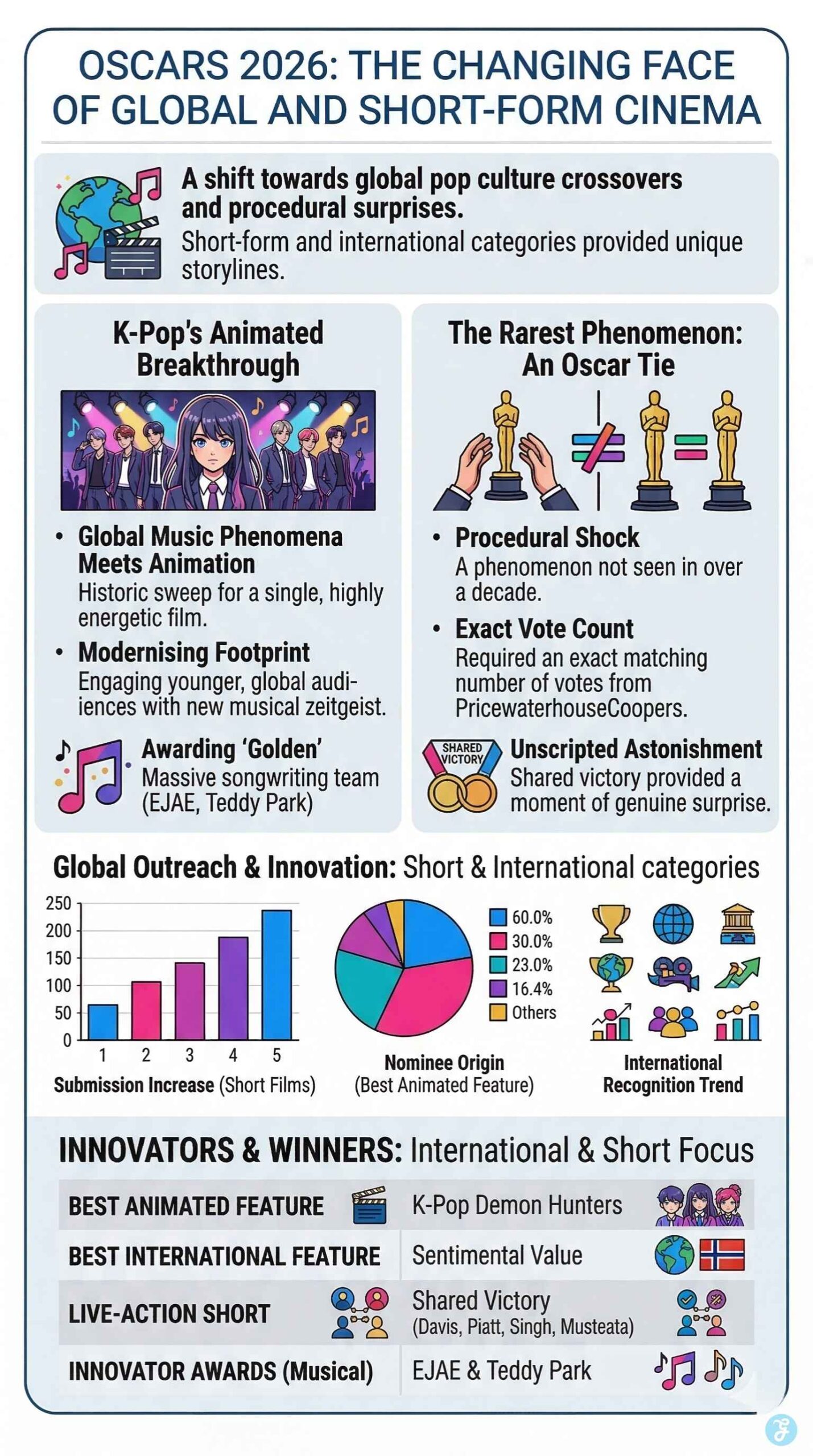
The secondary and short-form categories provided some of the night’s most fascinating storylines, including a massive pop-culture crossover event and a procedural shock that delighted trivia enthusiasts. The animated categories were completely overtaken by a global musical phenomenon that the Academy simply could not ignore.
K-Pop’s Animated Breakthrough
The beautiful intersection of global music phenomena and feature animation resulted in a historic sweep for a single, highly energetic film.
By awarding “Golden,” penned by a massive collaborative team including EJAE and Teddy Park, the Academy proved it is actively looking to modernise its musical footprint and engage with younger, global audiences who drive the current cultural zeitgeist.
While the music branch made history, the short film branch delivered an incredibly rare mathematical outcome that stunned the Dolby Theatre.
The Rarest Phenomenon: An Oscar Tie
The live-action short category delivered a procedural shock that hasn’t been seen at the Academy Awards in over a decade.
Ties at the Oscars are the stuff of Hollywood myth, requiring an exact matching number of votes from the Academy’s accounting firm, PricewaterhouseCoopers. The shared victory for Sam A. Davis, Jack Piatt, Alexandre Singh, and Natalie Musteata provided a moment of genuine, unscripted astonishment in a heavily choreographed broadcast.
Ultimately, all of these individual victories, historic firsts, and mathematical anomalies point toward a larger, incredibly hopeful narrative for the future of cinema.
Hollywood’s Resilient Horizon
The final, lasting results of the 98th Academy Awards heavily suggest an industry that is actively fighting back against its own existential dread by leaning into what it does best: massive, wholly original, human-driven storytelling.
The 2026 Oscars were not just a pat on the back for a job well done; they were a definitive statement of purpose. By handing the night over to Paul Thomas Anderson and Ryan Coogler, and by shattering glass ceilings for Black actors, female cinematographers, and global musicians, the Academy has forcefully declared that the future of film does not lie in algorithmic repetition. It lies in the messy, beautiful, and deeply human pursuit of original art.
If the 98th Academy Awards are any indication, the magic of the movies is not just surviving; it is boldly reinventing itself.
The Renaissance of the Silver Screen: Why 2026 Matters
The 98th Academy Awards will undoubtedly be remembered not just for the golden statues handed out, but for the profound, undeniable message those statues conveyed to the global film industry.
A Definitive Rejection of the Algorithm
As the dust settles on the Dolby Theatre, the ultimate takeaway from this year’s ceremony is a renewed faith in the tangible magic of the movies.
The massive triumph of One Battle After Another and Sinners is a definitive victory for the risk-takers. For years, Hollywood has been paralysed by the fear of shrinking theatrical windows and the seductive, cost-cutting promises of generative technology. Yet, the Academy’s resounding endorsement of Paul Thomas Anderson and Ryan Coogler proves that critics, voters, and audiences are starving for the exact opposite. They want the messy, the historical, and the deeply human. They want sprawling, auteur-driven epics that challenge the intellect and genre-bending nightmares that confront our darkest histories.
Before we close the book on this historic season, here are the final defining shifts we must keep our eyes on moving forward. Such as:
- The massive box office returns for these original epics will embolden studios to greenlight larger budgets for unproven IP.
- The historic, barrier-breaking wins in casting and cinematography will force long-overdue structural changes in how below-the-line crews are hired, valued, and credited.
- The absolute shutout of traditional, safe biopics signals the death knell for algorithmic, paint-by-numbers “Oscar bait”.
Ultimately, the 2026 Oscars were a spectacular, vital defence of the art form itself. By shattering glass ceilings and rewarding visionary directors, actors, and artisans who refuse to compromise, Hollywood has aggressively mapped out its own survival. The silver screen is not dying; thanks to the brilliant minds honoured this year, it is simply experiencing a magnificent, highly anticipated rebirth.
The Final Cut: Will the Academy Survive the Decade?
The 2026 Oscars were a microcosm of an industry in transition, terrified of its own shadow. The clash between Paul Thomas Anderson’s traditionalism and the viral dominance of Sinners, the plummeting ratings masked by skyrocketing TikTok views, and the awkward friction between old Hollywood royalty and new digital creators all point to a singular conclusion. The Academy cannot continue to operate in the middle ground.
To salvage its Oscars 2026 cultural relevance and secure its future, it must stop treating the modern audience as a nuisance to be managed. The institution must either lean fully into its niche, accepting its fate as an elite, high-art dinner party, or it must radically restructure its format, its voting biases, and its attitude to become a true, egalitarian celebration of global entertainment.
If they choose to remain stagnant, the golden statues will soon become nothing more than beautiful relics of a bygone era.