
As the 2026 tax season approaches, Australian digital asset holders face a landscape that is far more transparent than in previous years. The Australian Taxation Office (ATO) has refined its protocols to ensure that every transaction—from a simple swap to complex DeFi yields—is accurately reported. Understanding Crypto Tax Laws In Australia is no longer optional for the casual enthusiast but a necessity to avoid significant penalties.
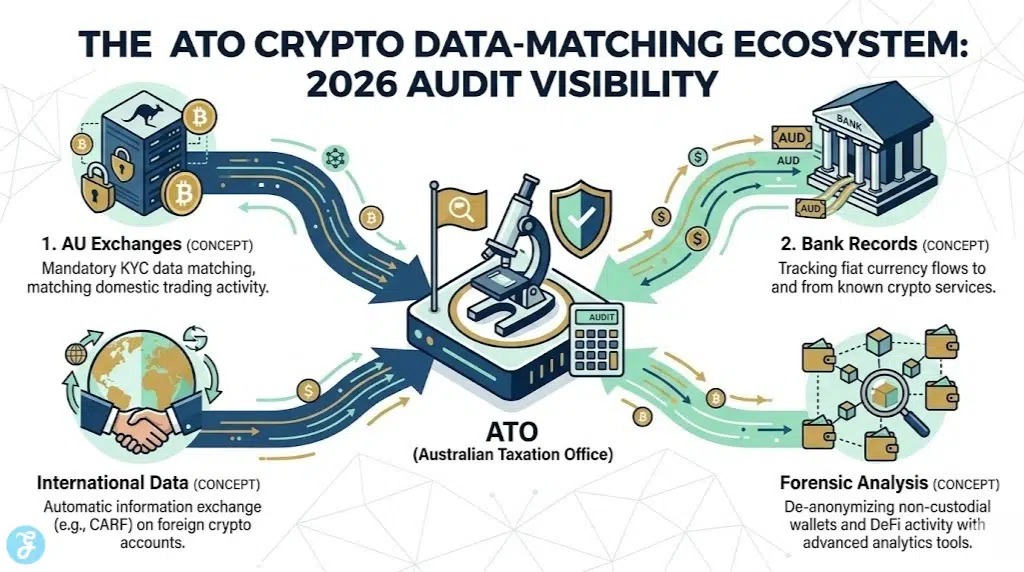
With the integration of the OECD’s Crypto-Asset Reporting Framework (CARF) and advanced forensic blockchain tools, the tax office has unprecedented visibility into domestic and international exchange activity.
How We Selected Our 7 Eye-Opening Facts About Crypto Tax Laws In Australia
Identifying the most critical updates for the 2025–2026 financial year involved a deep dive into the latest ATO data-matching protocols and legislative shifts. We prioritized information that directly impacts the majority of individual investors and those engaging in emerging decentralized finance activities. Our team selected these specific facts based on the following criteria to ensure maximum relevance for your tax planning.
-
Scrutiny Level: We focused on areas where the ATO has publicly announced increased auditing and data collection.
-
Financial Impact: We prioritized rules that can significantly increase or decrease your final tax bill.
-
Operational Changes: We looked for shifts in how digital assets are classified, such as the transition from “currency” to “taxable property.”
-
2026 Specificity: Each fact is grounded in the current regulatory environment of the 2025–2026 tax cycle.
7 Leading Facts About Crypto Tax Laws In Australia
Navigating the complexities of the Australian tax system requires a clear understanding of how the government views your digital portfolio. The following facts reveal the rigorous nature of modern compliance and the specific mechanisms used to track and tax your crypto activities.
1. The ATO Data Matching Program Covers Over 1.2 Million Australians
The Australian Taxation Office has extended its massive data-matching program to cover all transactions from the 2014–15 to the 2025–26 financial years. By collecting bulk records from Australian designated service providers, the agency can match names, dates of birth, and wallet addresses against individual tax returns. This means that any underreporting is likely to be flagged automatically by the ATO’s sophisticated algorithms.
Best Feature/For: Ensuring a level playing field for all taxpayers through automated compliance.
Why We Chose It:
-
It covers a decade of historical data which can trigger back-tax audits.
-
The program affects up to 1.2 million individuals and entities annually.
-
It utilizes direct data feeds from major Australian crypto exchanges.
-
The system now includes cross-border data through international agreements.
Things to consider:
-
You cannot hide domestic exchange activity from the tax office.
2. Crypto Swaps Are Treated as Immediate Capital Gains Events
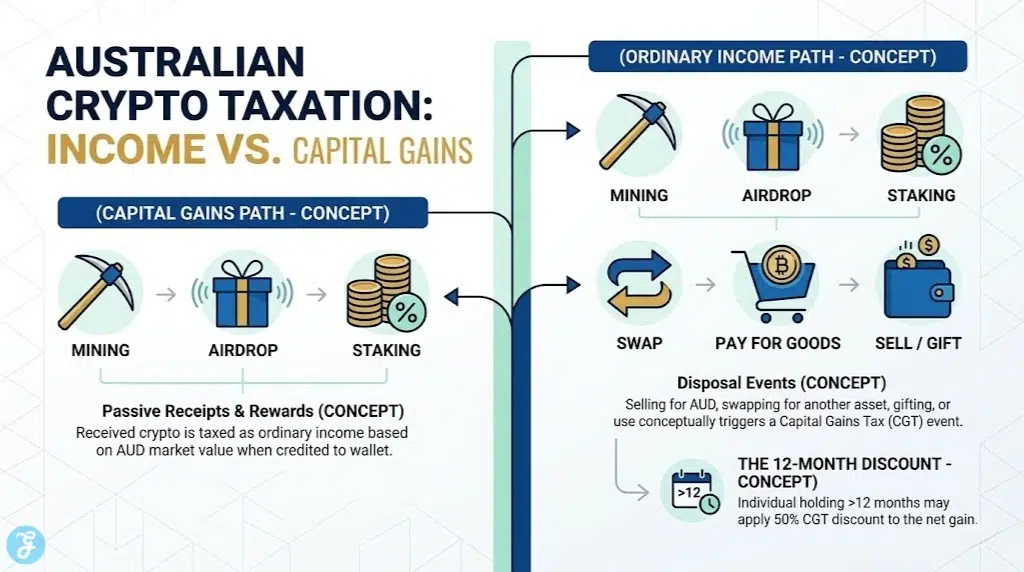
One of the most common misconceptions is that tax is only due when you “cash out” to Australian Dollars. In reality, the ATO views swapping one cryptocurrency for another as a disposal of the first asset and an acquisition of the second. You must calculate the fair market value in AUD at the exact time of the swap to determine your capital gain or loss.
Best Feature/For: Preventing the deferral of tax liabilities through continuous trading.
Why We Chose It:
-
It applies even if the tokens have an equivalent value like wrapped assets.
-
This rule is a major trap for high-frequency traders using DeFi protocols.
-
It requires meticulous record-keeping for every single transaction date.
-
The AUD value at the time of the trade is the only metric that matters.
Things to consider:
-
Gas fees and trading commissions can be added to your cost base to reduce the gain.
3. Staking and Airdrops Are Taxed as Ordinary Income
When you receive rewards for maintaining a network through staking or participating in an airdrop, the ATO treats these as “other income” similar to bank interest. You must declare the AUD market value of these tokens at the time they are credited to your wallet. If you later sell those tokens, you will then trigger a separate capital gains event based on that new cost base.
Best Feature/For: Capturing value from passive income streams within the crypto ecosystem.
Why We Chose It:
-
It separates the initial receipt of the asset from its future price growth.
-
The rule applies to proof-of-stake rewards and guardian node payments.
-
Initial airdrops with a cost base of zero are taxed differently than established tokens.
-
It forces users to pay tax even if they have not sold the reward for fiat.
Things to consider:
-
High-yield staking can push you into a higher marginal tax bracket unexpectedly.
4. The 50 Percent CGT Discount Requires a 12 Month Holding Period
Australian individual investors can significantly reduce their tax bill by holding an asset for at least 12 months before disposing of it. This 50 percent discount applies to your net capital gain after any capital losses have been applied. However, this benefit is strictly for investors and is not available to those classified as “traders” carrying on a business.
Best Feature/For: Encouraging long-term investment over short-term speculation.
Why We Chose It:
-
It is the most effective legal way to minimize your crypto tax liability.
-
The discount applies only to individuals and certain trust structures.
-
The holding period is calculated from the date of acquisition to the date of the contract for sale.
-
It effectively slashes your marginal tax rate on those specific gains by half.
Things to consider:
-
The discount is applied after offsetting any current or carried-forward losses.
5. Crypto Is Legally Classified as Property Rather Than Currency
Under Crypto Tax Laws In Australia, digital assets are treated as a form of property and are therefore subject to Capital Gains Tax (CGT). Unlike foreign fiat currencies, crypto does not benefit from certain currency-based exemptions. This classification ensures that almost every disposal—including gifting coins to a friend—is a taxable event.
Best Feature/For: Providing a clear legal framework for how various digital assets are taxed.
Why We Chose It:
-
It applies to Bitcoin, altcoins, NFTs, and even some stablecoins.
-
The classification prevents the use of “personal use” exemptions in most cases.
-
It allows for the offsetting of capital losses against capital gains.
-
This status remains consistent regardless of the asset’s utility.
Things to consider:
-
Gifting crypto is taxed the same as selling it for a profit.
6. Personal Use Exemptions Are Extremely Narrow for Crypto
While a “personal use asset” exemption exists for purchases under 10,000 AUD, the ATO applies this rule with extreme scrutiny. To qualify, you must demonstrate that the crypto was acquired and used within a very short timeframe specifically to buy goods or services for personal consumption. If you held the crypto as an investment or for profit-making purposes, the exemption is immediately void.
Best Feature/For: Allowing minor everyday transactions to remain tax-free under specific conditions.
Why We Chose It:
-
It is one of the most misunderstood areas of Australian crypto tax.
-
The ATO frequently audits claims for personal use exemptions.
-
The intention at the time of purchase is the deciding factor.
-
Most “HODLers” will not qualify for this exemption even for small buys.
Things to consider:
-
Using crypto to pay for a hotel or a meal is usually the only valid scenario.
7. Forensic Blockchain Tools Allow the ATO to Trace “Anonymous” Wallets
The myth of blockchain anonymity has been thoroughly debunked by the ATO’s use of forensic analytics. By linking exchange records with on-chain data, the tax office can trace the movement of funds between private wallets and centralized platforms. This enables them to identify undeclared income from DeFi platforms and non-custodial wallets that do not have their own KYC requirements.
Best Feature/For: Maintaining the integrity of the tax system in a decentralized environment.
Why We Chose It:
-
It allows the ATO to map entire wallet clusters to a single identity.
-
Forensic tools can de-anonymize transactions on most public blockchains.
-
The technology can track funds even through multiple “hops” between wallets.
-
It bridges the gap between private on-chain activity and public tax reporting.
Things to consider:
-
Moving funds to a hardware wallet does not hide the transaction from the ATO.
An Overview Of 7 Crypto Tax Laws In Australia
Navigating the Australian crypto tax landscape requires a strategic approach to record-keeping and timing. The following table provides a summary of how different activities are treated by the ATO to help you visualize your potential tax obligations.
| Activity Type | Tax Classification | Key Requirement | Main Tax Impact |
| Selling for AUD | Capital Gains Tax | Calculate proceeds minus cost base | Gain added to taxable income |
| Crypto Swaps | Capital Gains Tax | Fair market value in AUD at time of trade | Immediate taxable event |
| Staking Rewards | Ordinary Income | AUD value when received | Taxed at marginal income rate |
| Holding >12 Months | CGT Discount | Proof of acquisition date | 50% reduction in taxable gain |
| Gifting Assets | Capital Gains Tax | Market value at time of gift | Treated as a sale for tax purposes |
| Airdrops | Ordinary Income | Market value upon receipt | Taxed as income (if established) |
| DeFi Yields | Ordinary Income | AUD value when credited | Similar to interest income |
Our Top 3 Picks and Why?
Of these seven facts, we believe that Data Matching, Crypto Swaps, and the 12 Month Discount are the most critical for every Australian to understand. Data matching is the engine that drives enforcement, making it impossible to ignore the ATO’s reach. The rules surrounding crypto-to-crypto swaps are the most frequent cause of unintended tax debt, as many traders assume they only pay when they exit to fiat. Finally, the 12-month discount is your most powerful tool for legal tax minimization, provided you have the patience to hold through market volatility.
Buyer’s Guide: How to Choose the Right Crypto Tax Laws In Australia by Yourself?
Managing your crypto tax obligations requires more than just a spreadsheet; it requires a systematic approach to data collection and classification. You must ensure that every trade is documented in Australian Dollars and that you are using the correct accounting method allowed by the ATO. Use the following framework to ensure your reporting is compliant and optimized.
-
Software Integration: Does your chosen tax tool directly connect to all the exchanges and wallets you use?
-
ATO Compliance: Does the software generate an “Estimated Income” and “Capital Gains” report specifically for the Australian tax return?
-
Method Selection: Are you using FIFO, HIFO, or LIFO to calculate your cost base effectively?
-
Record Retention: Are you keeping your transaction records for the mandatory five-year period required by law?
Decision Matrix: Which Approach Should You Take?
| Choose This Strategy if… | Choose That Strategy if… |
| You have a high volume of daily trades. | You should use Automated Crypto Tax Software. |
| You only buy and hold a few major assets. | You can likely manage with a Manual Spreadsheet. |
| You participate in complex DeFi and Liquidity Pools. | You must consult a Crypto-Specialist Accountant. |
| You received a “Please Explain” letter from the ATO. | You should seek Immediate Professional Legal Advice. |
The Final Checklist: 5 Steps Before You Lodge
-
Consolidate every transaction from all exchanges, wallets, and DeFi protocols into one master list.
-
Convert every non-AUD transaction into Australian Dollars using the spot price at the time of the event.
-
Identify and separate your staking and airdrop rewards from your capital gains activities.
-
Apply any eligible 50 percent discounts for assets held longer than 12 months.
-
Double-check that your total net capital gain matches the “Capital Gains” section of your individual tax return.
Mastering the Australian Digital Asset Tax Cycle
Staying ahead of Crypto Tax Laws In Australia is the only way to build a sustainable and profitable digital portfolio in 2026. By treating your crypto activity with the same professional rigor as a share portfolio, you can avoid the stress of an audit and maximize your legal tax benefits. The ATO’s transparency is a permanent fixture of the landscape, and those who adapt early will find themselves in a much stronger financial position.