

We built machines to do our heavy lifting, and now we are letting them dictate how we should feel, too? The industry is chasing algorithmic perfection while bleeding out its soul. Efficiency is peaking, but authentic human connection remains the only absolute and unhackable metric for the future of digital marketing in 2026.
The Day The Algorithms Peaked
The shift happened quietly in the first quarter of 2026 when major advertising networks celebrated hitting near-perfect predictive targeting. This milestone was supposed to be the victory lap for data scientists everywhere. Systems finally achieved the ability to predict consumer needs before those consumers even felt a spark of desire. Yet, as the math became perfect, the engagement became hollow. We have optimized every single pixel of the user journey only to realize that we have inspired absolutely no one.
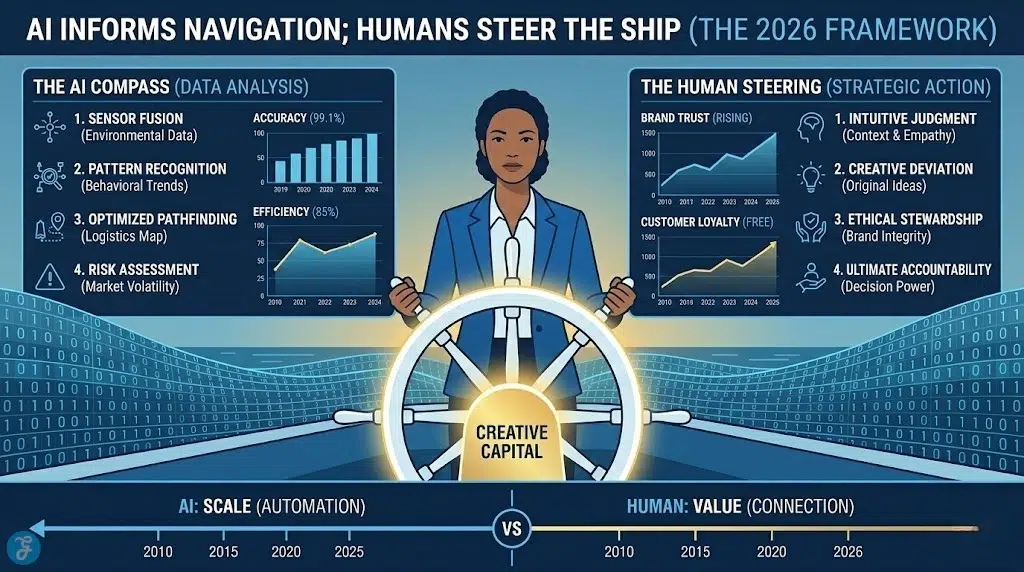
The Strategic Evolution of the Future of Digital Marketing
Navigating this new era requires a fundamental pivot from chasing clicks to cultivating genuine human resonance.
The Algorithmic Saturation Point
The digital landscape has become a sterile echo chamber where every brand sounds like a version of the same generative model. Consumers are reporting a profound sense of fatigue when interacting with social feeds that feel mathematically calculated rather than emotionally inspired. The human brain is incredibly adept at recognizing patterns, and in 2026, it is actively filtering out anything that lacks the “shimmer” of human imperfection. When every email is perfectly structured, and every video is flawlessly edited by an agentic AI, the consumer simply tunes out. We are currently marketing to wallets and data points instead of speaking to actual people with lived experiences.
The Reality of AI Trust in 2026
The assumption that high usage equates to high trust is the greatest fallacy of the modern tech era.
The Klaviyo AI Persona Research released on March 10, 2026, reveals a startling reality about consumer sentiment. While artificial intelligence usage is ubiquitous, consumers are functionally enthusiastic skeptics. They rely on the tools for productivity but do not inherently trust the outputs or the brands that over-automate their communications. Furthermore, this trust is highly fragmented across demographics and personas.
The 2026 AI Persona and Usage Reality
| Metric | Data Point | Strategic Implication |
| Overall Trust | Only 5-13 percent report full trust | Consumers use AI heavily but remain deeply skeptical of its authenticity. |
| Generational Shift | 93 percent of Gen Z use it weekly | Multiple reports confirm AI has largely replaced traditional search engines for youth. |
| The Gender Gap | Men are more likely to completely trust AI | Women are more likely to distrust generative AI |
The Return of the Brand Manifesto
The future of the industry belongs to those who are brave enough to have a definitive and perhaps even polarizing point of view. For years, we used data as a captain that steered us toward the safest and most average middle ground. This resulted in “bland-ification” where every startup looked and spoke like every other incumbent. In 2026, a brand manifesto is no longer just a document for internal alignment but a public declaration of humanity. People want to know what a brand stands for beyond its quarterly growth targets. They want to see the fingerprints of the creators on the products they buy.
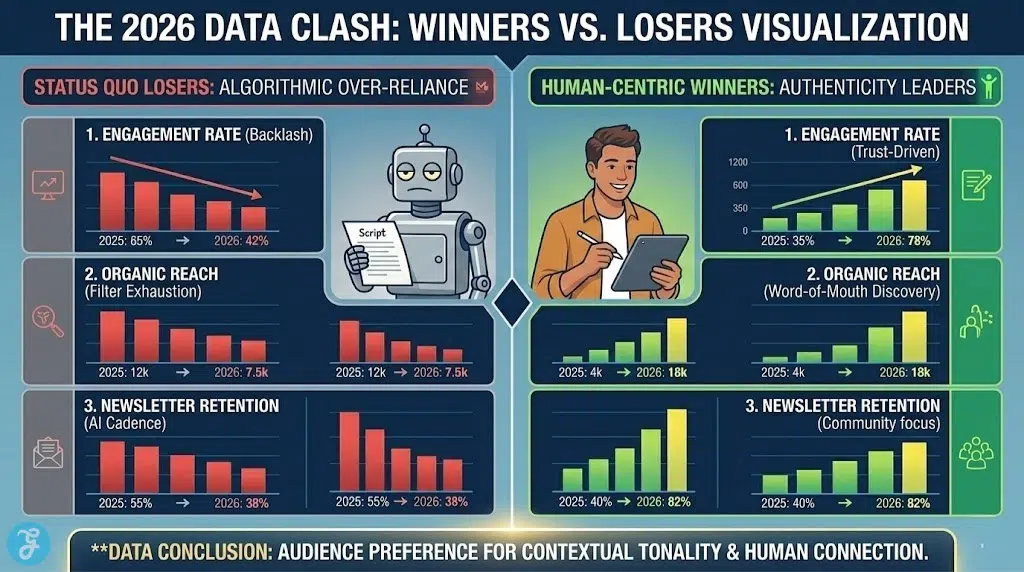
Economic Realism in a Synthetic World
The cost of being average has never been higher because the cost of producing average content has dropped to zero.
If your agency is still selling content volume as a service, it is effectively selling you a commodity that a server farm can produce for pennies. The economic value has shifted entirely from the ability to produce content to the ability to produce meaningful content. While organizations are seeing an average 24.69 percent productivity increase from automation, most brands have not successfully integrated this technology into their core soul. Money is flowing away from mass distribution of synthetic noise and toward high-impact campaigns that actually move the needle on trust.
Enterprise Adoption and Contextual Trust
| Category | Verified Data Point | Market Reality |
| Organizational Integration | 88 percent use AI, but 62 percent are experimenting | Efficiency is real but core strategic integration remains incredibly low. |
| Institutional Mistrust | 67 percent of Black women cite surveillance fears | A March 2026 Brookings update notes a deep trust deficit due to historical bias. |
| Legal Enforcement | Article 50 takes effect August 2, 2026 | Transparency is now a legal requirement under the EU AI Act with massive fines. |
The Death of Synthesized Content and the Rise of Original Data
The era of simply repackaging existing information has officially reached a permanent dead end.
Agentic artificial intelligence can aggregate the entire internet in milliseconds. This renders standard informational blog posts completely obsolete. When a consumer wants a basic definition or a standard guide in 2026, they simply ask their operating system. They only click through to a brand publication when they need a hard opinion or proprietary data that does not exist anywhere else in the training sets. This dynamic has destroyed the traditional top of the funnel. Brands must now act as primary research institutions rather than passive content curators.
Ethical Boundaries as Competitive Advantages
Privacy is no longer just a legal hurdle but a fundamental pillar of brand strategy in 2026. As global regulations like the expanded European AI Act take hold, the ability to target users via invasive tracking is vanishing. Brands that built their entire ecosystem on the “Back-Stage” reality of data mining are finding themselves lost in the dark. The winners are those who embrace “Front-Stage” transparency.
They are building direct relationships with their audiences based on mutual value rather than surveillance. Ethical marketing is becoming the primary way to differentiate a premium brand from a generic automated vendor.
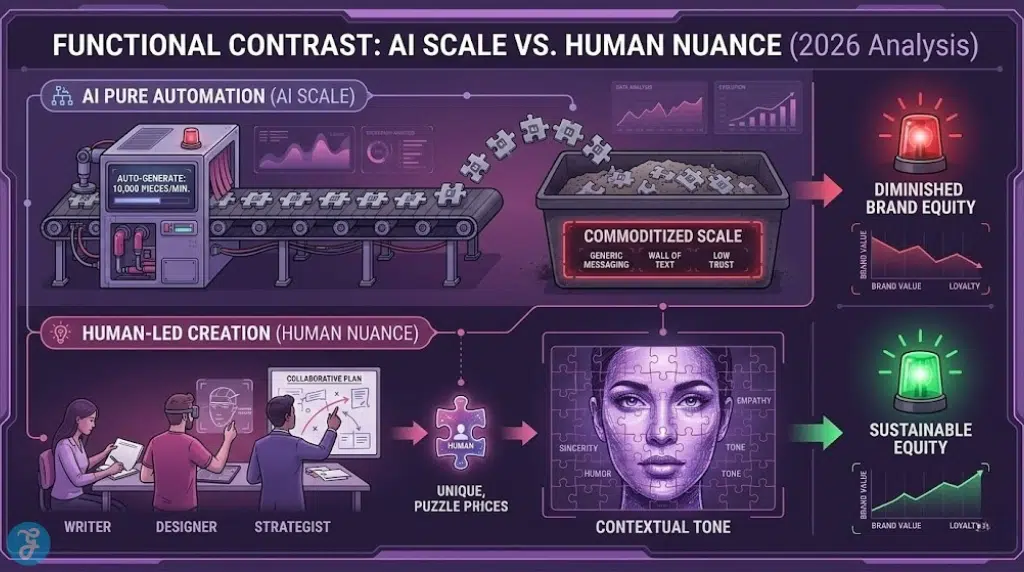
The Rise of Contextual Intelligence
We must stop confusing predictive accuracy with contextual understanding. An AI can tell you that a user is likely to buy a suit because they visited a tailor website, but it cannot understand that they are buying that suit for a funeral and need a tone of somber respect rather than a “limited time offer” coupon. Human creativity provides the nuance that prevents a brand from appearing tone-deaf. This contextual intelligence is the final frontier because it requires a level of empathy and lived experience that code simply cannot replicate.
Dismantling the Efficiency Myth
Let us address the strongest argument coming from the automation purists who believe that human creativity is a luxury we can no longer afford.
The technocrats argue that AI can personalize content at a scale and speed that no human team could ever match. They point to machine learning models that run thousands of multivariate tests per second to find the perfect word combination that triggers a purchase. They claim that in a world of infinite data, gut feeling is a liability.
This logic falls apart the moment you look at the 2026 consumer sentiment data. Efficiency is only a virtue if you are moving in the right direction. If you are efficiently alienating your audience with sterile and invasive messaging, you are simply accelerating your own obsolescence. The supposed cost savings of heavy automation are a mirage.
When you remove the human from the creative process, you remove the soul from the brand. You become a commodity. And in a global market of commodities, the only way to compete is on price. That is a race to the bottom that no healthy business wants to win. Authenticity is the only thing that justifies a premium price point in the post-generative era.
The Moral and Practical Roadmap for Change
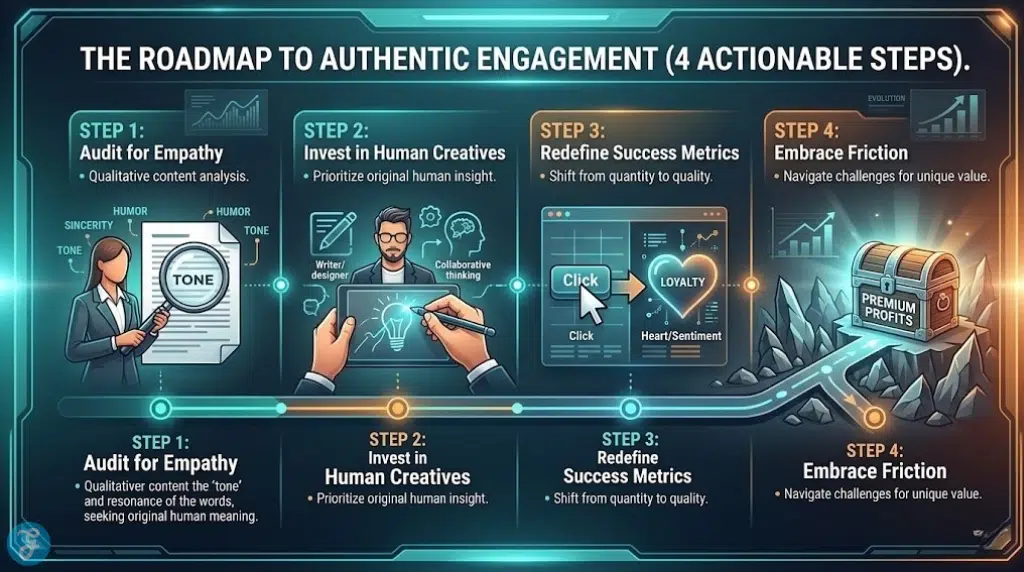
We cannot just critique the current state of affairs; we must provide a concrete path forward for the industry.
-
Audit for Empathy: You must immediately review every automated touchpoint in your customer journey. If your “welcome” sequence sounds like it was written by a committee of robots, it probably was. Replace the sterile scripts with a voice that actually reflects your team.
-
Invest in Human Creatives: Stop looking for prompt engineers and start looking for poets, psychologists, and storytellers. The most valuable person in your marketing department should be the one who can tell you why a campaign feels “off” even when the data says it should work.
-
Redefine Your Metrics: Move beyond the vanity metrics of clicks and impressions. Start measuring brand sentiment, the depth of community discussions, and the lifetime value of customers who joined because of your values rather than your discounts.
-
Embrace Strategic Friction: The goal of marketing should not always be to make everything as easy as possible. Sometimes, you want a bit of friction to ensure you are reaching the right people. Human creativity creates the kind of beautiful friction that turns a casual browser into a lifelong advocate.
The Takeaway
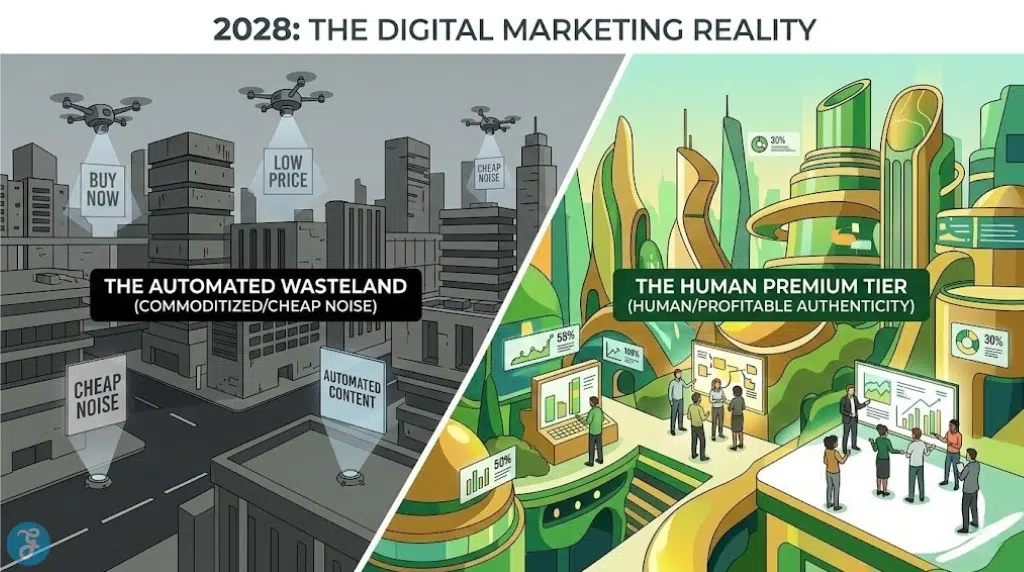
Looking over the horizon of the next eighteen months, we are going to see a brutal market correction. The brands that fired their creative teams to save a few dollars will be desperately trying to hire them back at triple the cost as their audience trust evaporates. We are entering a two-tier digital economy. The bottom tier will be an automated wasteland of cheap noise where nobody is listening. The top tier will be human, expensive, and deeply profitable because it is built on the only thing a machine cannot simulate, which is a genuine soul. Understanding this shift is the inevitable future of digital marketing.
Are you building a brand that speaks to the human heart, or are you just feeding another algorithm?






















