

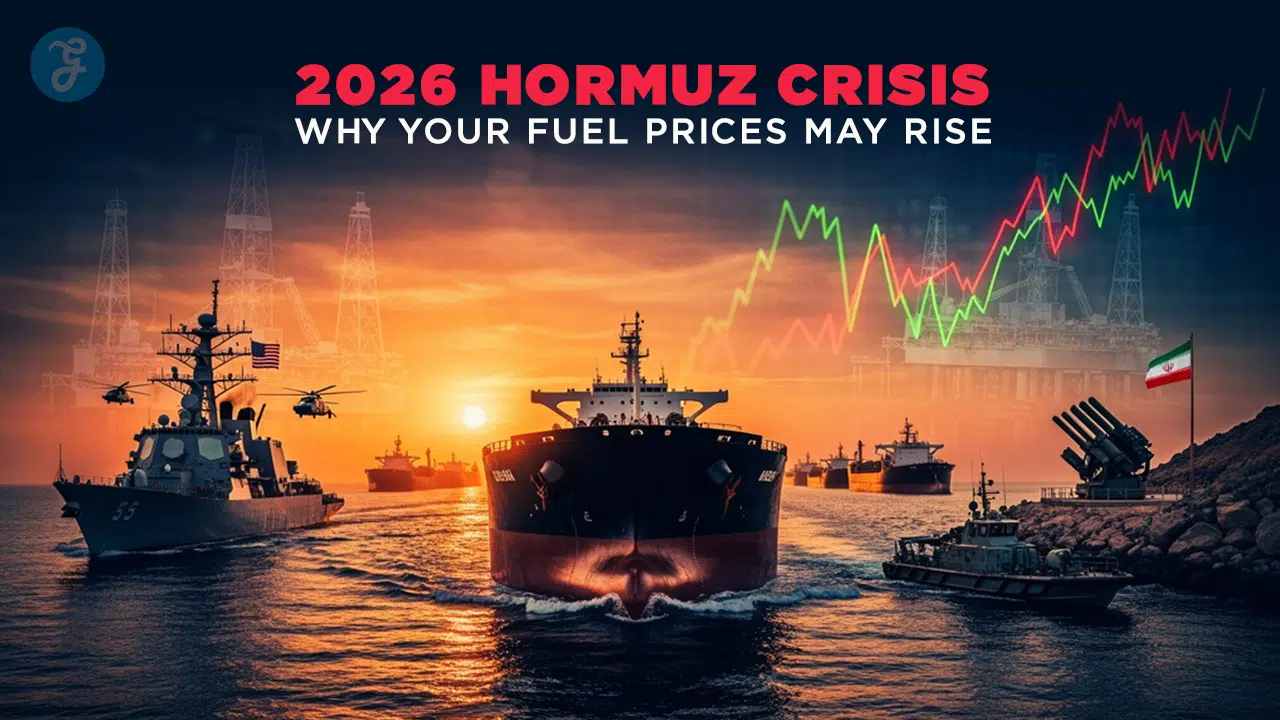
The world just received a brutal, trillion-dollar lesson in geography, and the tuition is being billed directly to your savings account. For decades, Western military theorists spoke about “Operation Epic Fury” as if it were a clean, surgical video game—a high-tech strike that would end the “Iranian threat” once and for all. On February 28, 2026, they finally pulled the trigger. They thought they were winning. Instead, they triggered a global economic heart attack that has left the “Rules-Based Order” gasping for air.
Now, the reality has set in: you can bomb a capital city, but you cannot bomb a 21-mile-wide chokepoint into submission. The Strait of Hormuz closure impact is now effectively total, and the global economy is currently sinking alongside the illusion of Western maritime supremacy.
The Epic Fury Hangover: How It All Started
The timeline of the 2026 crisis is a study in how a few hours of kinetic action can undo decades of global trade stability. The spark was lit on February 28, 2026, with the launch of “Operation Epic Fury.” This joint US-Israeli campaign was marketed as a definitive solution to years of regional tension. The operation utilized high-altitude, long-range precision strikes targeting the command-and-control infrastructure of the Islamic Revolutionary Guard Corps (IRGC) and several high-profile strategic sites within Tehran.
The strikes on Tehran will likely be recorded in history as a masterpiece of tactical execution and a catastrophe of strategic suicide. While the Pentagon celebrated the precision of its high-altitude campaign, they fundamentally misread the room. Washington’s “surgical” strikes were performed with an arrogant disregard for the physical anatomy of the global economy.
By targeting leadership and infrastructure, they expected a conventional surrender; what they got was a calculated asymmetric blackout.
The Hubris of High-Altitude Strikes assumes that a nation-state is a series of nodes that can be disconnected. But Iran isn’t just a nation; it is a geography. Kinetic war vs. economic reality is a battle the West has already lost. Every missile that hit a building in Tehran was a deposit into a global inflation fund that is now being withdrawn with interest.
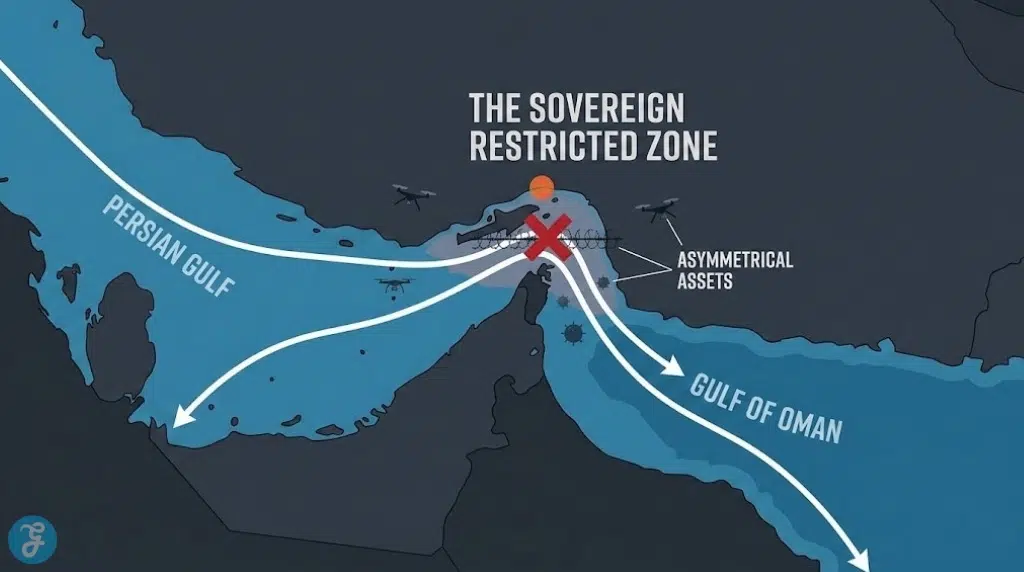
Within six hours of the strikes, the IRGC moved to its pre-prepared “Asymmetrical Protocol.” Small, highly mobile drone units and coastal missile batteries were activated along the jagged coastline overlooking the water. The Strait of Hormuz has been transformed into the world’s most effective “off-switch” for Western capital, proving that you cannot use kinetic force to solve a structural dependency on a single stretch of water.
Geography vs. Aircraft Carriers: The Asymmetrical Truth
The Islamic Revolutionary Guard Corps (IRGC) didn’t need a massive blue-water navy to neutralize the most expensive carrier groups in human history. They simply used the terrain. By declaring the Strait a “Sovereign Restricted Zone” and backing it up with asymmetrical precision—Mohajer-6 drones, smart mines, and shore-to-ship missiles—they have turned the world’s most vital artery into a “no-go” zone for Western capital.
The $13 Billion Paperweight
The USS Gerald R. Ford class carriers were built for open-ocean dominance, not a 21-mile knife fight. In this narrow corridor, these carriers are technologically over-qualified yet strategically useless. They are essentially $13 billion paperweights sitting in the Gulf of Oman, unable to project power without risking a total hull loss to a swarm of “suicide” drones.
Analyzing the Drone-to-Dollar Ratio reveals the true nature of the shift. A $20,000 IRGC drone forces a $2,000,000 interceptor missile response from a US destroyer. This is the math that ends empires. When it costs you 100 times more to defend a trade route than it costs your enemy to close it, the game is over. Furthermore, the 2026 crisis marks the official death of “Deterrence.” You cannot deter a nation that has already decided it has nothing left to lose after its capital has been struck.
The Insurance Guillotine: The Invisible Blockade
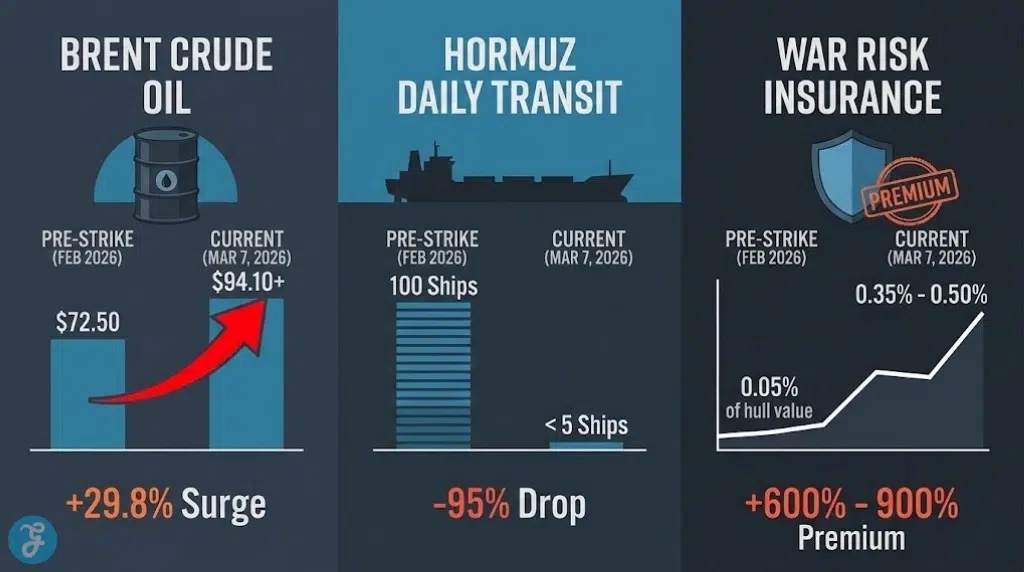
While the media focuses on sea mines and drone swarms, the real closure of the Strait was executed in the boardrooms of London. Lloyd’s List and the global insurance markets have done more to stop trade than any Iranian missile battery could. War-risk premiums have surged by over 500%, effectively creating an invisible wall that no commercial vessel is willing to climb.
Global Energy and Shipping Pulse (Updated March 9, 2026)
| Metric | Pre-Strike (Feb 2026) | Current (March 9, 2026) | Change |
| Brent Crude Oil | $72.50 | $114.10+ | +57.4% |
| Hormuz Daily Transit | ~150 Ships | 3 Ships | -98% |
| War Risk Insurance | 0.05% of hull value | 3.00% – 5.00% | +1000%+ |
| LNG Freight Rates | $12,500/day | $61,000/day | +388% |
| Dubai Escape Charter | $15,000 | $100,000+ | +566% |
Global Energy and Shipping Pulse
Currently, over 200 tankers sit in a “Floating Purgatory” in the Gulf of Oman, anchored and refusing to transit due to “War Risk” protocols. This has triggered a “Force Majeure Ripple” as major suppliers like Qatar and Kuwait halt shipments, creating a terminal shortage in the physical (not just paper) oil markets. This is no longer a price hike; it is a supply failure.
The Asian Bloodletting: Who Actually Pays?
The most savage irony of the 2026 crisis is that the primary victims are not in Washington or Tel Aviv. The people paying for “Epic Fury” are the billions of citizens in the Global East and Southeast Asia who rely on the Gulf for their very survival.
China and India under Pressure
China is facing a full-scale industrial heart attack. With 40% of its oil imports dependent on this 21-mile gap, the failure of the Western maritime system to provide security has left Beijing’s manufacturing hubs facing mandatory power quotas. The “Special Relationship” with Tehran hasn’t provided a magic shield; the IRGC’s blockade is absolute.
Similarly, India is in a macroeconomic death spiral. The Rupee has collapsed to 91.70 against the dollar, threatening to liquidate the Indian middle class. While Washington plays the hero, New Delhi is quietly bleeding cash. The government and Oil Marketing Companies are artificially absorbing the shock by freezing Mumbai petrol prices at 103.54 rupees while quietly hiking cooking gas to survive the week. The common citizen is not paying the true cost at the pump yet. The state is simply burning its national reserves to buy time before the inevitable reckoning.
The Southeast Asian Darkness
The lights are literally going out. In Manila, 10% mandatory energy cuts have been implemented alongside “hunker down” orders for the hospitality sector. In Bangkok and throughout Myanmar, the return of even-odd license plate rationing has caused the total paralysis of private transport, turning modern cities into logistics graveyards. The Strait of Hormuz closure impact is the physical manifestation of a Western military gamble that Asia never signed up for.
The Russian Winner’s Circle: The Multipolar Pivot
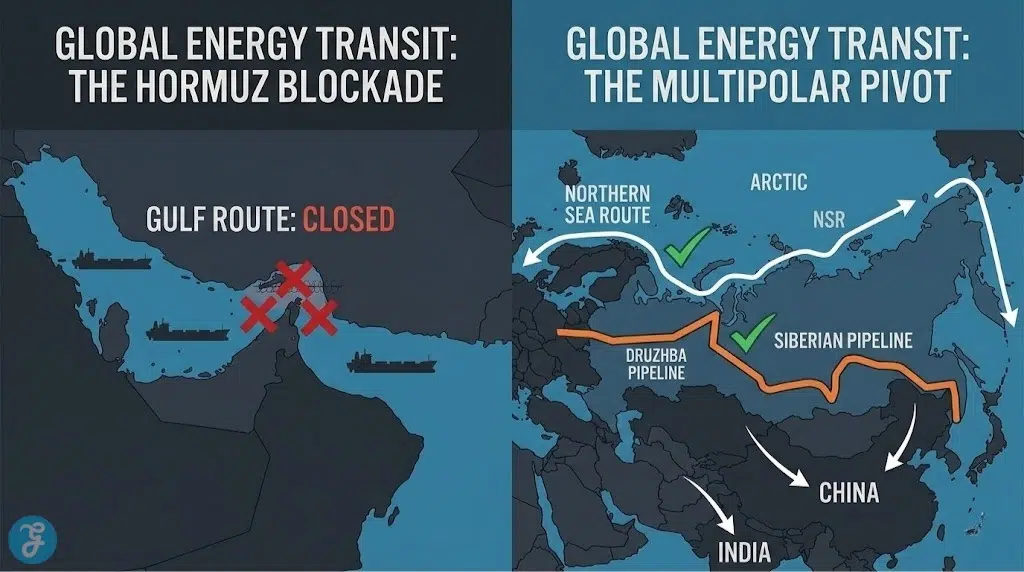
While the West drowns in its own inflation, Moscow is performing a “Mediation Masterclass.” Vladimir Putin is calling for an immediate halt to the conflict while actively profiting from every cent the oil price rises. Every day the Strait remains closed is a global advertisement for the Siberian pipelines and the Northern Sea Route (NSR).
Russia is successfully positioning itself as the only reliable “Plan B” for the Global East. By offering long-term contracts outside the dollar-denominated “Hormuz Risk,” Moscow is essentially becoming the new manager of global energy insurance. The pivot to the Arctic and the East is no longer a choice—it is a survival mechanism.
The Death of International Waters
For 80 years, the world was sold the lie that “Freedom of Navigation” was a universal law. It was actually just a service provided by a single hegemon. The Strait of Hormuz closure impact has exposed that UN maritime laws (UNCLOS) are merely suggestions in a post-strike environment.
The New Rules of the Sea are simple: “International Waters” only exist if the local power allows them to. The IRGC has revoked the West’s “Free Pass,” and the Strait has become the literal grave of American naval supremacy. Sovereignty in 2026 is defined by who can stop the water, not who “claims” it from a distance of 7,000 miles. This is the end of the Unipolar Era, written in the black smoke over the Gulf.
The Geopolitical Anatomy of the Strait of Hormuz Closure Impact
This event represents a fundamental shift in the global power dynamic, where geography and asymmetrical warfare have effectively neutralized traditional naval supremacy.
Tactical Success vs. Strategic Suicide
While “Operation Epic Fury” successfully struck command nodes in Tehran, it failed to account for the physical anatomy of the global economy. A tactical win on land triggered a terminal blockade at sea.
The Drone-to-Dollar Deficit
The 2026 crisis has proven that $13 billion aircraft carriers are strategically over-qualified for a 21-mile knife fight. When a $20,000 drone forces a $2,000,000 interceptor missile response, the math of empire ceases to function.
The Insurance Guillotine
The Strait was not closed by sea mines alone. It was closed by the boardrooms of London. A 500% surge in war-risk premiums created an invisible wall that no commercial vessel or its financiers is willing to cross.
Asia as the Primary Victim
Despite the conflict being a Western military gamble, the “bloodletting” is occurring in the East. China’s industrial quotas, India’s rupee collapse, and Southeast Asia’s energy rationing prove that the “Rules-Based Order” is a liability for the Global East.
The Russian Energy Insurance
By default, Moscow has become the world’s central bank for energy security. With the Gulf route paralyzed, the Northern Sea Route and Siberian pipelines are no longer alternatives. They are the only “Plan B” left.
The Law of Control Over Suggestions
The UN Convention on the Law of the Sea has been exposed as a Western suggestion. In 2026, maritime law is defined by the regional power that can physically stop the water, marking the official end of the unipolar era.
The Permanent Repricing of Reality
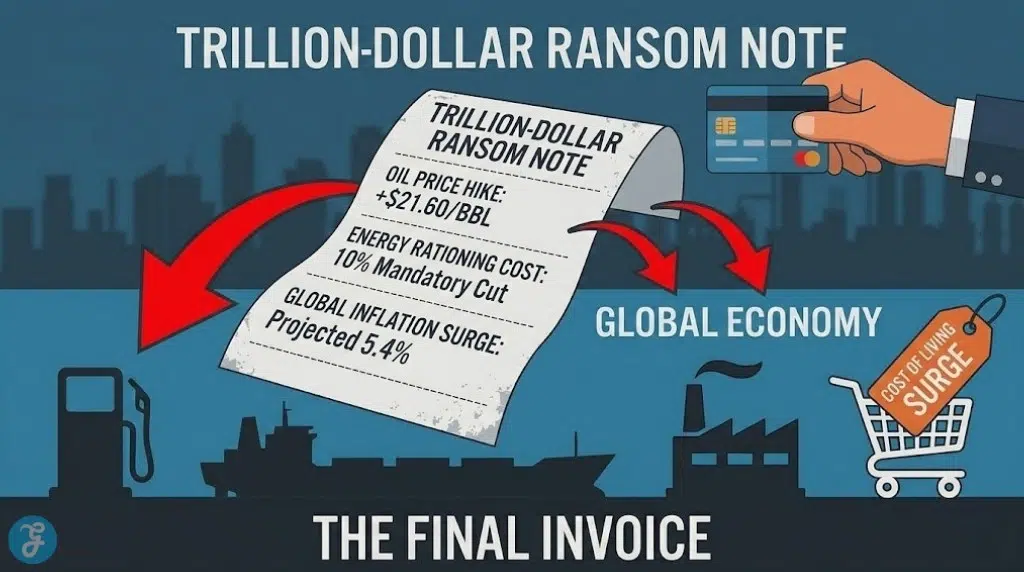
There is no “going back to normal.” The current $114+ Brent crude price is a structural adjustment. The global economy has been permanently hijacked, and the ransom is being paid by every consumer at the petrol pump.
The Trillion-Dollar Ransom Note
The battleship game is over. The permanent repricing of energy means that “Normal” is now a pre-February 28th memory. We have entered an era where your bank account is the scoreboard. Every time a drone is launched or a strike is ordered, the “ransom” is deducted from your rent money and food budget.
The empire is naked, the East is moving on to new routes, and the lights are staying off. The verdict is clear: you can’t buy back a world order once you’ve set its primary artery on fire. The Strait of Hormuz closure impact is the final invoice for 80 years of strategic arrogance.
Disclaimer: Editorialge maintains a steadfast commitment to responsible reporting on the evolving conflicts in West Asia involving Israel, Iran, U.S., Gulf nations and non-state actors like Hezbollah, Hamas, Houthis, Islamic State, and others. In an environment where digital disinformation is widespread, we cannot independently verify every social media post or claim involving national and non-state actors. Our priority remains factual accuracy and the exercise of extreme caution when documenting all regional media.





















