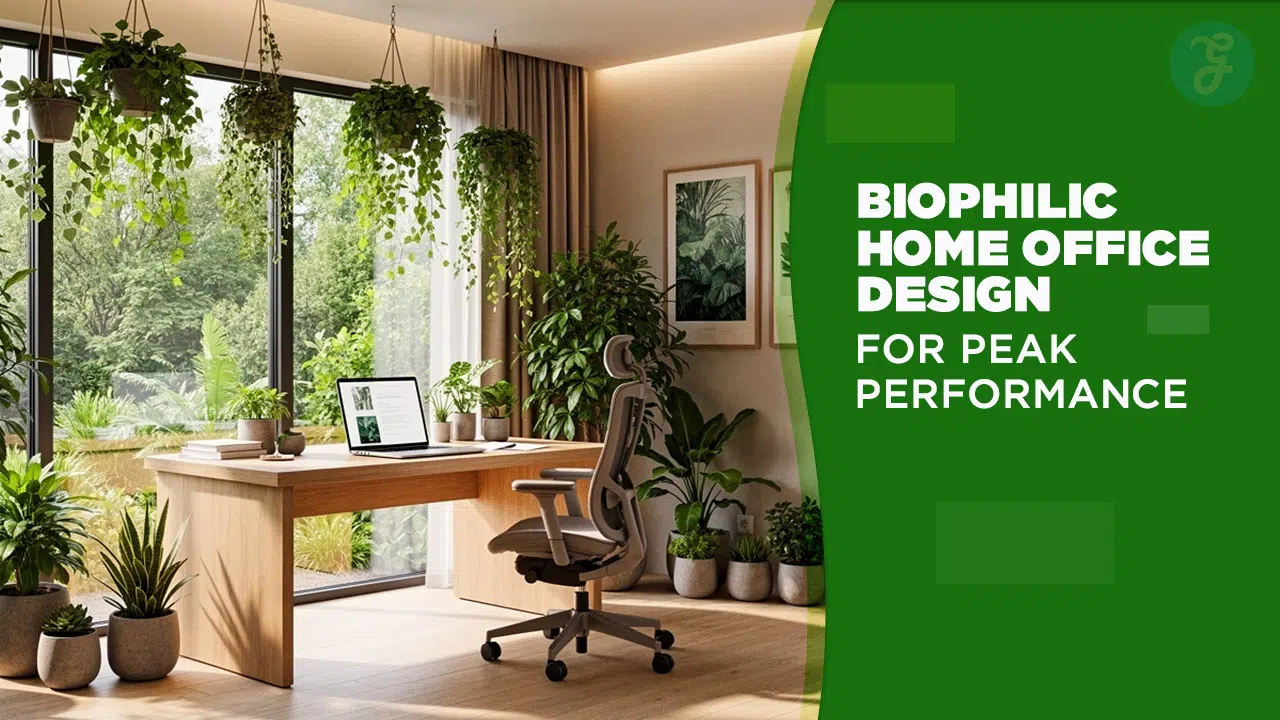
The year 2026 has officially retired the “clinical” home office. We have moved past the era of sterile white desks and ergonomic chairs that look like they belong in a cockpit. Today, a functional workspace is a biological one. As remote work becomes a permanent fixture of our professional lives, we are seeing a massive shift toward regenerative environments. We are no longer just designing for the eyes. We are designing for the nervous system.
Biophilic home office design is the core of this movement. It is a philosophy that recognises a simple truth: humans are not meant to thrive in boxes. While many mistake this for simply “adding a few succulents to a shelf,” true biophilic design is much deeper. It is the intentional integration of natural rhythms, textures, and patterns into our built environment. It isn’t just about aesthetics. It is about survival.
The value proposition is clear. We are currently facing a “Remote Work Burnout” epidemic. Screen fatigue and isolation are the new workplace hazards. By merging nature with smart technology, we can solve these issues at the source. A biophilic space doesn’t just look better. It actively lowers your heart rate. It sharpens your focus. It restores the mental energy that eight hours of video calls tend to drain.
In this guide, we rank the most effective strategies to turn your four walls into a living sanctuary. We look at the evidence. We examine the 2026 trends. Most importantly, we show you how to build a workspace that works as hard for your health as you do for your career.
What is Biophilic Home Office Design?
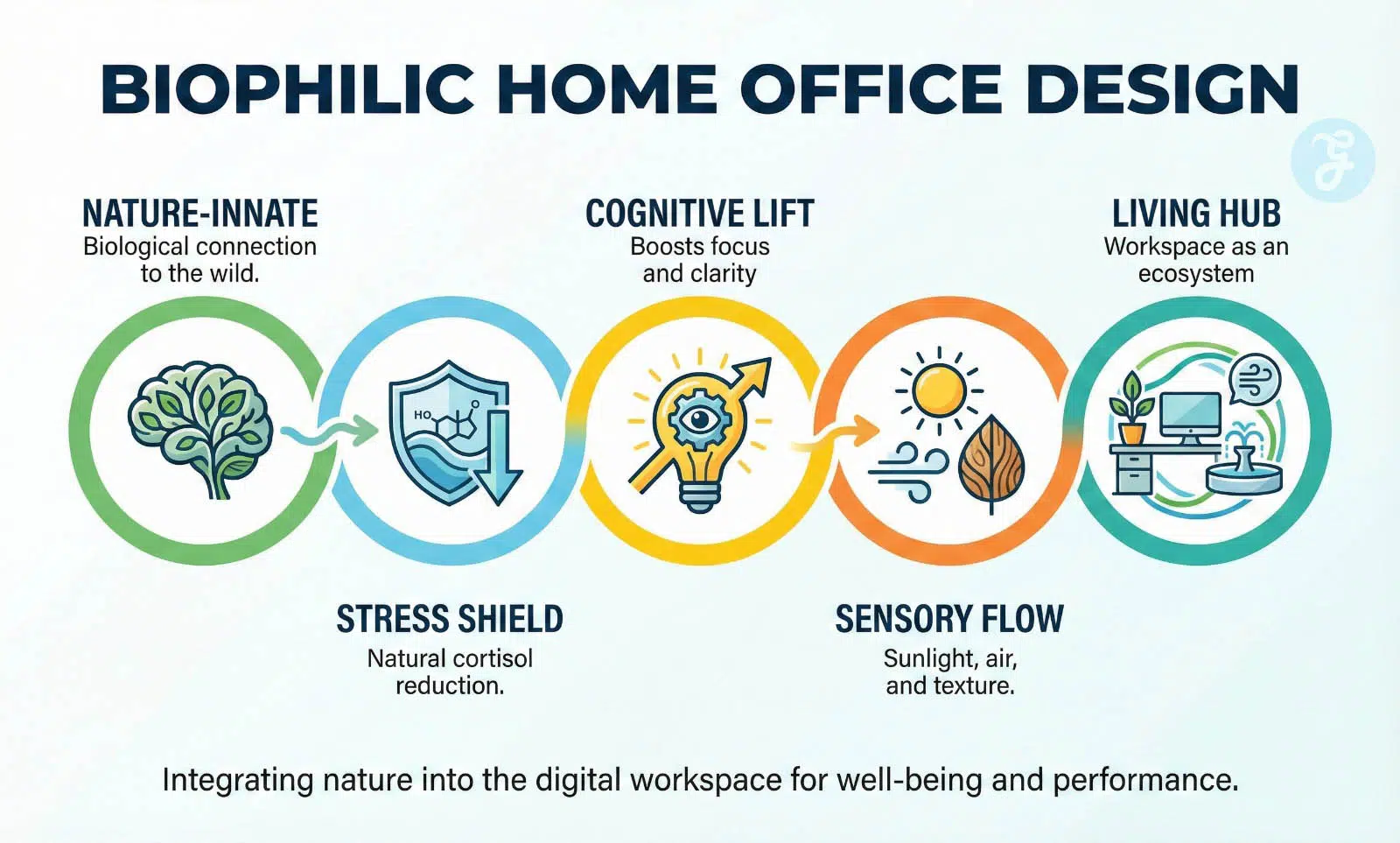
At its core, biophilic home office design is the intentional practice of weaving the natural world into the digital workspace. It is far more than a decorative trend or a collection of desk plants; it is a science-backed methodology rooted in the “biophilia hypothesis,” which suggests humans possess an innate, biological need to connect with nature. In the context of 2026 remote work, this design philosophy serves as a relational bridge between our ancient sensory systems and our modern professional demands. It moves beyond aesthetics to address the fundamental ways our environment shapes our nervous system, energy levels, and cognitive endurance. By integrating direct natural experiences (Nature in the Space), such as sunlight, airflow, and living flora, with indirect cues (Natural Analogues) like organic textures, wood grains, and fractal patterns, biophilic design creates a regenerative habitat. This approach acknowledges that we do not just work in a room; we work within an ecosystem. When successfully executed, it transforms a static office into a living sanctuary that actively lowers cortisol and recharges mental clarity, ensuring the home office supports the human being just as much as the human supports the business.
The Science of the Living Office
To understand why biophilic home office design is so effective, we have to look at our biology. The Biophilia Hypothesis suggests that we have a genetic connection to the natural world. When we are cut off from it, our cognitive performance suffers.
Scientific research in 2025 and 2026 has solidified the link between indoor air quality (IAQ) and mental clarity. Poor ventilation and synthetic materials off-gas chemicals that cloud our judgement. Conversely, a biophilic space uses “Attention Restoration Theory.” This suggests that looking at natural fractals, like the pattern of wood grain or the veins in a leaf allows the brain’s “directed attention” to rest.
The result is a triple bottom line of wellness. Physically, your cortisol levels drop. Cognitively, your creativity spikes. Psychologically, the “four-wall syndrome” of home isolation disappears. You aren’t just working from home. You are working within an ecosystem.
The Methodology
Not all green upgrades are equal. In this, we evaluate ten strategies based on three specific pillars:
- Scientific ROI: Does the data prove it improves health or output?
- Implementation Ease: Can you do this in a flat or a rented space?
- Sensory Impact: How much does it actually change the way the room feels?
We have prioritised these strategies to help you invest your budget where it will have the most significant impact on your daily life.
The 10 Essential Strategies

Strategy 1: Dynamic Light & Circadian Syncing
- Scientific ROI: Regulating light exposure can improve sleep quality by 25% and alertness by 18%. By matching the sun’s Kelvin cycle, you prevent the late-afternoon “mental fog” caused by static, high-glare environments.
- Implementation Ease: Extremely high. Renters can swap standard bulbs for smart, programmable LEDs (e.g., Hue or Nanoleaf) without changing fixtures.
- Sensory Impact: It alters the room’s atmosphere from “clinical” in the morning to “cosy and safe” by sunset, shifting your mood subconsciously.
Strategy 2: Visual Connection (The Green View)
- Scientific ROI: The “40-second green micro-break” is proven to boost concentration levels by 6%. Simply having a plant in your peripheral vision increases heart rate variability (a key marker of stress resilience).
- Implementation Ease: Moderate. While floor plants are easy, “Living Shelves” require sturdy wall mounting or freestanding modular units.
- Sensory Impact: It adds depth and life to a room, making a small flat feel like an expansive, breathing ecosystem rather than a cage.
Strategy 3: Material Honesty (Tactile Variety)
- Scientific ROI: Physical contact with wood surfaces triggers the parasympathetic nervous system, lowering blood pressure more effectively than contact with synthetic metal or plastic.
- Implementation Ease: High. If you cannot change your desk, adding a cork desk mat or a solid wood laptop stand provides the same tactile benefit.
- Sensory Impact: It introduces warmth. Natural textures feel “human” and grounding, breaking the sterile coldness of modern tech hardware.
Strategy 4: Acoustic Comfort (Natural Buffers)
- Scientific ROI: Reducing ambient noise by just 5 decibels can improve task accuracy by 10%. Natural absorbers like moss or mycelium prevent the “auditory fatigue” of echo-prone rooms.
- Implementation Ease: High. Moss “art” panels can be hung like pictures with simple command strips, making them perfect for renters.
- Sensory Impact: The room feels “hushed” and expensive. It creates a cocoon-like stillness that makes deep work feel effortless.
Strategy 5: Biomorphic Forms (Fractal Patterns)
- Scientific ROI: The human eye is evolved to scan natural fractals. Environments with curved furniture and organic patterns have been shown to reduce physiological stress levels by as much as 60%, while simultaneously lowering cognitive load by roughly 15% as the brain processes these shapes with greater ease.
- Implementation Ease: Moderate. Requires choosing specific furniture shapes or using removable “fractal” vinyl decals on glass surfaces.
- Sensory Impact: It removes the “aggressive” feel of sharp corners, making the workspace appear more inviting and less confrontational.
Strategy 6: Thermal & Airflow Variability
- Scientific ROI: Subtle fluctuations in temperature and airflow mimic the outdoors, which has been shown to improve worker performance by up to 12% compared to stagnant air.
- Implementation Ease: High. Portable smart fans with “natural breeze” settings provide the benefit without needing HVAC overhauls.
- Sensory Impact: It eliminates that “stuffy” office feeling, providing a refreshing, multisensory reminder of the world outside.
Strategy 7: Prospect and Refuge Layout
- Scientific ROI: This layout satisfies a primal survival instinct. Reducing the “startle reflex” (by having a wall at your back) allows the brain to dedicate more energy to complex problem-solving.
- Implementation Ease: High. Usually just involves rearranging existing furniture to face the door or window while backing into a corner.
- Sensory Impact: It provides a profound sense of security and “ownership” over the space, making you feel like the captain of your domain.
Strategy 8: Olfactory Design (Scent-Scaping)
- Scientific ROI: Olfactory signals reach the brain’s limbic system instantly. Beyond mood, specific compounds like phytoncides (found in forest air) boost immune function, while scents like lemon or rosemary can reduce typing errors by a measurable margin.
- Implementation Ease: Extremely high. Requires only a waterless nebuliser or a few specific potted herbs like lavender or eucalyptus.
- Sensory Impact: It creates an “invisible boundary” for work. When you smell your “office scent,” your brain knows it is time to focus.
Strategy 9: Presence of Water
- Scientific ROI: The sound of water acts as a natural sound masker, providing a stochastic (random) frequency that is more balanced and less fatiguing than synthetic white noise. This has been shown to lower sympathetic nervous system activity (the “fight-or-flight” response) and reduce physiological stress by up to 11%.
- Implementation Ease: High. Small, self-contained tabletop fountains only require a standard plug and an occasional water top-up.
- Sensory Impact: It introduces a soothing, rhythmic pulse to the room that neutralises the “hum” of city life or household appliances, creating a sensory anchor for deep work.
Strategy 10: Seasonal & Ephemeral Connections
- Scientific ROI: Humans crave variety. Changing your environment with the seasons prevents “habituation”, where you stop noticing your surroundings and keeping your brain engaged.
- Implementation Ease: High. Involves simple swaps like heavier wool textiles in winter or lighter linen and seasonal flowers in spring.
- Sensory Impact: It keeps the workspace feeling fresh and “new,” preventing the mental stagnation that often leads to remote-work burnout.
Sustainability & Ethical Sourcing
In 2026, biophilic home office design is defined by a shift from merely “eco-friendly” to “regenerative” materiality, where every element must actively give back to the ecosystem. This evolution prioritises carbon-negative substances like mycelium composites… mushroom-root structures grown in moulds to create fire-resistant, acoustically superior wall panels—and algae-based textiles that sequester carbon during production. High-performance, rapidly renewable resources such as cork and bamboo have become the gold standard for flooring and cabinetry due to their zero-deforestation footprint and natural ability to regulate humidity. Ethical sourcing now demands radical transparency; consumers look for “Material Passports” or Cradle to Cradle® certifications to ensure that timber is FSC-certified and that bio-leathers (sourced from cactus or pineapple fibres) are produced through fair-labour artisanal partnerships. Ultimately, a true biophilic workspace is a circular one, where raw, non-toxic finishes like clay plaster and limewash replace synthetic paints, ensuring that once a piece of furniture reaches its end-of-life, it can return to the earth without leaving a chemical legacy.
Future-Proofing Your Workspace
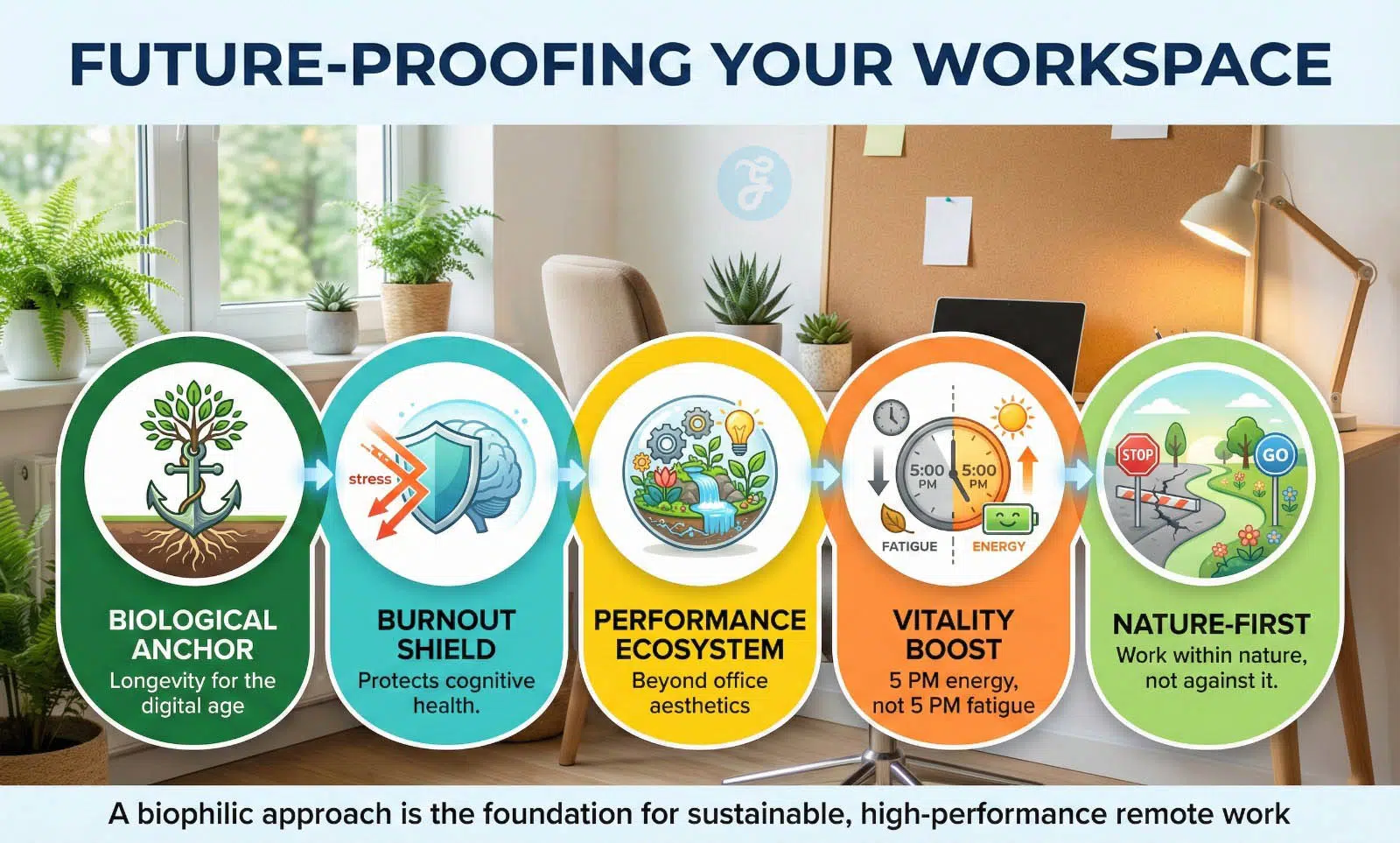
Investing in biophilic home office design is no longer an aesthetic luxury; it is a fundamental pillar of professional longevity. As we navigate the complexities of 2026’s digital-first economy, our workspaces must serve as more than just a background for video calls, they must function as biological anchors. By ranking and implementing these ten strategies, from circadian-syncing light to the grounding touch of regenerative timber, you are effectively building a high-performance ecosystem that protects your cognitive health and dampens the fires of remote-work burnout. The goal is a home office that leaves you feeling more vital at 5:00 PM than you did at 9:00 AM. In the end, we do our best work not by conquering nature, but by finally allowing ourselves to work within it.
Building a Cognitive Defence System
To future-proof your workspace in 2026, you must view your home office as a dynamic asset rather than a static room. As digital demands increase and the boundary between professional and personal life continues to blur, the biophilic approach acts as a crucial “shock absorber” for the mind. This isn’t about chasing a trend; it is about building a structural defence against the psychological fatigue inherent in a hyper-connected world. By investing in these biological foundations today, you are ensuring that your workspace can evolve alongside your career without becoming a source of depletion.
Designing for Resilience and Longevity
Future-proofing also means designing for adaptability and resilience. A truly biophilic office responds to the shifting rhythms of the day and the seasons, preventing the “habituation” that leads to boredom and stagnation. Whether it is through the installation of modular green walls that improve air quality or the use of smart glass that manages heat gain, these strategies ensure your environment remains optimised regardless of external changes. When you prioritise your biological needs, you create a space that doesn’t just house your work; it enhances your capacity to perform it.
Ultimately, the most successful professionals of the next decade will be those who recognise that human output is inextricably linked to human input. By transforming your office into a regenerative sanctuary, you are making a long-term commitment to your cognitive longevity and emotional well-being. You are moving from a state of simply surviving the workday to a state of thriving within it. The future of work isn’t just remote; it is lived, and it is natural.