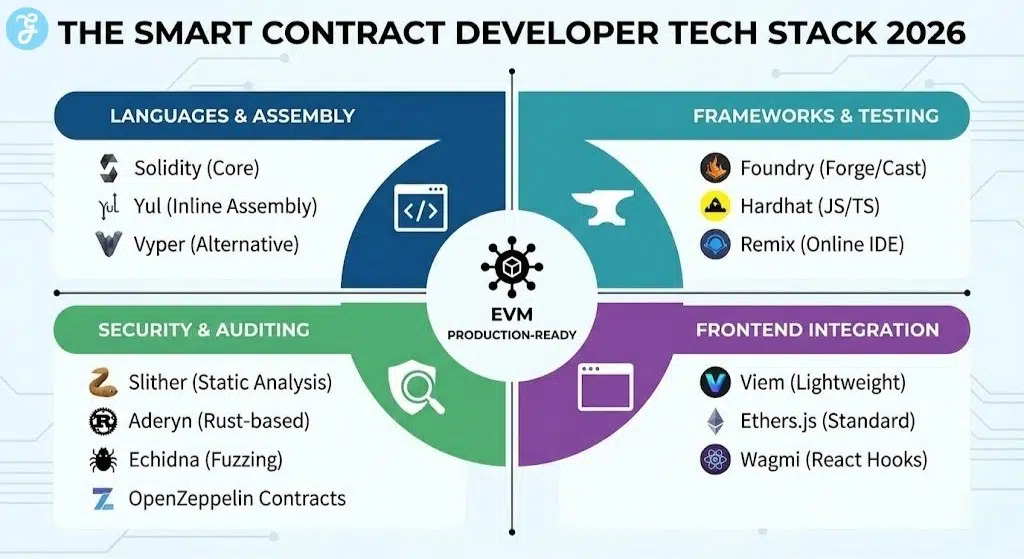
The decentralized web in 2026 has transitioned from simple smart contract execution to complex, AI-integrated autonomous organizations and modular scaling solutions. As Solidity remains the undisputed backbone of the Ethereum Virtual Machine (EVM) ecosystem, the tools available to master it have become significantly more immersive and high-fidelity. To find the best resources to learn Solidity 2026, one must look beyond basic syntax and focus on resources that emphasize security, gas optimization, and advanced developer tooling like Foundry and Hardhat.
Whether you are a seasoned backend engineer transitioning to Web3 or a complete beginner, the 2026 learning landscape offers everything from gamified coding environments to intensive, professional-grade bootcamps. This guide highlights the top resources currently defining the standard for smart contract education.
How We Chose Our Top 10 List?
Our selection process for 2026 is grounded in the current industrial requirements for “Production-Ready” code. We prioritized platforms that do not just teach the language but also instill deep security auditing habits and real-world deployment experience.
We applied the following weightings to our research and comparison:
| Criteria | Weighting | Focus Area |
| Technical Depth | 40% | Coverage of the EVM, assembly (Yul), and gas optimization |
| Community & Support | 30% | Active Discord/forums and peer-to-peer code reviews |
| Tooling Integration | 30% | Hands-on use of Foundry, Hardhat, and security tools like Slither |
Here Are The 10 Best Resources to Learn Solidity in 2026
The following platforms and tools have been vetted for their curriculum accuracy and their ability to produce world-class smart contract engineers in the current year.
1. Cyfrin Updraft (Patrick Collins)
Founded by Patrick Collins, Cyfrin Updraft has become the “Gold Standard” for free blockchain education in 2026. It offers a structured path that takes students from absolute zero to advanced smart contract security. The platform is famous for its hands-on approach, requiring students to build real-world protocols while learning the nuances of the Foundry framework.
Special Features:
-
Over 50 hours of free, high-quality video content and written documentation.
-
Direct paths for both developers and security researchers (auditors).
-
Integrated project testing that mimics professional production environments.
Things to Consider:
-
The sheer volume of content can be overwhelming for casual learners.
-
Requires a significant time commitment to reach the “Advanced” stages.
-
Focuses heavily on the Foundry framework over Hardhat.
Best for: Developers who want a comprehensive, free, and professional-grade education.
2. Alchemy University
Alchemy University (formerly ChainShot) provides a highly interactive and browser-based learning experience. Their 2026 curriculum is particularly strong on the “Ethereum Developer Bootcamp,” which covers the cryptographic foundations of blockchain before moving into Solidity. The platform uses a “learn by doing” model where you write and test code directly in the web interface.
Special Features:
-
In-browser coding environment with instant feedback on syntax and logic.
-
High-quality cohort model for those who need community accountability.
-
Strong focus on Web3 frontend integration (Ethers.js and Viem).
Things to Consider:
-
The browser-based IDE can occasionally feel disconnected from “real” local dev environments.
-
The advanced modules are less comprehensive than specialized security platforms.
-
Relies on the Alchemy ecosystem for its node provider examples.
Best for: Visual learners and beginners who want to see immediate results without complex setup.
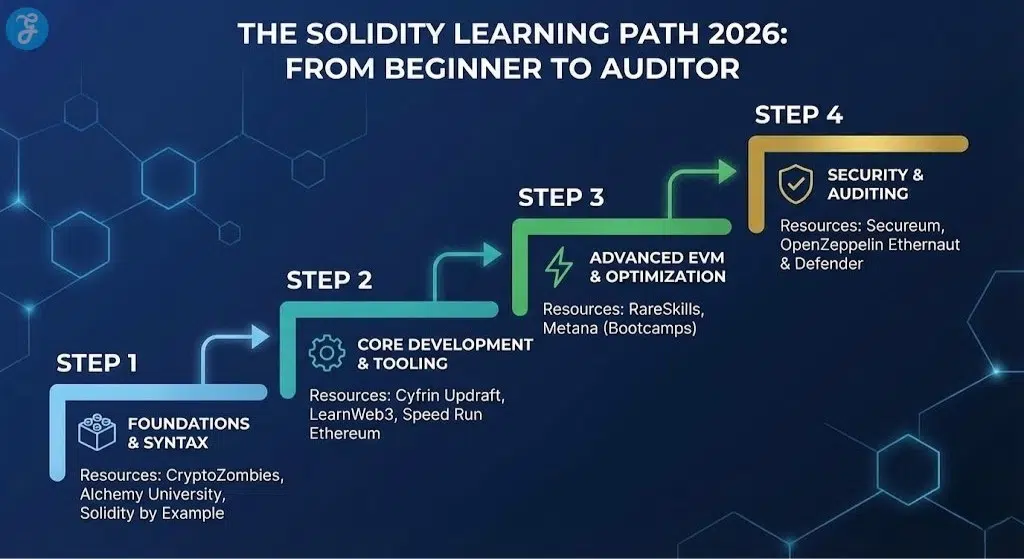
3. RareSkills
RareSkills is the premier destination for intermediate developers looking to become senior “EVM architects.” In 2026, they are the leaders in teaching gas optimization and the Yul assembly language. Their blog is a treasure trove of technical deep-dives, while their paid bootcamps are known for being the most rigorous in the industry.
Special Features:
-
Unrivaled depth in EVM internals, opcode analysis, and gas-efficient patterns.
-
High-intensity cohorts with direct mentorship from industry experts.
-
Specialized courses on Zero-Knowledge (ZK) proofs and security auditing.
Things to Consider:
-
Very high price point compared to free alternatives.
-
Not suitable for beginners; you must already be a proficient coder.
-
Requires a massive weekly time commitment (20+ hours) during cohorts.
Best for: Experienced software engineers aiming for top-tier roles at major DeFi protocols.
4. Speed Run Ethereum
Created by Austin Griffith and the BuidlGuidl, Speed Run Ethereum is a challenge-based curriculum. It bypasses traditional “lessons” and instead gives you specific apps to build—from an NFT gallery to a decentralized staking app. It is designed to get you “comfortable with the uncomfortable” by throwing you into the deep end of building and deploying.
Special Features:
-
Focuses on the “Scaffold-ETH” stack for rapid prototyping and deployment.
-
Community-driven challenges that earn you “reputation” in the BuidlGuidl ecosystem.
-
Completely free and open-source, maintained by a collective of builders.
Things to Consider:
-
Lacks the structured theory found in traditional courses.
-
Can be frustrating for learners who prefer a step-by-step lecture format.
-
Success depends heavily on your ability to self-research when you get stuck.
Best for: Practical builders and hackers who learn best through trial and error.
5. CryptoZombies
While it is one of the oldest resources, CryptoZombies has been refreshed for 2026 to include Layer 2 scaling and NFT standards. It remains the best entry point for absolute beginners who find technical documentation intimidating. The course gamifies the process of building a “Zombie Army” smart contract to teach the basics of state variables and inheritance.
Special Features:
-
Completely gamified and highly engaging visual progression.
-
Teaches Solidity through the lens of building a functional game.
-
No local environment setup is required to finish the basic curriculum.
Things to Consider:
-
Does not cover advanced security or professional developer tooling (Foundry/Hardhat).
-
The syntax can occasionally feel simplified for the sake of the game.
-
Primarily focused on beginners; you will quickly outgrow it.
Best for: Absolute beginners and non-technical people wanting to understand how smart contracts work.
6. Metana
Metana is a high-end, career-focused Web3 bootcamp that specializes in the “transition” period. In 2026, they are known for their strong emphasis on Rust (for Solana) alongside Solidity (for Ethereum). Their biggest draw is the “Job Placement Guarantee” or career support that connects graduates with Web3 startups.
Special Features:
-
Intensive 4-month program with personal 1-on-1 mentor sessions.
-
Strong focus on building a professional portfolio of production-grade code.
-
Dedicated career coaching and interview preparation modules.
Things to Consider:
-
Significant financial investment (several thousand dollars).
-
The pace is very fast, making it difficult for those with a full-time job.
-
Highly competitive application process for the flagship cohorts.
Best for: Career-switchers who want a direct path into a high-paying Web3 job.
7. LearnWeb3
LearnWeb3 is a comprehensive community and education ecosystem that covers the entire stack. Their 2026 tracks are divided by difficulty (Freshman, Sophomore, Junior, Senior) and include specialized paths for DAO governance and Cross-Chain development. They have one of the most active Discord communities for peer support.
Special Features:
-
A vast library of mini-courses on specific Web3 topics (IPFS, Graph, etc.).
-
“Learn-to-Earn” mechanics that reward students with NFTs and tokens for completion.
-
Strong emphasis on the “full stack,” connecting smart contracts to frontends.
Things to Consider:
-
The quality of older tutorials can vary as the ecosystem moves fast.
-
The “gamification” can sometimes distract from deep technical focus.
-
Some tracks are very broad and lack the “deep-dive” intensity of RareSkills.
Best for: Developers looking for a community-driven, holistic Web3 education.
8. Secureum
Secureum is the primary resource for those specifically interested in smart contract auditing and security. In 2026, their “Race” days (competitive auditing challenges) have become the unofficial entrance exam for the auditing industry. Their curriculum is highly academic and focuses on finding vulnerabilities in complex codebases.
Special Features:
-
Massive “Audit Findings” database and security checklists.
-
Competitive “Race” events that rank students against other security researchers.
-
Deep focus on the “Dark Forest” of Ethereum—exploits, MEV, and frontrunning.
Things to Consider:
-
Very steep learning curve; assumes you already know Solidity perfectly.
-
The content is dry and highly technical (quizzes, documentation, lists).
-
Not a general “development” course; purely security-focused.
Best for: Aspiring smart contract auditors and security researchers.
9. OpenZeppelin Documentation & Defender
While technically a library provider, OpenZeppelin is the “Bible” of secure Solidity patterns in 2026. Every professional developer must learn their standards (ERC-20, ERC-721, AccessControl). Their “Defender” platform and security blogs provide real-time education on how to manage and protect contracts post-deployment.
Special Features:
-
The industry standard for secure, audited, and reusable smart contract components.
-
Extensive documentation on “Why” specific security patterns are used.
-
Their “Ethernaut” wargame is a top-tier resource for learning common hacks.
Things to Consider:
-
It is a reference resource, not a structured “how-to” course.
-
Documentation assumes a high level of technical literacy.
-
Can lead to a “copy-paste” habit if the developer does not understand the underlying logic.
Best for: Professional developers who need to implement industrial-grade security patterns.
10. Solidity by Example
Solidity by Example is a minimalist, code-first website that provides clean, concise snippets for every possible Solidity function. In 2026, it remains the most-used reference site for developers who just want to see how to implement a “Reentrancy Guard” or a “Gasless Permit” without reading a 20-page article.
Special Features:
-
Clean, zero-fluff code examples for almost every Solidity keyword and pattern.
-
Categorized by difficulty, from “Hello World” to “EVM Opcodes.”
-
Extremely fast to navigate during a live coding session or hackathon.
Things to Consider:
-
Provides the “What” but often lacks the “Why” and broader context.
-
Not a learning path; it is a dictionary of code snippets.
-
Does not cover project architecture or deployment strategies.
Best for: Active developers who need quick syntax reminders and logic templates.
Solidity Education Market Overview 2026
The 2026 educational market is split between “Freemium” high-quality video platforms and high-ticket, cohort-based bootcamps that guarantee job placement. We are also seeing a massive shift toward “Security-First” education, where developers are taught to think like auditors from day one.
| Resource | Learning Model | Best Feature | 2026 Pricing |
| Cyfrin Updraft | Video/Documentation | Free, 50+ hours of pathing | Free |
| RareSkills | Cohort/Bootcamp | Deep EVM & Yul dives | Paid (Premium) |
| Alchemy Univ. | Interactive Coding | Integrated web IDE | Free |
| Metana | Career Bootcamp | Job placement guarantee | Paid (Bootcamp) |
| Secureum | Security Focused | Auditing “Race” days | Free/Paid |
How Should You Choose The Best Option For You
Your choice of resource should align with your 2026 career goals and current skill level:
-
For the Absolute Beginner: Start with CryptoZombies to understand the logic, then move to Alchemy University.
-
For the Aspiring Professional: Commit to the Cyfrin Updraft path for a comprehensive, free education.
-
For the Career Switcher: Invest in Metana for the networking and job placement support.
-
For the Future Auditor: Focus on Secureum and the OpenZeppelin Ethernaut challenges.
-
For the Senior Engineer: Use RareSkills to master the EVM and Yul for high-performance DeFi.
| Category | Top Pick | Primary Reason |
| Comprehensive Free Education | Cyfrin Updraft | 50+ hours of professional, current-year pathing. |
| Interactive Learning | Alchemy University | Integrated coding environment and strong frontend focus. |
| Advanced EVM Mastery | RareSkills | The industry leader in gas optimization and deep-tech. |
| Security & Auditing | Secureum | Competitive environment for the world’s best auditors. |
Wrap-Up
The best resources to learn Solidity 2026 are those that treat smart contract development as a high-stakes engineering discipline rather than just “another programming language.” In an environment where a single bug can result in the loss of millions, the quality of your education is your first line of defense. By combining the structured paths of Cyfrin with the practical building of Speed Run Ethereum and the security rigor of Secureum, you can build a skill set that is both future-proof and highly valuable in the 2026 Web3 economy.