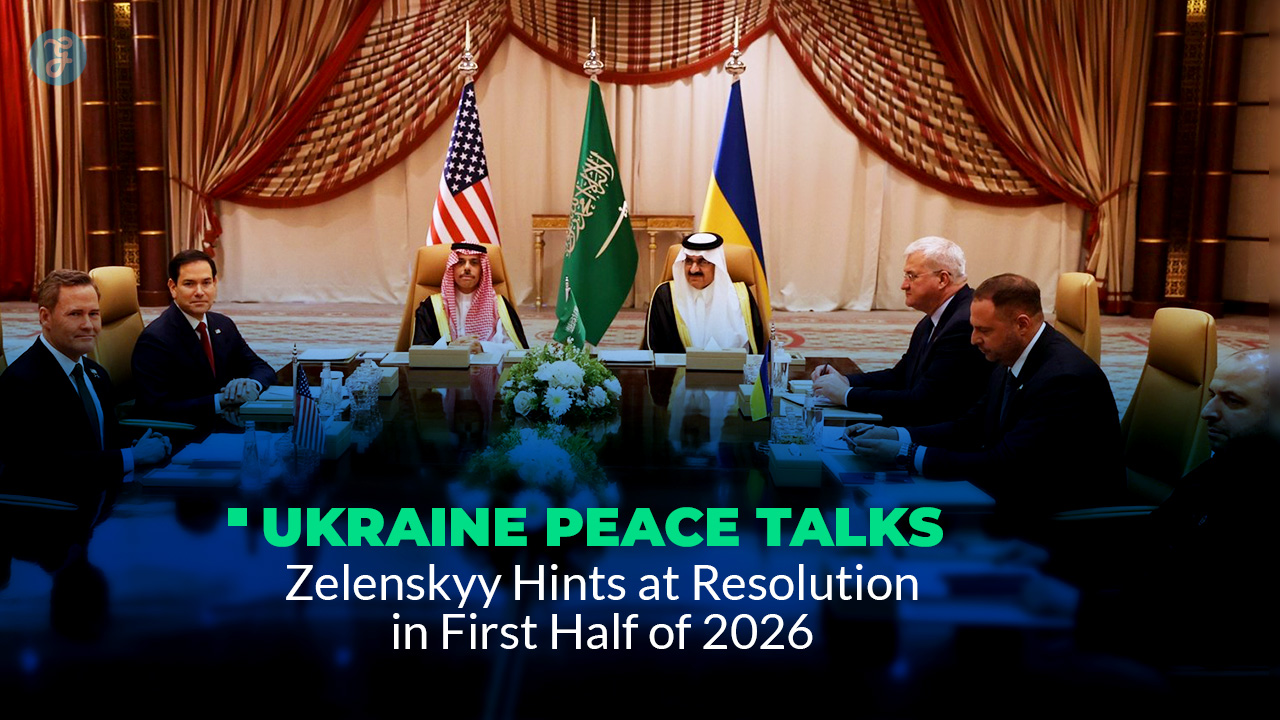
Why is this significant right now? After four years of grinding attrition, President Zelenskyy’s January 8 statement—suggesting the war could end during Cyprus’s EU presidency (Jan–June 2026)—is not just hope; it is a signal that the diplomatic architecture for a ceasefire is largely built.
With a “90% ready” deal on the table and Russia’s war economy hitting a predicted stagnation point, this moment marks the pivot from how to win to how to end.
The “Long Winter” of 2025: How We Got Here
To understand the weight of Zelenskyy’s comments in Nicosia this week, we must look at the brutal calculus of 2025. The past year was defined by the “Great Exhaustion.” Ukraine faced a critical manpower crisis, forcing unpopular mobilization reforms, while the U.S., under the Trump administration, shifted from direct grants to the “PURL” (Prioritized Ukraine Requirements List) mechanism—essentially forcing Europe to foot the bill for American weapons.
Meanwhile, Russia’s “military Keynesianism”—the economic boom driven by defense spending—hit its mathematical limit in late 2025. With inflation hovering near 16% and the National Wealth Fund depleted, the Kremlin is entering 2026 facing a stark choice: negotiate now while holding territory, or risk a Soviet-style economic collapse by 2027.
The Architecture of the “Resolution”
Zelenskyy’s hint at a resolution in the first half of 2026 aligns with leaks from the recent “Coalition of the Willing” summit in Paris. The emerging deal appears to be a transactional compromise driven by exhaustion on both sides.
1. The Security Guarantee Shift
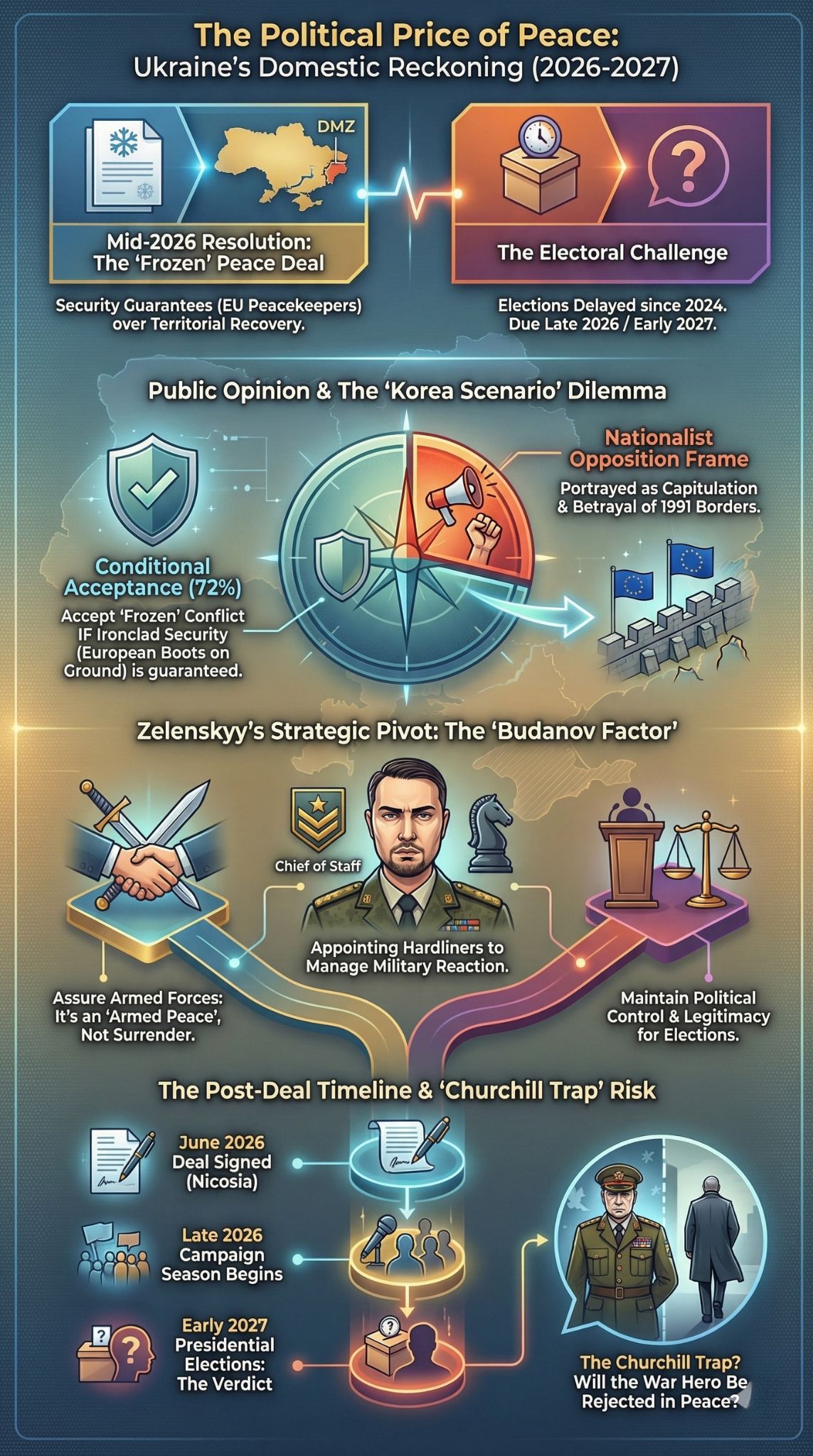
The rhetoric has shifted from immediate NATO membership to “tangible security.” The draft agreement reportedly involves a U.S.-backed, European-led peacekeeping force (likely French and British troops) deployed to monitor the contact line. This “tripwire” force serves as the security guarantee Zelenskyy needs to sell a ceasefire to the Ukrainian public, substituting Article 5 with actual boots on the ground.
2. The “Trump Deal”: Transactional Peace
The reported $800 billion recovery deal discussed between Washington and Kyiv suggests the U.S. strategy is now commercial. By offering American investors preferential access to Ukraine’s critical minerals and reconstruction contracts, the Trump administration has incentivized a stable peace. This turns Ukraine’s security into a U.S. economic interest, a language the current White House speaks fluently.
The Economic Precipice: Why Russia Might Sign
The most overlooked factor is the Russian economy. For three years, Putin traded future stability for current military output. That bill is coming due in 2026.
| Metric (Jan 2026) | Russia | Ukraine |
| GDP Growth Forecast | 0.6% – 1.0% (Stagnation) | 2.0% (Recovery dependent) |
| Inflation Rate | ~7% (Officially), Real >15% | ~9% |
| Manpower Status | Labor shortage critical; factories poaching workers | Mobilization ceiling reached |
| Key Constraint | Fiscal Exhaustion: Oil revenues down 34% YoY | Aid Fatigue: US aid conditional/loan-based |
The Economic Deadlock Driving Negotiations (Source: IMF/Rosstat 2026 Projections)
Russia’s transition from a “managed cooling” to “structural stagnation” means the Kremlin can no longer afford the infinite war it promised. A ceasefire in 2026 allows Putin to claim victory (holding ~19% of Ukraine) and pivot to fixing the domestic economy before the 2030s.
Domestic Fallout: The Political Price of Peace
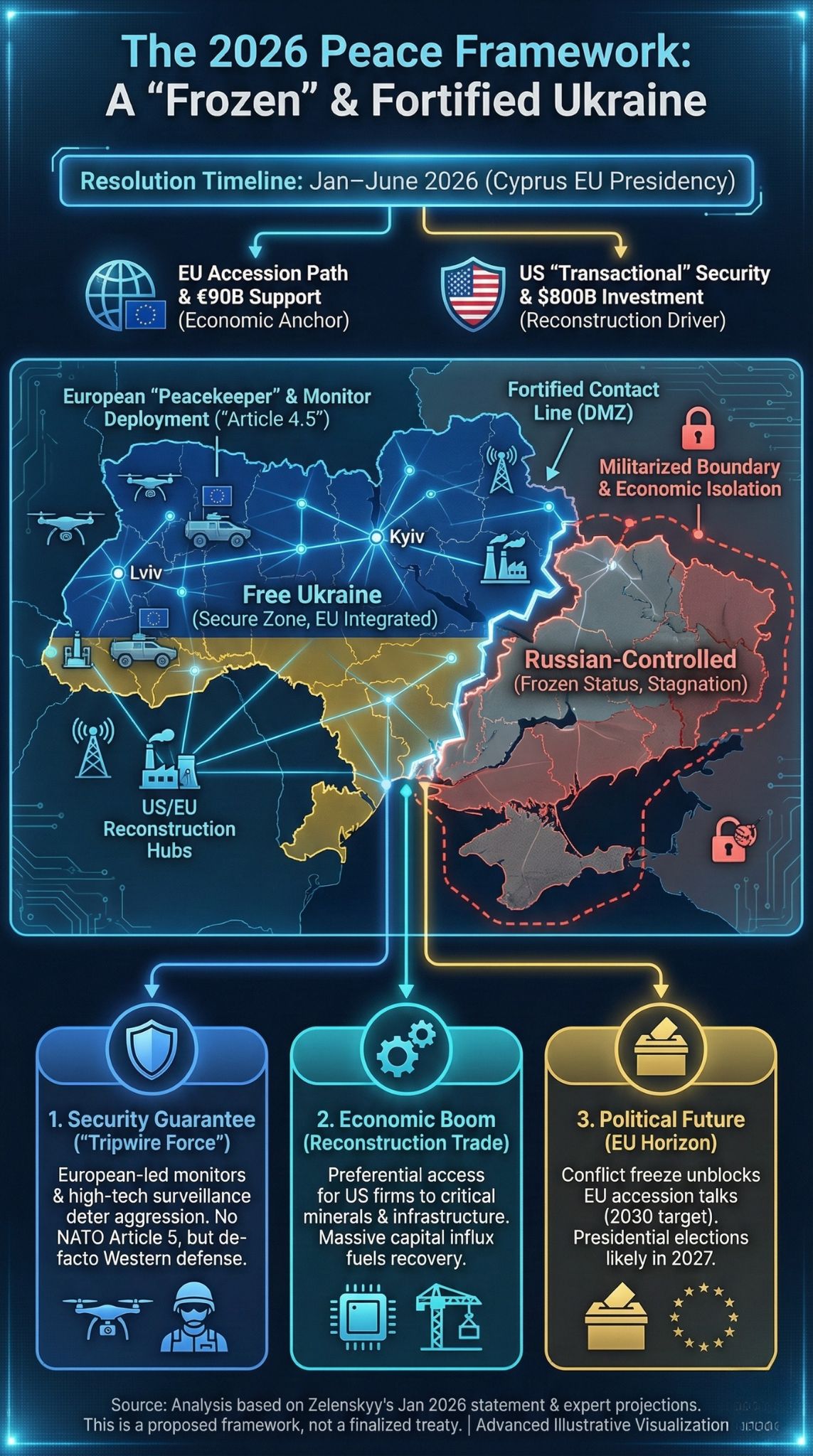
Ukraine’s Internal Struggle Zelenskyy’s timeline is also an electoral one. Elections have been suspended since 2024. A “Resolution” in mid-2026 would likely trigger presidential elections by late 2026 or early 2027.
The challenge for Zelenskyy is the “Korea Scenario”—accepting a frozen conflict without formally ceding land. Recent polls suggest 72% of Ukrainians would accept a freeze if accompanied by ironclad security guarantees (the European peacekeepers), but the nationalist opposition may frame this as capitulation.
The “Budanov Factor” The recent reshuffle, appointing Kyrylo Budanov as Chief of Staff, signals a dual-track strategy: negotiate the peace, but keep a hardliner close to manage the military’s reaction. Budanov’s presence assures the armed forces that the “resolution” isn’t a surrender.
Expert Perspectives
The Hawk: “Any ceasefire in 2026 that leaves Russia in control of the land bridge to Crimea is just a pause. Putin will use this time to rearm and attack again in 2028.” — Institute for the Study of War (Hypothetical Analyst Note)
The Realist: “This is the best deal Ukraine gets. The manpower isn’t there to retake the Donbas, and Western aid is shifting to loans. A fortified, prosperous Western Ukraine is a victory in itself.” — GLOBSEC 2026 Security Scenarios
The Economist: “Russia is running on fumes. The 2026 budget shows no room for offensive operations without printing money to hyperinflation levels. Moscow needs this pause as much as Kyiv.”
Future Outlook: What Happens After the Signatures?
If Zelenskyy’s timeline holds, the “Resolution” of mid-2026 will not be a peace treaty, but a highly militarized armistice.
- The Grey Zone: Expect a DMZ (Demilitarized Zone) similar to the 38th Parallel, monitored by drones and European troops.
- Economic Boom vs. Bust: Ukraine will see a massive influx of reconstruction capital (the $800B deal), creating a post-war boom. Russia will likely face a “post-war hangover” as military demand vanishes, potentially sparking domestic unrest.
- EU Accession: The Cyprus presidency is symbolic. The end of active hostilities unblocks Ukraine’s EU accession talks, likely setting a 2030 target for full membership.
Key Milestones to Watch (Next 6 Months):
- February 2026: The Paris Summit outcomes (deployment of peacekeepers?).
- April 2026: IMF review of Russia’s Q1 economic performance (the breaking point?).
- June 2026: End of Cyprus EU Presidency—the deadline for the “Resolution.”
Final Thoughts
Zelenskyy’s statement is the first time the “end” has been defined by a calendar date rather than a military condition. It acknowledges a painful reality: total military victory is unlikely, but a strategic victory—a secure, EU-integrated Ukraine backed by Western troops—is within reach. The war may end in 2026, not with a bang, but with a signature.