Why Does Norway Have So Many Electric Cars when most countries are still trying to “boost adoption” year after year? In Norway, electric vehicles are not a niche product or a trend. They are simply what most people buy when they replace a car. That shift didn’t happen because Norwegians are magically different drivers. It happened because Norway changed the rules and the experience of owning a car.
Over time, Norway made gas and diesel cars expensive to buy, while making EVs easier to afford and easier to live with. It also made charging feel normal, not stressful. And because Norway’s electricity is mostly renewable, EVs fit neatly into the country’s broader energy story. When you stack price, convenience, and confidence together, you get a market where EVs become the default choice.
This article explains the five biggest reasons behind Norway’s EV dominance, plus what other countries can copy and what is harder to replicate. The goal is simple: clear facts, practical explanations, and a useful takeaway for readers who want to understand how Norway became the world’s EV leader.
Quick Snapshot Of Norway’s EV Lead (Numbers That Matter)
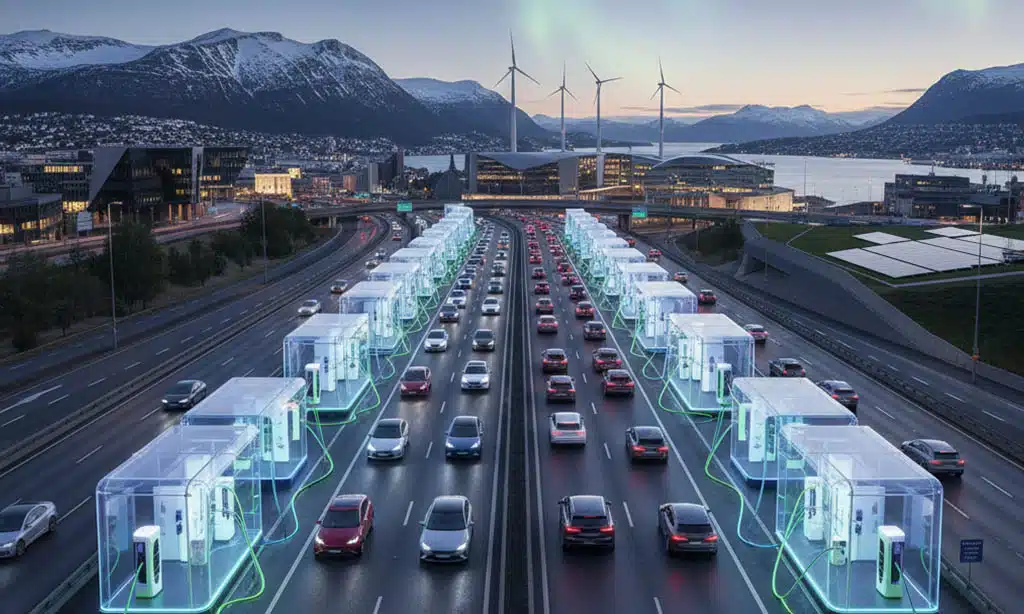
Norway is often labeled the EV capital of the world, and the numbers behind that claim are hard to ignore. The most attention-grabbing metric is new car sales share. In recent years, battery-electric vehicles have taken the overwhelming majority of new passenger car registrations in Norway, reaching close to nine out of ten new cars in 2024. That level of dominance is rare anywhere else, especially for a technology that was considered “early adopter” not long ago.
But it’s also important to understand what those numbers do and do not mean. New car share can flip fast when incentives are strong. The total car fleet changes more slowly because older vehicles stay on the road for years. Norway’s EV success looks strong on both metrics: EVs dominate new sales, and EVs are becoming a large share of the total passenger car fleet too. That second point matters because it shows the change is real and lasting, not just a short-term spike.
The snapshot also tells you something else: Norway is already dealing with “late-stage EV adoption” issues. That includes scaling charging where demand is highest, adjusting incentives so the tax system remains sustainable, and making sure the transition stays fair. Those are the issues other countries will face later, after they pass the early growth phase.
In other words, Norway is not just ahead. It is living in the future of mass EV adoption. That is why studying Norway is so useful for anyone trying to predict what comes next in other markets.
Norway EV Adoption Snapshot
| Metric | What It Tells You | Why It Matters |
| EV share of new car sales | What buyers choose today | Shows how strong the market has become |
| EV share of total car fleet | How fast the whole fleet changes | Proves it’s not just a “new sales” story |
| EVs vs diesel/gas in the fleet | Drivetrain tipping point | Signals a structural market shift |
| Charging readiness | Can people charge easily? | Convenience decides mass adoption |
| Policy direction | Are rules stable and clear? | Long-term confidence drives decisions |
What People Mean By “EV Capital” (And What This Article Does Not Claim)
The phrase “EV capital” sounds simple, but it can mean different things depending on what you measure. Some people mean “the highest EV share of new car sales.” Others mean “the most EVs per person.” Some use it to describe charging density or how easy it is to own an EV without hassles. Norway scores well across most of these definitions, which is why the label sticks.
At the same time, it’s easy to oversimplify the story. Norway did not become the EV capital because of one subsidy. It wasn’t a single law or a single political party. It was a system. The system included taxes, perks, infrastructure, energy, and social acceptance that grew stronger over time. That “stack” of advantages is what made EVs feel like the obvious choice.
This article also avoids two common traps. First, it does not claim Norway is perfect. Every policy has costs, and every market has drawbacks. Second, it does not pretend Norway’s path is automatically repeatable elsewhere. Some countries have different electricity mixes, different housing patterns, and different public budgets. Those differences matter.
What you will get here is a clear, neutral explanation of why the strategy worked in Norway, what the trade-offs look like, and which parts are most transferable. If you want to understand EV adoption in the real world, Norway is the best case study available.
What “EV Capital” Can Mean
| Meaning | Simple Definition | Example Measure |
| Sales-share leader | EVs dominate new registrations | % of new passenger cars that are EVs |
| Fleet transition leader | EVs are a large share of cars on the road | % of total car fleet that is EV |
| Charging-ready country | Charging is practical and reliable | Chargers per area + uptime + access |
| Policy leader | Incentives and rules push EVs long-term | Tax design + perks + targets |
Reason 1: EV-Friendly Taxes Made Electric Cars The Default Choice
Norway’s biggest EV accelerator is not a marketing campaign or a “green mindset.” It is the way the country taxes cars. Norway designed its vehicle taxation so that higher-emission vehicles cost more to purchase, while zero-emission vehicles are treated more favorably. That difference at the checkout is often large enough to change a buyer’s decision.
This approach matters because it works on the biggest barrier to EV adoption: upfront price. Many drivers compare sticker prices more than lifetime costs. Norway made EV prices feel reasonable next to gas and diesel alternatives, especially in the years when batteries were more expensive and EV options were fewer. When EVs became competitive, adoption took off.
Another key point is policy stability. Buyers need to trust that incentives won’t vanish right after they commit to a major purchase. Norway’s incentives were not random or short-lived. They were part of a long-running strategy that allowed consumers and automakers to plan ahead. That predictability is one of the most underrated reasons Norway’s EV shift became so deep.
Taxes also send a cultural message. When your system consistently rewards low-emission choices, the market starts treating those choices as normal. That shift changes dealer behavior, used-car markets, financing options, and even social expectations. Over time, it becomes less about “choosing green” and more about “choosing smart.”
How Purchase Taxes And Registration Taxes Shape Car Prices
Purchase-related taxes can quietly control what people buy, because they change the final number a buyer must pay. Norway’s system traditionally placed heavy taxes on new cars, which made the tax exemptions and reductions for EVs unusually powerful. When the tax gap is large, the market moves fast.
The practical outcome is simple. Many buyers who might have considered a mid-range gas car find that a comparable EV suddenly looks affordable. In some cases, the EV can even look like the better deal when you consider equipment levels, financing, and resale value. This pushes EVs beyond early adopters and into regular households.
It also shapes the market for manufacturers. If a country consistently sells mostly EVs, automakers treat that country differently. They bring more models, they prioritize deliveries, and they compete harder on price. Over time, the selection improves, and adoption grows again.
This becomes a feedback loop: more demand brings more supply, and more supply makes EVs easier to buy. That loop is one reason Norway reached mass adoption earlier than most countries.
How VAT Rules Influence “Mass Market” Adoption
VAT is a major cost in many countries, and Norway’s VAT is high by global standards. Favorable VAT treatment for EVs has been one of the strongest levers for making EVs affordable. As EVs became dominant, Norway adjusted the VAT design so the system could remain sustainable while still supporting mainstream EV adoption.
That adjustment matters because it shows how incentives evolve. Early on, many countries need strong incentives to create a market. Later, those incentives can be narrowed, capped, or redesigned. Norway’s approach demonstrates a key principle: you can tighten incentives without crashing demand if EVs have already become the default.
For readers, the takeaway is not “copy Norway’s exact rule.” The takeaway is to recognize that VAT treatment can make or break mass adoption. If you want EVs to become normal, you must reduce the upfront sticker shock.
Why Predictable Policy Beats One-Time Subsidies
One-time subsidies often create a short spike in demand and then a slump when the money runs out. Predictable policy does the opposite. It builds confidence, and confidence builds stable demand. Stable demand gives businesses permission to invest, including charging networks, service teams, and training for technicians.
Predictable policy also reduces stress for consumers. People don’t feel rushed into buying. They don’t worry that they “missed the window.” They also see EV ownership as a safe choice, not a gamble.
This is a major reason Norway’s EV story looks different from countries that rely on temporary rebate programs. Norway built a long runway. That runway gave the market time to mature, prices time to fall, and the public time to accept EVs as normal.
Reason 1 Key Points
| Key Driver | What It Did | Result For Buyers |
| Purchase/registration tax design | Made high-emission cars costly | EVs look better at checkout |
| VAT advantages (with later adjustments) | Reduced sticker shock for many EVs | EVs became mass-market |
| Long-term consistency | Increased trust and planning | Stable demand, not boom-bust |
Reason 2: Everyday Perks Reduced The Friction Of Driving Electric
Norway didn’t just make EVs cheaper to buy. It also made EVs nicer to own. That second part matters more than many people realize. When a new technology feels inconvenient, it stays niche. When it feels easy, it becomes normal.
Everyday perks have included discounts or advantages related to toll roads, ferries, and local road charges. Some areas also experimented with parking benefits or access perks. These incentives reduced the daily cost of driving and made EV ownership feel rewarding in small ways that add up over months and years.
These perks also worked as a psychological bridge. For a long time, EVs were new. People had questions: Will it work in winter? Can I charge it easily? What if I need a long trip? Perks gave drivers a reason to try EVs even if they still had doubts. Once they tried an EV, many discovered they liked the driving experience, quiet cabins, and home charging convenience.
As EV adoption grew, Norway adjusted these perks. That is another important lesson. A good incentive is not necessarily permanent. It can be phased down as markets mature. Norway’s story shows how to use perks as a temporary push, not a forever entitlement.
Toll Roads, Ferries, And Local Fee Discounts
Toll and ferry costs can be a daily reality in Norway, depending on where you live and how you travel. Discounts here can be meaningful, especially for commuters and families who travel frequently. For many households, these savings made EV ownership feel immediately beneficial rather than “good for the future.”
These perks are also visible. A tax exemption is real, but it’s invisible once you’ve bought the car. A toll discount shows up repeatedly in your routine. That repetition reinforces the feeling that EVs are the smart choice.
Over time, as EVs became the norm, Norway moved toward limiting how generous these discounts can be. That helps keep systems fair and financially stable while still maintaining some advantage for zero-emission driving.
The lesson is clear: when you want people to adopt a new technology, reward them in ways they notice often.
Parking, Access Benefits, And Time Savings
Some EV perks are about money. Others are about time. Time is often more valuable than a small discount. In dense places, access benefits or parking policies can strongly influence choices, especially for people who drive daily for work.
Even when such perks are local and not universal, they signal something important: public authorities want EV adoption, and they are willing to shape urban rules to make EV ownership easier.
However, these perks are also politically sensitive. If too many people qualify, the advantage disappears. If the perk feels unfair to non-EV drivers, it can create backlash. That is why many places adjust or remove these benefits as adoption grows.
Norway’s experience suggests that perks work best when they are targeted, time-limited, and tied to clear goals.
Why Perks Matter Even When EV Prices Fall
As EV prices drop and models improve, you might assume perks become less important. In reality, perks still matter because they reduce friction. Even when two cars cost roughly the same, the more convenient option tends to win.
Perks also help in the “middle market,” where buyers are not EV enthusiasts. They simply want the best overall deal. If an EV comes with lower daily costs and less hassle, it becomes the rational choice.
And perks can speed up the used market. When more people buy new EVs, more used EVs appear later. That helps lower-income buyers enter the EV market. A healthy used market is essential for full fleet transition.
So even when prices improve, perks can be the difference between “growth” and “dominance.”
Reason 2 Key Points
| Incentive Type | What It Changes | Why It Works |
| Toll/ferry discounts | Lowers daily driving cost | Frequent, visible savings |
| Local fees and perks | Reduces hassle | Makes EVs feel easier |
| Time-related benefits | Saves minutes every day | Strong behavioral nudge |
| Gradual reduction | Prevents backlash | Keeps incentives sustainable |
Reason 3: Charging Infrastructure And Reliability Kept Range Anxiety Low
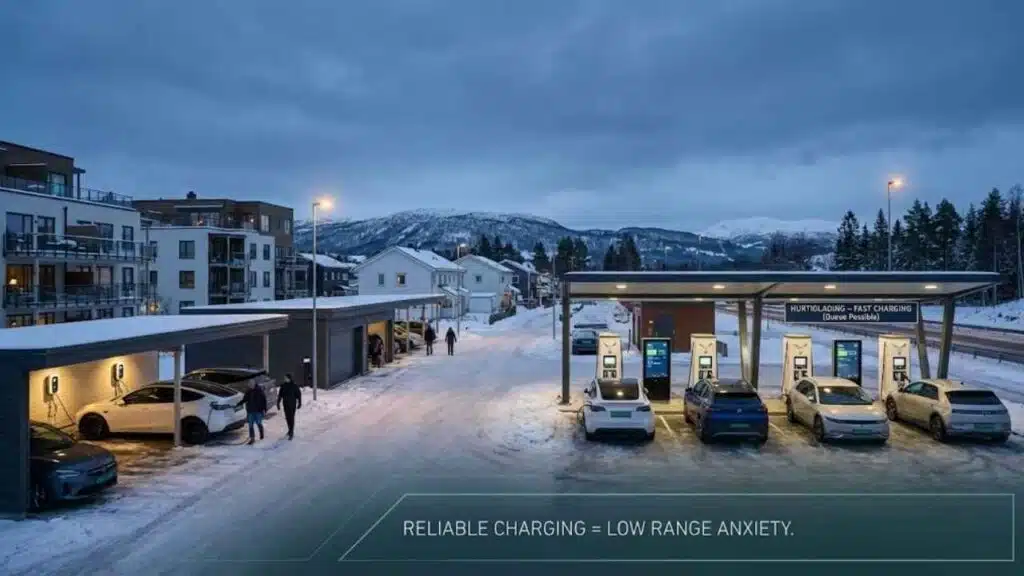
Even the best incentives fail if drivers can’t charge easily. Charging is the backbone of practical EV life. Norway invested in charging growth and created conditions where charging providers had confidence to expand. The goal was not just “more chargers,” but “less anxiety.”
A key point is that most EV charging is not supposed to happen at public fast chargers. The ideal EV lifestyle is charging at home or at work. That turns charging into something you do while sleeping or working, not something you do on purpose like a fuel stop.
Norway’s high EV share also created market pressure. When a country sells mostly EVs, charging becomes a business opportunity. Providers invest because there are customers. That is another feedback loop: more EVs attract more charging, and better charging attracts more EVs.
Still, high adoption creates new issues too. Busy travel weekends and popular urban zones can face queues if infrastructure growth lags behind demand. Norway’s experience is useful because it shows what “late-stage scaling” looks like.
Home Charging Advantage And Apartment Solutions
Home charging is often the biggest convenience advantage EVs have over gas cars. If you can plug in where you live, you stop thinking about charging as a chore. You just drive and recharge naturally.
But apartments complicate this. Norway’s EV success required solutions for shared parking, building rules, and installation challenges. The details vary by city and building type, but the principle is universal: apartment charging access is essential for EVs to become mainstream.
Workplace charging also helps. For people who cannot charge at home, charging at work can deliver the same “set it and forget it” convenience.
The takeaway is that EV adoption is not only about highways. It is also about neighborhoods and parking spaces.
Public Fast Charging On Highways And Key Routes
Fast chargers are what make EVs feel road-trip ready. Even if you use them rarely, you want to know they exist. That knowledge changes how confident you feel about buying an EV.
In a country with winter conditions and long drives, fast charging corridors matter. Drivers want to know they can reach cabins, family homes, and tourist destinations without complicated planning.
Fast charging is also a safety net for people who cannot charge at home. It gives them the confidence that EV ownership is still possible, even if it requires a different routine.
A reliable fast-charging network turns EV ownership from “urban-friendly” into “nationally practical.”
What Still Causes Charging Complaints (Even In Norway)
No charging system is perfect, especially when adoption is very high. The most common complaints in high-EV markets tend to be about queues, broken chargers, confusing payment systems, or poor charging behavior (cars left plugged in too long).
Winter can also reduce range and increase energy use for heating. That means drivers may need to charge more often, especially on long trips. Charging speeds can also be affected by cold batteries, which is why preconditioning and modern battery management matter.
Another issue is peak demand. When everyone travels at the same time, even a strong network can feel strained. Norway’s story shows that infrastructure must keep growing even after EVs dominate sales.
The lesson is not that EVs “don’t work.” The lesson is that success creates new scaling tasks.
Reason 3 Key Points
| Charging Element | What It Solves | Why It Matters |
| Home and workplace charging | Makes charging effortless | Builds everyday convenience |
| Apartment charging solutions | Expands access to more people | Unlocks city-wide adoption |
| Fast charging corridors | Enables long trips | Removes range anxiety |
| Reliability and uptime | Prevents frustration | Trust drives repeat purchases |
| Scaling for peak travel | Avoids queues in hotspots | High adoption requires growth |
Reason 4: Clean, Affordable Electricity Made EVs Economically Logical
Norway’s electricity system is a major advantage for EV adoption. The country produces most of its electricity from hydropower, which means EVs can be driven with very low operational emissions compared to countries with fossil-heavy grids.
This matters for the climate argument, but it also matters for the economic argument. When electricity is relatively affordable and stable compared to fuel prices, EVs can offer lower cost per kilometer. That advantage grows when drivers can charge at home during off-peak hours or use smart charging options.
Norway also benefits from energy familiarity. People already trust electricity as a reliable system in daily life. Electrifying transport then feels like a natural next step, not a risky experiment.
Still, electricity markets can face price swings, and winter demand can increase overall system pressure. Norway’s advantage is not “free energy.” It is that the energy base is clean and largely domestic, which supports long-term electrification.
Electricity Mix And Why It Matters For Real-World Emissions
EVs have no tailpipe emissions, but real-world climate impact depends partly on the electricity used to charge them. In a country with a mostly renewable grid, EVs can deliver strong emissions reductions compared to gas and diesel cars.
This also affects public acceptance. When people believe EVs genuinely reduce emissions, support tends to rise. In contrast, in countries with coal-heavy grids, public debates can become more polarized.
Norway’s electricity mix makes the EV story easier to defend with plain logic. Charge a car with renewable power and you cut emissions. That clarity is powerful in politics and in public perception.
It also influences corporate fleets. Businesses can switch to EVs and credibly claim emissions benefits, which supports green procurement and ESG goals.
Energy Prices, Cost Per Kilometer, And Buyer Math
Most buyers do not calculate cost per kilometer precisely, but they feel it in their monthly budget. EVs often have lower running costs because electricity can be cheaper than gasoline or diesel for equivalent distance. EVs can also have lower routine maintenance because they have fewer moving parts than internal combustion engines.
The combination of lower operating cost and strong purchase incentives helped Norway make EVs a rational financial choice, not only an environmental one.
For many families, that financial logic is what matters most. People like clean technology, but they love predictable monthly costs. EVs can deliver that predictability when charging access is easy.
This is why Norway’s EV dominance is not just about ideology. It’s about household economics.
The Oil Producer Paradox: Why Norway Still Went All-In
Norway is known globally for oil and gas production, so it may seem contradictory that it leads in EVs. But domestic transport policy and export industries are separate issues. A country can export resources while also choosing to reduce domestic emissions and air pollution.
Norway’s approach can be seen as practical. It used policy tools to shape domestic consumption, improve air quality, and reduce transport emissions while maintaining economic strength.
This is also a reminder that energy transition is not “one switch.” It can happen in parts. Transport electrification can move faster than other sectors because the technology is ready and the benefits are immediate for consumers.
In simple terms, Norway found a way to make EVs make sense at home, regardless of what it sells abroad.
Reason 4 Key Points
| Energy Factor | What It Changes | Why It Helps EV Adoption |
| Renewable-heavy power | Stronger emissions benefit | Boosts public support |
| Lower operating cost potential | Better monthly budget experience | Makes EVs financially attractive |
| Domestic electricity strength | More energy confidence | Supports long-term electrification |
| Maintenance savings | Fewer routine service costs | Improves total cost of ownership |
| Winter realities | Higher energy use | Planning + infrastructure solves it |
Reason 5: Long-Term Political Consensus And Public Buy-In Did The Heavy Lifting
One reason Norway’s EV story is so strong is that it lasted. Policies didn’t flip every election cycle. That stability gave consumers confidence and allowed businesses to invest in charging, service networks, and model availability. It also allowed the used EV market to grow steadily, which is critical for broader adoption.
Political consensus does not mean everyone agreed on every detail. It means the overall direction stayed consistent: reward zero-emission vehicles and steadily move the market toward cleaner transport.
Public buy-in grew because EV ownership delivered real benefits. Drivers experienced quiet rides, instant acceleration, lower operating costs, and convenient home charging. When the “EV experience” is good, support becomes self-reinforcing.
Norway also reached a stage where EVs became social proof. When many neighbors drive EVs, the technology feels normal. That reduces uncertainty and lowers the psychological barrier to switching.
At that point, EV adoption becomes less of a campaign and more of a default behavior.
Cross-Party Continuity Since The Early Incentive Years
Continuity is a hidden superpower in policy. People buy cars expecting to keep them for years. If incentives feel fragile, buyers hesitate. Norway’s long-running approach reduced that hesitation.
Continuity also helps supply. Automakers prioritize markets with stable demand. Stable demand leads to better selection, faster deliveries, and sometimes better pricing. That makes the market even stronger.
It also helps infrastructure providers. Charging companies are more likely to invest when they believe EV growth is steady, not temporary.
In short, continuity turns EV adoption from a short-term program into a long-term transformation.
No Big Domestic Auto Lobby (A Quiet Advantage)
Countries with large traditional car manufacturing sectors often face harder trade-offs because policy changes can threaten existing jobs and investments. Norway imports most passenger vehicles, so the politics of EV adoption focused more on consumers, emissions, and infrastructure than on protecting a domestic automaker base.
This doesn’t mean Norway had no resistance. It means the political obstacles were different, and sometimes simpler.
That also allowed Norway to build a policy that was strongly consumer-facing. If consumers benefit and the market shifts, politicians can point to visible success.
In practical terms, Norway had fewer “industrial politics” constraints than some countries, which may have helped speed up policy action.
Culture, Environmental Values, And Tech Adoption
Culture is real, but it should not be used as a lazy explanation. The better way to say it is this: Norway’s policies shaped behavior, and behavior shaped culture. When EV ownership becomes common, it becomes part of normal life.
Environmental values can support adoption, especially when paired with practical benefits. But values alone rarely create a market shift of this scale. Norway’s success happened because EVs were not only “better for the planet.” They were also easier to live with and often cheaper over time.
Tech adoption also becomes easier when people trust institutions and infrastructure. Reliable electricity, reliable roads, and predictable rules create the conditions where new technologies feel safe.
So yes, culture played a role, but it worked together with policy, infrastructure, and economics.
Reason 5 Key Points
| Social/Political Factor | What It Does | Why It Matters |
| Policy continuity | Builds long-term confidence | Encourages buyers and investors |
| Clear national direction | Aligns cities and agencies | Prevents fragmented progress |
| Consumer experience | Creates positive word-of-mouth | Social proof accelerates adoption |
| Fewer domestic auto constraints | Reduces industrial resistance | Makes policy easier to sustain |
| Ability to adjust incentives | Avoids backlash | Keeps transition realistic |
Why Does Norway Have So Many Electric Cars? A Simple Recap
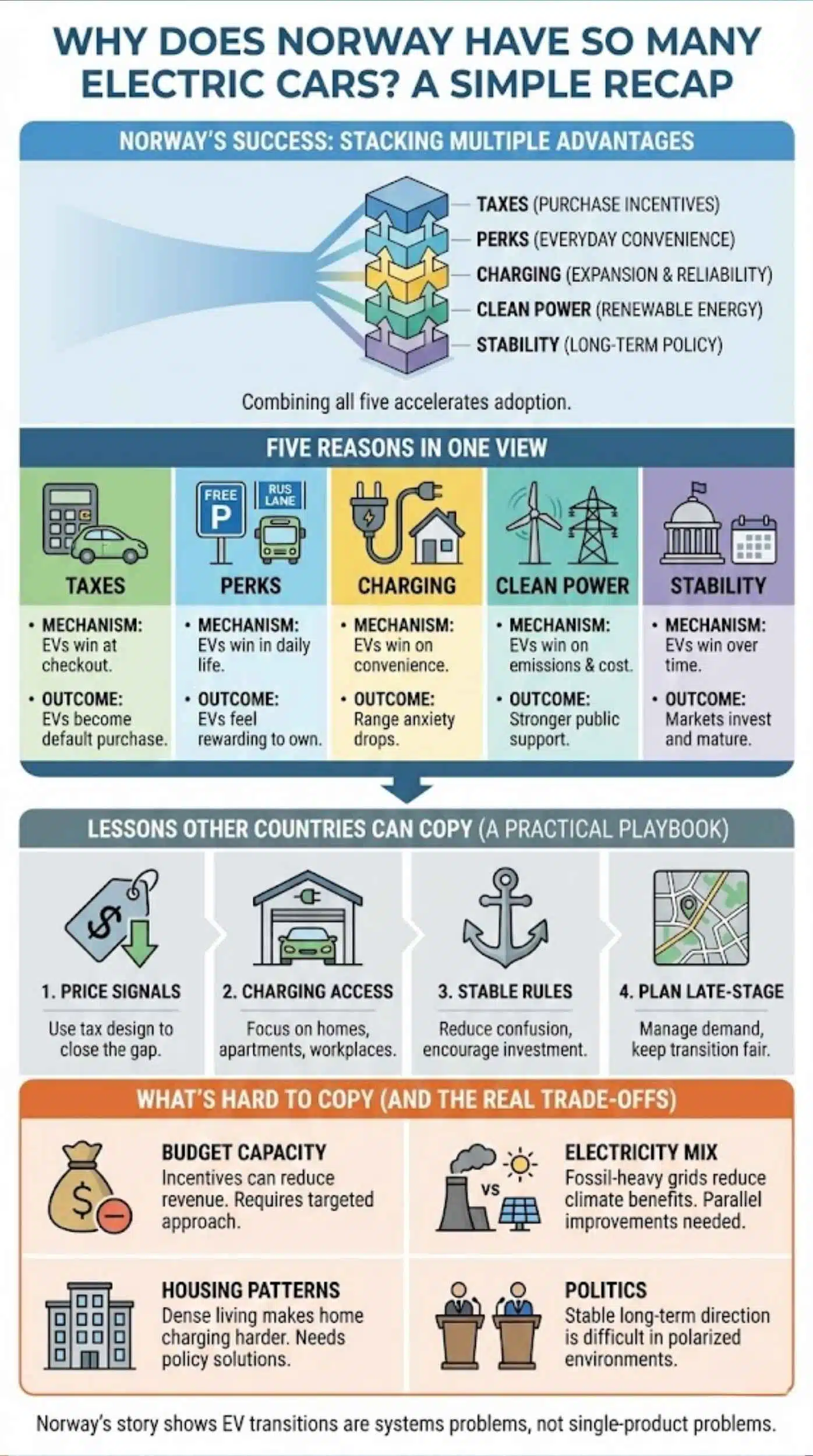
Why Does Norway Have So Many Electric Cars comes down to one core idea: Norway stacked multiple advantages instead of relying on just one. It made EVs cheaper to buy through tax design. It made EVs cheaper and easier to use through everyday perks. It made EVs practical through charging expansion. It strengthened the climate logic through renewable electricity. And it kept the direction steady long enough for the market to fully transform.
If you remove any one piece, adoption slows. If you combine all five, adoption accelerates. That is Norway’s real lesson.
Five Reasons In One View
| Reason | The Core Mechanism | The Outcome |
| Taxes | EVs win at checkout | EVs become default purchase |
| Perks | EVs win in daily life | EVs feel rewarding to own |
| Charging | EVs win on convenience | Range anxiety drops |
| Clean power | EVs win on emissions and cost | Stronger public support |
| Stability | EVs win over time | Markets invest and mature |
Lessons Other Countries Can Copy
Norway’s path is not a perfect template, but it offers a practical playbook.
Start with price signals. If gas and diesel cars are still cheaper at purchase, many buyers will stick with what they know. Use tax design, fee structures, or targeted incentives to close that gap.
Next, make charging easy where people park. Focus on homes, apartments, and workplaces. Highway fast charging is important, but daily charging access is what makes EVs effortless.
Then, keep the rules stable. Stable policies reduce confusion and encourage investment. Many markets fail not because EVs are bad, but because the policy environment is unpredictable.
Finally, plan for the “late stage.” When EVs dominate sales, the problems change. You must scale charging, manage electricity demand smartly, and keep the transition fair.
What To Copy First
| Action | Why It Works | Practical First Step |
| Strong, clear price signals | Changes buyer behavior fast | Redesign taxes/fees |
| Charging where people park | Reduces daily friction | Apartment + workplace charging |
| Reliable fast-charging corridors | Builds travel confidence | Prioritize key routes |
| Stable multi-year policy | Builds trust and investment | Publish a long-term plan |
| Equity-focused design | Keeps support broad | Target support to mainstream buyers |
What’s Hard To Copy (And The Real Trade-Offs)
Some parts of Norway’s success are harder to replicate.
Budget capacity matters. Strong incentives can reduce government revenue. If a country is already under fiscal pressure, it may need a more targeted approach.
Electricity mix matters too. A renewable-heavy grid makes EV climate benefits clearer and stronger. Countries with fossil-heavy grids can still benefit from EVs, especially on air pollution, but the climate argument may require parallel grid improvements.
Housing patterns matter. Home charging is easiest in detached homes with private driveways. Dense apartment living requires policy and infrastructure solutions that are harder than installing a home wallbox.
Finally, politics matters. Stable long-term direction is difficult in polarized environments. That doesn’t mean it’s impossible. It means the strategy must be designed to survive political change.
Norway’s story is powerful, but it also shows that EV transitions are systems problems, not single-product problems.
Hard-To-Copy Constraints
| Constraint | Why It Slows Adoption | What Helps |
| Limited public budget | Incentives can be costly | Target incentives carefully |
| Fossil-heavy electricity | Reduces climate impact | Clean the grid in parallel |
| Apartment-heavy housing | Home charging is harder | Shared charging solutions |
| Political instability | Policies may change fast | Build cross-party support |
| Peak demand scaling | Chargers can get crowded | Keep expanding infrastructure |
Final Thoughts
Why Does Norway Have So Many Electric Cars is not a mystery when you look at the full system. Norway made EVs cheaper at purchase through tax policy. It reduced daily ownership friction through perks. It built charging confidence through infrastructure. It benefited from clean electricity that strengthened the climate and cost argument. And it maintained stable direction long enough for EVs to become normal.
The real lesson is simple: EV adoption grows fastest when EVs are the easiest choice, the cheapest choice, and the least stressful choice. Norway engineered that reality over time. That is why its EV transition is not just impressive. It is instructive.
FAQs
What Percent Of New Cars Sold In Norway Are Electric?
In recent years, Norway has reached close to nine out of ten new passenger car sales as battery-electric vehicles, and some recent periods have been even higher. The exact percentage varies by year and month, but the overall trend is clear: EVs dominate new registrations.
Are EVs In Norway Subsidized Or Mostly Tax-Advantaged?
Norway’s strongest lever has been tax advantage and tax design rather than a single cash subsidy. The impact is similar: EVs become cheaper than gas and diesel alternatives for many buyers.
Do Electric Cars Work Well In Norway’s Winter?
Yes, but winter reduces range and can affect charging speed. Drivers manage this with good charging access, realistic trip planning, and modern EV features like battery preconditioning.
Is Norway Banning Gas And Diesel Cars?
Norway is best understood as pushing the market with incentives and long-term targets. The result is that EVs win the market without needing a simple “ban headline” to explain adoption.
What Can Other Countries Learn From Norway’s EV Strategy?
Make EVs financially attractive, make charging easy, keep policy stable, and plan for scaling. Norway’s success is a stacked approach, not a single trick.