
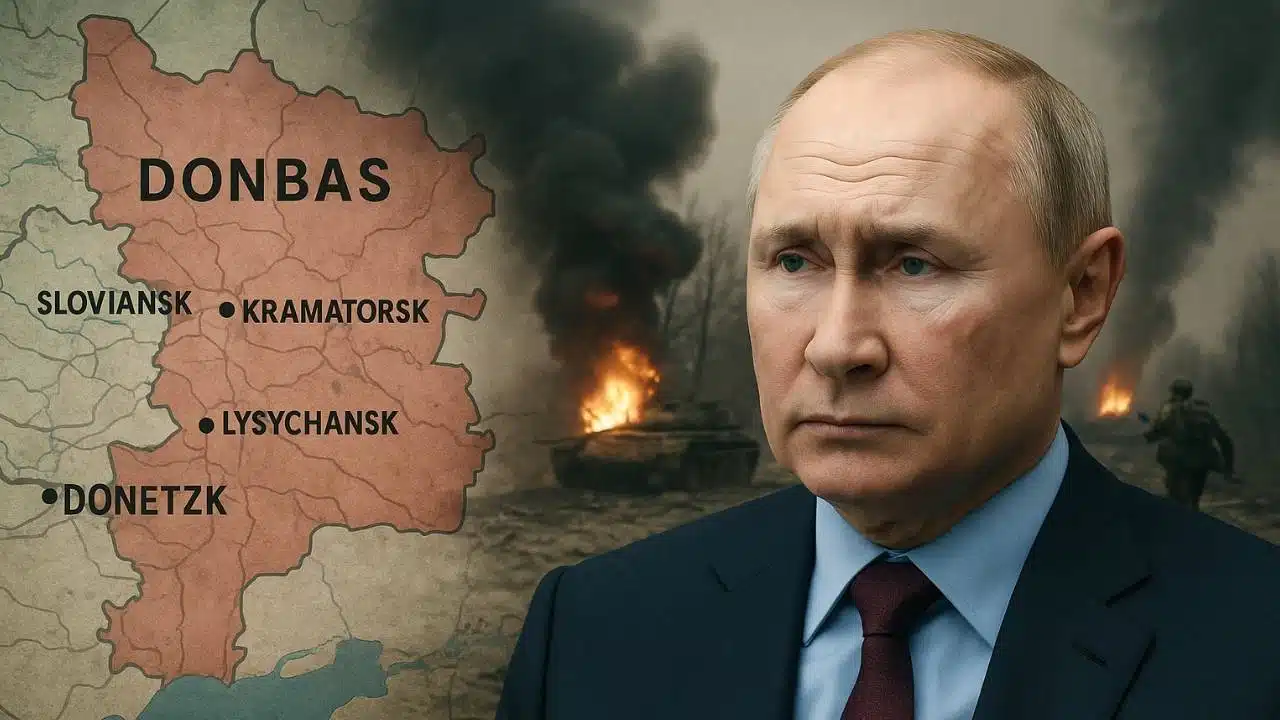
Russian President Vladimir Putin has issued one of his clearest and most uncompromising warnings to date regarding the future of Ukraine’s eastern Donbas region. Speaking to Source before his scheduled state visit to New Delhi, Putin insisted that Ukrainian troops must withdraw from territories Russia claims as its own—or Russia will take full control by force. His statement underscores Moscow’s refusal to consider territorial concessions or compromise on what it calls the “liberation” of Donbas, a region where Russia currently controls about 85% of the territory following nearly three years of war.
Putin’s remarks directly clash with Ukraine’s long-standing position. President Volodymyr Zelensky has repeatedly stressed that Kyiv will never surrender any part of its internationally recognized territory, including Donbas and the Russian-occupied areas seized since the start of the full-scale invasion in February 2022. Zelensky argues that accepting territorial loss would reward aggression, weaken Ukraine’s sovereignty, and set a dangerous global precedent.
Putin’s warning came at a particularly sensitive moment. The United States, under President Donald Trump, is attempting to craft a peace plan that could bring an end to the war. Trump’s selected envoy, businessman Steve Witkoff, recently held lengthy talks with Russian officials in the Kremlin, followed by planned discussions with Ukraine’s negotiating team in Florida. Trump described the initial meetings as “reasonably good,” though he cautioned that no agreement could be predicted yet, noting that “it does take two to tango” when both sides hold firm red lines.
Stalled Negotiations and Unresolved Disputes Over Territory and Security
The U.S. initiative has already attracted controversy. Early drafts of the peace proposal reportedly suggested placing remaining Ukrainian-controlled areas of Donbas under temporary Russian administrative arrangements—an idea viewed by many in Kyiv and Europe as far too accommodating to Moscow. Although the Witkoff delegation presented Russia with a revised version of the plan, Putin said he had not seen the updated text before his meeting with Witkoff and Trump adviser Jared Kushner. According to Putin, the discussions took considerable time because Russian officials needed to review each point in detail.
Despite this effort, the Kremlin publicly stated that the discussions did not lead to significant progress. Yuri Ushakov, one of Putin’s senior advisers and a central figure in Russia’s negotiations, declared that the talks produced “no compromise.” He hinted that Russia’s battlefield advances in southeastern Ukraine had strengthened Moscow’s hand, allowing it to negotiate from what it sees as a position of increased military confidence.
Ukraine strongly rejects that framing. Ukrainian Foreign Minister Andrii Sybhia accused Russia of dragging out discussions while intensifying operations on the ground, arguing that Moscow aims to capture more territory before agreeing to any ceasefire. Ukraine maintains that meaningful peace talks can only happen if backed by firm international pressure on the Kremlin and secured through reliable, enforceable guarantees that Russia will not use a future ceasefire to regroup and attack again.
Zelensky noted that Ukrainian negotiators had already pushed for major revisions to the original U.S. plan when they met American delegates in Geneva on 23 November. Both sides described the updated terms as a more balanced “refined peace framework,” though neither Kyiv nor Washington released specifics, citing diplomatic sensitivity.
European Leaders Voice Alarm and Fear a Potential U.S.–Russia Deal Over Ukraine’s Head
Concerns intensified across Europe following a report by Germany’s Der Spiegel, which claimed to have reviewed a confidential transcript from a high-level conference call involving several European leaders. According to the report, the leaders expressed deep unease about the direction of U.S. negotiations and the possibility that Washington could agree to territorial concessions that Ukraine itself rejects.
In the reported transcript, French President Emmanuel Macron was quoted as warning that the United States might “betray Ukraine on the issue of territory,” highlighting fears that Kyiv could be pressured into making unacceptable compromises without firm security guarantees. German Chancellor Friedrich Merz reportedly urged President Zelensky to act “extremely carefully” in the coming days, cautioning that various parties involved in negotiations might be “playing games” with both Ukraine and Europe. Finnish President Alexander Stubb was quoted as reinforcing those concerns, saying that Europe must ensure Ukraine is not left isolated at the negotiating table.
Although the Source has not verified the transcript and the Élysée Palace denied the exact wording attributed to Macron, European governments have long emphasized that any peace agreement must respect Ukraine’s sovereignty. They fear a rushed or imbalanced deal could destabilize Europe’s security landscape for years.
Responding to the speculation, the White House insisted that the Trump administration’s peace team—which includes Secretary Marco Rubio, Steve Witkoff, and Jared Kushner—continues to work “tirelessly” to gather feedback from both sides and shape a peace proposal capable of producing a durable settlement. U.S. officials stressed that conversations remain ongoing and that no final terms have been agreed.
Meanwhile, the situation on the battlefield remains volatile. Russia currently controls roughly 20% of Ukrainian territory, and despite incurring heavy losses, Russian troops have made incremental gains in southeastern Ukraine in recent weeks. Kyiv believes these advances are part of Moscow’s strategy to strengthen its negotiating position and force Ukraine into concessions it otherwise would not consider.