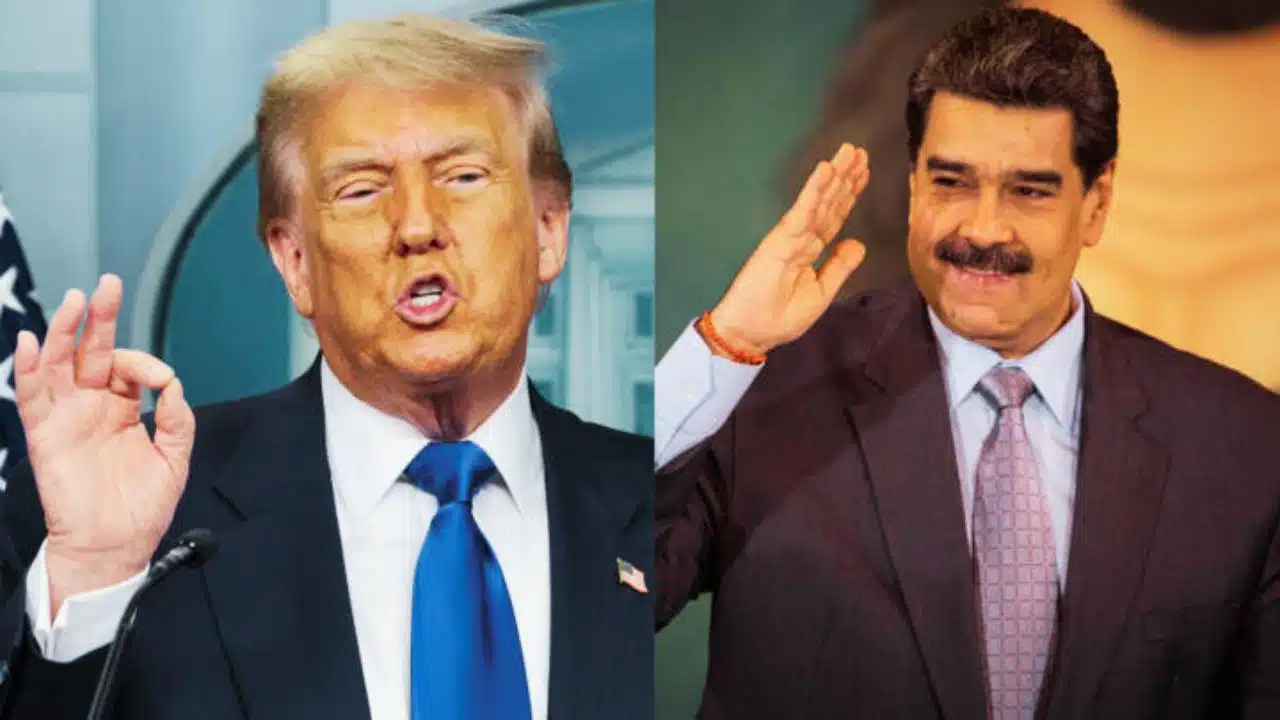
US President Donald Trump has signaled he is open to authorizing military strikes inside Mexico to combat drug trafficking, while simultaneously floating the prospect of direct talks with Venezuelan leader Nicolás Maduro amid a broader regional security and narcotics crackdown.
Speaking to reporters in the Oval Office, Trump said he would be “OK” with US counter‑drug strikes on Mexican territory and refused to rule out putting American troops on the ground in Venezuela, framing both moves as part of an aggressive effort to stop narcotics and illegal migration reaching the United States.
‘Would I Launch Strikes in Mexico? It’s OK With Me’
Pressed by reporters on whether he would sanction cross‑border operations in Mexico, Trump gave one of his clearest endorsements yet of potential unilateral US military action against drug cartels operating in a neighboring ally.
“Would I launch strikes in Mexico to stop drugs? It’s OK with me. Whatever we have to do to stop drugs,” Trump said, adding that he believed such action could save “millions of lives” in the United States.
Trump stressed that no such operation had been ordered but underscored his personal support for the idea, saying, “I didn’t say I’m doing it, but I’d be proud to do it.”
Mexico Bristles as Ally Is Cast as a Battlefield
Trump’s comments risk inflaming tensions with Mexico, which has long pushed back against any suggestion of unilateral US military action on its soil and insists that security cooperation must respect national sovereignty.
The US president has repeatedly accused Mexico of failing to sufficiently confront powerful trafficking organizations and of allowing drugs and migrants to flow north, sharpening his rhetoric despite existing joint efforts on intelligence‑sharing and border security.
Analysts warn that public talk of airstrikes or raids inside Mexico could complicate cooperation with President Andrés Manuel López Obrador’s government and fuel anti‑US sentiment, even as both countries depend on each other economically and logistically to tackle cartel violence.
Military Pressure Mounts Around Venezuela
Trump’s remarks on Mexico came as Washington steps up a high‑profile military and intelligence posture around Venezuela, officially framed as a campaign against narcotics traffickers operating in the Caribbean and northern South America.
The US has deployed warships, aircraft and thousands of personnel to the region, and has carried out a series of strikes on boats it says were carrying drugs near Venezuelan waters, operations that have reportedly killed dozens and further rattled Caracas.
In parallel, the administration is moving to designate Venezuela’s alleged “Cartel de los Soles” — which Washington claims is headed by Maduro and senior officials — as a terrorist organization, a label that would open the door to broader sanctions and potential military options.
Trump Leaves Troop Option ‘On the Table’ in Venezuela
Asked whether he would rule out deploying US troops in Venezuela, Trump pointedly declined to do so, signaling that he wants adversaries to believe that all instruments of power remain available.
“No, I don’t rule out that, I don’t rule out anything,” he said, arguing that Venezuela has “dumped hundreds of thousands of people into our country from prisons” and linking Maduro’s government directly to drugs and migration flows into the US.
The comments extend a years‑long pattern in which Trump has used open‑ended language on possible military action to pressure foreign leaders, even as Pentagon officials and many lawmakers remain wary of another US intervention in Latin America.
Opening a Diplomatic Channel With Maduro
In a notable shift in tone, Trump also said he “probably would talk to” Nicolás Maduro at some point, describing a potential diplomatic opening even as Washington continues to treat the Venezuelan leader as an authoritarian adversary.
“At a certain period of time, I’ll be talking to him,” Trump told reporters, while stressing that Maduro “has not been good to the United States” and insisting that his government has inflicted “tremendous damage” through drugs and migrant flows.
Hours later, Maduro signaled that he, too, was open to dialogue, declaring that “anyone who wants to engage in dialogue will find in us people of their word” and punctuating his message with an appeal in English: “Talk, yes. Peace, yes. War, no. Never, never, war.”
Maduro Cries ‘Aggression’ as CIA Given Expanded Role
Venezuela has denounced the US military build‑up and covert operations as part of a push for regime change, accusing Washington of violating international law and threatening the country’s sovereignty.
Trump has authorized the CIA to conduct operations in and around Venezuela, a move that has deepened anxiety in Caracas about potential destabilization efforts and revived memories of the agency’s Cold War‑era footprint in Latin America.
Maduro responded with military drills and fiery rhetoric, warning against “CIA‑orchestrated coups d’état” and urging the US public to reject “endless wars” like those seen in Iraq and Libya, even as he calls for dialogue to defuse the confrontation.
Domestic Politics and a Hard‑Line Image
The twin messages — openness to striking cartels inside Mexico and leaving the door open to force in Venezuela while dangling talks with Maduro — come as Trump seeks to project a tough‑on‑crime, tough‑on‑border image to voters at home.
Advisers and experts suggest the White House is attempting to negotiate “from a place of strength,” using military deployments and terrorist designations as leverage to extract concessions from Maduro on political transition, migration and control over natural resources such as oil.
Trump’s critics, however, argue that the strategy is dangerously escalatory, risks drawing the US into open conflict, and blurs the line between counter‑narcotics operations and broader geopolitical ambitions in a region with a long history of US interventions.
Regional Fallout and Strategic Uncertainty
Beyond Mexico and Venezuela, Trump has signaled that Colombia’s “cocaine factories” could also become targets, saying he would be “proud” to “knock out those factories” as part of an expanded anti‑drug campaign.
Such rhetoric unsettles partners across Latin America, where governments balance a desire for US assistance against fears of becoming entangled in unilateral American military ventures and domestic backlash.
For now, US objectives remain opaque: officials speak of combating drug trafficking and “narco‑terrorism,” while analysts note that Washington could also be seeking leverage over migration policy and access to key natural resources, even as the risk of miscalculation or unintended escalation grows.