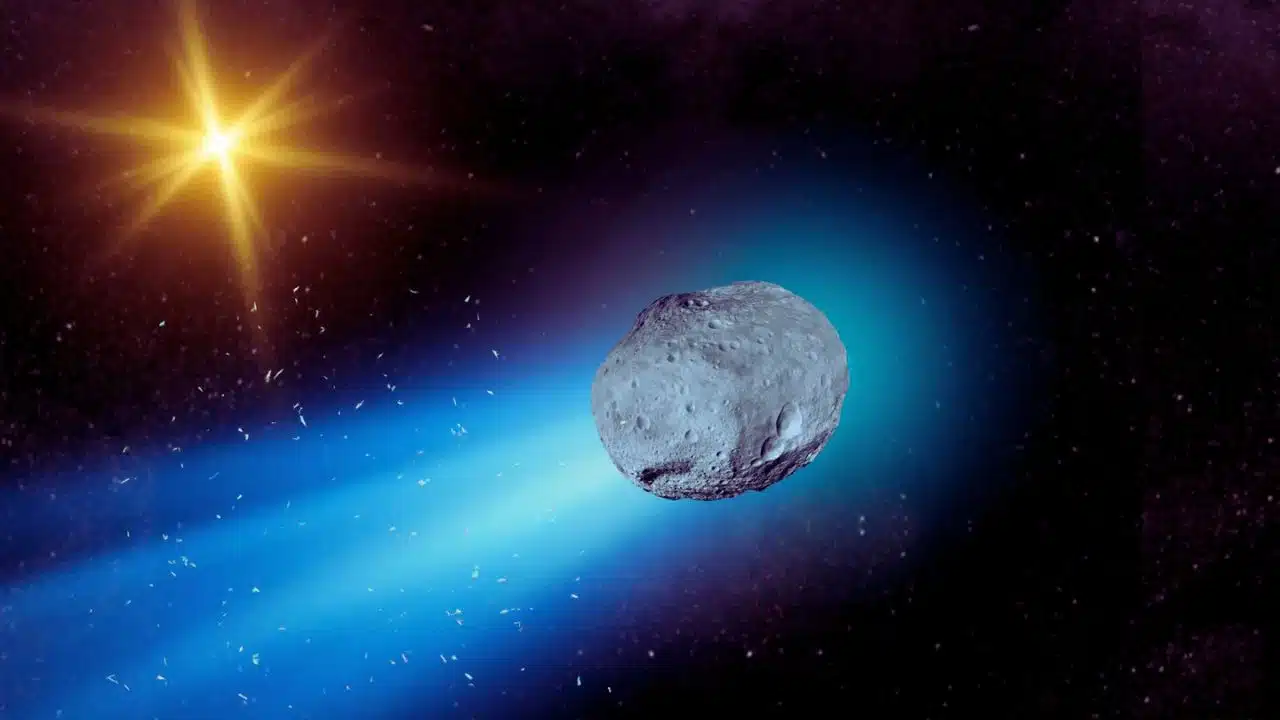
Scientists around the world are racing to study an ancient interstellar comet sweeping through our Solar System, hoping it will reveal how stars, planets, and perhaps even the building blocks of life formed billions of years ago.
A rare visitor from deep space
Astronomers have identified the object as 3I/ATLAS, only the third known interstellar visitor after 1I/ʻOumuamua and 2I/Borisov. Unlike ordinary comets born in the icy outskirts of our own Solar System, 3I/ATLAS is thought to have formed around a distant star and then been flung into interstellar space, wandering the galaxy for billions of years before arriving here.
Early observations show the comet is travelling at extraordinary speed on a hyperbolic path, meaning it will pass through once and never return. Its steep trajectory through the Milky Way suggests it comes from the galaxy’s ancient “thick disk,” a region populated by some of the oldest known stars.
Possibly the oldest comet ever seen
Scientists estimate that 3I/ATLAS could be more than 7 billion years old, making it potentially older than our 4.6‑billion‑year‑old Solar System. If confirmed, that would make it the most ancient comet ever observed and a unique sample of the early Milky Way, preserved in ice and dust.
Researchers say the object likely formed around an ancient star when the galaxy itself was still young, locking in a chemical record of that primordial environment. Because interstellar space is so cold and dark, much of that material may have remained largely unchanged during its journey between the stars.
Why scientists are so excited
Interstellar comets are natural probes of other planetary systems, carrying matter that condensed around distant suns under conditions very different from our own. By measuring the gases, dust, and ices streaming off 3I/ATLAS, astronomers hope to compare its chemistry with that of typical Solar System comets and see how planet-forming disks vary across the galaxy.
Such objects could also reveal how comets help “seed” newborn star systems with water and organic molecules, ingredients seen as crucial for the emergence of life. If ancient interstellar comets like 3I/ATLAS regularly pass through young planetary systems, they may play a hidden role in distributing the raw materials for oceans and atmospheres on newly forming worlds.
Signs of an active, unusual comet
Telescopes have already spotted a bright coma of gas and dust surrounding 3I/ATLAS, confirming that the object behaves like a classic comet as it is warmed by the Sun. Astronomers have also reported unusual features, including a rare “anti‑tail,” a structure that appears to point toward the Sun due to the geometry of its orbit and the way dust spreads out along its path.
Spectroscopic measurements show a chemical mix that does not match anything seen before in local comets, hinting at formation under very different conditions. Researchers are particularly interested in volatile elements and metals in the gas surrounding the comet, which can act as fingerprints of its birthplace far beyond our own stellar neighborhood.
Clues from radio signals and water
One of the most intriguing discoveries came when radio observatories detected emissions from hydroxyl radicals, molecules produced when ultraviolet sunlight breaks apart water vapor in the comet’s coma. This signature is a classic sign that 3I/ATLAS is rich in water ice, reinforcing the conclusion that it is a natural comet rather than anything artificial.
The strength and behavior of these emissions are helping scientists estimate how much water the comet is releasing and how its nucleus responds to solar heating. That information feeds into models of how interstellar comets form, how their ice survives eons in deep space, and how similar bodies might behave when they pass near other stars.
A surface reshaped by cosmic radiation
New research suggests that billions of years exposed to cosmic rays in interstellar space may have dramatically altered the comet’s outer layers. High‑energy particles can darken and harden the surface, creating an insulating crust that hides more pristine material deeper inside.
Scientists studying 3I/ATLAS think the outer shell may no longer preserve its original composition, complicating efforts to treat it as an untouched relic. However, they hope that as the comet approaches the Sun, deeper, less‑processed layers may be exposed through fractures and jets, providing a clearer view of its ancient interior.
Racing against time with powerful telescopes
Because the comet is moving so quickly and will soon head back into the dark between the stars, observatories worldwide are coordinating an intensive observing campaign. Ground‑based telescopes, space observatories, and radio arrays are all being used to track the coma, tail, composition, and rotation of 3I/ATLAS over the coming months.
Future facilities such as the Vera C. Rubin Observatory are expected to spot many more such visitors, but 3I/ATLAS offers an early test of how to study them in detail. Astronomers say each new interstellar object will add pieces to a much larger puzzle about how common comets are in the galaxy and how they shape the evolution of planetary systems.
What this comet could reveal about us
By comparing 3I/ATLAS with earlier interstellar visitors like ʻOumuamua and Borisov, scientists can start to map the diversity of objects roaming the galaxy. Initial studies suggest that each may come from a different stellar population and age group, offering snapshots of planet formation across billions of years.
In the long run, these ancient travelers could change how humanity understands its own origins, showing whether the ingredients for planets and life are unique to the Solar System or widely shared among the stars. For now, 3I/ATLAS is giving astronomers a fleeting but extraordinary chance to hold a piece of the galaxy’s deep past up to the light and read the story written in its ice.