In a ruling that has sent shockwaves through the tech world, a federal jury in San Francisco ordered Google to pay $425 million after finding the company unlawfully collected smartphone app usage data even when users had deliberately switched off tracking features. The verdict, delivered on September 3, 2025, concludes a class action lawsuit first filed in July 2020, which represented tens of millions of American consumers.
According to legal filings, the case affected an estimated 98 million users and 174 million devices across the United States. The decision underscores the growing legal risks facing Big Tech firms as governments, watchdogs, and consumers push back against invasive data collection practices.
The Core of the Lawsuit: Google’s Privacy Settings Questioned
The case revolved around Google’s “Web & App Activity” setting, which was marketed as a way for users to control whether their app activity would be saved and used for ad personalization. Plaintiffs argued that, even with this option disabled, Google continued to intercept, track, and sell app usage data from widely used platforms such as Uber, Venmo, Instagram, and others.
The plaintiffs’ attorneys accused Google of “illegal interception of consumers’ private activity”, alleging that the company misled users by promoting privacy controls that, in reality, failed to block hidden tracking operations.
The suit claimed that the data was systematically harvested and monetized through advertising technologies at the very heart of Google’s $200-billion-a-year business model.
Jury’s Findings: A Costly Verdict but No Punitive Damages
After weeks of testimony, jurors found Google liable on two of three major claims, siding with consumers who insisted their privacy rights had been violated.
Key points from the jury’s decision include:
- $425 million in compensatory damages: awarded based on the scale of data collection and its estimated financial value.
- No punitive damages: jurors did not find that Google acted with “malice” or intentional harm, which would have triggered much higher financial penalties.
- Massive scale: the case covered years of hidden tracking and spanned millions of users, making it one of the largest privacy awards in U.S. history.
While the damages represent a huge payout, the lack of punitive penalties means Google avoided the possibility of fines running into the billions.
Google’s Defense: “We Will Appeal”
Immediately after the verdict, Google spokesperson Jose Castaneda defended the company’s practices and confirmed it would appeal the ruling.
Google’s position is that:
- Its privacy tools are transparent and give users meaningful control.
- When users turn off personalization, Google claims it “honors that choice.”
- Data collected in this case was described as pseudonymous and non-personal, not tied to specific user identities.
However, the jury clearly rejected this defense, finding that users were misled about how their app activity was tracked.
Broader Context: Google’s Mounting Privacy Troubles
This ruling adds to a growing list of privacy and regulatory challenges faced by Google in both the United States and Europe.
Previous U.S. Cases
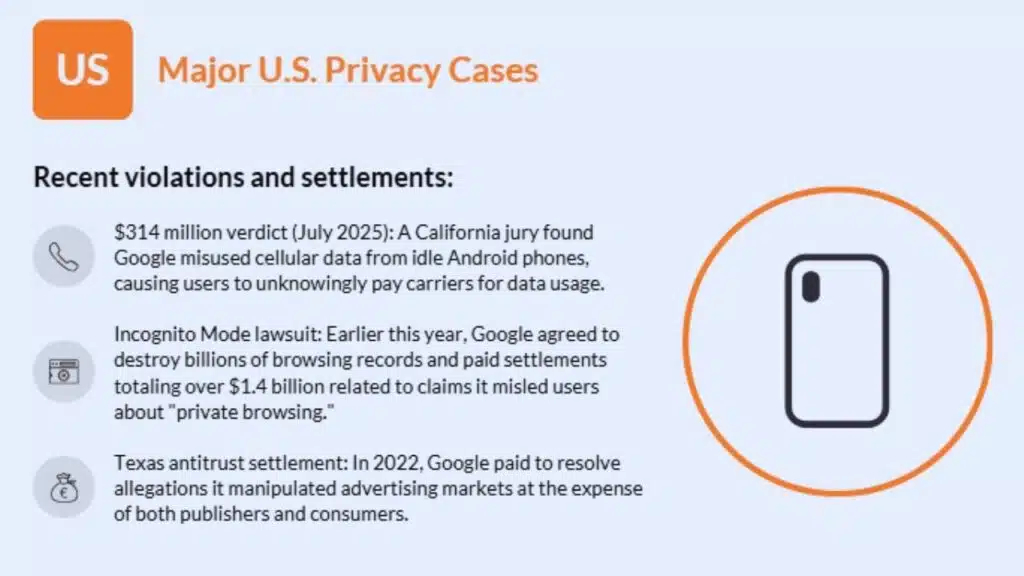
- $314 million verdict (July 2025): A California jury found Google misused cellular data from idle Android phones, causing users to unknowingly pay carriers for data usage.
- Incognito Mode lawsuit: Earlier this year, Google agreed to destroy billions of browsing records and paid settlements totaling over $1.4 billion related to claims it misled users about “private browsing.”
- Texas antitrust settlement: In 2022, Google paid to resolve allegations it manipulated advertising markets at the expense of both publishers and consumers.
European Fines
The company has also faced repeated penalties in Europe, particularly from France’s CNIL watchdog, which has aggressively enforced EU privacy laws:
- 2020: €100 million fine for cookie violations.
- 2021: €150 million fine for making it too difficult for users to refuse cookies.
- 2025: Another €325 million fine for failing to secure free, informed consent for advertising cookies.
In the same decision, fast-fashion giant Shein was fined €150 million—the largest penalty ever imposed on an e-commerce retailer in France.
Why This Matters: A Turning Point for Tech Privacy
The $425 million judgment is not just a financial setback for Google—it represents a broader shift in how courts and regulators treat the balance between user privacy and tech profits.
Key Implications:
- User Trust at Risk; Consumers increasingly expect that when they toggle off tracking, companies will respect that choice. This verdict highlights a trust gap between what companies promise and what they actually deliver.
- Legal Precedent: The case sets a precedent that privacy assurances must be clear, enforceable, and transparent. Ambiguous or misleading settings can expose firms to billion-dollar lawsuits.
- Global Scrutiny: Regulators in the EU, UK, India, and Australia are watching closely. Google, along with rivals like Meta, Amazon, and Apple, may face similar lawsuits over hidden tracking practices.
- Business Model Under Fire: Google’s reliance on targeted advertising is once again under pressure. With cookies being phased out and alternatives like Privacy Sandbox under review, the company must prove it can generate ad revenue without violating user rights.
What Comes Next?
Google has confirmed it will appeal the San Francisco ruling, which could delay payouts for years. Appeals courts will re-examine whether the jury misapplied the law or whether the damages awarded were excessive.
Meanwhile, lawmakers in Washington, D.C., are pushing for federal privacy legislation that could standardize rules across all 50 states, potentially limiting Google’s ability to argue that its practices comply with fragmented state laws.
In Europe, privacy watchdogs are intensifying their enforcement. Google is still under active investigation by EU regulators for how its advertising ecosystem handles user data after third-party cookies are phased out in 2025–2026.
This $425 million verdict represents more than just another fine for Google. It is a wake-up call for the tech industry, showing that users, regulators, and courts are no longer willing to accept vague promises about privacy.
As governments worldwide ramp up scrutiny, Google and other tech giants face a clear challenge: rebuild user trust with genuine transparency, or risk further billion-dollar penalties.
The Information is Collected from BBC and MSN.