The India–UK Free Trade Agreement (FTA) signed in 2025 is a major breakthrough in bilateral economic relations and marks a pivotal moment in modern trade diplomacy. This comprehensive deal is expected to dramatically enhance trade volumes, remove long-standing tariff barriers, and open new doors for goods, services, and professionals between two major economies.
As global trade systems face turbulence—especially due to the effects of protectionist policies in other parts of the world—this FTA stands out for fostering cooperation, improving economic integration, and securing long-term gains for industries and individuals alike. With India now enjoying 99% duty-free access to the UK, and both countries reducing import taxes across hundreds of product categories, the deal is already being hailed as a landmark achievement.
Key Deal Structure and Economic Scope
The India–UK trade deal has been carefully designed to bring mutual economic benefits through staged tariff liberalization. The agreement immediately eliminates or significantly reduces tariffs on a broad range of products from both countries.
-
99% of Indian exports to the UK will now enter duty-free, effectively removing nearly all import taxes on Indian goods.
-
For UK exporters, 90% of tariff lines will see gradual reductions, with 85% of them becoming completely duty-free over the next decade.
-
Bilateral trade between India and the UK reached $21.9 billion in 2024, and the agreement is projected to increase annual trade flows by an additional £25.5 billion over time.
This deal also addresses non-tariff barriers, improves market access in services, and streamlines customs and mobility protocols, creating a modern and holistic partnership that extends well beyond the trade of goods.
1. Full Duty-Free Access for India’s Exports: Unlocking Competitive Advantage
A critical highlight of the FTA is the immediate provision of zero tariffs on 99% of Indian exports. This change dramatically improves India’s competitiveness in the UK market across numerous sectors:
-
Previously, key Indian goods faced tariffs ranging between 10% and 70%, severely impacting profit margins and price competitiveness.
-
The duty-free access now covers nearly all of India’s current export value, creating a predictable and stable environment for businesses.
This comprehensive tariff elimination provides a strategic edge for India’s exporters and helps offset preferential access enjoyed by competitors like Bangladesh and Vietnam under existing trade arrangements.
2. Agriculture and Processed Foods: Major Boost for Rural India
India’s agriculture and agro-processing sectors are among the biggest beneficiaries of the FTA:
-
The deal ensures duty-free access for over 95% of agricultural tariff lines, enabling smooth entry for a wide range of products into the UK.
-
These include fresh fruits and vegetables, cereals, pulses, millets, spices (e.g., turmeric and black pepper), processed foods, and value-added items like mango pulp, pickles, and jams.
Earlier, some processed food items faced steep tariffs of up to 70% in the UK. Their removal is expected to increase agri-export earnings by over 20% within three years, benefiting millions of Indian farmers, cooperatives, and agro-industrial units.
The deal also opens new markets for emerging superfoods like jackfruit and millets, aligning with India’s initiative to promote millets globally.
Importantly, the agreement safeguards sensitive agricultural sectors such as dairy, edible oils, apples, and oats, ensuring that Indian farmers in these areas are protected from potential market disruptions.
3. Marine Products: A $5.4 Billion Opportunity Waiting to Be Tapped
India’s marine industry gains strategic access to one of the world’s most lucrative seafood markets:
-
Key products such as shrimp, tuna, fishmeal, and aquafeed are now free of UK tariffs, which previously ranged between 4.2% and 8.5%.
-
India currently holds only a 2.25% market share of the UK’s marine imports, indicating a significant growth potential.
-
The sector is projected to expand to $5.4 billion in exports, offering fresh growth opportunities for India’s coastal economies, especially in states like Andhra Pradesh, Kerala, Gujarat, and Odisha.
With zero-tariff access, Indian exporters can scale up production, improve packaging and compliance, and compete more effectively with exporters from countries like Vietnam, Thailand, and Norway.
4. Textiles and Clothing: Removing Historical Disadvantages
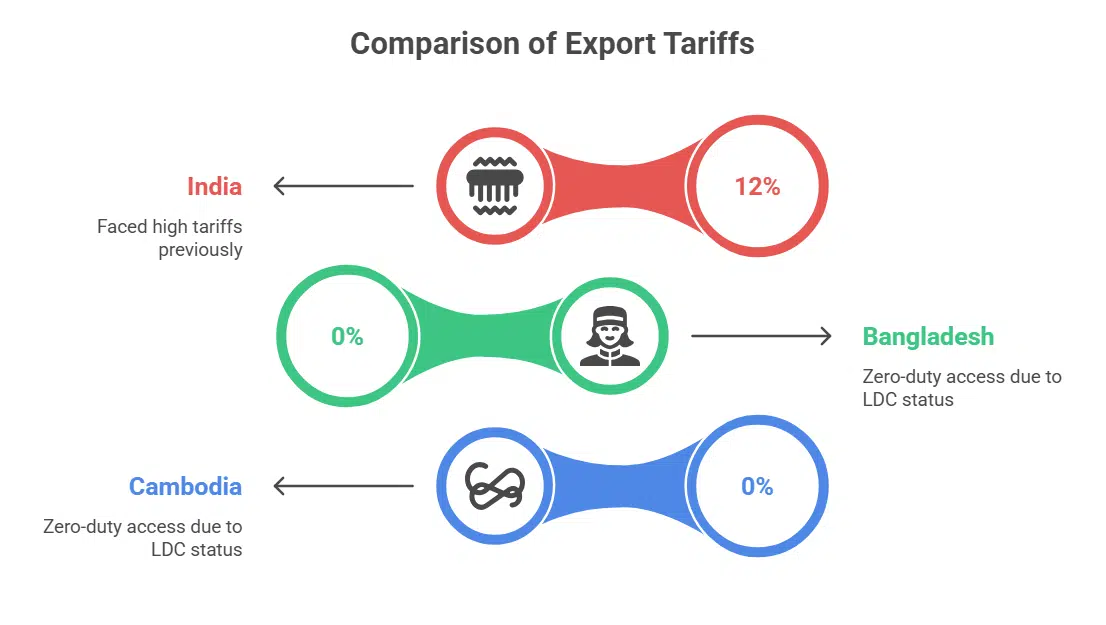
The Indian textile and apparel industry receives a major boost through duty-free access across 1,143 tariff lines:
-
These cover ready-made garments, home textiles, carpets, woollens, and handicrafts.
-
Previously, Indian exporters faced tariffs as high as 12%, while countries like Bangladesh and Cambodia had zero-duty access due to their Least Developed Country (LDC) status.
The UK textile market is valued at $26.95 billion, but India’s share has remained underwhelming at $1.79 billion. With the new agreement:
-
Indian exporters are expected to gain at least 5% more market share within the next two years.
-
MSMEs in hubs like Ludhiana, Tiruppur, Panipat, and Surat stand to gain from increased exports and improved order volumes.
Despite India’s global engineering exports worth $77.79 billion, only $4.28 billion worth of goods go to the UK. The FTA aims to change that:
-
The deal eliminates import duties (previously up to 18%) on industrial machinery, transport equipment, auto parts, and power tools.
-
The UK imports over $193.52 billion in engineering goods annually, creating immense untapped potential for Indian manufacturers.
Projections suggest that India’s exports in this category could double to $7.5 billion by 2029–2030, helping MSMEs and large manufacturers gain strong footholds in the UK market.
6. Pharmaceuticals and Medical Devices: Expanding Access to the UK Healthcare Market
The FTA has strategic implications for India’s pharma sector, which is globally recognized for its affordable generics:
-
Tariffs on generic drugs have been removed, improving market access in a country where India already has a strong pharmaceutical presence.
-
India’s current pharma exports to the UK stand at $1 billion, while the UK imports over $30 billion annually.
In addition, the deal ensures zero-duty access for medical devices such as:
-
Surgical instruments
-
Diagnostic kits
-
ECG and X-ray machines
This will make Indian medical products more competitive in the UK and support public healthcare affordability in both countries.
7. Chemicals and Plastics: Accelerating Industrial Trade
India’s exports of chemicals and plastics are expected to grow significantly due to tariff eliminations:
-
Chemical exports to the UK, currently valued at $843 million, could rise by 30–40%, reaching $650–750 million by FY2026.
-
High-growth categories include intermediates, polymers, and specialty chemicals.
-
India’s plastic exports are projected to increase by 15%, especially in products like films, sheets, pipes, packaging materials, and kitchenware.
This will help manufacturers in Gujarat, Maharashtra, and Tamil Nadu expand into UK supply chains.
8. Sports Goods, Toys, Gems, and Jewellery: Strengthening Niche Exports
India’s niche sectors also stand to gain from the FTA:
-
Sports goods such as cricket bats, soccer balls, rugby equipment, and non-electronic toys will benefit from zero tariffs.
-
In gems and jewellery, where India currently exports $941 million, the FTA provides access to the UK’s $3 billion jewellery market.
This is expected to double India’s jewellery exports within 2–3 years, providing a major boost to artisans and exporters in Surat, Jaipur, and Mumbai.
9. Leather and Footwear: Empowering MSME Clusters
The FTA removes 16% tariffs on leather products and footwear, providing a lifeline for India’s leather sector, which is driven by small and medium enterprises (SMEs).
-
Cities like Agra, Kanpur, Kolhapur, and Chennai are projected to see exports rise beyond $900 million.
-
Indian leather manufacturers are expected to gain 5% more market share in the UK within the next 1–2 years.
This growth will enhance employment in rural and semi-urban manufacturing hubs, which are central to India’s export strategy.
10. Mobility for Indian Professionals: Major Gains in Services Sector
One of the most progressive aspects of the deal is the support for labour mobility and professional services:
-
75,000 Indian professionals will be exempt from UK social security contributions for up to three years, lowering the cost of working abroad.
-
Indian service providers gain access to 36 service sectors without needing to clear an Economic Needs Test, facilitating quicker market entry.
-
Professionals from India can work in 35 identified sectors for up to 2 years, even if their employers have no local office in the UK.
-
Additionally, 1,800 Indian cultural professionals including chefs, yoga instructors, and musicians will be eligible for short-term visas annually, strengthening cultural diplomacy and employment.
This framework supports India’s growing pool of tech workers, consultants, wellness experts, and creative professionals seeking global opportunities.
A Strategic and Inclusive Partnership
The India–UK Free Trade Agreement 2025 is not just a tariff-reduction pact. It is a forward-looking framework that enhances economic collaboration, boosts employment, supports SMEs, encourages professional mobility, and strengthens bilateral ties.
With its wide-ranging benefits across sectors, the deal lays a solid foundation for inclusive growth, enabling both nations to emerge stronger in a rapidly shifting global economy. For India, it marks another major step toward becoming a global manufacturing and export powerhouse. For the UK, it secures a reliable, high-growth partner in Asia amid post-Brexit trade realignment.