The entire dilemma of public versus private cloud has been frustrating IT people for over ten years. Both public and private cloud come with great features, and honestly, choosing between the two often feels like choosing your favorite child. Private cloud offers you that nostalgia of control and dedicated resources, while public cloud solutions have been overwhelmingly successful lately, and there is some good reasoning behind this.
It comes down to scaling platform that does not crush your CFO or corporate purse strings, and access to faster innovation that would take your company years to build in-house. That being said, weighing the right decision is not following a trend; it is assessing what matters to your own specific business circumstance.
This guide will help us to put these questions to rest by comparing how two approaches actually stack up and explaining why many companies are no longer looking to develop a private cloud solution, but instead taking advantage of the flexibility of public cloud benefits.
Defining Public Cloud vs. Private Cloud
Let me effectively summarize this for you. Public cloud is like living in a really nice apartment. You are a tenant that shares an infrastructure with other tenants, but you still receive an individual space and someone is taking care of maintenance, upgrades and security. Notable vendors include Amazon Web Services, Microsoft Azure and Google Cloud Platform.
Private cloud on the other hand is like owning a home. You are user of dedicated hardware, you have complete control, and there is no tenant. It’s possible to have a private cloud on-premise, using a data center that you own, or managed by a third party, either way, the private cloud is yours.
The big differences are what is owned by whom, who manages what, and how you pay. In a public cloud, you typically are using a pay as you go model ($300/ mo), contracting or renting resources from the provider. A private cloud will usually require you to buy or lease dedicated hardware and either manage it yourself or pay someone to manage it for you.
Cost Efficiency – The Leading Reason for Public Cloud
This is where it starts to get real with public cloud for most businesses: The pay-as-you-go model is great if you only pay for what you use, not based on what you think you may need someday. No more buying servers so you have enough resources to accommodate future growth, which often results in servers or resources that sit idle most of the time.
With private cloud, you’re faced with big capital expenses typically in infrastructure (servers, storage, networking gear, and software licenses) and you still have the ongoing costs of power, cooling, maintenance, and the costs of staff to manage the systems.
The cost variability of public cloud may scare some finance teams since under public cloud your monthly costs could go up or down based on usage. But to be honest, the majority of enterprises are spending significantly less across the board because they do not over-provision or buy resources “just in case.”
By including the total cost of ownership of all the hidden costs of having your own infrastructure, public cloud can be cheaper.
Benefits of Scalability and Flexibility
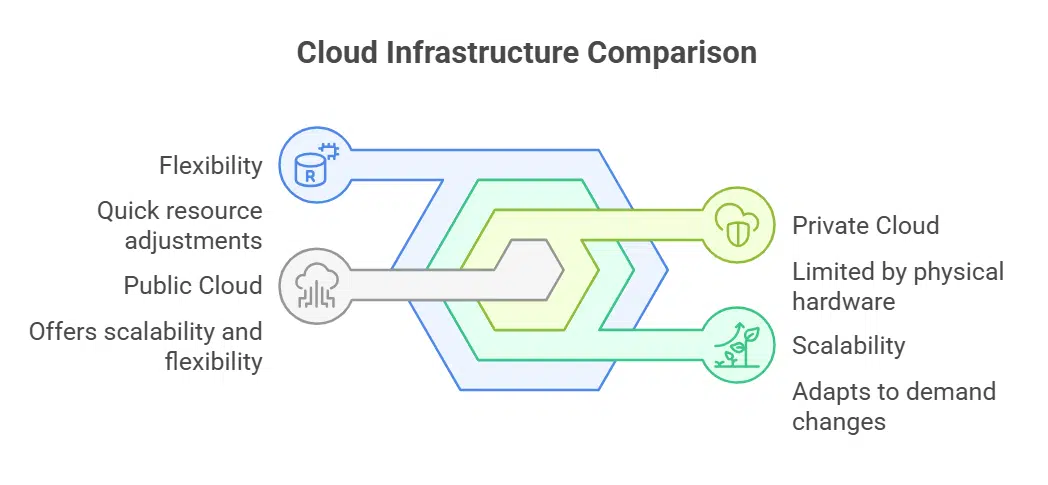
This is where public clouds will wipe the floor with private clouds. Need to create 100 new servers for some project? Done in minutes not weeks. Traffic spike because your app went viral? Infrastructure scales automatically.
Private clouds are limited to whatever physical hardware and virtualization solution you have installed. And if you need more than your current setup supports, you have procurement cycles, installation time, and wear and tear of getting it all setup properly to look forward to with physical hardware.
For any businesses that have seasonal demand or highly unpredictable growth, public cloud is a complete game changer. Every e-commerce site on Black Friday, or tax software during filing season. Instead of considering how much hardware to buy to handle peak demand year-round, to having the capability to scale up when needed and down when not used, is infinitely better.
Benefits of Innovation and Services
The public cloud service providers are basically engaged in an arms race for who can offer the most cool, bleeding-edge services like artificial intelligence, machine learning platforms, tools for advanced analytics, Internet of Things (IoT) services and all of the other things that would take you a significant investment of time and money to build yourself.
These providers deliver new services and updates every week, month and year. Look up how many new features Amazon Web Services releases annually, I dare you to do at your own physical data center.
Private cloud environments are delayed so much in getting new technologies implemented and adopted they tend to fall well behind in keeping up. As an example, by the time you evaluated, procured, tested and deployed some new capability, the public cloud vendor has already moved to something new.
Real-world example: A startup I know who wanted to add machine learning capabilities to their app. Instead of building the infrastructure and hiring data scientists for months, they simply leveraged AWS’s pre-configured machine learning services and built a working prototype in weeks.
The Smart Money is on Public
Choosing between public cloud and private cloud is not simply a technical checkbox. It is a strategic choice that will impact how your business grows and responds to whatever the market throws at you next.
Sure, private clouds continue to make sense for some regulated industries or companies which require complete control over their infrastructure. However, for most businesses the public cloud benefits are almost impossible to refute – lower costs, scaling that you can actually use, and access to innovation that would take longer to build in-house.