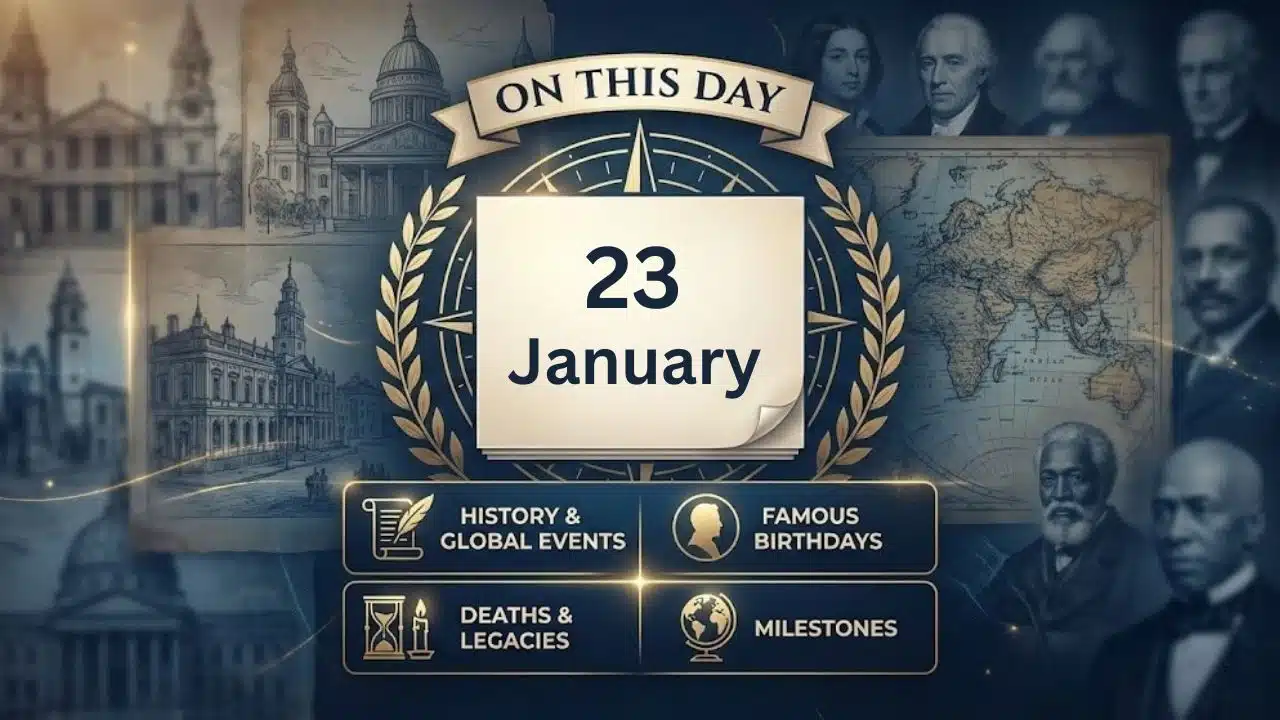
January 23 is the kind of date that quietly connects very different corners of the world. In South Asia, it is inseparable from the memory of Netaji Subhas Chandra Bose and the continuing arguments about courage, strategy, and freedom. In China’s long historical record, it marks both an imperial turning point and one of humanity’s deadliest natural disasters.
In the United States, it is linked to a civil-rights milestone that helped dismantle barriers to voting. And in recent memory, January 23 also carries a modern shock, the day Wuhan entered lockdown in 2020, a moment that shaped how the world thinks about public health and state power.
To make this “On This Day January 23” report easy to scan, here is a quick table first, followed by deeper context.
At-A-Glance: Key Events On January 23
| Year | Place | What Happened | Why It Still Matters |
|---|---|---|---|
| 1556 | China (Shaanxi/Shanxi region) | Catastrophic Shaanxi earthquake (deadliest recorded) | Disaster preparedness, housing safety, historical demography |
| 1368 | China | Zhu Yuanzhang proclaimed as Hongwu, founding the Ming era | State-building, administration, cultural identity in East Asia |
| 1719 | Europe (Liechtenstein) | Liechtenstein’s principality established | Microstates, sovereignty, modern European order |
| 1849 | United States | Elizabeth Blackwell became the first woman to earn an M.D. in the U.S. | Women in medicine, education access |
| 1964 | United States | 24th Amendment ratified, banning poll taxes in federal elections | Voting rights, civil-rights enforcement |
| 1968 | Korea/US | USS Pueblo seized by North Korea | Cold War escalation, hostages, intelligence risks |
| 1973 | United States/Vietnam | Nixon announced an agreement to end U.S. involvement in Vietnam | War endings, peace terms, political memory |
| 2020 | China (Wuhan) | Wuhan entered lockdown during early COVID-19 crisis | Pandemic governance, trust, global health systems |
The Bangalee Sphere
Historical Events And Turning Points
Netaji’s Birthday And The Politics Of Courage
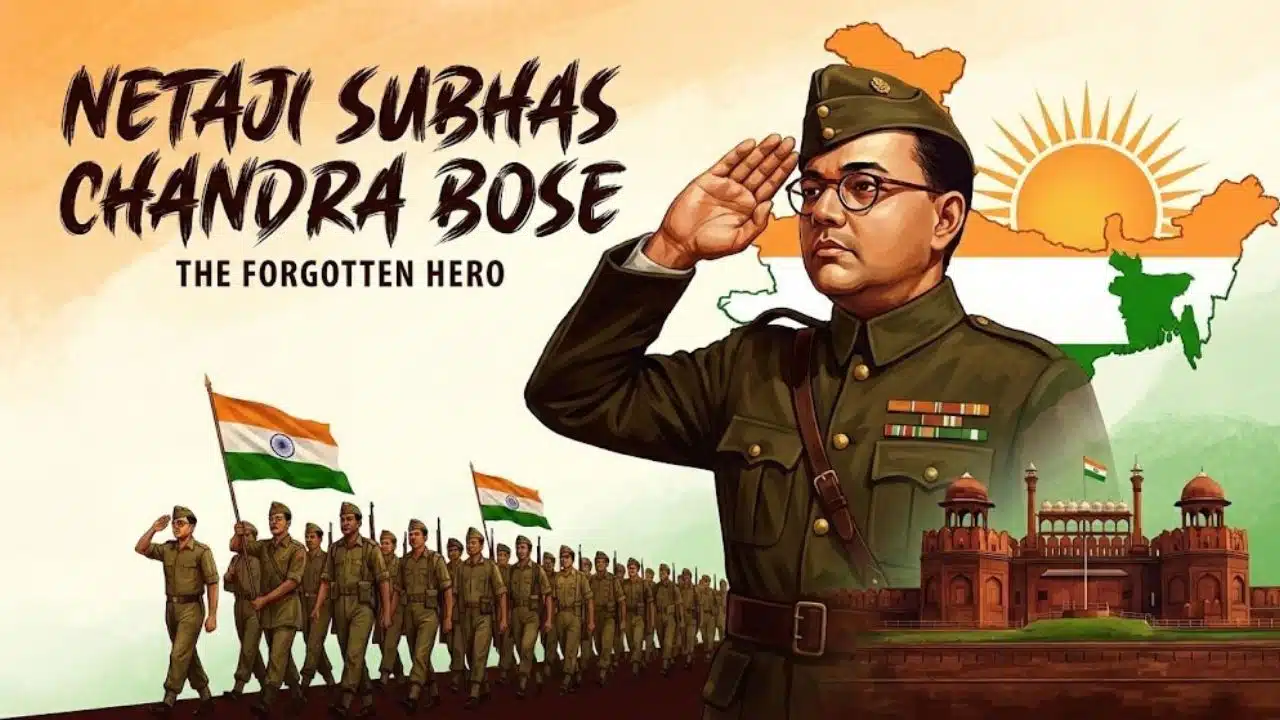
January 23 is best known across India and among Bangalee communities worldwide as the birth anniversary of Subhas Chandra Bose (born 1897), popularly remembered as Netaji.
The Government of India formally designated January 23 as “Parakram Diwas” (Day of Valour) from 2021 onward to commemorate Bose’s birth anniversary and to use his legacy as a public message about resilience and civic courage.
Why Bose matters today is not only because he opposed colonial rule, but because he embodies a continuing debate that still shapes South Asian politics:
-
Is freedom achieved primarily through mass civil resistance, or through military strategy, or a combination of both?
-
How do colonized societies define legitimacy when the colonial state calls resistance “rebellion”?
-
What happens when a liberation movement must negotiate support across borders?
Bose’s life forces readers to confront difficult questions about alliances, propaganda, and the moral costs of wartime choices. These questions remain current in a world where liberation struggles, counterinsurgency, and geopolitical bargaining still overlap.
A Bengal-Specific Literary Marker: Ishwar Chandra Gupta’s Death (1859)
Bengali cultural history also ties January 23 to the death of Ishwar Chandra Gupta, poet and journalist associated with a transitional moment in Bangla literature and the early Bengali public sphere. Banglapedia records that he died on 23 January 1859 and highlights his role in shaping modern Bengali society through journalism and satire.
His significance today is easy to miss unless we look at how print culture works:
-
Newspapers do not only report society.
-
They produce society by shaping what people argue about, laugh at, and fear.
In that sense, Gupta belongs to a lineage that connects the 19th-century Bengali newsroom to the present-day Bengali digital public sphere.
Chittagong To Kolkata: Nabinchandra Sen’s Death (1909)
Another Bangalee cultural milestone linked to January 23 is the death of Nabinchandra Sen (1847–1909), a Bengali poet born in the Chittagong region and remembered for epic and nationalist-inflected writing.
If Ishwar Chandra Gupta reflects an early modern Bengali press culture, Nabinchandra Sen reflects how literary epics can be repurposed as cultural nationalism, especially in periods when political sovereignty is not yet possible.
Famous Births (Bangalee Sphere)
Subhas Chandra Bose (1897)
-
Profession: Freedom movement leader, organizer, political strategist
-
Why remembered: A major alternate pole within India’s anti-colonial imagination; continues to shape debates on methods of resistance and nationalism
-
Public observance: Parakram Diwas (India)
Abdur Razzak (Nayak Raj Razzak) (Born January 23, 1942)
Bangladesh’s film history links January 23 to the birth of Abdur Razzak, widely known as “Nayak Raj,” remembered as a defining star of Bangladeshi cinema for decades.
Even if you do not follow Dhallywood, his cultural role is easy to explain: in newly independent or rapidly changing societies, cinema often becomes the most powerful “mass mirror” of aspiration, romance, class tension, and modern identity. Razzak’s stardom belongs to that deeper social story.
Famous Deaths (Bangalee Sphere)
-
Ishwar Chandra Gupta (1859): Bengali poet-journalist, an influential figure in transitional Bangla literature and early public debate
-
Nabinchandra Sen (1909): Bengali poet known for epic and nationalist currents in literature
International Observances & Holidays
Major International Days
There is no widely recognized official UN-designated “International Day” permanently fixed to January 23 in the way that March 8 (International Women’s Day) is. However, several popular civic observances occur on this date.
Notable National And Popular Observances
National Handwriting Day (Observed January 23)
In the U.S., National Handwriting Day is promoted for January 23, encouraging people to write by hand and reflect on handwriting as a skill and art. It is explicitly tied to the date.
Why it matters now:
-
Handwriting is no longer central to many education systems.
-
Yet writing by hand remains linked to memory, learning, and personal expression.
-
It also has cultural symbolism: signatures, letters, diaries, and documents still carry emotional weight in ways digital text often does not.
National Pie Day (United States, January 23)
The American Pie Council invites people to celebrate National Pie Day on January 23.
This is not “world history,” but it is cultural anthropology in action: food days reveal how societies build identity through nostalgia and shared rituals, even when the ritual is simply eating something familiar.
Global History
China
1556: The Shaanxi Earthquake
Encyclopaedia Britannica describes the Shaanxi province earthquake of 1556 as likely the deadliest earthquake ever recorded, striking early on January 23, 1556, with an estimated 830,000 killed or injured.
Why it matters today:
-
It shows how housing style and geography can turn natural hazards into mass death.
-
It is a historical warning about “silent vulnerabilities,” where everyday structures become fatal under stress.
-
It also reminds us that the worst disasters are often not the most famous internationally, but the ones that overwhelm local capacity.
1368: The Founding Moment Of The Ming Era
January 23 is also associated with the moment Zhu Yuanzhang proclaimed the start of the Hongwu era, tied to the founding of the Ming dynasty.
Long-term significance:
-
The Ming era became one of the major reference points for Chinese statecraft, cultural identity, and administration.
-
It helps explain why “dynastic change” is not only political history in China, but also cultural memory, a way people understand order, legitimacy, and continuity.
2020: Wuhan Lockdown And The Start Of A New Global Era
In the early COVID-19 crisis, Wuhan entered lockdown on January 23, 2020, a move widely treated as unprecedented in scale for a modern city.
Why the date still matters:
-
It changed global expectations about what governments might do during health emergencies.
-
It accelerated debates about surveillance, public compliance, misinformation, and cross-border responsibility.
-
It shaped a new language of crisis: “lockdown,” “flatten the curve,” and “essential work” became global phrases.
United States
1964: A Voting Rights Milestone
The 24th Amendment was ratified on January 23, 1964, abolishing poll taxes in federal elections.
Why it matters now:
-
Poll taxes were not only a fee. They were a gatekeeping mechanism that hit poor voters hardest and functioned as a tool of racial exclusion in practice.
-
The amendment shows how legal change can remove an explicit barrier, yet also reminds us that new barriers can appear through other means, such as registration constraints or district design.
1849: Elizabeth Blackwell And The Struggle For Professional Entry
Elizabeth Blackwell received her medical degree on January 23, 1849, a landmark moment for women in modern medicine.
Her story still matters because it is not only about one person’s success. It is about how institutions change:
-
A door opens for one individual.
-
That opening becomes precedent.
-
Precedent slowly becomes expectation.
1968: The USS Pueblo Seizure
U.S. Naval historical materials note that USS Pueblo was seized on January 23, 1968, an incident that escalated Cold War tensions in East Asia.
The lesson for today’s geopolitics is blunt: intelligence operations can spark diplomatic crises faster than leaders can control public anger.
Russia (And The Wider Cold War Context)
Even when a January 23 event is not “about Russia” directly, Cold War dynamics shaped much of the world’s response to events like the USS Pueblo seizure and the Vietnam peace process. Those incidents were rarely isolated. They were interpreted through a global lens of rivalry, deterrence, and ideological messaging.
United Kingdom
For January 23, the strongest “UK angle” is cultural and institutional, rather than a single defining political event that dominates global memory. One example is the continuing influence of British colonial-era structures in South Asia, which shaped the political environment Bose and his contemporaries confronted. The relevance is not in a single UK event on this date, but in the way empire made South Asian history inseparable from London’s decisions.
Europe
1719: Liechtenstein’s Founding
Britannica notes the principality’s founding in 1719, part of the long European story of microstates and sovereignty.
Why it matters:
-
Microstates challenge the assumption that only large states matter.
-
They survive through diplomacy, legal identity, and strategic neutrality.
Australia
January 23 does not carry a single globally dominant Australia-specific state event in the sources consulted here. Still, the date often falls during Australia’s summer civic season, close to Australia Day (January 26), which is itself intensely debated in relation to Indigenous rights and historical memory.
Canada
Canada shares cultural observances like National Handwriting Day awareness through North American media circulation, and Canada’s public life often resonates with U.S. civil-rights milestones because legal reforms and rights discourse travel across borders.
Rest Of World (Asia, Africa, South America)
The most globally resonant “rest of world” dimension on January 23 in modern memory is the Wuhan lockdown’s worldwide ripple effects, which were felt in Africa and South America through supply chains, remittances, public health capacity, and vaccine inequality.
Notable Births & Deaths (Global)
Famous Births
Here are five widely recognized figures born on January 23:
-
Subhas Chandra Bose (1897, Indian) – Anti-colonial leader; Parakram Diwas is tied to his legacy
-
John Hancock (1737, American) – Revolutionary-era statesman known for his iconic signature (also linked to National Handwriting Day symbolism)
-
Édouard Manet (1832, French) – Painter whose work shaped modern art’s transition toward Impressionism
-
Django Reinhardt (1910, Belgian-born Romani-French) – Jazz guitarist whose style became foundational in “gypsy jazz” traditions
-
Abdur Razzak (1942, Bangladeshi) – Iconic film star and cultural figure in Bangladeshi cinema
Famous Deaths
Five major figures who died on January 23 include:
-
Salvador Dalí (1989, Spanish) – Surrealist artist whose public persona and imagery shaped modern visual culture
-
Paul Robeson (1976, American) – Singer, actor, and civil-rights figure with a global political footprint
-
Edvard Munch (1944, Norwegian) – Modern artist whose work, including “The Scream,” became a universal symbol of anxiety
-
Ishwar Chandra Gupta (1859, Bengali) – Poet-journalist tied to early modern Bengali public life
-
Nabinchandra Sen (1909, Bengali) – Poet whose work carried epic and nationalist energies
“Did You Know?” Trivia (January 23)
-
The deadliest earthquake in recorded history is tied to January 23. The 1556 Shaanxi earthquake’s death toll is estimated around 830,000 killed or injured, making it a chilling reminder of how disasters scale when housing and geology align in the worst way.
-
January 23 marks a key moment in voting rights history in the U.S. The 24th Amendment’s ratification date is January 23, 1964, a direct constitutional strike against poll taxes in federal elections.
-
A modern “world-changing” public health moment happened on January 23. Wuhan’s lockdown began on January 23, 2020, becoming a symbol of the new pandemic era and reshaping global crisis playbooks.
Quote Of The Day
“Give me blood, and I promise you freedom.”
This line is associated with Netaji Subhas Chandra Bose, delivered in a widely remembered wartime speech in 1944.
Takeaways: Why “On This Day January 23” Still Feels Alive
If you read January 23 only as a list, it looks like scattered facts. If you read it as a connected human record, it becomes something else: a date that holds state power, public courage, cultural imagination, and human vulnerability side by side.
On This Day January 23, you can trace how societies respond to crisis, how they build institutions, and how they keep memory alive through anniversaries, poems, films, and public rituals.