The UN Security Council Middle East crisis has become the defining geopolitical emergency of our time. On February 28, 2026, the world woke up to a reality many feared but few truly prepared for. The United States and Israel initiated a massive joint military campaign against Iran. They called their operations Epic Fury and Roaring Lion. The coordinated strikes involved thousands of munitions. They targeted Iranian leadership, security forces, nuclear program facilities, and ballistic missile sites.
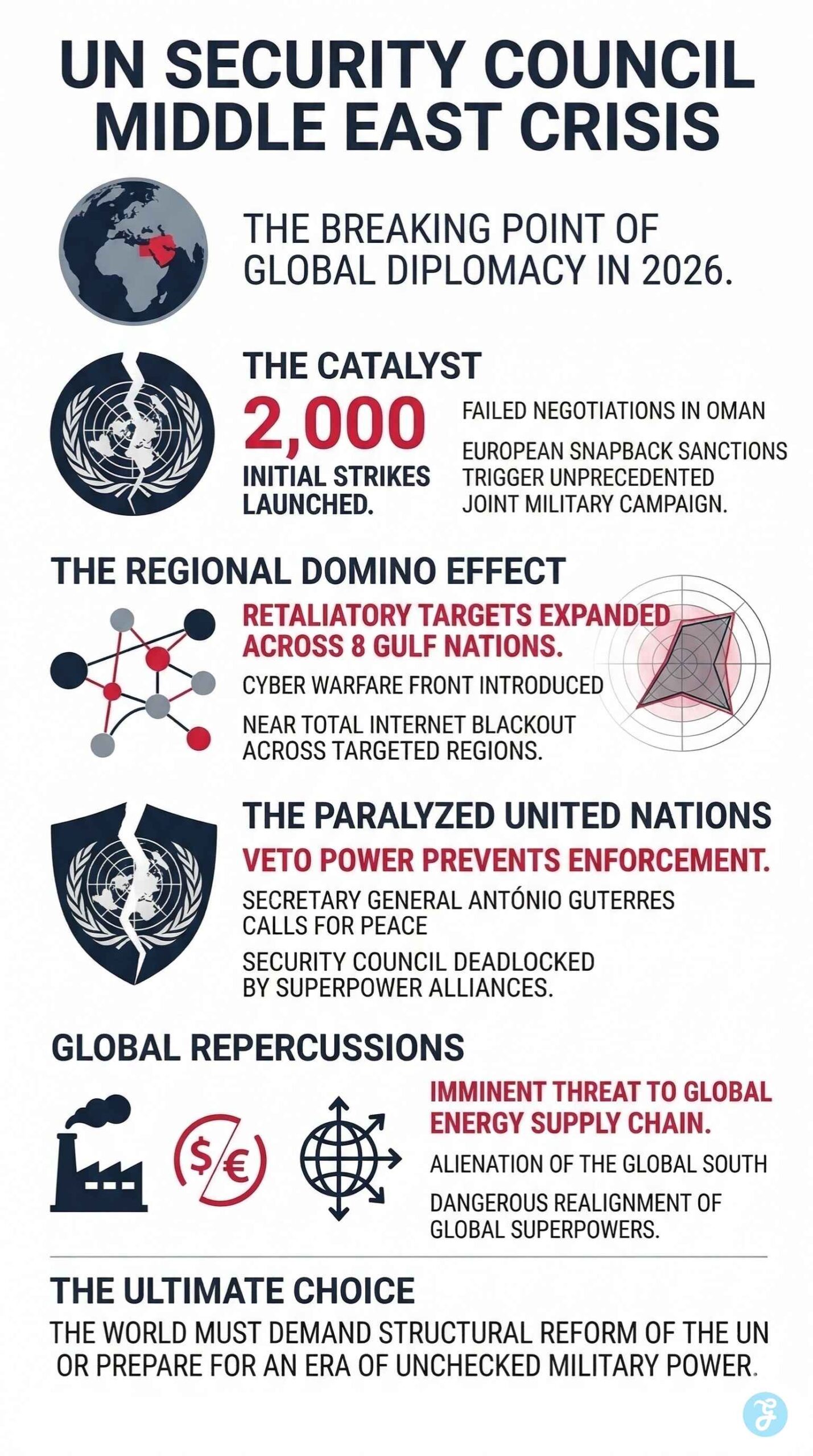
In stark contrast to the deafening explosions across Tehran, the United Nations headquarters in New York echoed with desperate pleas for diplomacy. The sudden transition from diplomatic pressure to massive military force by the US and Israel happened overnight. The collapse of the Oman nuclear talks only weeks prior set the stage for this unprecedented escalation.
The United Nations is now facing its most severe existential test to date. As the Middle East burns and missiles fly across borders, the UN Security Council is proving to be a broken shield. This raises the terrifying question of whether any diplomatic body can still stop a world war.
The Genesis of the 2026 Middle East Escalation
The road to this explosive US-Israel-Iran conflict in 2026 was paved with failed negotiations and mounting distrust. To understand the sheer scale of the February 28 attacks, we must look at the diplomatic breakdown that occurred earlier in the year.
The Collapse of the Oman Negotiations
Indirect nuclear talks between the United States and Iran took place in Oman in early February 2026. These talks were meant to find a peaceful resolution to Iran’s advancing nuclear program. The negotiations collapsed completely. Divisions between the two sides were insurmountable. The US demanded that Iran end all nuclear enrichment activity and dismantle its ballistic missile program immediately. The Iranian delegation refused these terms without a guaranteed timeline for sanctions relief.
The European Snapback Sanctions
This diplomatic failure did not happen in a vacuum. It followed the October 2025 triggering of snapback sanctions against Iran. The United Kingdom, Germany, and France initiated these sanctions under the framework of the original 2015 nuclear deal. The European nations argued that Iran had repeatedly violated the terms of the agreement.
This diplomatic maneuver pushed Iran further into a corner and crippled its already weakened economy. Massive civilian protests erupted across Iran in early 2026 due to failing infrastructure and economic hardship. The Iranian government suppressed these protests with extensive force.
The Joint Military Campaign Objectives
The US and Israeli governments concluded that diplomacy had been exhausted. They argued that a nuclear-armed Iran posed an unacceptable security threat to the world. The military campaign was unprecedented in its scope. American B-2 stealth bombers and Israeli F-15 fighter jets launched a coordinated assault. The strikes targeted the Pasteur Street district in Tehran. This area housed the presidential palace and the compound of Supreme Leader Ali Khamenei.
| Operation Name | Lead Nation | Primary Targets | Stated Strategic Goal |
| Operation Roaring Lion | Israel | Air defenses, radar installations, and missile launchers in northern and central Iran | Remove existential threats to the State of Israel and dismantle nuclear infrastructure |
| Operation Epic Fury | United States | IRGC naval facilities, drone launch sites, and ballistic missile complexes in southern Iran | Prevent nuclear weapon acquisition and protect core national security interests |
Reports confirmed the assassination of Supreme Leader Ali Khamenei along with other high-ranking officials. The immediate destruction of Iranian air defenses gave the US and Israel total air supremacy within hours.
The Regional Domino Effect and Iran Strikes Back
The scope of the destruction could not be contained within Iranian borders. The Middle East escalation rapidly spilled over, creating a regional domino effect. Iran launched a massive counter-offensive named Operation True Promise IV.
The Scope of Retaliation
Iran fired hundreds of ballistic missiles and drones in retaliation. The targets were not limited to Israel. The Iranian military expanded its sights to include US military assets across neighboring Arab states. Missiles were launched at facilities in Bahrain, Kuwait, Qatar, Saudi Arabia, the United Arab Emirates, Oman, Iraq, and Jordan. Qatar reported intercepting multiple drones and cruise missiles. The attack forced QatarEnergy to declare a force majeure and halt liquefied natural gas production.
The Human Cost
The human toll of this conflict has been catastrophic on all sides. Iranian media reported significant civilian casualties. An Israeli airstrike reportedly hit a school in Minab and killed dozens of students. Intercepted missile debris caused civilian deaths in the UAE and other Gulf nations. The relentless bombardment has destroyed civilian infrastructure and displaced thousands of families.
The Information Blackout
Adding to the chaos is a near-total internet blackout across Iran. This information vacuum prevents independent verification of casualties and structural damage. The fog of war is thick. Unconfirmed reports and rumors regarding the survival of various military commanders fuel regional panic. The Iranian population is bearing the greatest cost of this war, trapped between a relentless military campaign and a deeply entrenched regime fighting for survival.
The Invisible Frontline of Cyber and Artificial Intelligence
The kinetic strikes of Epic Fury and Roaring Lion represent only half the battlefield. A silent but equally devastating war is raging across digital networks. Advanced artificial intelligence now dictates targeting logistics, intercept trajectories, and real-time threat assessment. The near-total internet blackout in Iran was not merely collateral damage. It was a calculated cyber offensive designed to blind the military infrastructure and isolate the populace from the outside world.
This digital escalation raises a terrifying new challenge for the United Nations. International law remains hopelessly outdated regarding cyber warfare. When a state-sponsored hacker disables a hospital power grid or a water treatment facility, the UN Charter offers little guidance on what constitutes a proportional response. The 2026 Middle East crisis marks the first major conflict where predictive algorithms and malicious code are treated as weapons of mass disruption. The Security Council has no mechanisms to monitor, let alone regulate, this invisible frontline.
António Guterres and the Plea for De-escalation
UN Secretary-General António Guterres became the central diplomatic figure pleading for sanity. During an emergency UN Security Council meeting, António Guterres’ response was firm and directed at all involved parties.
Invoking Article 2 of the UN Charter
Guterres condemned both the massive military strikes by the US and Israel and the subsequent retaliatory attacks by Iran. He explicitly cited Article 2 of the UN Charter. This foundational rule reminds member states to refrain from the threat or use of force against the territorial integrity or political independence of any state. He declared that the strikes violated international law and undermined global security.
The Warning of Uncontrollable Chains
The Secretary-General expressed deep regret that the recent diplomatic talks in Oman were abandoned. He warned the Security Council that military action carries the risk of igniting an uncontrollable chain of events. His specific fear is a cascading regional war that drags in global superpowers and creates a humanitarian disaster of unprecedented scale. He pleaded for an immediate cessation of hostilities and a return to the negotiating table.
The Limits of Moral Authority
The tragic reality of Guterres’s position is clear. He possesses the world’s most prominent diplomatic microphone but absolutely zero enforcement capability. The United Nations cannot deploy forces or enforce peace without the unanimous backing of the Security Council. Guterres can only appeal to the moral conscience of nations that have already chosen war over diplomacy.
Inside the Paralyzed UN Security Council
The emergency UN sessions highlighted a deeply fractured global community. The Security Council chambers became a theater of accusations and justified aggression.
The Defense of Preemption
The United States and Israel vigorously defended their military actions. US Ambassador Mike Waltz and Israeli Ambassador Danny Danon argued that the strikes were lawful and necessary. They framed the operation as a vital measure for global war prevention. Ambassador Waltz stated that the cost of inaction was far greater than the burden of decisive action. Ambassador Danon argued that stopping an extremist regime from obtaining nuclear weapons transcends traditional diplomatic boundaries.
The Demand for Accountability
Iranian Ambassador Amir Saeid Iravani delivered a fierce counter-argument. He labeled the US and Israeli actions as unprovoked aggression, war crimes, and a crime against humanity. He highlighted the civilian casualties in Minab and urged the UN to hold the attackers accountable. He questioned whether any powerful member state could simply use force to determine the political future of another sovereign nation.
The Stance of the East and the Fragmented Middle
The geopolitical divide was stark. Russia and China strongly condemned the US and Israeli strikes. They characterized the campaign as a preplanned act of armed aggression and warned of severe global economic fallout. Meanwhile, the United Kingdom and France walked a tightrope. They expressed deep concern over the fragile situation and urged restraint from all sides. However, they focused their criticism heavily on Iran for its nuclear non-compliance and destabilizing regional activities.
| Security Council Faction | Primary Argument | Proposed Action |
| United States & Israel | Preemptive self-defense is necessary to stop a nuclear-armed Iran. | Continue military operations until the nuclear threat is completely neutralized. |
| Iran | The strikes are illegal acts of aggression and war crimes. | The UN must condemn the US and Israel and demand an immediate ceasefire. |
| Russia & China | The attacks violate international law and threaten global stability. | Immediate halt to Western military action and a return to diplomatic frameworks. |
| UK & France | Escalation is dangerous, but Iran is responsible for nuclear non-compliance. | Resume diplomacy while maintaining pressure on Iran to dismantle its nuclear program. |
The Deepening Alienation of the Global South
The intense debates within the Security Council chambers expose a profound disconnect between global superpowers and the rest of the world. Nations across Africa, Latin America, and Southeast Asia are watching the Middle East escalation with growing resentment. They inevitably bear the brunt of the resulting economic shockwaves. Spiking energy prices and disrupted global supply chains devastate developing economies long before they impact Western capitals.
Yet, these nations have absolutely no voice in the veto process. The Global South increasingly views the UN diplomatic failure as undeniable proof of a rigged system. When permanent Security Council members or their closest allies violate the UN Charter, they face zero institutional consequences. When developing nations step out of line, the international community punishes them swiftly with crushing sanctions.
This glaring hypocrisy is destroying whatever trust remains in the United Nations. It is actively accelerating a push toward alternative global alliances and economic blocs entirely outside the traditional Western sphere of influence.
Why the UN Architecture is Failing in 2026
The UN diplomacy failure we are witnessing is not a temporary glitch. It is a fundamental flaw in the architecture of the institution. We are witnessing the League of Nations moment for the United Nations.
The Veto Power Trap
The permanent members of the Security Council hold veto power. They consistently use this power to block resolutions that conflict with their geopolitical alliances. The United States will veto any resolution condemning Israel. Russia and China will block severe actions against Iran. This structural paralysis guarantees that the UN cannot take decisive action when a permanent member is directly involved in a conflict.
The Rise of Unilateral Military Actions
Major powers have normalized preemptive strikes. When the US and Israel launched Epic Fury and Roaring Lion, they bypassed the UN framework entirely. They determined the threat level internally and acted unilaterally. This renders the UN Security Council irrelevant in matters of supreme global security.
The Diminishing Deterrence of International Law
When the most powerful nations on earth ignore the UN Charter without consequence, the entire system of international law collapses. If preemptive strikes aimed at regime change are accepted as standard foreign policy, the UN loses its deterrent effect entirely. Small nations realize that international law will not protect them from the military might of superpowers.
The Global Repercussions and the Threat of World War
The ripple effects of this conflict are spreading rapidly. Are we nearing a world war? The indicators are highly alarming.
Economic Shockwaves
The global economy is facing a massive shock. The Gulf region is now an active warzone. Energy markets are in turmoil. Qatar’s halt of liquefied natural gas production is just the beginning. The Iranian military has threatened to close the Strait of Hormuz. This would cut off a massive portion of the world’s oil supply and trigger a catastrophic global recession.
Nuclear Proliferation Fears
The conflict presents a terrifying paradox. The strikes were designed to stop a nuclear program. However, they might ultimately convince other nations that nuclear weapons are their only guarantee of survival. If a country sees that conventional military power cannot stop a superpower invasion, it will inevitably pursue nuclear deterrence.
The Realignment of Global Superpowers
This war is solidifying global alliances into hostile blocs. Iran is being pushed closer to Russia and China. The West is unifying behind the US and Israel. This polarization mirrors the rigid alliance structures that preceded both the First and Second World Wars.
Finally: A Call for Structural Reform or a Grim Acceptance
The UN Security Council Middle East crisis of 2026 has exposed the fragile illusion of global governance. The UN is paralyzed by its outdated design. The veto power system protects the aggressors and silences the victims. Secretary-General Guterres can plead for calm, but his words cannot stop ballistic missiles.
We face a stark choice. The international community must either demand a radical structural reform of the United Nations or accept a grim new reality. If the UN cannot evolve to enforce peace and hold all nations accountable equally, the world must prepare for a terrifying era of unchecked military power.
The ash settling over Tehran and the echoes in the Security Council chambers serve as a final warning. Diplomacy is dying, and the missiles are already in the air.