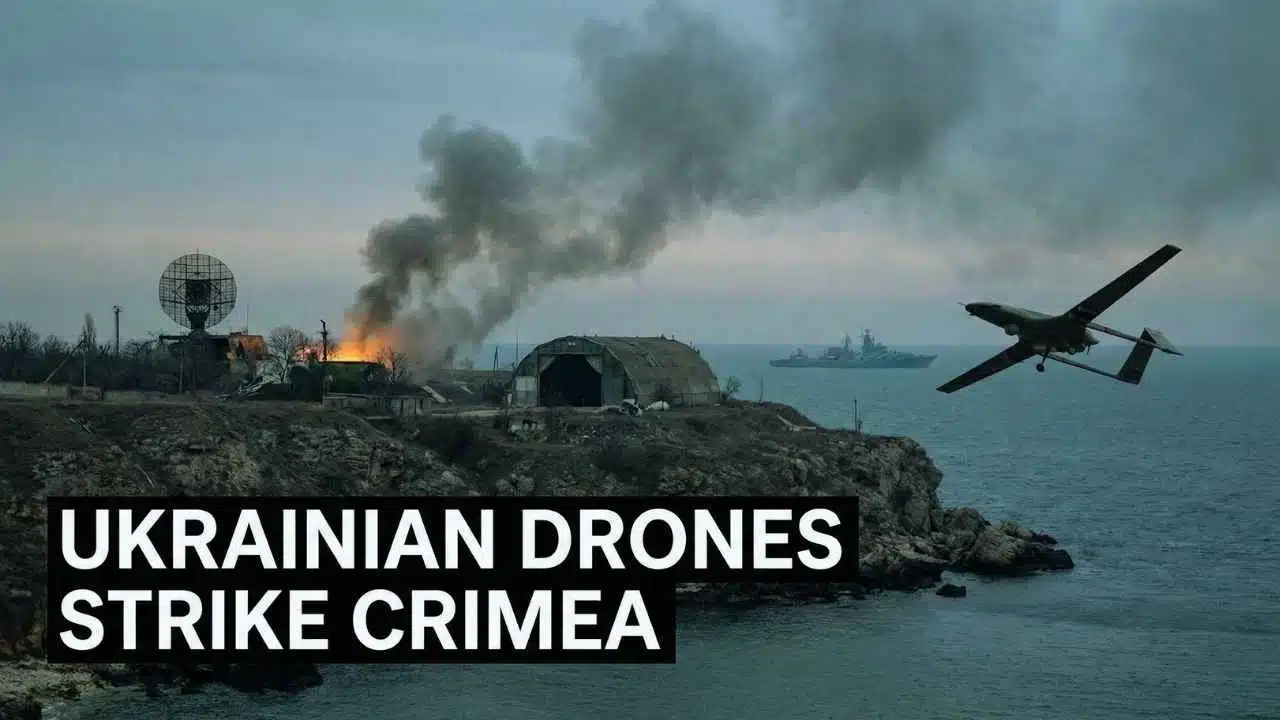
Ukrainian drones hit Russian sites in Crimea in late December, with Kyiv saying it struck air-defense radars, aircraft, and naval-related targets as both sides escalate long-range attacks across the Black Sea region.
What happened and what Ukraine says it hit?
Ukraine’s security and military branches described a fresh cluster of drone operations aimed at Russian-controlled military infrastructure in Crimea, a peninsula Russia seized in 2014 and has used as a major base during the war.
On Dec. 26, 2025, Ukraine’s Unmanned Systems Forces said its operators carried out strikes on multiple targets in Crimea, including a radar site and a location linked to high-speed landing craft used by Russia’s Black Sea Fleet. In the same set of claims, Ukraine said drones also struck facilities linked to Russian command and logistics in occupied areas of eastern Ukraine.
Earlier in the month, Ukraine’s Security Service (SBU) reported an overnight operation against the Belbek military airfield near Sevastopol, a strategic air base that supports Russian air operations over the Black Sea and southern Ukraine. The SBU said its long-range drones hit key air-defense components at Belbek, including two Nebo-SVU radar systems, a 92N6 radar component associated with Russia’s S-400 air-defense system, and a Pantsir-S2 air-defense unit. The agency also said a MiG-31 aircraft was hit during the strike.
In a follow-up claim days later, the SBU said drones hit two Su-27 fighter jets at Belbek, describing one aircraft as being on a taxiway and ready for a combat sortie. Ukraine’s security service estimated the combined value of the two aircraft at around $70 million.
Ukraine’s public messaging around these attacks has been consistent: it frames the strikes as part of a campaign to reduce Russia’s ability to defend and sustain military operations from Crimea by targeting the “eyes” (radars), the “shield” (air defenses), and the platforms (aircraft and boats) that support Russian operations.
Key claims at a glance
| Date (2025) | Location | Ukraine’s claimed target(s) | Why it matters (in plain terms) |
| Dec. 26 | Crimea | Radar site; area linked to Black Sea Fleet landing craft | Weakens detection and maritime capability |
| Dec. 17–18 | Belbek airfield, Crimea | Nebo-SVU radars; 92N6 radar; Pantsir-S2; MiG-31 | Targets layered air defense and an aircraft |
| Dec. 20 (claimed) | Belbek airfield, Crimea | Two Su-27 fighter jets | Reduces available combat aircraft |
These are claims made by Ukrainian agencies and cannot be fully verified immediately from independent access on the ground in Crimea.
Why Crimea is a focal point and why these targets matter?
Crimea is central to Russia’s military posture in the Black Sea. It hosts airfields, ports, logistics sites, command infrastructure, and air-defense networks that help Russia protect occupied territory and support operations against Ukraine.
For Ukraine, Crimea is also a place where military effects can ripple outward. If Russian radar coverage is disrupted, it can create gaps in early warning and targeting. If air defenses are degraded, other sites become easier to hit. And if aircraft and naval craft are damaged, Russia may have fewer tools available for patrols, strikes, and rapid deployment.
What the named systems do (simple explanations)?
Russia’s air-defense concept relies on layers, from long-range detection to short-range “point defense.” The equipment Ukraine listed fits into that structure:
| System named by Ukraine | What it does | Why Ukraine might target it |
| Nebo-SVU radar | Detects aircraft and tracks aerial threats at long range | Reduces early warning and tracking |
| 92N6 radar (linked to S-400) | Helps guide S-400 engagements by tracking targets and supporting launches | Makes a high-end air-defense battery less effective |
| Pantsir-S2 | Short-range air defense often used to protect key sites from drones and missiles | Opens space for follow-on drone waves |
| Su-27 / MiG-31 aircraft | Fighters/interceptors used to defend airspace and support operations | Reduces sortie capacity and air patrol strength |
| Landing craft / fast boats | Supports coastal operations and rapid movement in littoral waters | Pressures Russia’s maritime mobility in Crimea |
Even when an air-defense system is not destroyed, hitting radars or command-and-control nodes can still force changes in posture. Defenders may have to reposition assets, ration interceptor missiles, or rely on less capable coverage. That kind of friction can matter during sustained strike campaigns.
Crimea’s geography adds another reason it stays in focus. Its coastline and infrastructure connect air and sea routes. Ports and naval facilities in and around Sevastopol, along with airfields such as Belbek, are tied to Russia’s ability to operate in the Black Sea and to supply forces in occupied southern Ukraine.
What Russia says, and what can be independently confirmed?
Russia regularly reports intercepting Ukrainian drones over Crimea, the Black Sea, and nearby regions. In late December, Russian official communications again described air-defense activity and drone shootdowns in and around Crimea during short time windows.
That creates a familiar information gap: Ukraine emphasizes successful strikes and lists specific equipment; Russia emphasizes interceptions and often provides fewer details on damage. Because Crimea is controlled by Russia and wartime access is limited, outside observers can struggle to confirm the full scope of damage quickly.
What is verifiable right now?
- Timing and pattern: Both Ukrainian and Russian statements point to repeated drone activity involving Crimea in late December.
- Strategic logic: Crimea remains a high-value military hub, and air-defense radars, airfields, and naval-related sites are plausible targets in a long-range strike campaign.
- Limits on confirmation: Independent verification is constrained by restricted access, security controls, and wartime information operations.
What remains uncertain in real time?
- How many drones reached specific targets versus being intercepted.
- Whether equipment listed by Ukraine was destroyed, damaged, or temporarily disabled.
- The duration of any operational impact and how quickly Russia repairs or replaces affected assets.
A practical way to understand these exchanges is to focus on what each side is trying to achieve. Ukraine is signaling that it can reach into Crimea and disrupt high-value military nodes. Russia is signaling that it can defend Crimea and blunt attacks. Both messages shape morale, deterrence, and domestic perception—along with battlefield realities.
The broader war context: drones, infrastructure, and civilian impact
The Crimea strikes are part of a wider phase of the war in which drones and missiles are used far from the frontline. Over the past year, the pace and scale of aerial attacks have continued to grow, with winter often increasing the stakes as power infrastructure becomes more critical for heating, water systems, and basic services.
Ukraine’s long-range drone campaign has frequently focused on military and logistics nodes—airfields, depots, and command sites—while Russia has launched large drone-and-missile waves that Ukraine says hit cities and essential services, including the power grid. When energy systems are damaged in freezing weather, the humanitarian impact can rise quickly.
International monitoring has also highlighted how drones affect civilians, especially in frontline regions where short-range drones can hover, observe, and then strike. UN human rights monitoring has documented significant civilian casualties linked to drone attacks and has raised concerns about how these weapons are being used and how quickly civilians can become targets when drones provide persistent surveillance.
At the same time, diplomacy and external support remain moving pieces. Ukraine continues to push for security guarantees and sustained military assistance from partners. Russia continues to frame its objectives in territorial and security terms. This political backdrop matters because strike patterns can shift when either side believes it has leverage—or fears it is losing it.
What to watch next in Crimea and the Black Sea?
If drone attacks on Crimea continue at a steady tempo, three developments will be worth watching closely.
First is air-defense resilience. If radars or point-defense systems are repeatedly disrupted, Russia may need to rotate or reposition air defenses, concentrate protection around a smaller number of priority sites, or increase reliance on electronic warfare and decoys. Any of these adjustments can create new vulnerabilities or reduce coverage elsewhere.
Second is airfield operations. Claims about hits on aircraft at Belbek, if accurate, point to a pressure campaign on sortie generation—how many aircraft can fly and how often. Even limited damage can slow operations if it forces dispersal, additional sheltering, or changes in ammunition handling and maintenance routines.
Third is Black Sea dynamics. Strikes connected to landing craft and coastal assets suggest continued pressure on Russia’s maritime tools in and around Crimea. If Russia is compelled to move assets, change basing patterns, or increase protective measures, that can alter how it supports operations along the southern front and how it handles maritime security.
For now, the core reality is that Crimea remains a central arena for long-range drone warfare. Ukraine is trying to degrade military capability and signal reach. Russia is trying to defend a critical hub and show control. The next weeks will reveal whether the current wave is a brief spike—or the start of a sustained winter campaign focused on air defenses, airfields, and logistics.