Have you ever wanted to make smarter choices with your money, only to feel lost watching the crypto market move at lightning speed? Lots of coins flash across your screen every single day. Picking the real winners from thousands of digital assets can feel exactly like searching for a needle in a haystack. I totally get that feeling. Last year, people traded over $100 billion worth of cryptocurrencies each day. That is a massive number, and it shows just how much this space continues to grow. New coins pop up constantly, and some of them could completely change how we use money or the internet.
I want to share some simple facts about the top cryptocurrencies that deserve your attention right now. We will look at clear reasons why they stand out this year. Grab your favorite cup of coffee, and let’s go through my picks for the 10 top Cryptocurrencies to watch this year together!
What Are Cryptocurrencies?
Cryptocurrencies are digital coins you can send, get, or trade online. They work without a central bank and use computer code to keep your funds safe.
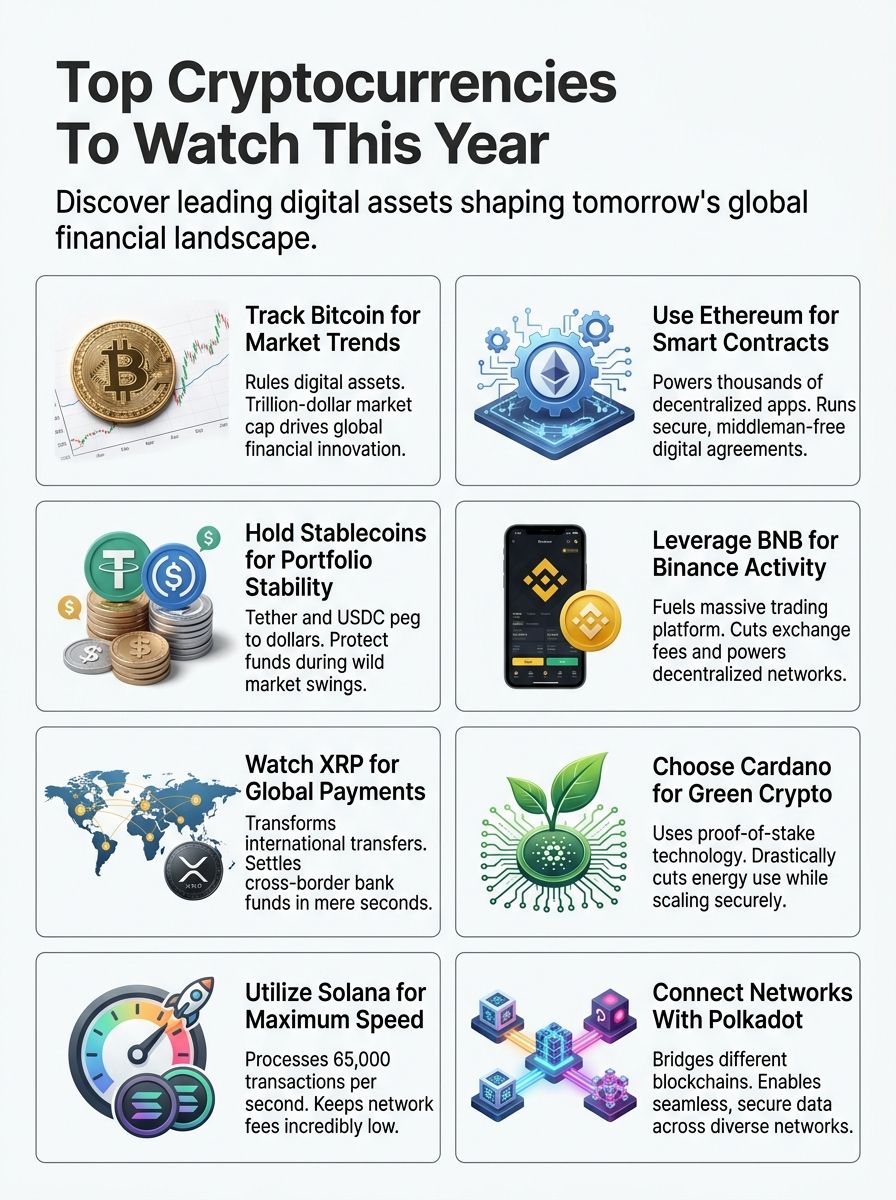
Definition of cryptocurrencies
A cryptocurrency is a digital asset. People trade it on computers using blockchain technology. Blockchain works like a public ledger. It keeps track of all trades and stops fraud, kind of like your math teacher watching over the class during a test.
Unlike cash or coins you can hold in your hand, these currencies live entirely online. They move from person to person right away, which helps cut costs and waiting time for everyone involved. “It’s money without borders,” fans often say when talking about Bitcoin or Ethereum.
Bitcoin is the first peer-to-peer digital currency that solves the double-spending problem using a decentralized network.
Key features of cryptocurrencies
Cryptocurrencies have changed how people think about money. Many investors watch these digital assets closely for growth and fresh investment opportunities.
- Decentralization means no single person or government controls the network. Thousands of computers, called nodes, run the system together.
- Blockchain technology records every transaction in a public, tamper-resistant ledger. This boosts trust and transparency between traders.
- Cryptocurrencies let people send and receive funds worldwide without banks slowing things down. Transactions can clear in minutes, even across continents.
- Security is strong because cryptography protects accounts and data. Hacking is very hard with advanced algorithms shielding user information.
- Peer-to-peer trading cuts out costly middlemen. Direct exchanges save time and often lower fees for users on cryptocurrency exchanges.
- Most cryptocurrencies use limited supply models. Bitcoin will cap at 21 million coins forever, and this scarcity affects price analysis, trading volume, and market cap over time.
- Accessibility keeps growing since anyone with internet access can join or trade digital assets. No paperwork or long wait times stand in your way.
- Tokenomics shapes each project’s value through rewards, utility, or specific goals like powering smart contracts or running decentralized apps.
- Smart contracts automate deals without human error or bias. Ethereum leads here, but many altcoins now offer this feature as well.
- Transparency allows anyone to see the entire transaction history online in real time. This unique record helps spot fraud fast.
Reasons to Focus on Cryptocurrencies This Year
Crypto is changing fast, with fresh ideas popping up almost every week. People are moving money in digital ways now, and skipping this trend could mean missing the next big leap in finance.

Adoption Trends
Big banks and companies are joining the crypto crowd in massive numbers. In early 2026, over three hundred million people held digital assets worldwide.
Many countries now test central bank digital currencies for easier trades. More stores let you pay with Bitcoin or altcoins like Ethereum.
A pro-tip I always share with friends is to watch institutional money. It gives you a great clue about where the market is heading.
- Spot Bitcoin ETFs: US funds like BlackRock’s IBIT attracted billions in capital, proving Wall Street is fully on board.
- Strategic Reserves: In 2026, discussions around a US Strategic Bitcoin Reserve gained serious traction, acting as a massive catalyst for price stability.
- Digital Wallets: Secure crypto apps sit on millions of phones, making market cap growth fast and steady in many regions.
Technological Breakthroughs
Following the spread of cryptocurrency adoption, fresh technological breakthroughs have set digital assets apart from old-school finance. In 2026, the networks will be much faster and cheaper to use.
Developers keep tinkering with smart contracts to make trading safe and simple for daily use. Stablecoins like Tether (USDT) and USD Coin (USDC) have grown more steady using transparent reserves, keeping holders calm during wild price swings.
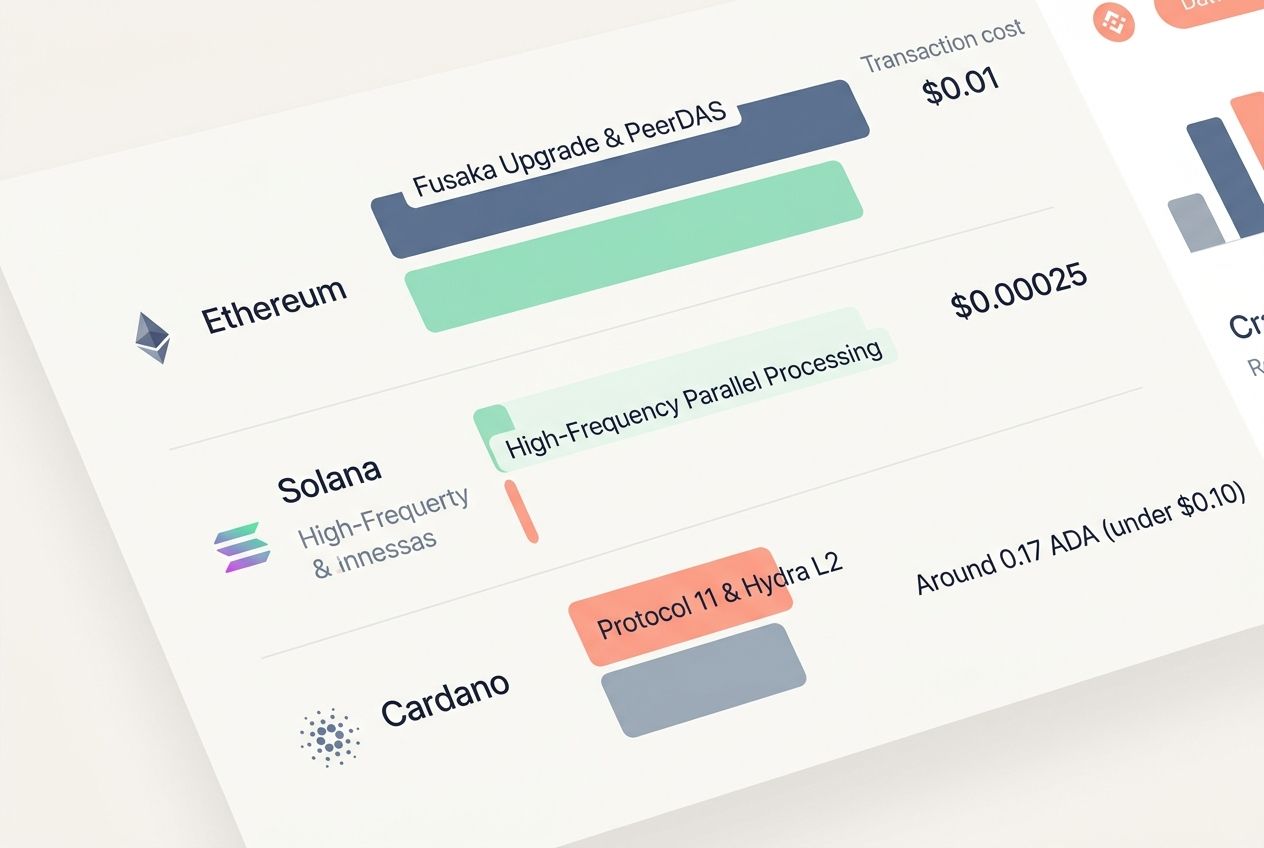
Crypto now works smarter and uses less power, too. Let me show you how transaction fees and speeds have improved recently.
| Blockchain Network | 2026 Breakthrough Feature | Average Transaction Fee |
|---|---|---|
| Ethereum | Fusaka Upgrade & PeerDAS | Dropped to $0.01 |
| Solana | High-Frequency Parallel Processing | Roughly $0.00025 |
| Cardano | Protocol 11 & Hydra L2 | Around 0.17 ADA (under $0.10) |
Top 10 Cryptocurrencies to Watch This Year
Some coins shine bright with big ideas and strong support. Others spark change, stirring up plenty of talk in trading circles.
1. Bitcoin (BTC): Market Leadership and Influence
Bitcoin stands at the forefront of digital assets. With a market cap soaring past $1.7 trillion in early 2026, it rules as the largest cryptocurrency.
Its price hovered between $74,000 and $90,000 this year, grabbing attention from investors and big companies alike. Many people view Bitcoin as digital gold because it leads cryptocurrency trends and shapes how other coins act.
Big companies like Tesla and MicroStrategy have bought large amounts of Bitcoin for their reserves, proving its impact on financial innovation. New spot ETFs based on Bitcoin have boosted its popularity among traditional US investors who want a piece of the action without owning tokens directly.
A 2026 Forbes report noted that potential favorable US regulations could drive massive institutional adoption, pushing Bitcoin’s price expectations even higher.
2. Ethereum (ETH): Innovations in Smart Contracts and Dapps
Ethereum brings brilliant ideas to blockchain technology. Its smart contracts run without middlemen, making deals fast and safe.
Vitalik Buterin launched Ethereum in 2015. Today, developers use it to build hundreds of decentralized apps that cover gaming, finance, art, and more.
Ether (ETH) is the second-largest digital asset by market cap after Bitcoin. Let us look at a few reasons why Ethereum is so powerful right now.
- The $0.01 Gas Fee: Thanks to the Fusaka upgrade in late 2025, Ethereum solved its congestion problem. By January 2026, average transaction fees dropped to just a penny.
- Record Daily Usage: With cheaper fees, the network processed a record 2.6 million transactions in a single day in early 2026.
- Green Energy: The switch to proof of stake lowered energy use by over 99 percent, making Ethereum a top choice for big DeFi projects like Uniswap and Aave.
3. Tether (USDT): Standardizing Stablecoins
Tether (USDT) keeps its price close to the US dollar. Each USDT is backed by assets held by Tether Limited, so one coin almost always equals one dollar.
People use Tether for quick trades and to hold value without worrying about big swings in price. In early 2026, its market cap reached roughly $186.7 billion, making it the undisputed giant among stablecoins.
Traders pick USDT since most cryptocurrency exchanges accept it and because trading volume is high day and night. For many investors, Tether feels like cash inside the crypto world.
| Tether (USDT) 2026 Fact | Why It Matters For You |
|---|---|
| Backed by $135B in US Treasuries | Provides immense stability and proves the reserves are tied to safe, real-world assets. |
| $120 Billion Daily Trading Volume | You can easily swap your coins for USDT at any time without waiting for a buyer. |
4. USD Coin (USDC): Stability in Digital Currency
Speaking of stability, USDC steps up next to Tether on the list. Each USD Coin equals one real US dollar, held safe in bank accounts or short-term bonds.
This strict 1:1 peg gives traders and investors total peace of mind during wild market swings. Launched by Circle and Coinbase in 2018, USDC keeps its value steady with tight controls and clear, audited reports.
Its strong liquidity makes buying or selling other cryptocurrencies much easier on big exchanges worldwide. Here are a few clear reasons USDC stands out.
- Massive Scale: USDC holds a massive market cap between $73 billion and $79 billion in early 2026.
- Visa Integration: Visa officially launched USDC settlement in the United States, allowing banks to settle obligations using the Solana blockchain.
- Regulatory Clarity: With the passage of the US GENIUS Act in 2025, USDC operates under a clear, regulated framework that financial institutions love.
5. BNB (BNB): Enhancing the Binance Ecosystem
USDC steadies the ship, but BNB brings speed and fuel to the massive Binance crypto engine. Users trade huge volumes of BNB daily on cryptocurrency exchanges.
Launched by Binance in 2017, this digital asset powers their entire trading platform. People use it for lower fees, new token launches, and even shopping through select payment partners.
BNB is not just a simple coin. It helps drive decentralized apps and smart contracts within the BNB Smart Chain ecosystem.
In early 2026, BNB traded around $620 to $670, boasting a market cap exceeding $84 billion. The network also introduced the Fabric Protocol (ROBO) through exciting HODLer Airdrops.
6. XRP (XRP): Transforming International Payments
XRP moves money across borders fast. Banks and payment firms use XRP to send funds in just seconds, cutting costs and wait times. Ripple Labs, the company that created XRP, works with hundreds of partners worldwide. Many see XRP as a digital bridge between different fiat currencies.
This altcoin keeps gaining ground as global finance turns more digital each year. Let us look at why XRP is having a great year.
- Legal Clarity: Following the conclusion of the SEC case, the 2025 FIT21 Act officially categorized XRP as a digital commodity in the US.
- Full Relisting: Coinbase fully reinstated XRP for buying, selling, and custody for users across all 50 US states.
- Real-World Usage: Bitso expanded its use of Ripple Payments in early 2026, using XRP to settle cross-border transactions between the US and Latin America in near real-time.
7. Cardano (ADA): Advancing Sustainability and Scalability
Cardano (ADA) stands out for its green, academic approach. It uses proof-of-stake, which cuts down on energy use compared to older blockchain models.
Big brains like Charles Hoskinson helped build it, bringing peer-reviewed science into blockchain technology. Developers love Cardano’s intense focus on safety.
Projects from Africa to Asia now run on ADA’s network due to low fees and high speed. Its market cap consistently lands it among the top digital assets worldwide.
The March 2026 Protocol 11 hard fork introduced major Plutus smart contract upgrades. Along with the Hydra L2 solution, it pushed the network’s capacity toward a blazing fast 1,000 transactions per second.
8. Solana (SOL): Pioneering in High-performance Blockchain
Solana stands out for its incredible speed. It can handle around 65,000 transactions every second, which leaves many other blockchains eating its dust.
Fees stay low, so trading and sending tokens costs just a fraction of a cent even when traffic gets heavy. Many developers use Solana to build games, DeFi apps, and NFT collections.
It has strong support from big investors like Multicoin Capital. Let us compare Solana’s speed and cost to traditional systems.
| Payment Method | Average Settlement Time | Average US Transaction Fee |
|---|---|---|
| Traditional Wire Transfer | 1 to 3 Business Days | $15 to $30 |
| Solana Blockchain | Under 1 Second | $0.00025 |
9. Dogecoin (DOGE): Cultivating a Dedicated Community
Dogecoin started as a joke, yet now it has fans who never quit. Its bright spirit and strong community can turn even the grayest market day sunny side up.
While the community is fun, investing requires looking at the actual numbers. In March 2026, Dogecoin traded near $0.10 with a market cap of around $14 billion to $15 billion.
A common pitfall is expecting Dogecoin to reach astronomical prices like $50. Here is why you should keep your price predictions grounded.
- Infinite Supply: Dogecoin adds about 5 billion new tokens every single year. This inflation makes massive price spikes very difficult to sustain.
- The Market Cap Reality: For Dogecoin to hit just $10, its market cap would need to hit $1.4 trillion, which equals the total value of global assets like silver.
- Expert Consensus: Most sensible price analysis models forecast Dogecoin to fluctuate between $0.09 and $0.50 during 2026.
10. Polkadot (DOT): Facilitating Blockchain Interoperability
Polkadot acts like a bridge connecting different blockchains. Instead of working alone, networks can share data and talk to each other using DOT. A developer named Gavin Wood, who helped create Ethereum, started Polkadot in 2020. It now handles thousands of transactions every second.
The system uses special parachains to boost speed and lower fees. Big projects use Polkadot for their digital assets because it makes trading between separate blockchains quick and safe.
In a huge win for US institutional access, 21Shares launched TDOT in early 2026. It stands as the very first Polkadot ETF in the United States, managing over $11 million in assets right out of the gate.
Trends Shaping Cryptocurrency Today
Fresh ideas and new tools are shaking up the crypto market outlook right now. Stick around to see what these exciting changes could mean for your next move.
Expansion of Stablecoins
Stablecoins keep gaining massive ground, backed by actual dollars or other safe assets. Big companies and even governments have started to notice this incredible growth.
More apps now accept payments in stablecoin rather than cash or credit cards. As more people enter the crypto space for investment, these digital currencies offer a safe place to store value without wild price drops. Let us explore why stablecoins are the backbone of modern trading.
- Massive Market Size: The total stablecoin market cap exceeded $300 billion by 2026, highlighting their essential role in decentralized markets.
- Regulatory Trust: US regulations like the GENIUS Act mandate strict one-to-one reserve requirements and federal oversight, making stablecoins much safer for everyday users.
- Trading Anchors: Stablecoin trading volumes often match or beat giants like Ethereum or Bitcoin on popular cryptocurrency exchanges.
Evolution of Decentralized Finance (DeFi)
Stablecoins opened new doors for crypto users, but Decentralized Finance DeFi took things a step further. DeFi uses smart contracts on blockchains to let people borrow, lend, and trade digital assets without banks.
Apps like Uniswap and Aave made crypto trading feel as easy as using a basic app on your phone. Anyone can join these markets with just a wallet and some tokens.
People now trade billions of dollars each day through decentralized finance platforms. This technology is changing the game for investors everywhere.
| DeFi Metric | 2026 Market Status |
|---|---|
| Total Value Locked (TVL) | Rebounded strongly to the $130 billion to $140 billion range. |
| Growth Projection | Expected to grow at a 43.3% rate, potentially hitting $300 billion by the end of the decade. |
Shifts Towards Energy-efficient Blockchain Solutions
DeFi keeps growing fast, but energy use has become a big worry for the planet. Bitcoin mining alone can gulp up as much power as medium-sized countries.
New blockchains like Cardano and Polkadot now use proof-of-stake instead of proof-of-work, cutting their power needs way down. Investors show more interest in these low-energy digital assets because saving electricity means lower costs.
Ethereum switched to proof-of-stake in 2022 through an update called “The Merge,” dropping its energy use by over 99.95 percent overnight. Tokenomics often reward those who help keep things green.
Guidelines for Evaluating Cryptocurrency Investments
Making smart choices with digital coins takes more than guessing. Read on, and you might find a trick or two to help keep your wallet happy and secure.
Analyze Market Capitalization and Trading Activity
Market capitalization shows the true total value of a cryptocurrency. You find this number by multiplying the current price by how many coins are in circulation.
High market cap usually means better stability and trust, but some new altcoins can also grow fast. Trading activity tracks how much people buy and sell each day.
Big trading volume signals high demand and helps keep prices steady, while low volume makes prices jump around like popcorn in hot oil. Let us look at how price and supply interact.
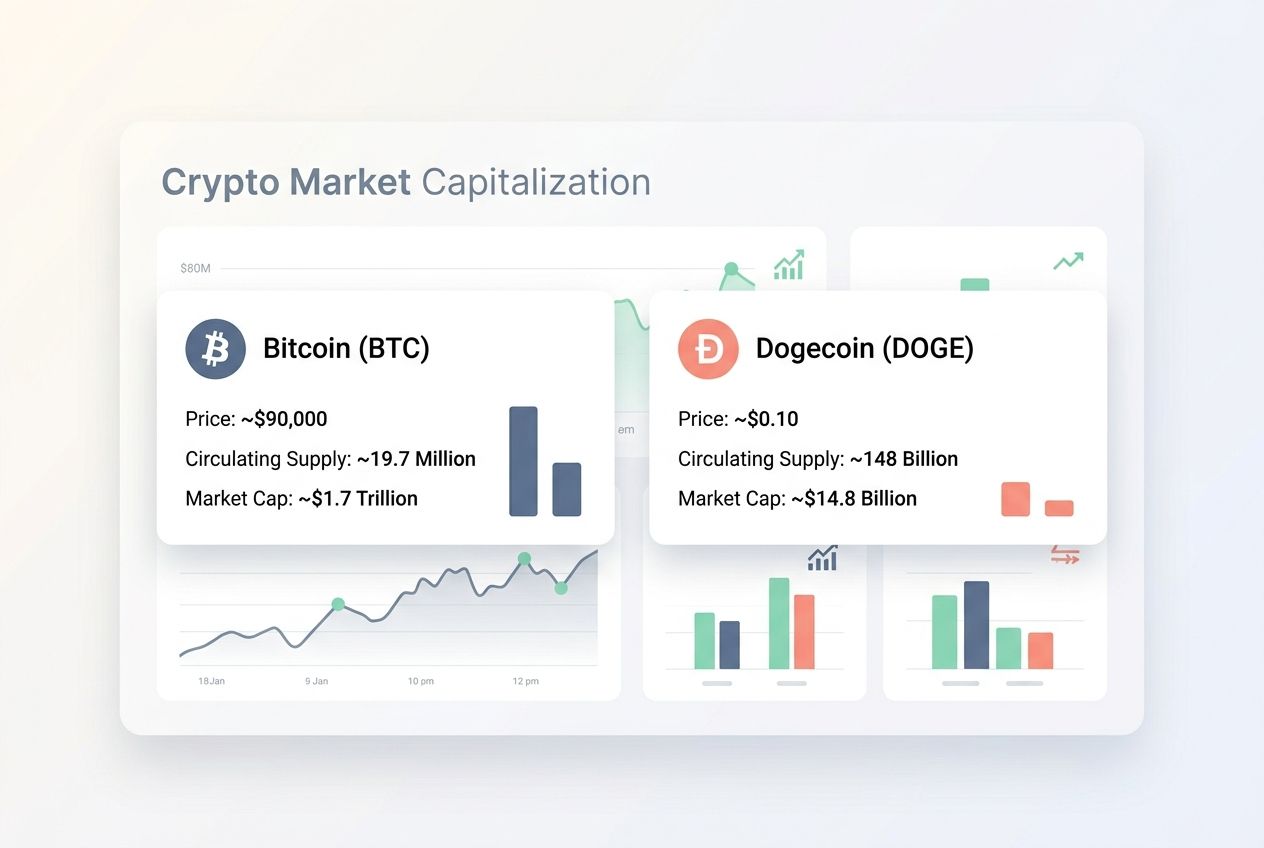
| Coin Example | Price | Circulating Supply | Resulting Market Cap |
|---|---|---|---|
| Bitcoin (BTC) | ~$90,000 | ~19.7 Million | ~$1.7 Trillion |
| Dogecoin (DOGE) | ~$0.10 | ~148 Billion | ~$14.8 Billion |
Investigate Real-world Applications
A coin is only as valuable as the actual problems it solves. Bitcoin gets used for fast peer-to-peer payments across borders. Ethereum powers thousands of smart contracts and digital assets, changing how people trade and build apps. Solana makes gaming and decentralized finance run faster than many older blockchains.
Shops now take some cryptocurrencies for goods, while banks test blockchain to send money more quickly. Here are a few concrete examples of real-world use.
- Corporate Settlement: Visa uses the Solana network to settle USDC transactions instantly in the US.
- International Remittance: Bitso uses Ripple (XRP) to move money between the US and Latin America in 3 to 5 seconds.
- Stable Pricing: Tether (USDT) helps businesses in developing nations lock in value against inflation.
Track Development Progress and Community Support
Watch how fast updates roll out for each digital asset. Teams that release new features, fix bugs, and share open progress often help their cryptocurrency grow stronger.
Check project websites and social media for roadmaps or update logs. Community support can completely make or break a coin’s future.
Look at Reddit, Twitter, and Discord groups to check if developers answer questions quickly. A lively, helpful community boosts trading volume and attracts massive investment opportunities.
The Importance of Smart Contracts in Cryptocurrency Growth
Smart contracts help digital money work in new and clever ways. These computer codes keep trades safe, fast, and fair for everyone.
Ethereum (ETH) (Smart Contracts)
Ethereum ranks as the second-largest cryptocurrency by market cap. Vitalik Buterin introduced it in 2015, and people use Ethereum for far more than just holding digital assets.
Its smart contracts let users build apps that run by themselves, without a bank or middleman. These smart contracts power DeFi projects, NFT platforms, and many popular altcoins.
With thousands of developers working on new ideas and tokenomics tools every day, Ethereum keeps leading blockchain technology forward. Here are the latest smart contract improvements.
- The Fusaka Upgrade: This 2025/2026 upgrade significantly improved data handling, letting smart contracts execute much faster.
- PeerDAS Technology: This new addition reduced the bandwidth required by network validators, keeping the system incredibly decentralized.
- Micro-Cent Fees: Because of these smart contract optimizations, users now pay just a penny for transactions that used to cost fifty dollars.
Cardano (ADA) (Smart Contracts)
Cardano uses a proof-of-stake blockchain, which means it saves energy while staying highly secure. The network supports advanced smart contracts, letting people build apps with less cost and speed.
Launched by Charles Hoskinson in 2017, Cardano aims to give fair financial access across the globe. ADA stands out for its research-based upgrades and careful testing before each code change goes live.
Developers use Cardano’s Haskell-based Plutus language to set up highly secure smart contracts. The March 2026 Protocol 11 upgrade made Plutus even more powerful, preparing the network for massive enterprise adoption.
The Role of Stablecoins in the Crypto Market
Stablecoins keep prices steady, making trading much smoother for everyone involved. They act as a safe bridge between digital coins and regular money.
Tether (USDT) (Stablecoins Section)
Tether (USDT) acts exactly like a digital dollar. Each token tries to match the price of one US dollar, which helps keep its value steady while most cryptocurrencies swing up and down wildly.
USDT has led stablecoins since 2014 and now ranks third by market capitalization, right behind Bitcoin and Ethereum. Over $120 billion in trading volume flows through Tether every day, making it the busiest coin on cryptocurrency exchanges.
Traders use USDT for quick swaps between digital assets because they avoid sudden price drops or jumps. Here is how investors use Tether daily.
- Parking Funds: Many investors pick Tether to park funds safely during high market swings.
- Cross-Border Transfers: Some use it to move money across borders fast without banks delaying the process.
- DeFi Lending: Users frequently lend their USDT in decentralized finance protocols to earn a steady interest rate.
USD Coin (USDC)
USD Coin, or USDC, works perfectly as a compliant stablecoin. It aims to keep its value tied close to the US dollar at all times.
Big companies like Circle and Coinbase heavily support it. You can easily trade USDC on almost all major cryptocurrency exchanges.
People use it for fast payments, trading digital assets, or simply holding cash online without relying on traditional banks. Let us look at why USDC is deeply trusted.
| USDC Feature | Why It Builds Trust |
|---|---|
| Fully Reserved Backing | Keeps real dollars and short-term US Treasury bonds in secure, audited accounts. |
| DeFi Integration | Over 250 blockchain applications integrate USDC as a core base trading pair. |
Wrapping Up
Coins like Bitcoin and Ethereum keep leading the pack of digital assets. Each network has its own unique tokenomics, trading volume, and exciting price trends. Stablecoins such as Tether have turned into essential tools for people wanting less risk in the crypto market. Energy-saving coins, including Cardano and Solana, are completely changing blockchain technology with brilliant new ideas.
People look at smart contracts on platforms like Ethereum to spot great investment opportunities or check liquidity. Altcoins offer a fantastic variety for every single type of investor. Some focus on financial innovation, while others boost the speed of decentralized finance.
Keep a close eye on these 10 top Cryptocurrencies in 2026. Sometimes a single news event can shift a coin’s price overnight, showing exactly how fast things move here!