Does the weather lately feel a bit more unpredictable? Many people have started noticing the same pattern. News reports frequently highlight wildfires, sudden floods, and record-breaking heat. With events like these appearing almost every week, it’s natural to wonder how experts manage to predict such rapid changes.
Another common question is whether these forecasts are accurate enough to truly help people prepare.
Here’s the encouraging part: artificial intelligence is transforming the field. Advanced systems can analyze massive climate datasets and help scientists forecast large-scale events faster than ever before.
However, there is an important trade-off. Running these powerful AI systems requires enormous data centers, and those facilities consume significant amounts of electricity and water.
The following explanation breaks down how these technologies work, the tools scientists use to predict future climate patterns, and the real costs involved in powering them.
Curious about what lies ahead? Let’s take a closer look.
The Role of AI in Climate Modeling
AI has become the MVP for scientists trying to figure out our warming planet. It does not just guess the weather. It processes information in a way that traditional computers simply cannot handle.
Enhancing predictive capabilities
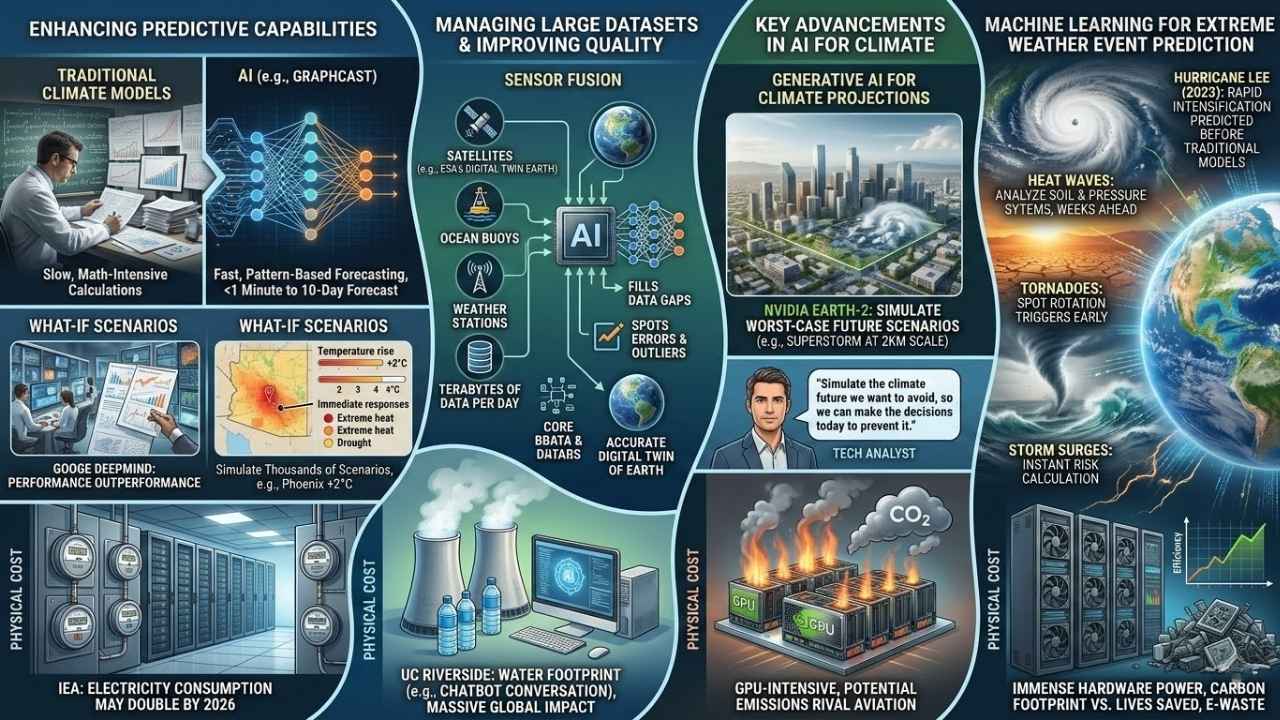
Think of traditional weather models like a really smart math student working through a long equation. It takes time. AI is different. It looks at the answer key from the last 100 years and learns the patterns instantly.
For example, Google DeepMind created a model called Graph Cast. In tests, it outperformed the world’s best traditional weather simulation systems in 90% of metrics. It can predict a 10-day forecast in under one minute.
Machine learning algorithms crunch numbers fast. This allows researchers to run thousands of “what if” scenarios. They can ask questions like “What happens to Phoenix if temperatures rise by 2 degrees?” and get an answer immediately.
However, this speed has a physical cost. A 2024 report by the International Energy Agency (IEA) estimates that data centers (which power these AI models) could double their electricity consumption by 2026. This creates a challenging cycle where the tools we use to save the planet also demand more from it.
Managing large datasets and improving data quality
We have satellites, ocean buoys, and weather stations sending us terabytes of data every single day. It is too much for humans to sort through.
AI acts like the ultimate editor. It spots mistakes, fills in missing gaps, and flags weird outliers that might be errors. A great example is the European Space Agency’s (ESA) “Digital Twin Earth” project. It uses AI to combine data from different sources to create a replica of our planet for testing.
But cleaning up this data takes power. Processing these massive records generates heat. Data centers need water to cool down. A study from the University of California, Riverside, suggests that a simple conversation with a chatbot can consume roughly a bottle of water in cooling costs. When you scale that up to global climate modeling, the water footprint is massive.
We have to balance these two realities. We need the sharp predictions to save lives. But we also need to manage the “junkyard” of e-waste and energy use these systems create.
Key Advancements in AI for Climate Modeling
This field is moving fast. We are seeing tools that don’t just look at numbers. They actually “see” storm risks and warming trends before they happen.
Generative AI for climate projections
You might know generative AI for writing emails or making images. But scientists use it to build “synthetic” climates. This helps them prepare for worst-case scenarios that haven’t happened yet.
NVIDIA is a big name here. Their Earth-2 platform uses generative AI to simulate weather patterns at a 2-kilometer scale. This allows city planners to see exactly how a superstorm would hit a specific neighborhood.
“Generative AI allows us to simulate the climate future we want to avoid, so we can make the decisions today to prevent it.” — Tech Industry Analyst
These models are incredibly power-hungry. The specialized chips (GPUs) required to run Earth-2 run hot. If the industry doesn’t shift to green energy, the carbon emissions from training these models could rival the aviation industry.
It is a strange paradox. We are burning energy to figure out how to stop the planet from burning.
Machine learning for extreme weather event prediction
Machine learning is like a scout looking for danger. It sifts through mountains of historical data to find the specific warning signs of a disaster.
Take Hurricane Lee in 2023. AI models correctly predicted the storm’s rapid intensification way before traditional physics-based models caught up. This gave people on the ground crucial extra hours to prepare.
- Heat Waves: AI analyzes soil moisture and pressure systems to predict heat domes weeks in advance.
- Tornadoes: improved radar algorithms can spot rotation triggers that human forecasters might miss during a chaotic storm.
- Storm Surges: AI calculates coastal risks by combining tide data with wind speed instantly.
The hardware required for this is immense. We are talking about server farms that run 24/7. Experts warn that without efficiency improvements, the carbon footprint of these calculations will keep growing. But when a timely warning saves a town from a flash flood, most people argue the energy cost is worth it.
AI-powered multi-source data integration
Imagine trying to read a map, a thermometer, and a wind gauge all at once while running. That is what climate scientists used to do. Now, AI does it for them.
This is called “sensor fusion.” It pulls data from NASA’s Earth Observing System satellites and combines it with readings from tiny sensors in the ocean. The result is a real-time health check of the Earth.
It allows us to track things we couldn’t see before. We can now monitor methane leaks from pipelines from space using AI that scans satellite imagery for invisible gas plumes.
Processing this mix of data is heavy lifting. It drives up the demand for water cooling in data centers. Tech companies are under pressure to find “greener” ways to do this math. If they don’t, the solution becomes part of the problem.
Benefits of AI in Climate Modeling
Why are we pouring so much money and energy into this? Because the results are saving lives and money right now.
Increased accuracy in climate predictions
Old weather models were often wrong because they had to simplify the math to get it done in time. AI doesn’t have to simplify as much.
A study published in the journal Science showed that AI weather models are now matching or beating the gold-standard European Centre for Medium-Range Weather Forecasts (ECMWF) in accuracy. This means you get a better idea of whether you need an umbrella or an evacuation plan.
Faster and more efficient modeling processes
Speed is everything when a wildfire is moving toward a town. Here is how AI compares to the old way of doing things:
| Feature | Traditional Weather Models | AI-Powered Models |
|---|---|---|
| Speed | Takes hours on a supercomputer | Takes seconds/minutes on a desktop (once trained) |
| Cost | Extremely expensive to run daily | Lower operational cost per forecast |
| Data Use | Limited by strict physics equations | Learns from unstructured, messy real-world data |
The efficiency gain is huge. But we have to remember the “training cost.” Teaching the AI the first time takes months of supercomputer time. That front-loaded energy use is significant (often cited in the millions of metric tons of CO2 range for large models).
Improved decision-making for climate action
Data is useless if you can’t use it. AI translates complex charts into clear warnings.
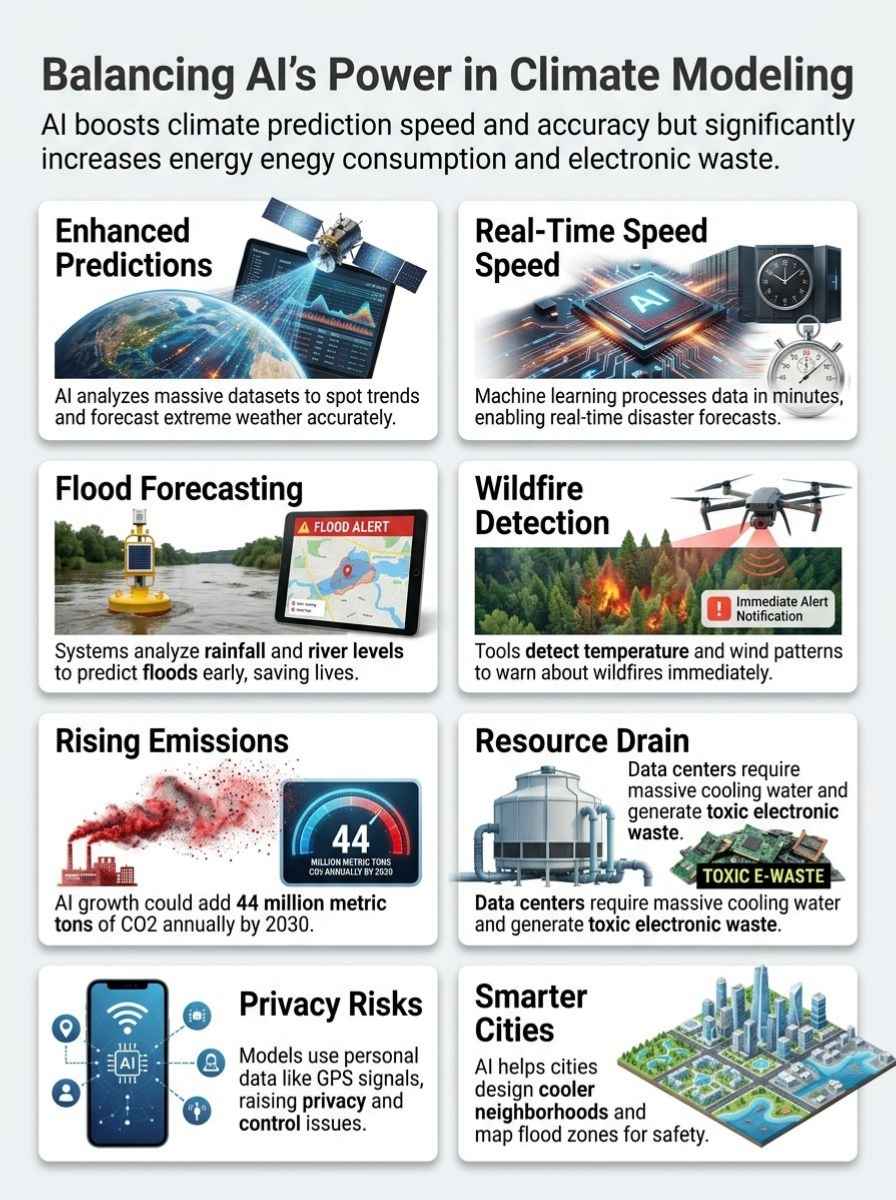
For example, Google’s Flood Hub uses AI to predict river floods up to seven days in advance. It covers 80 countries. It sends simple alerts to people’s phones so they know to move to higher ground.
Decision-makers use these insights to write better laws. If an AI model predicts that a specific sea wall will fail in 2030, the city council can budget for a better one today. It moves us from reacting to disasters to preventing them.
Challenges of Using AI in Climate Modeling
It is not all perfect. Relying on AI brings some serious hurdles that we need to talk about honestly.
Energy consumption and environmental impact of AI systems
We cannot ignore the electricity bill. Training a single large AI model can emit as much carbon as five cars produce in their entire lifetimes.
Data centers are now competing with local communities for power. In places like Northern Virginia (a huge data center hub), the power grid is under massive strain. These facilities also need water for cooling. In a drought-stricken area, using millions of gallons of water to cool servers is a controversial choice.
If the tech industry does not switch to renewables, the emissions from AI could hit that scary projection of over 40 million metric tons annually by 2030. We need green AI, not just smart AI.
Data privacy and ethical considerations
To predict local disasters, AI needs local data. Sometimes, that includes knowing where people are.
During a disaster, apps might track movement via GPS to see evacuation routes. This raises a big question. Who owns that data? Is it safe?
There is also an issue of fairness. Wealthy nations have great weather data. Developing nations often have “data deserts” where there are no sensors. AI trained only on US or European data might fail to predict a flood in Africa accurately. We have to make sure these tools work for everyone, not just the people who built them.
Model interpretability and transparency
Scientists call this the “Black Box” problem. You feed data into the AI, and it spits out a prediction. But often, even the creators cannot explain why the AI made that specific choice.
This is risky. If an AI tells a city to evacuate because of a storm that doesn’t look dangerous yet, will the mayor trust it? If they can’t explain the logic, people hesitate.
New “Explainable AI” (XAI) research is trying to fix this. It aims to make the AI show its work. Without that transparency, it is hard to trust a machine with life-or-death decisions.
Case Studies of AI in Climate Applications
Let’s look at real-world examples where this tech is hitting the ground running.
AI-driven flood forecasting systems
Floods kill more people globally than almost any other weather disaster. Speed is the only defense.
Google’s Flood Hub is the standout example here. By analyzing terrain and rainfall data, it can predict floods in areas that never had flood gauges before. In India and Bangladesh, this system has sent out millions of alerts.
It is not perfect. It requires massive computing power. But for the families who got a warning notification three days before the water hit their doorstep, that technology is a miracle.
Wildfire prediction using machine learning
In the US, California is leading the way. The ALERT California program uses AI to watch feeds from over 1,000 cameras across the state.
Before this, a human had to stare at screens to spot smoke. Now, the AI spots a thin wisp of smoke and alerts firefighters instantly. In one case, the AI spotted a fire in the Cleveland National Forest at 3 a.m. Firefighters put it out before it grew larger than a small room.
This success proves that AI can be a “digital lookout” that never sleeps. Yes, the servers use energy, but stopping a mega-fire saves millions of tons of carbon from entering the atmosphere.
Renewable energy optimization with AI tools
The wind doesn’t always blow, and the sun doesn’t always shine. This makes renewable energy tricky for the power grid.
AI solves this. Companies like DeepMind have partnered with wind farms to predict wind power 36 hours in advance. This increased the value of that wind energy by 20%.
By predicting exactly when the power will dip, grid operators don’t have to fire up dirty coal plants as “backup.” It makes green energy more reliable and profitable. It is one of the best ways AI pays off its own carbon debt.
The Future of AI in Climate Change Mitigation
We are just getting started. The next few years will see AI move from just “watching” the climate to actively helping us fix it.
Potential for AI in carbon sequestration modeling
We need to pull carbon out of the air. But where do we put it? And which forests are actually helping?
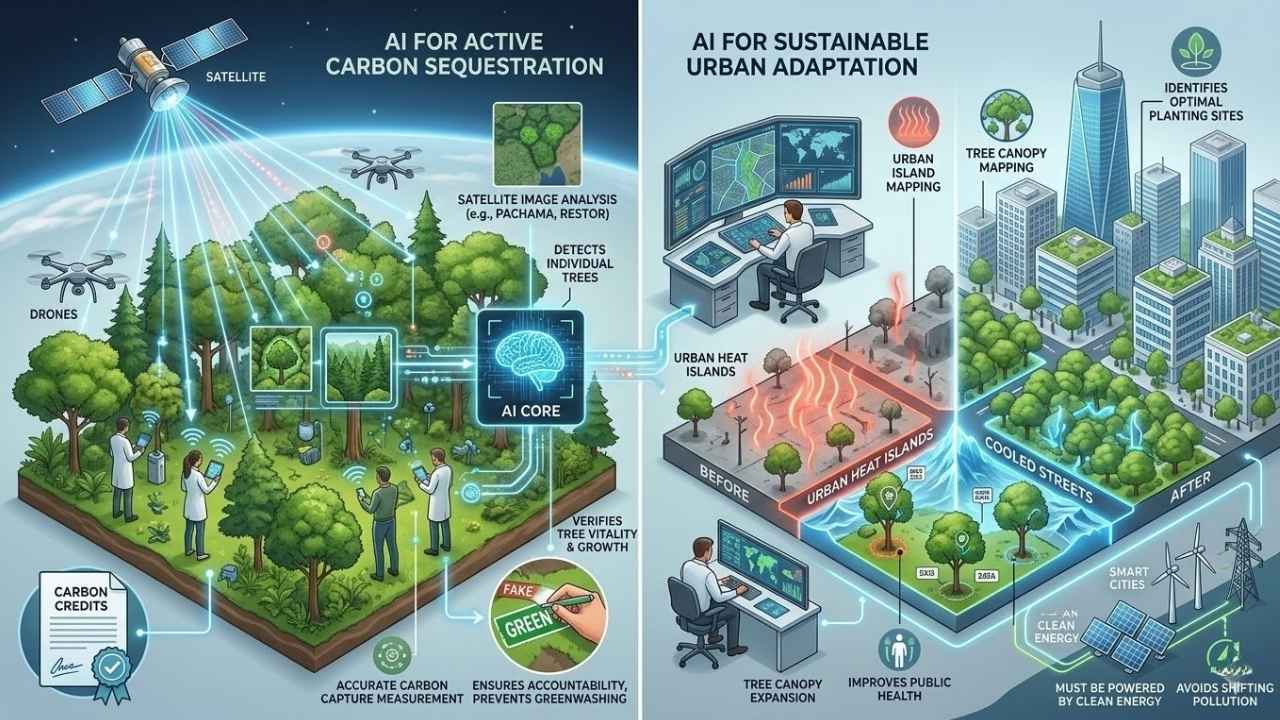
Startups like Pachama and non-profits like Restor use AI to analyze satellite images of forests. They can calculate exactly how much carbon a specific patch of trees is capturing.
This prevents “greenwashing.” Companies can’t just claim they planted trees; the AI verifies if the trees are alive and growing. It brings accountability to the carbon credit market.
Role in sustainable urban planning and adaptation strategies
Cities are getting hotter. Planners are using AI to map “urban heat islands“—those concrete areas that trap heat.
Cities like Los Angeles and New York use tree canopy mapping tools. These AI tools identify exactly which streets need more shade to cool down the neighborhood. It helps officials plant trees where they will have the biggest impact on public health.
Of course, we still face the energy hurdle. As we build “Smart Cities” run by AI, we must power them with clean energy. Otherwise, we are just shifting the pollution from the tailpipe to the power plant.
Final Thoughts
Artificial intelligence is reshaping the understanding of Earth’s systems. It accelerates forecasting, enables earlier wildfire detection, and supports the design of greener, more efficient cities.
However, significant side effects remain impossible to ignore. The rising energy demand and increasing electronic waste produced by large-scale computing infrastructure represent serious challenges that require urgent solutions. Responsible and efficient use of these technologies is essential.
Despite these concerns, the technology offers a meaningful source of optimism. Advanced tools provide a stronger ability to anticipate and respond to the accelerating changes driven by the global climate crisis.