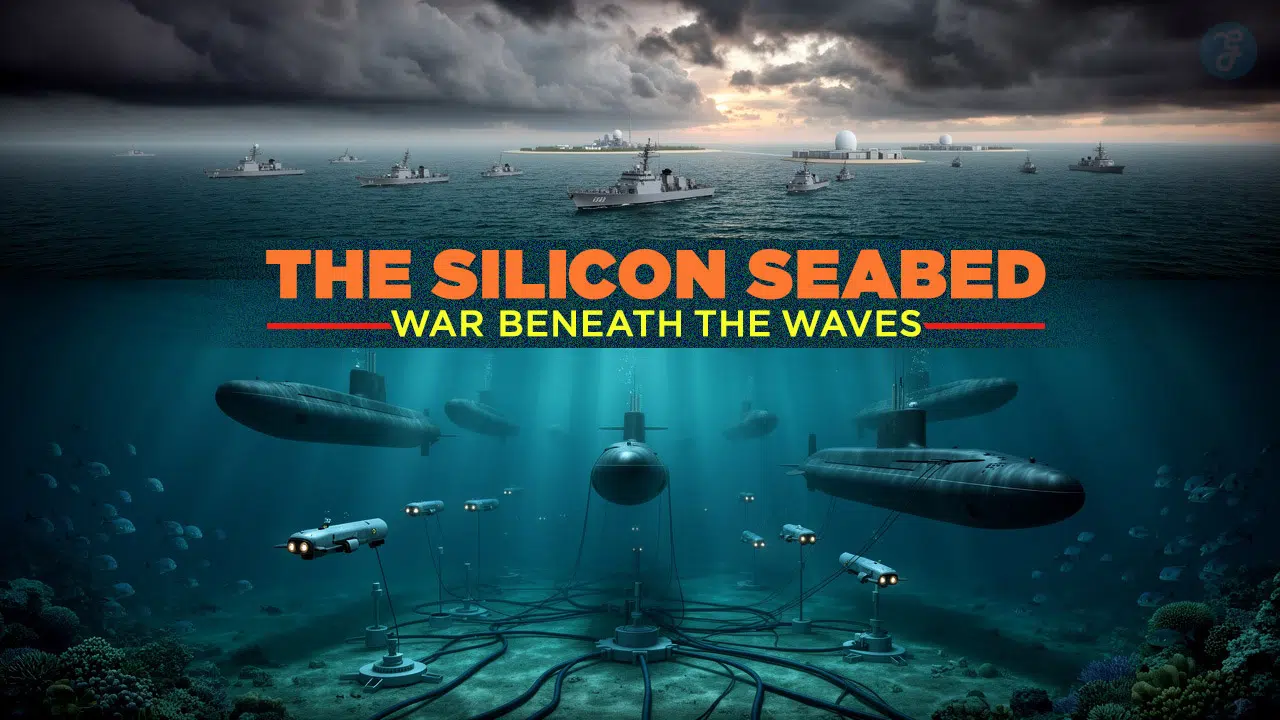
The morning of 25 February 2025 did not begin with a bang. There were no missile sirens in the Penghu Islands, no flash of steel on the horizon. Instead, there was a sudden, silent strike on the archipelago’s digital lifeline. It was a terrifying echo of the Matsu Islands blackout two years prior, a time when cafes saw mobile screens freeze on half-loaded pages, local clinics watched digital health records evaporate, and the familiar whirr of ATMs gave way to a cold “Connection Error.” This was the stark, real-world consequence of a targeted strike on South China Sea undersea cables. Now, the 100,000 residents of Penghu were hanging by a single, fragile backup thread. If that secondary line had failed, the modern world would have simply switched off.
While the local population struggled to reboot their lives, the Taiwanese Coast Guard was already racing towards a speck on their radar. Six nautical miles northwest of Jiangjun Fishing Harbour, they found the Hong Tai 58.
The vessel was a ghost of the global shipping industry. It flew a Togolese flag, a flag of convenience often used to mask true origins, but its heart was entirely Chinese. On its bridge stood Captain Wang Yuliang and a crew of seven Chinese nationals. For three days, the Hong Tai 58 had been performing a strange, mechanical dance. It did not move from A to B. Instead, it loitered in a restricted no anchor zone, tracing a jagged, zigzag pattern across the waves.
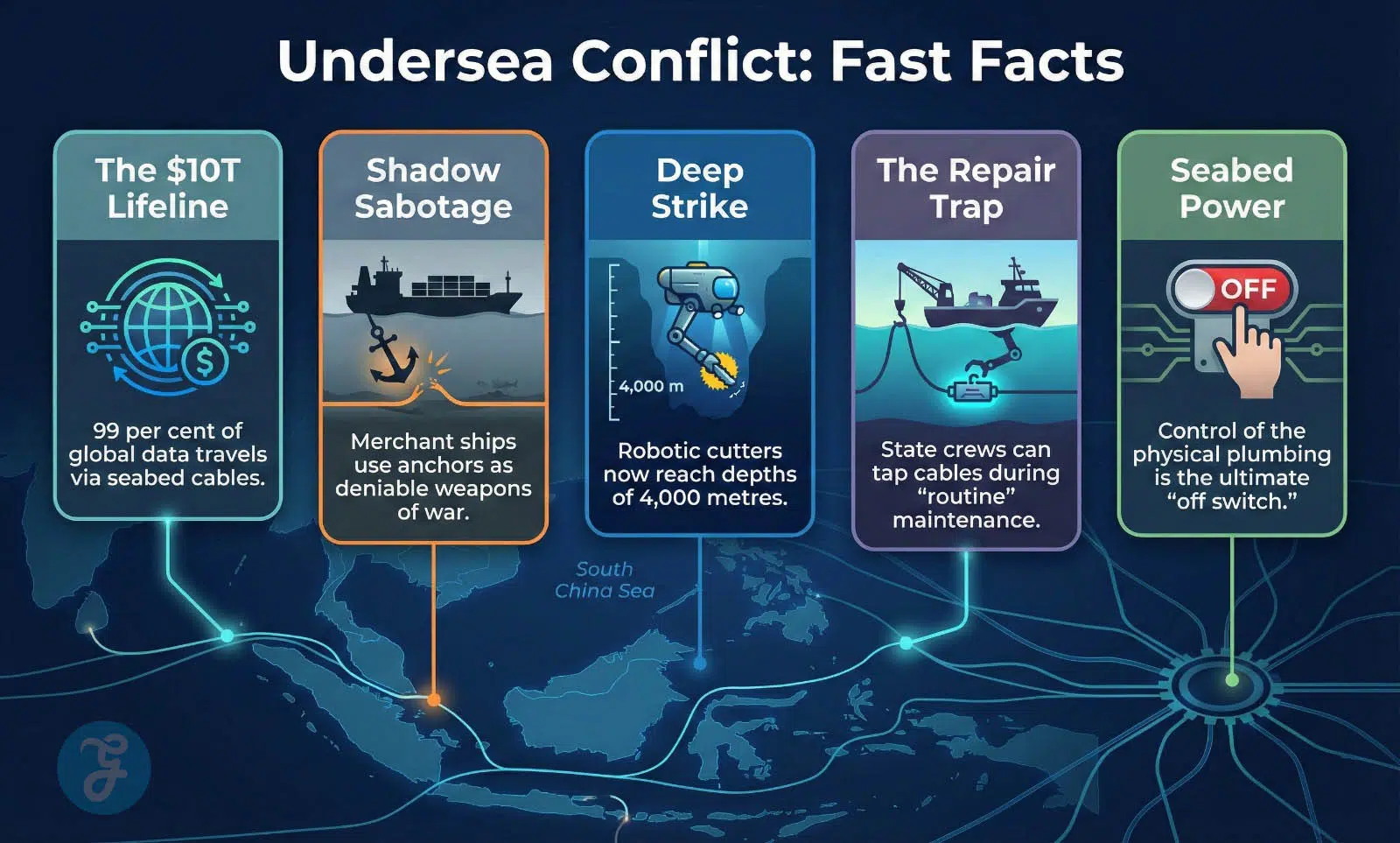
The “zigzag” is the signature of the modern saboteur. Radar logs later revealed the ship had been dragging its heavy anchor across the seabed like a jagged fingernail across a piano wire. At 3:30 AM, Chunghwa Telecom confirmed the Tai Peng No. 3 cable, the glass lifeline connecting Penghu to the main island, had been severed.
South China Sea Undersea Cables: The Shadow of the Glass War
This was no maritime accident. It was a precision strike.
The Hong Tai 58 represents a new, deniable class of weapon in Beijing’s “grey zone” arsenal. By the time the captain was sentenced to three years in a Taiwanese jail in June 2025, the damage was done. The incident proved that you do not need a billion-dollar destroyer to cripple an adversary. A rusty freighter and a heavy anchor can achieve the same result with far better plausible deniability.
We are currently fixated on the “theatre” of the South China Sea, the fighter jet intercepts and the artificial island fortresses. But this is a distraction. The real war is being fought in the dark, thousands of metres below the keel. It is a struggle for the 1.4 million kilometres of fibre-optic cables that serve as the central nervous system of our global existence.
Ninety-nine per cent of our data and ten trillion dollars in daily financial flows travel through these fragile tubes of glass. In the 2020s, digital sovereignty is not about software or firewalls; it is about the physical plumbing of the internet. Whoever controls these cables holds the “off switch” for the global economy and the “glass” through which every secret must pass.
The silence in Penghu was not a glitch. It was a rehearsal.
The Strategic Choke Point: $10 Trillion at Risk
The world’s most critical infrastructure is surprisingly unglamorous. It is not a gleaming satellite or a nuclear-powered carrier. It is a bundle of glass fibres, no thicker than a garden hose, shielded by copper, polyethylene, and galvanised steel. If you were to dive into the South China Sea today, you would find these cables resting on the silt, vulnerable to everything from a dragging anchor to a specialised deep-sea submersible.
This is the “Seabed Economy.” We tend to think of our data as ethereal, floating in a “cloud” above our heads. In reality, the cloud is underwater. According to global telecommunications data, undersea cables carry 99 per cent of all transcontinental digital traffic. Every frantic WhatsApp message, every encrypted diplomatic cable, and every high-frequency stock trade relies on this physical plumbing.
The numbers are staggering. On any given day in 2026, financial watchdogs estimate that roughly $10 trillion in transactions flow through these lines. This includes the SWIFT network, the backbone of global banking. To put that in perspective, a single Tier-1 international bank can move nearly $4 trillion across the seabed in a single 24-hour settlement cycle. If the primary South China Sea cable clusters were severed simultaneously, global markets wouldn’t just dip; they would experience a systemic “liquidity freeze.” The gears of capitalism would effectively grind to a halt.
Nowhere is this more precarious than the South China Sea. It is the world’s most congested data corridor, a geographic funnel through which the collective digital life of Japan, South Korea, Taiwan, and Southeast Asia must pass to reach Europe and the Middle East. Because the waters in the Taiwan Strait and the Sunda Shelf are relatively shallow, cables cannot be buried deep enough to avoid detection or accidental damage. They are sitting ducks in a contested bathtub.
We are witnessing a fundamental paradigm shift in maritime strategy. For the last century, “Freedom of Navigation” was the mantra of the high seas, the right of ships to move unhindered across the surface. Today, that concept is being augmented by “Security of Connectivity.” It no longer matters if the sea lanes are open for tankers if the data lanes are closed for business.
In the corridors of power in Washington and Beijing, the focus has shifted from the horizon to the abyss. The goal is no longer just to control the waves, but to secure the glass. In this new era, the nation that maps, maintains, and monitors the undersea topology controls the pace of global history.
The New Undersea Hierarchy
| Player | Declared Status | Actual Strategic Reality |
| Big Tech (Google/Meta) | “Service Providers” | New Gatekeepers. According to industry monitors like TeleGeography, by 2026, they own 70 per cent of transcontinental capacity, bypassing traditional telcos and challenging state sovereignty over data routes. |
| China (HMN Tech) | “Market Disrupted” | Stealth Dominator. Despite U.S. bans, industry data shows China has secured 19 per cent of the global market and created a “Digital Silk Road” that smaller ASEAN nations find too cheap to refuse. |
| Southeast Asian States | “Sovereign Hubs” | The Vulnerable Middle. While Singapore and Malaysia lead in landings, they lack the specialised fleet to repair cables independently, leaving them reliant on the very powers that may sabotage them. |
| The United States | “Security Leader” | The Architect of the Bypass. The U.S. has successfully rerouted critical traffic away from Chinese waters, but at the cost of higher latency and a fragmented, more expensive internet. |
| Japan (NEC) | “Infrastructure Partner” | The Quiet Giant. Holding 41 per cent of the regional supply share, a figure confirmed by recent submarine network market analyses, Japan is the actual technical spine of the Indo-Pacific, providing the physical hardware that keeps the U.S. alliance digitally viable. |
The Great Cable Decoupling
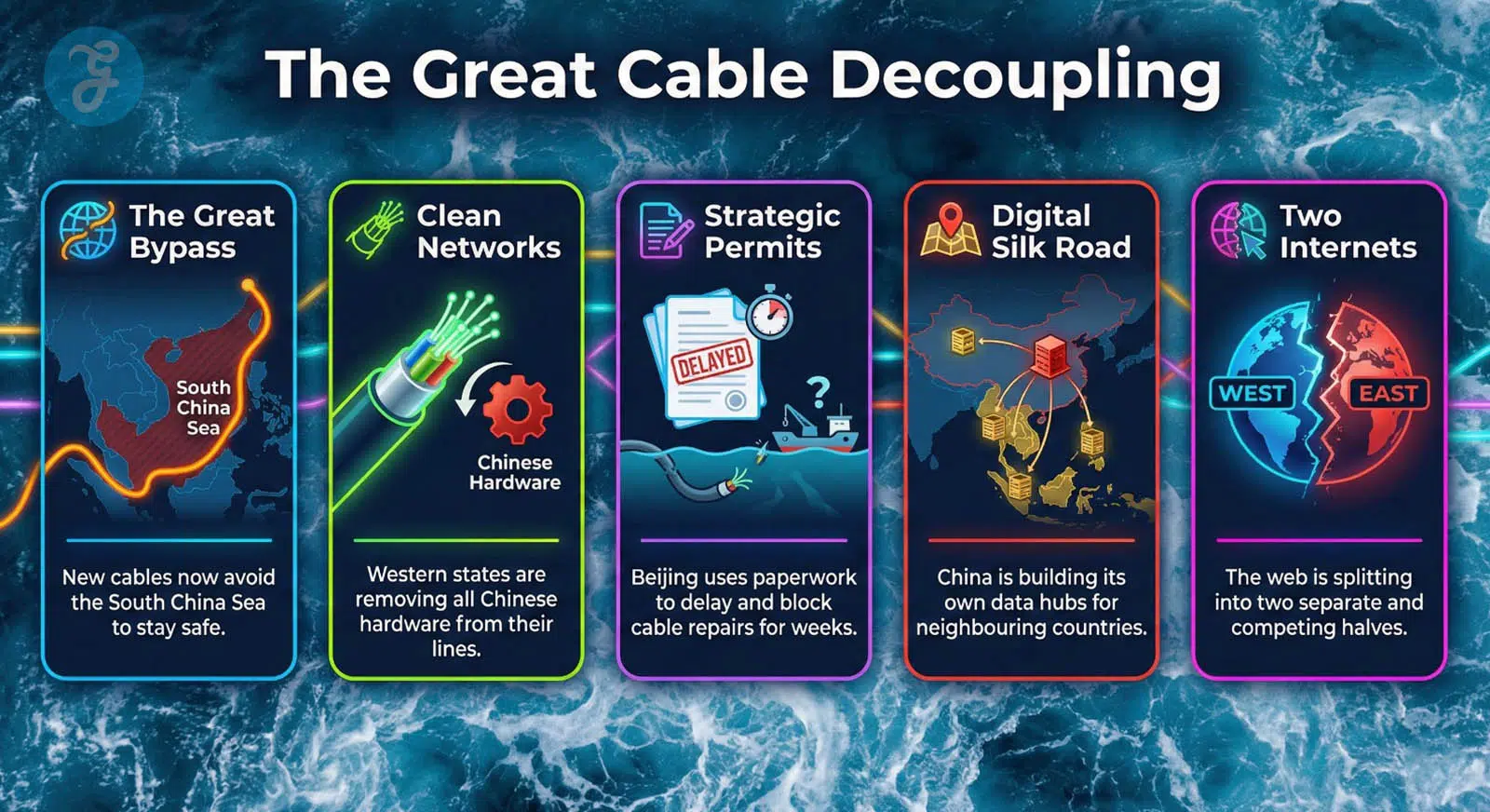
The map of the internet is being physically redrawn. For decades, the South China Sea was the undisputed superhighway of global data. Today, it is becoming a digital dead zone for Western infrastructure. Washington has spent the last five years executing a quiet, surgical operation to “decouple” its data from Chinese-controlled waters.
The strategy is anchored in the “Clean Network” initiative. On the surface, it sounds like environmental policy. In reality, it is a hard-line security mandate. The U.S. has effectively blacklisted Chinese suppliers like HMN Tech from any project touching American shores. This isn’t just about who makes the cable; it is about who lays it, who repairs it, and whose territory it crosses.
By early 2026, the results of this shift are visible on the ocean floor. We have entered the era of the Great Bypass. Mega-projects like Bifrost and Echo, now operational as of late 2025, have fundamentally altered the Pacific’s digital topography. These lines do not follow the traditional path through the South China Sea. Instead, they snake south, threading through the Celebes Sea and the Philippine Sea. They are designed to ensure that a packet of data travelling from San Francisco to Singapore never touches the silt of the “nine-dash line”.
The latest addition to this defensive architecture is the Candle system. Announced in late 2025 and slated for 2028, this massive 24-fibre-pair line will be the largest capacity cable in the Asia-Pacific. It is a technological fortress, designed to provide “network diversity”, a polite euphemism for making sure the West has a working internet even if China closes its maritime borders.
Beijing is not watching this from the sidelines. Its response is the “Digital Silk Road”. If the U.S. is building a bypass, China is building a toll booth. Beijing is positioning itself as the mandatory hub for ASEAN data, offering cut-price infrastructure to neighbours like Vietnam and Cambodia.
More aggressively, China has weaponised the permit process. In 2025, Western cable-repair crews reported “bureaucratic blockades” when trying to fix faults in contested waters. By requiring months of paperwork for a three-day repair, Beijing can leave a competitor’s network lagging or broken for weeks. This is not a war of missiles. It is a war of attrition, fought with permits, reroutes, and the silent, cold reality of the seabed. The internet is no longer a global commons. It is being carved into two distinct hemispheres.
The “Gray Zone” Fleet: Sabotage as Statecraft
The war beneath the waves is not being fought by a traditional navy. It is being waged by a “shadow fleet” of ageing cargo ships and fishing trawlers that provide Beijing with something more valuable than firepower: plausible deniability.
Vessels like the Xingshun 39, also known as the Shunxin 39, and the Hongtai 58 are the workhorses of this effort. On paper, they are unremarkable merchant ships registered to flags of convenience like Tanzania, Togo, or Cameroon. In practice, they are precision tools for maritime harassment. Since early 2023, Taiwan has recorded a series of critical incidents, including the complete digital isolation of the Matsu Islands, where undersea cables were severed by “accidental” anchor dragging. This is not a statistical anomaly; it is a signature “salami-slicing” tactic designed to test the resilience of Taiwan’s emergency infrastructure.
The technology behind these “accidents” was confirmed in early 2025. The China Ship Scientific Research Centre officially unveiled a deep-sea-cable-cutting device. It is a masterpiece of dark engineering. Equipped with a 150mm diamond-coated grinding wheel spinning at 1,600 rpm, it can slice through heavily reinforced, steel armoured cables. Crucially, it is rated for depths of 4,000 metres, reaching the “safe” abyssal zones where cables were once considered untouchable by anything other than nature.
But cutting a cable is only the first step. The more insidious threat comes from the ships that arrive to fix them.
Enter the “Trojan Repair” ship. A state-owned firm like S.B. Submarine Systems, a subsidiary of China Telecom, frequently handles regional maintenance. When a cable breaks, these vessels have a legitimate reason to loiter over the site for days. U.S. and UK intelligence officials have warned that these missions provide a perfect window for optical signal tapping. By installing “backdoor” splitters or monitoring equipment directly onto the fibre-optic repeaters, data can be siphoned without breaking the connection.
Sabotage vs. Espionage: The Underwater Playbook
| Tactic | Execution | Strategic Objective |
| Anchor Dragging | Trawlers like Hongtai 58 loiter in no-anchor zones to “accidentally” sever lines. | Denial of Service. Tests local resilience and creates economic chaos through digital isolation. |
| Deep-Sea Cutting | CSSRC robotic cutters slice armoured cables at 4,000 metres. | Precision Attrition. Targets specific high-security lines previously thought to be out of reach. |
| Optical Tapping | Repair ships like Bold Maverick install “backdoor” splitters on repeaters. | Silent Harvest. Mirrors data to mainland servers for long-term decryption and intelligence. |
Once a splitter is attached, the data is no longer private. It can be mirrored and sent to mainland servers. Even encrypted data can be harvested for “harvest now, decrypt later” strategies, waiting for the arrival of cryptographically relevant quantum computers to unlock the secrets. In the South China Sea, the very crews sent to restore your connection may be the ones ensuring it is never truly private again.
The End of the World Wide Web
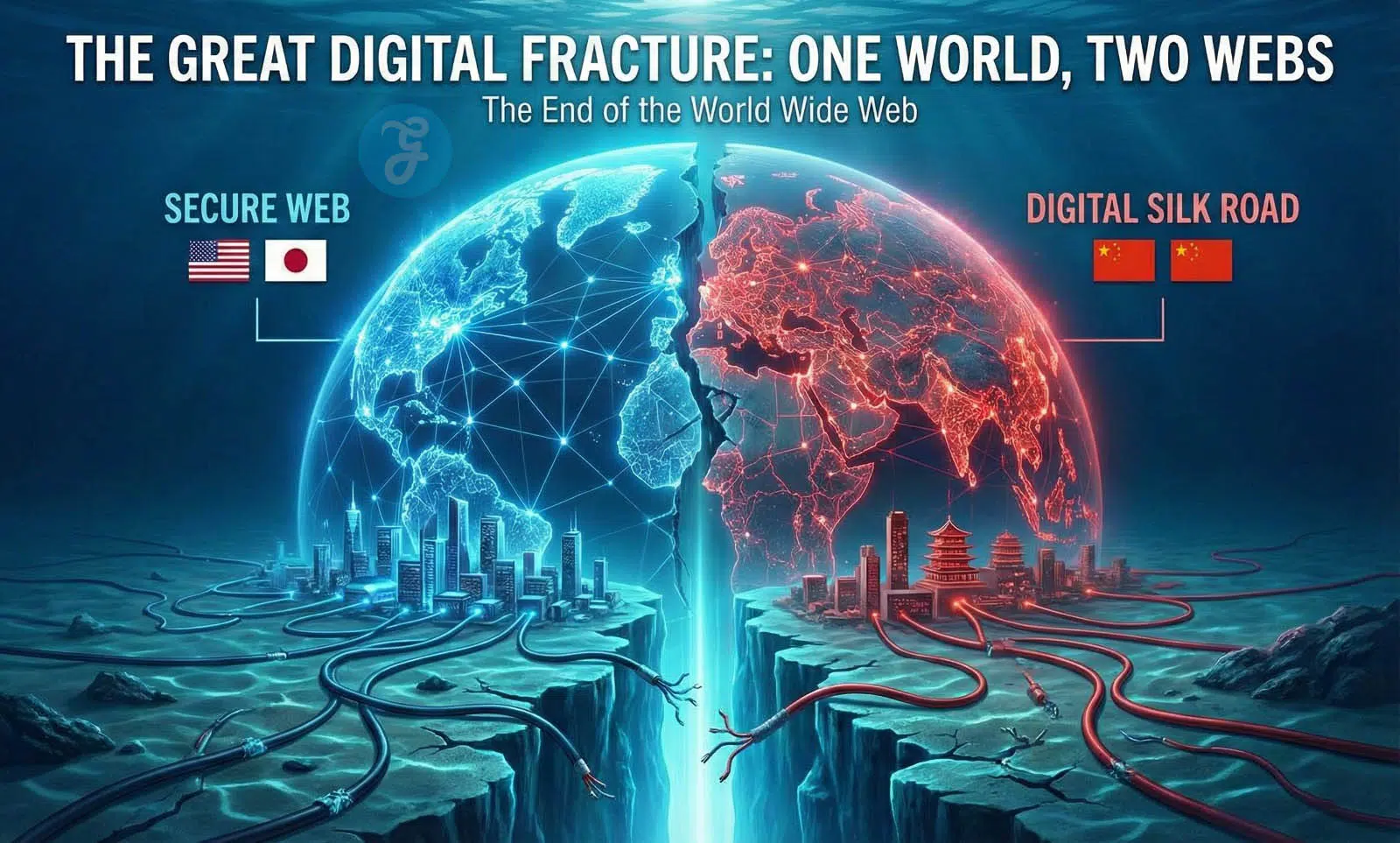
The dream of a borderless digital world is dying on the ocean floor. For three decades, the internet functioned on a simple logic: data takes the shortest, fastest path. In 2026, that logic has been replaced by a much darker one. Data now follows the politically safest path. We are witnessing the birth of the “Splinternet,” a world where the physical wires beneath the sea are being severed and reconnected to suit national interests.
This is the era of weaponised interdependence. In the past, a nation might blockade a port to strangle an enemy’s trade. Today, you only need to control a cable landing station. These are the nondescript concrete buildings on the coastline where the undersea glass meets the terrestrial grid. If you control the landing station, you control the “off-switch” for an entire nation’s economy. By pulling a single metaphorical lever, a state can decapitate an adversary’s banking system, ground its airlines, and silence its military communications.
This shift has created a brutal “Sovereignty Trap” for smaller nations. Countries like Vietnam, Thailand, and the Philippines are no longer just choosing trade partners. They are choosing their digital reality. Beijing offers the “Digital Silk Road,” providing high-speed cables at a fraction of the cost. The catch is that these lines are built and maintained by Chinese state firms, effectively handing the keys to the kingdom to the Communist Party.
On the other side, the U.S. and Japan offer “Secure” routes. These are safer but often more expensive and come with strict compliance demands. There is no middle ground anymore. If a country chooses a Chinese-built cable, Washington may refuse to let its own sensitive data pass through it. This forces a binary choice. It is a digital version of the Cold War, where the “Iron Curtain” is replaced by a curtain of fibre-optics.
This fragmentation is making the internet slower, more expensive, and far more fragile. When data has to bypass entire seas to avoid a political rival, latency increases. When a single region becomes a “no-go” zone for maintenance crews, the risk of a total blackout rises. We are no longer building a World Wide Web. We are building a series of walled gardens, separated by deep trenches and guarded by silent, underwater sentries. The internet was meant to unite us, but the silicon seabed is tearing us apart.
The New Iron Curtain is Underwater
If a kinetic conflict erupts in the South China Sea, we must disabuse ourselves of the notion that it will look like the wars of the past. The opening salvo will not be a missile strike or a torpedo launch. The first casualty will not be a sailor. It will be a server.
A total digital blackout would be the most effective weapon of modern statecraft. By severing a handful of strategic lines, an aggressor could plunge an entire nation into a pre-industrial state within seconds. No logistics. No banking. No coordinated defence. The silence would be more terrifying than any explosion. We have built our entire civilisation on a foundation of glass and sand, assuming the pipes would always be safe. That assumption is now a dangerous luxury. The strategic control of South China Sea undersea cables has become the primary metric of power in the modern age.
To prevent this, we need more than just better encryption. We need a physical maritime security coalition. The world’s leading democracies must treat undersea cables with the same urgency as they treat oil tankers. We need a permanent, multi-national task force dedicated to patrolling these corridors, much like the anti-piracy operations in the Gulf of Aden. This means shared intelligence on “shadow” vessels and rapid-response repair ships that can operate under military escort. Connectivity is now a collective security concern. It cannot be left to the whims of private corporations or the mercy of Beijing’s bureaucracy.
The reality is stark. The South China Sea is no longer just a patch of water contested for its fish or its oil. It is the site of a new, submerged Iron Curtain. We are entering a period where geography determines your digital destiny. We must decide if we are willing to defend the physical plumbing of the free world or if we are content to let it be dismantled, piece by piece, in the dark. In the 2020s, the old rules of power still apply, but the medium has changed. Whoever owns the glass, owns the world.