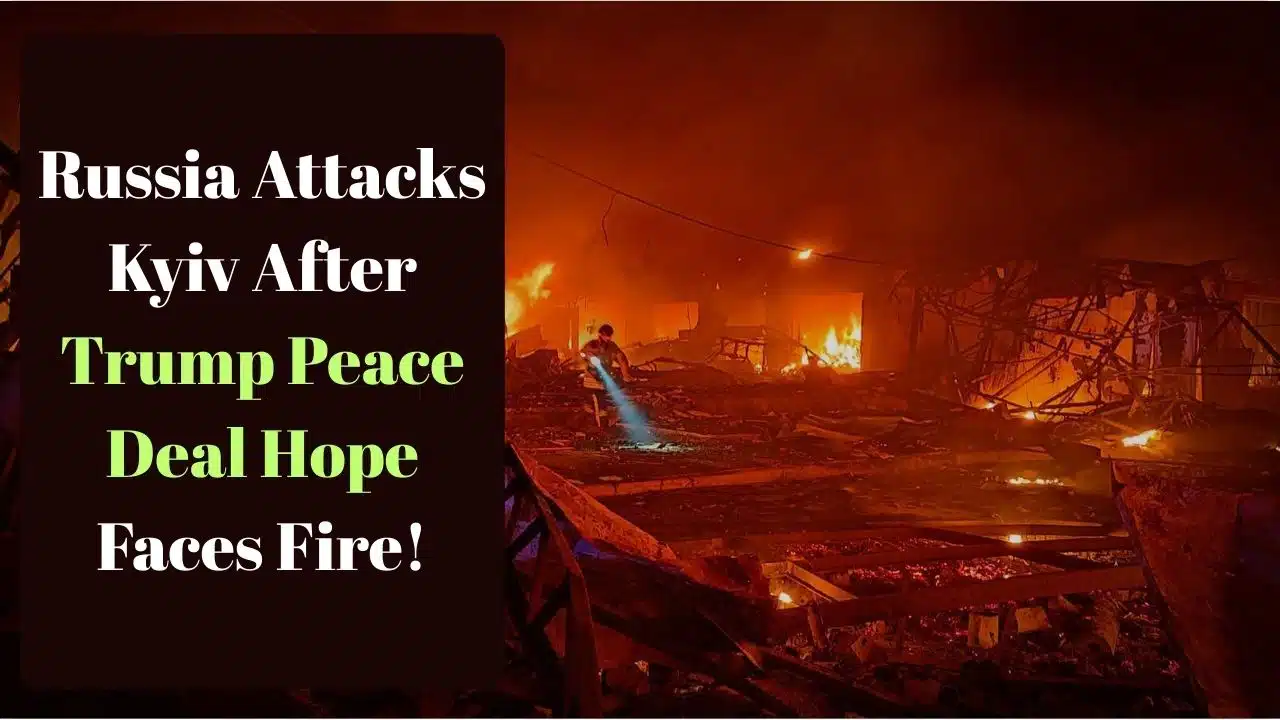
Russia attacks Kyiv after Trump peace deal hope, and the contrast feels brutal. In public, Washington talks about progress, draft texts, and new openings for peace. In Ukraine’s capital, people spend the night in stairwells and shelters while drones and missiles slam into homes and power lines.
A night of fire after days of “hope.”
Shortly before dawn on Tuesday, air-raid sirens wailed again over Kyiv. Residents in several districts woke to the sound of explosions and the glow of flames. Russia had launched a fresh wave of missile and drone attacks across Ukraine, with the capital as the main target.
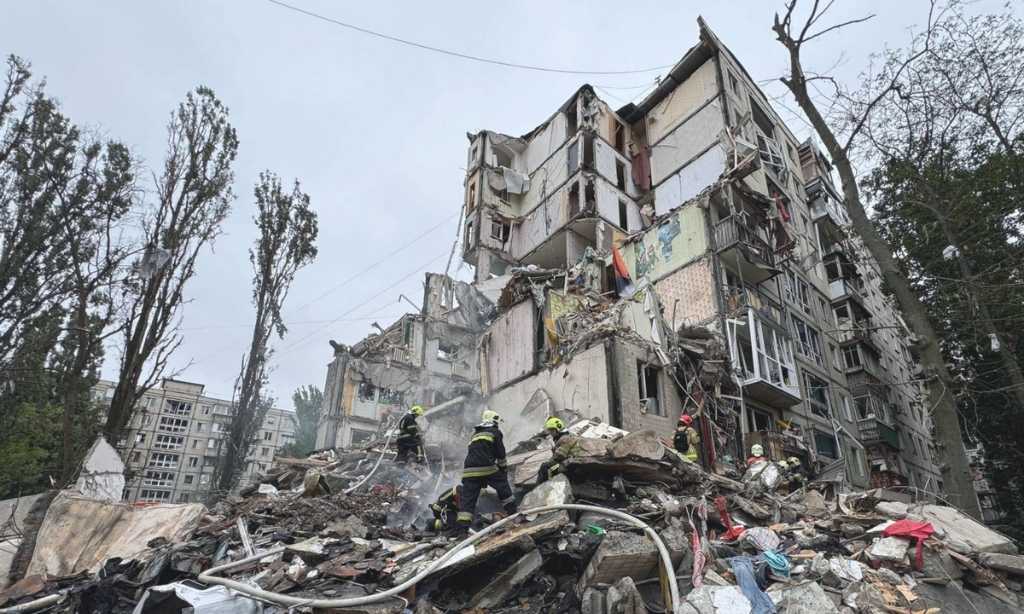
Emergency teams reported burning apartment blocks, shattered windows, and streets covered in debris. Water, electricity, and heat went out in parts of the city. People watched firefighters battle a blaze that climbed up the side of a nine-storey residential building in Kyiv’s eastern district.
Officials said at least four people died in Kyiv alone and at least seven more suffered injuries. Nationwide, the strikes killed at least six people and wounded many others. The numbers may still change as rescue work continues.
These attacks came right after a weekend of intense diplomacy. Trump’s administration had sent top officials to Geneva for talks with Ukraine on a new U.S. peace plan. The White House spoke of “very constructive” discussions and hinted that the outline of a deal was starting to take shape.
At the same time, Vladimir Putin praised the American proposal and said it could form the basis for a lasting settlement. Trump himself insisted that he still believed a peace deal was within reach.
The message from Kyiv looked very different. Peace hopes dominated speeches abroad. At home, missiles hit homes.
Kyiv hit again: homes and energy sites targeted
Local authorities gave a grim picture of the overnight assault. They said Russian forces targeted several districts of Kyiv with a mix of drones and missiles.
In the eastern Dniprovskyi district, one strike set a multi-storey apartment block on fire. Flames ripped through the upper floors as residents fled with what they could carry. Two people died there and at least five suffered injuries, according to the city’s mayor.
Another missile hit the central Pechersk district, a part of Kyiv that hosts offices and residential buildings. Images from the morning showed blackened facades, broken balconies, and smashed cars.
Later in the night, fresh explosions rocked the western Svyatoshynyi district. Local officials said a strike on a non-residential building killed more people and left several wounded. Exact figures remained fluid through the morning, but the combined toll in the capital reached at least four dead and more than seven injured.
Ukraine’s energy ministry confirmed that energy infrastructure also came under fire. Damage reports remained partial, yet people in parts of Kyiv described sudden blackouts and drops in heating pressure. Repair crews moved in as soon as the all-clear sounded.
Further south, in the Odesa region, missiles and drones hit energy and port facilities. Authorities there reported at least six injured, including children. The strikes damaged warehouses, cranes, and power equipment that support Ukraine’s grain exports and local industry.
Ukrainian officials said the attacks once again showed that Russia sees civilian infrastructure as a tool of war. They accused Moscow of using the winter cold as a weapon by repeatedly striking power plants and heating systems.
Trump’s peace push and Putin’s embrace
The timing of the attack sharpened questions around Trump’s peace narrative.
Over the past week, the administration has pushed a 28-point plan that aims to end the war. The document, according to people familiar with it, asks Ukraine to accept painful concessions. These include recognizing the loss of occupied territories, cutting its armed forces by a large margin, and shelving any path toward NATO membership. In return, Russia would get relief from some sanctions and a path to deeper economic ties.
Critics in Kyiv and in European capitals say the proposal leans heavily toward Moscow’s interests. Some call it a “surrender plan” that freezes the conflict on Russia’s terms.
The Kremlin, however, has reacted warmly. Putin says the U.S. plan could serve as a basis for a final settlement, though he wants clarifications and further talks. For Moscow, the proposal signals that Washington is ready to move the goalposts.
Trump has highlighted that response as proof that his team can bring both sides to the table. He argues that only strong pressure on Kyiv and Europe can force a compromise and claims that no other leader could push the war parties this close to a deal.
Facing backlash at home and abroad, the White House now stresses that the text is a starting point, not a finished treaty. Officials say they are already working on amendments with Ukraine and European allies. They frame the weekend talks in Geneva as the most productive round so far.
Still, the headline remains clear: the U.S. president signals fresh peace deal hope. Russia answers with more strikes.
Kyiv’s verdict: “Peace talks there, missiles here.”
From Kyiv’s point of view, the pattern looks familiar. Every step toward negotiations seems to come with a reminder from Moscow that it still controls the escalation ladder.
The head of the city’s military administration said Russian forces “deliberately” targeted civilian housing and essential services. He called the assault an act of “cynical terror” designed to break morale and send a signal, not just to Ukraine but also to foreign capitals.
Many Ukrainians read that signal as simple and brutal: Russia will keep bombing until any peace deal reflects its demands. A settlement that rewards aggression, they warn, will only invite more attacks later.
Officials also worry that generous talk about peace can undercut support for air defenses and ammunition. They argue that Ukraine needs stronger military backing now, not vague promises that fighting will soon stop.
For people who spent the night sheltering in basements, the message feels even more personal. Peace talks may bring hope one day, but right now, they do not stop missiles.
Retaliation and a wider war map
Ukraine did not let the strikes go unanswered. During the same night, its forces launched a large drone attack on Russia’s Rostov region. Local authorities there said drones hit the city of Taganrog, killing at least three people and injuring several others. Homes, warehouses, and social facilities suffered damage.
Russia claimed that its defenses destroyed scores of Ukrainian drones over several regions and over occupied Crimea. Officials there spoke of more than two hundred drones intercepted or otherwise neutralized.
The exchange shows how far the war has moved beyond the front line. Each side now hits targets deep inside the other’s territory. Each strike complicates already fragile talks.
Ukraine argues that operations inside Russia are legitimate responses to constant missile and drone attacks. Russia accuses Ukraine of terrorism and uses those strikes to justify further waves against Ukrainian cities.
The pressure on the peace plan
The events of the past few days have increased pressure on Trump’s peace effort from all directions.
For Ukraine, the key issue is security. Leaders in Kyiv insist that any plan must protect the country from renewed attacks after a ceasefire. They want clear guarantees, firm limits on Russian forces, and help to rebuild defenses.
European governments worry about precedent. They fear a settlement that rewards territorial conquest and undermines basic principles of sovereignty. Some push for changes that would let Ukraine keep a larger army and limit how much land it must give up.
Inside the United States, critics warn that a deal seen as too soft on Moscow could fracture support for Ukraine and damage Washington’s credibility with its allies. Supporters of the plan argue that endless war serves nobody and that hard choices are unavoidable.
Trump and his team now try to walk a narrow line. They present the peace plan as bold and realistic but promise adjustments. They speak of steady progress, yet say no one will force Ukraine into a humiliating agreement.
Today’s strikes make that balancing act even harder. When Russia attacks Kyiv after the Trump peace deal hope, it exposes the gap between words about peace and the reality of life under bombardment.
Between air-raid sirens and negotiation rooms
For people in Kyiv, the rhythm of the war has not changed. Sirens sound. Families grab children and move to doorways or shelters. They wait in the dark, scroll news on their phones, and hope the next explosion lands far away.
Above them, drones buzz and air-defense systems fire interceptors into the night. Below them, diplomats debate commas and clauses in draft texts that may or may not shape the future.
The question now is whether those texts can catch up with events on the ground. A peace deal that ignores what happened in Kyiv this week will struggle to win trust in Ukraine. Yet a deal that demands too much from Russia may fail before it reaches a signing ceremony.
Until that gap closes, Ukrainians will go on living between negotiations and air raids. And each time Russia attacks Kyiv after the Trump peace deal hope, it will remind them that for all the talk of progress, the war is still decided by missiles, drones, and the resilience of the people under fire.