You spend hours crafting the perfect post, hoping Google will notice. Yet sometimes traffic barely moves, leaving you wondering if people discover content through other paths. Many creators experience the same frustration.
Here’s something worth knowing: Bing and DuckDuckGo can bring high-quality visitors to your site, often with far less competition than the larger search engines. This guide walks through the exact steps to help your content get noticed on these platforms.
So grab a coffee and explore how to attract more eyes to your site—without fighting the toughest battles.
Why Consider Optimizing for Bing and DuckDuckGo?
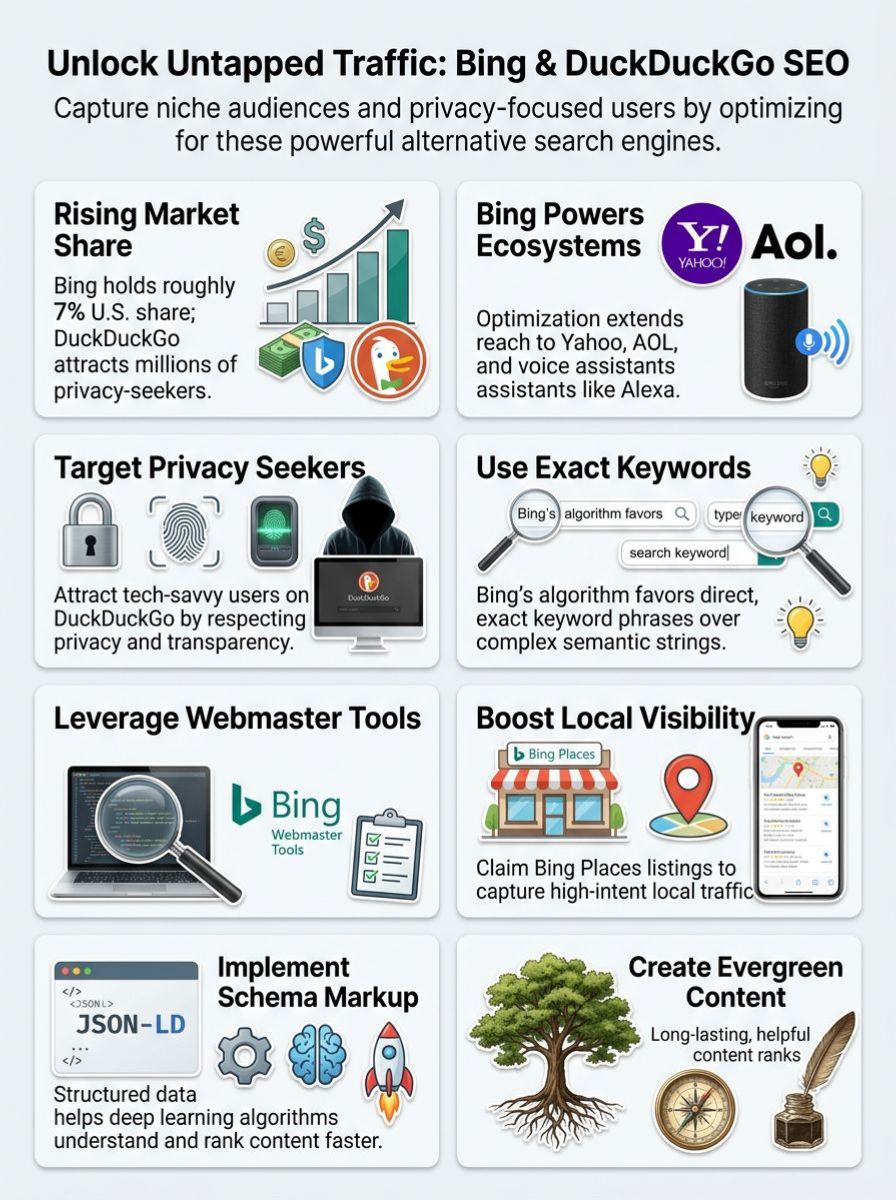
Some folks use Bing and DuckDuckGo every single day. Ignoring them means you are leaving fresh traffic on the table. If you want to grow your audience, showing up here is a smart move.
Bing and DuckDuckGo are quietly gaining ground. Recent 2025 data from Stat counter shows Bing holding a strong position in the U.S. desktop market, often exceeding 12 percent share. DuckDuckGo continues to hold steady with around 2 percent of the total U.S. market.
More people are looking for privacy. They turn to engines like DuckDuckGo because it does not track their searches or build a profile on them.
Many devices use Bing by default. If you buy a new Windows laptop, Microsoft Edge opens with Bing ready to go. This simple default setting instantly connects millions of users to the platform.
“A key feature driving Bing’s adoption is Microsoft Rewards. Users earn points for searching, which they can trade for gift cards. This gamification keeps loyal users coming back daily.”
As privacy worries grow and AI tools like Microsoft Copilot improve, marketers see real value here. Adding Search Engine Optimization for Bing and DuckDuckGo into your digital marketing plans is no longer just an optional extra.
Privacy-focused users gravitating toward DuckDuckGo
People who care about their online privacy choose DuckDuckGo. This engine promises not to track or store searches. It feels like a breath of fresh air compared to the ads and trackers you see elsewhere.
DuckDuckGo does not build personal profiles. Everyone gets the same answer to the same question. This appeals to tech-savvy folks, journalists, and parents who are tired of feeling watched.
Since 2008, DuckDuckGo has built trust with a simple promise: user privacy comes first. For brands, this means you can focus on evergreen content that answers broad questions. You do not need to rely on tracking tools or deep data collection to win here.
Bing’s role in powering search results for other platforms
Bing does a lot of heavy lifting behind the scenes. It powers search results for Yahoo, DuckDuckGo, and even Ecosia. It also feeds answers to voice assistants like Alexa.
If you ask a smart speaker a question, there is a good chance Bing is providing the answer. Optimizing for Bing SEO means your content reaches users on Bing.com and all these partner platforms too.
That helps you grow organic traffic from multiple channels without doing extra work. With privacy-focused users turning to DuckDuckGo, showing up in both places helps you catch different types of traffic.
Bing and DuckDuckGo are snapping up small but valuable pieces of the search pie. Some folks land on Bing by default, while privacy fans head straight for DuckDuckGo.
U.S. and global search engine trends
Search habits have shifted. Here is how Bing and DuckDuckGo stack up against Google in the U.S. and worldwide as of late 2025.
| Search Engine | U.S. Desktop Share (2025) | Key Features & Audience |
|---|---|---|
| 78%-80% | Dominates mobile and general search. The default for most, but highly competitive. | |
| Bing | 12%-15% | Strong on desktop due to Windows/Edge. Audience is often older (35+) with higher household income ($100k+). |
| DuckDuckGo | ~2.0% | Favored by privacy advocates. Uses Apple Maps for local search. No tracking or personalization. |
| Yahoo | ~2.5% | Powered largely by Bing. Still relevant for older demographics and finance/news readers. |
Default browser settings play a big role in Bing’s numbers. Millions of Windows devices use Edge with Bing set as the main search option. DuckDuckGo’s growth shows that folks value privacy more than ever.
These engines might not threaten Google’s throne, but they offer a focused audience. For local traffic using Bing Places or tech-savvy readers on DuckDuckGo, this slice of the market is worth capturing.
Default settings driving Bing usage
Bing scoops up users thanks to Microsoft devices. Computers running Windows often have Bing set as the go-to search engine in Edge. Many people stick with these original choices out of habit.
This means Bing grabs a solid slice of web traffic quietly. Voice assistants and smart TVs also use Bing by default. These built-in choices mean more organic traffic swings Bing’s way without users changing a thing.
For digital marketing efforts, these defaults are reliable. They boost local search visibility and evergreen content results across different platforms powered by Bing’s algorithm.
Key Benefits of Optimizing for Bing
Bing rewards clear and focused pages. Its reach extends past its own site, putting your hard work in more hands than you might think.
Simpler algorithm requirements
Bing uses advanced AI, but its requirements feel less strict than Google’s. Focus on clear content structure and exact match keywords often pays off here.
Search Engine Optimization for Bing does not need as much technical tweaking. Many experts find it easier to predict ranking results. One major advantage is the IndexNow protocol.
- IndexNow: This tool allows you to instantly notify Bing when you publish or update content.
- Faster Indexing: Unlike Google, where you wait for a crawl, Bing can index your new page within minutes of submission.
- Clear Signals: Bing is more open about what it wants, making it easier for small businesses to see real gains.
Evergreen content works well since Bing values consistency. Even small businesses can see real gains in web traffic by targeting this search engine.
Focus on exact match keywords
Sticking to exact match keywords can help sites rank better in Bing search results. This means using the same words people type when searching, like “organic traffic” or “local search.”
Bing’s system often favors these clear matches over fuzzy phrases. For example, if your page targets “digital marketing,” use that specific phrase in your titles and headers.
People searching with DuckDuckGo also use direct terms. Since DuckDuckGo does not track users, each query stands alone. Clear and simple evergreen content that uses straightforward keywords covers more ground.
Integration with Bing-powered platforms
Bing does not just serve up its own results. It powers searches for Yahoo, AOL, and Amazon’s Alexa. Microsoft Edge defaults to Bing, leading users there automatically.
This means your content reaches people on many platforms with one effort. Bing Places helps local businesses boost visibility. It captures organic traffic from people nearby who use these different tools.
Even some Apple Siri queries have relied on Bing data. Optimizing for Bing increases your reach across digital marketing channels. These integrations make your Search Engine Optimization SEO efforts stretch farther.
Key Benefits of Optimizing for DuckDuckGo
DuckDuckGo loves sites that respect user privacy. If you want to stand out to these users, you need to think a little differently.
Privacy-conscious audience appeal
Privacy-focused users flock to DuckDuckGo because it promises not to track them. This draws tech-savvy people who want real privacy. Big companies like Apple have even set DuckDuckGo as an option on their devices.
Search results are not personalized. Everyone sees the same thing regardless of their history. This levels the playing field for new content.
“A unique feature of DuckDuckGo is the !Bang command. Users can type ‘!a’ to search Amazon or ‘!w’ to search Wikipedia directly. While you cannot optimize for this directly, it shows how power-users on this platform prefer speed and direct answers.”
Creating evergreen content reaches this group better. Brands that highlight honesty and care about user privacy can stand out here. For digital marketing, these users value transparency more than customized ads.
Unique search behaviors and priorities
People using DuckDuckGo often care most about user privacy. They skip personalized results, so your content must have wide appeal. Evergreen content stands out since it reaches many different people at once.
Many users land here because they want unbiased answers. They may also be using Apple devices, where DuckDuckGo is a popular alternative.
Local organic traffic works differently here too. DuckDuckGo uses Apple Maps for its local results. This means if you want to rank for “pizza near me” on DuckDuckGo, your Apple Maps listing matters more than your Google Profile.
For some industries, this means local reach without extra steps. You just need to ensure your presence is solid on the platforms that feed DuckDuckGo’s results.
How to Optimize for Bing
Getting seen on Bing is easier than you think. Stick around to discover some fast ways to boost your SEO game there.
Use Bing Webmaster Tools
Bing Webmaster Tools helps boost your site’s performance. It offers unique features that even Google doesn’t have. Experts recommend using it to gain more organic traffic.
- Sign up with a Microsoft account to access Bing Webmaster Tools for free.
- Submit your sitemap directly to improve how Bing crawls your web pages.
- Enable the IndexNow feature. This is a must-do step that alerts Bing instantly when you update a page.
- Use the “Site Scan” feature to spot technical SEO issues that might block you.
- Track keyword rankings to see which search queries drive traffic.
- Get detailed information on backlinks, which are key for Bing SEO.
- Link Bing Webmaster Tools with Bing Places for Business to support local search.
- Review security alerts to ensure user privacy stays safe.
Build high-quality backlinks
Search engines pay close attention to backlinks. High-quality links from trusted sites help boost your website’s authority.
- Trusted sources like .gov and .edu hold strong value for search engine optimization on Bing.
- Bing favors links from older, established domains. Domain age is a trust signal here.
- Building backlinks through local news coverage supports Bing Places visibility.
- Earning mentions in niche blogs helps lift site ranking for specific keywords.
- Bing values Social Signals. Unlike Google, Bing openly considers shares and likes from social media as a ranking factor.
- DuckDuckGo likes honest, privacy-respecting content. Earning links from tech blogs is a smart strategy.
- Writing evergreen content often gets picked up by resource lists.
- Guest posts on trustworthy sites introduce your brand to new audiences.
- Local partnerships bring citations that are important for Bing SEO.
- Target a mix of high-authority and locally recognized domains for success.
Prioritize schema markup for better visibility
Schema markup helps Bing understand your content. Adding the right tags can boost your search visibility and grab more organic traffic.
- Use clear, structured data to describe your pages. Bing processes this information quickly.
- Highlight key business details like address and phone number using local business schema.
- Mark up evergreen content with schema to reach a wider audience. DuckDuckGo also looks for these signals.
- Choose popular schemas such as Article, Product, FAQ, or Recipe.
- Schema boosts click-through rates by enabling rich results like star ratings.
- Sites with schema often score higher in Bing’s SEO reports.
- Using schema supports privacy-focused platforms by making your site easier to display.
- Exact match keywords in schema make it easier for engines to categorize you.
- Local businesses using markup draw more clicks from users seeking services nearby.
- Niche marketing campaigns see better outcomes when core offers are marked up.
How to Optimize for DuckDuckGo
Think like your reader and keep their privacy top of mind. Get smart with local strategies to boost visits from folks nearby.
Focus on high-quality, privacy-respecting content
People who use DuckDuckGo care about their privacy. They want useful content without being tracked. You need to earn their trust quickly.
- Create evergreen content that helps a wide audience since results are not personalized.
- Avoid using aggressive pop-ups or too many tracking cookies.
- Use plain, helpful language to reach tech-savvy users and beginners alike.
- Make sure your website uses HTTPS for secure browsing.
- Cite facts from trusted sources to boost relevance in organic search.
- Write clear titles and meta descriptions using exact match keywords.
- Focus on topics like data security or honest product reviews.
- Remove unnecessary scripts that might collect personal information without consent.
- Design pages to load quickly on mobile devices.
- Share knowledge through FAQs that answer common questions.
Improve local SEO for regional visibility
Local search brings in visitors who are nearby. Focusing on regional SEO helps you stand out, especially with DuckDuckGo users.
- Claim your business on Apple Maps Connect. DuckDuckGo pulls its map data from Apple, not Google. This is the most critical step for local visibility here.
- Claim your business on Bing Places. This helps you show up for general searches that feed into DuckDuckGo’s text results.
- Add accurate details such as address, phone number, and hours. These key facts help users find you fast.
- Use keywords based on your city or area. Connect these keywords to user queries.
- Ask happy customers to leave reviews on platforms that sync with Apple Maps, like Yelp or TripAdvisor.
- Check that your listings match your website info to avoid confusing the algorithms.
- Optimize evergreen content for local events or news to attract attention.
- Include schema markup on location pages so algorithms understand your details.
- Make sure your website loads quickly. Mobile users looking for local spots hate waiting.
Improving local SEO is about making sure the right people find you. By covering Apple Maps and Bing Places, you cover all your bases.
Submit your site to DuckDuckGo
You can reach more privacy-focused users with DuckDuckGo. Submitting your site is easy because you mostly do it through other channels.
- DuckDuckGo does not have a direct submission form. It uses sources like Bing and Wikipedia.
- Make sure your site is indexed on Bing. Since DuckDuckGo pulls from Bing’s index, this is your primary path in.
- Optimize your content for Bing SEO using exact match keywords.
- Create evergreen content that appeals to everyone.
- Update your business profile in Bing Places and Apple Maps.
- List your site in trusted directories like Yelp. DuckDuckGo uses third-party data to show information.
- Keep your website fast and mobile-friendly.
- Prioritize user privacy by avoiding intrusive ads. Tech-savvy audiences appreciate this focus.
Each of these steps gives you a shot at better visibility. You are reaching an audience that wants straightforward answers.
Is It Worth the Effort?
Some businesses find gold in smaller ponds. For others, the splash is barely a ripple. Deciding where you stand can make all the difference.
Comparing traffic potential to Google
Google takes the lion’s share of web traffic. It pulls in about 80% to 90% of searches depending on the device. Bing holds roughly 12% of the desktop market, and DuckDuckGo hovers near 2%.
For most businesses, Google will drive more visitors simply because it is bigger. However, volume isn’t everything.
Bing users often have higher purchasing power. Statistics show that a large portion of the Bing audience earns over $100,000 per year. They are often searching from work computers for B2B solutions.
Tech-savvy users who care about privacy use DuckDuckGo. If your content strategy focuses on privacy or tech, this audience is highly valuable. Site owners looking for new digital marketing angles should not ignore these platforms.
Niche audiences and specific industries
Some industries see real benefits by focusing on Bing and DuckDuckGo. Tech companies, privacy advocates, and local businesses often find loyal users here.
Bing Places can be a strong source of local organic traffic for service providers. DuckDuckGo appeals to people searching for sensitive topics like finance or health who want privacy.
These groups want search results that do not track them. Bing’s algorithm favors exact match keywords, so niche marketers gain an edge. Optimizing for these platforms means less competition and decent visibility within specialized areas.
Final Thoughts
Choosing to optimize for Bing and DuckDuckGo gives your Search Engine Optimization strategy more reach. You can connect with privacy-focused users and those on Microsoft devices. The steps are simple, like using Bing Webmaster Tools, setting up Index Now, and claiming your Apple Maps listing.
These changes take little time but can lead to gains in organic traffic from new sources. Small tweaks today can help you grow web traffic tomorrow.
If you want more ways to boost results, plenty of guides are out there. Give it a try. I have seen quiet wins happen after tuning up even small sites for these engines!