While the global news cycle remains fixated on political fragmentation and the noise of short-term election cycles, a quiet but fundamentally transformative revolution took place yesterday in the misty port city of Hamburg. On January 26, 2026, amidst the industrial backdrop of Germany’s gateway to the world, ministers from nine nations gathered not just to sign a document, but to physically rewire the European continent.
The North Sea Wind Pact, formally enshrined as the Hamburg Declaration, is not merely another environmental pledge to be filed away and forgotten. It is a hard-nosed, binding industrial treaty that marks the definitive end of the fossil fuel era in Northern Europe and the birth of a new geopolitical super-entity: the North Sea Powerhouse.
The Engineering Shift: From Spokes to Spiderwebs
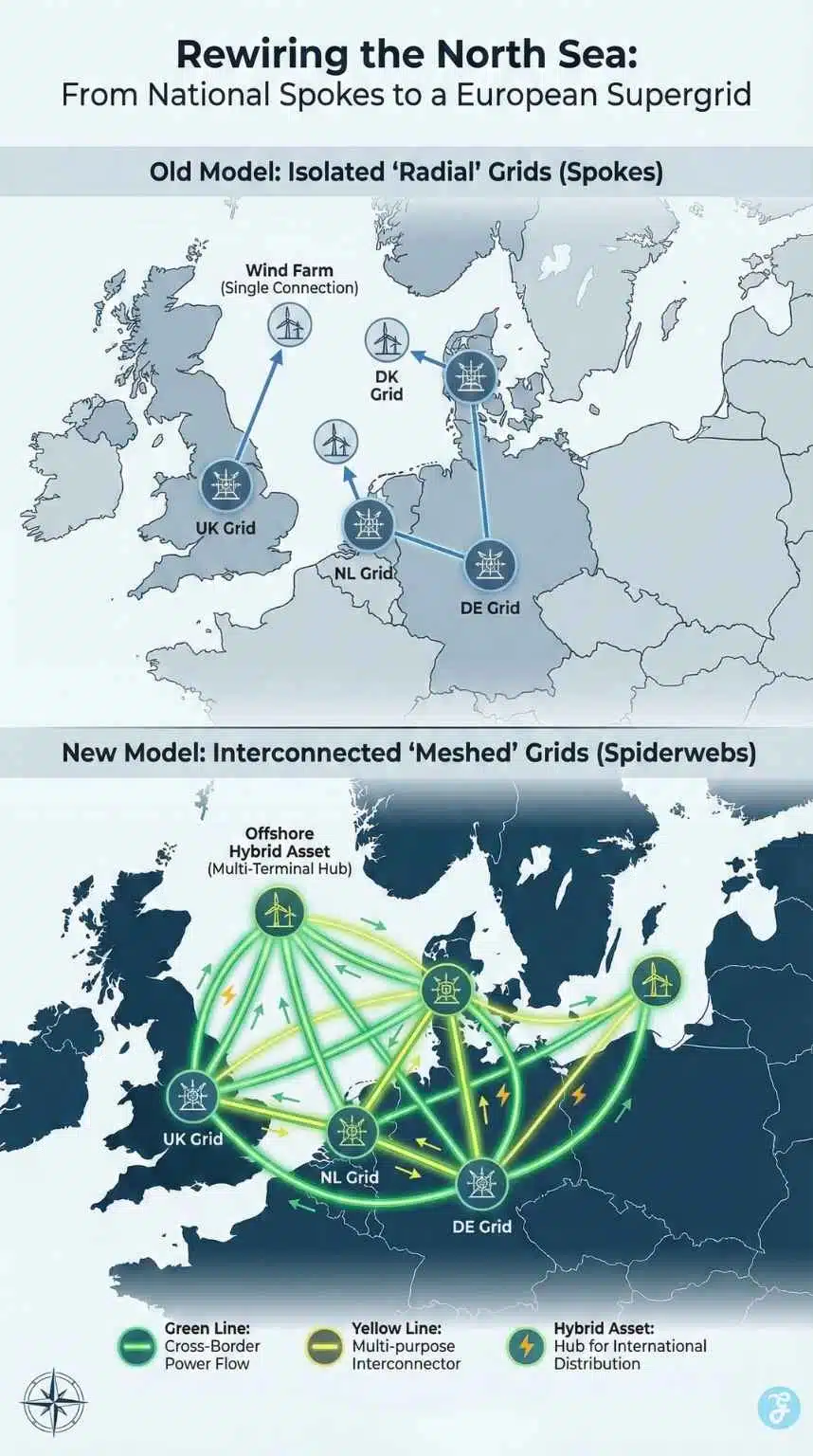
To understand the magnitude of the Hamburg Declaration, one must first understand the antiquated “topology” of Europe’s current energy system. This section details how the physical wiring of the continent is shifting from national silos to a unified regional grid.
The Obsolete Radial Model
Historically, offshore wind farms have been developed as “radial” assets. Picture a bicycle wheel where the hub is the national shore and the spokes are the cables running out to the turbines. In this system, a wind farm located just 50 miles from the Dutch coast but owned by a UK developer connects exclusively to the UK grid, often via a cable that runs hundreds of miles west. It is a model built on the logic of national borders, not the logic of engineering efficiency. The Hamburg Declaration effectively declares this model obsolete.
Offshore Hybrid Assets: The Meshed Grid Standard
The core innovation championed at the summit is the “Offshore Hybrid Asset” (OHA). These are wind farms that serve a dual purpose: they generate power, but they also serve as transmission highways between nations. Imagine a massive wind farm located in the middle of the North Sea, roughly equidistant between the UK and the Netherlands. Under the new “meshed” model, this farm is connected by high-voltage direct current (HVDC) cables to both countries.
When the wind is blowing, it sends green power to both markets. However—and this is the crucial innovation—when the wind is not blowing, the cables don’t sit idle. Instead, they act as a massive interconnector, allowing the UK to import excess solar power from the continent or allowing Norway to export its hydro-storage capacity to Germany. The wind farm becomes a bridge.
Technological Standardization and Efficiency
This shift from radial spokes to a meshed spiderweb is technically profound. It requires the standardization of voltage levels, converter technology, and grid codes across nine different legal jurisdictions. The summit saw the launch of specific pilot projects that will blaze this trail, most notably LionLink, a multi-purpose interconnector between the UK and the Netherlands, and the newly announced “HansaLink” concepts linking Germany to its neighbors. The efficiency gains of this topology are immense, reducing the number of cables touching land and acting as a shock absorber for the entire continent.
The Strategic Layer: Security is the New Green
Perhaps the most striking feature of the 2026 Hamburg Summit was the guest list. While previous energy summits were populated solely by environment ministers, this gathering included high-level defense officials, signaling that the North Sea has graduated from a “green playground” to a “critical security zone.”
Defending Critical National Infrastructure (CNI)
The shadow of the Nord Stream pipeline sabotage still looms large over European strategic planning. That event demonstrated the fragility of subsea energy infrastructure. With the North Sea Wind Pact, Europe is effectively placing its entire energy juggernaut into one ocean basin. By 2050, the North Sea will host thousands of turbines and thousands of kilometers of cables. The Hamburg Declaration addresses this vulnerability by classifying offshore wind farms as Critical National Infrastructure (CNI). The pact includes agreements on joint naval patrols, shared surveillance data, and the deployment of underwater drone technology to monitor cables for tampering.
Combating Hybrid Threats and Cyber Risks
The “security” angle extends beyond physical sabotage to encompass “hybrid threats,” such as cyberattacks on grid control systems. A successful hack on a multi-national offshore hub could blackout three countries simultaneously. Consequently, the Declaration mandates a unified cybersecurity standard for all North Sea operators, closing the backdoors that hackers might exploit in a fragmented regulatory landscape.
Energy Sovereignty as Defense Policy
Furthermore, the geopolitical narrative has shifted. German Minister Robert Habeck and his counterparts framed the North Sea Powerhouse as the antidote to “weaponized energy.” By generating 100 GW of power domestically, Europe immunizes itself against the whims of petrostates. The wind blowing across the Dogger Bank cannot be turned off by a foreign dictator. It is a resource that belongs to no one and everyone, a “freedom energy” that underpins the continent’s strategic autonomy.
Yes, to make this op-ed truly “definitive” and elevate it from a policy summary to a sharp geopolitical analysis, you should add three specific angles that are currently missing or under-emphasized.
Based on the latest context (January 2026), the most valuable additions would be:
- The “Atlantic Divide” (Geopolitical Contrast): A direct comparison between Europe’s “All-In” strategy and the US “Retreat” under the Trump administration (specifically the pausing of US offshore leases mentioned in reports). This heightens the stakes.
- The Consumer “Wallet” Argument: Hard data on why this lowers bills. The moral argument is weak; the economic argument (Strike Price €75 vs Wholesale €85) is unbeatable.
- The “Green vs. Green” Dilemma: Acknowledge the tension between fast permitting and marine biodiversity. This adds intellectual honesty and balance.
The Atlantic Divide: Europe Accelerates, America Pauses
The timing of the Hamburg Declaration sends a signal that resonates far beyond the European continent. While nine European nations are locking arms to accelerate offshore wind, the winds blowing across the Atlantic tell a very different story. The recent moves by the Trump administration to pause major offshore wind leases and target the sector with regulatory uncertainty have created a stark “Atlantic Divide.”
For the last five years, the global energy race was defined by the US Inflation Reduction Act (IRA), which sucked capital away from Europe. Hamburg represents Europe’s counter-offensive. As Washington steps back from the ocean, creating a vacuum in the global supply chain, Europe is stepping in. This divergence offers a unique opportunity: turbine manufacturers and cable layers, spooked by political volatility in the US market, are looking for a safe harbor. The Hamburg Declaration provides exactly that, a 25-year, state-backed roadmap. By committing to 100 GW, Europe is not just building power plants; it is telling the global supply chain, “Bring your factories here. We are the only adults in the room.”
The Financial Architecture: Who Pays for the Supergrid?
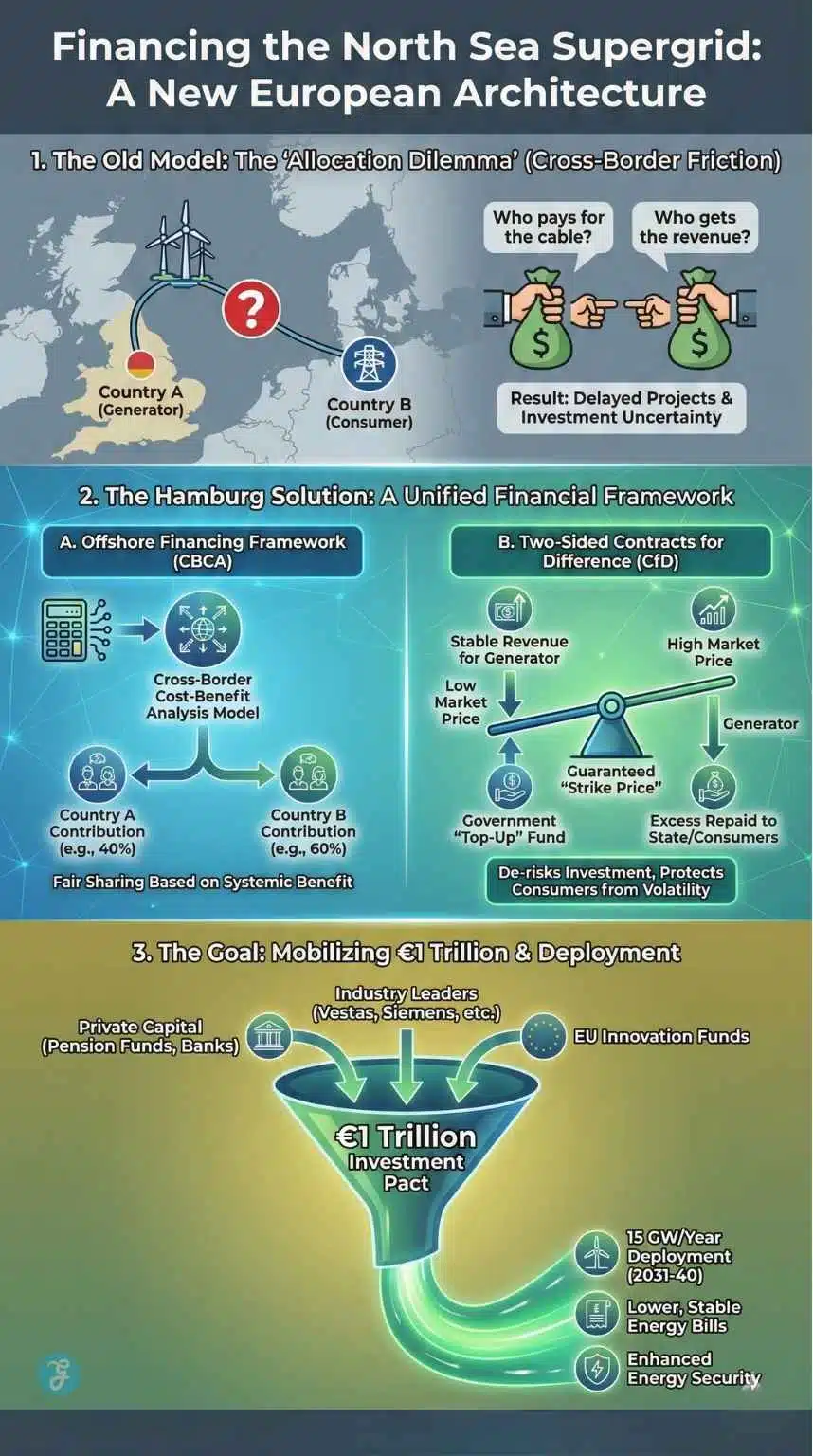
Engineering dreams and security strategies die without capital. The greatest obstacle to the “meshed grid” vision has always been the “Valley of Death”—the financial gap between a project’s conception and its final investment decision (FID).
Solving the Allocation Dilemma
Cross-border projects are notoriously difficult to finance because of the “allocation dilemma”: If a wind farm in Dutch waters sends 60% of its power to Germany, who pays for the cables? The Hamburg Declaration introduces a revolutionary “Offshore Financing Framework” designed to solve this. For the first time, the nine nations have agreed on a standardized mechanism for Cross-Border Cost-Benefit Sharing (CBCA). This uses complex modeling to determine the wider systemic benefits of a project and allocates costs accordingly.
De-Risking with Two-Sided CfDs
Parallel to this is the Investment Pact, signed with over 100 industry leaders to mobilize the estimated €1 trillion required. The industry has committed to a deployment rate of 15 GW per year between 2031 and 2040. In return, governments offered the Two-Sided Contract for Difference (CfD) as the gold standard. Unlike standard subsidies, this protects both producer and consumer: if prices crash, the government tops up revenue; if prices skyrocket, the generator pays back the excess. This provides the stability pension funds need.
The Deflationary math: €75 vs. €85
For years, critics have labeled offshore wind as a luxury good, nice to have, but expensive. The data from the Hamburg Summit flips this narrative on its head. The latest analysis presented to ministers shows a compelling arbitrage: the average “strike price” for new offshore wind projects (the guaranteed price paid to generators) is hovering around €75 per MWh. In contrast, the average wholesale electricity price in major European markets has persistently averaged above €85 per MWh due to lingering gas volatility.
This means the North Sea Wind Pact is structurally deflationary. Every gigawatt of wind capacity that comes online effectively drags the average cost of electricity down, not up. The “Two-Sided CfD” mechanism ensures this benefit flows directly to the consumer. When market prices spike (driven by gas shortages or geopolitical tension), wind farms will be paying money back to the state, acting as a financial shield for households. We are moving from a world where green energy required a subsidy to a world where fossil fuel reliance pays a “volatility tax.”
Anticipatory Investment Models
Additionally, the pact addresses “anticipatory investment.” In the past, grid operators were forbidden from building cables until wind farms were fully approved. The new framework encourages grid operators to build the “superhighways” first, with regulators guaranteeing cost recovery even if the wind farms are delayed. It is a “build it, and they will come” approach applied to high-voltage physics.
The Industrial Reality Check: The “Valley of Death”
While the diplomats celebrated in Hamburg, the industrial captains in the room remained cautiously realistic. The offshore wind sector has just emerged from a bruising period known as the “profitless boom.”
The Hamburg Declaration acknowledges the “industrial emergency” caused by inflation and raw material shortages. Writing targets is easy; welding steel in a winter storm is hard. The current supply chain is simply not big enough to deliver 100 GW. There are not enough installation vessels, cable factories, or steel supplies.
The Supply Chain Pledge
To address this, the pact includes a Supply Chain Acceleration Pledge. Governments have committed to using “non-price criteria” in future auctions. The new rules allow governments to award contracts based on resilience and sustainability rather than just the lowest price. This is a covert form of industrial protectionism, designed to shield the European wind sector from being undercut by state-subsidized competitors and to sustain high-value supply chains within Europe.
Bridging the Skills Gap
The labor question is equally pressing. The transition is projected to create 91,000 new jobs in the North Sea region. However, these are highly technical roles. The Declaration launches a transnational “North Sea Skills Academy” to standardize certifications, allowing a technician trained in Hull to work seamlessly on a platform off the coast of Esbjerg. Without this human capital, the hardware simply won’t work.
The “Green vs. Green” Dilemma
However, we must not romanticize the industrialization of the North Sea. Placing 100 GW of capacity into the water means driving thousands of monopiles into the seabed and laying thousands of miles of cable through protected marine habitats. Environmental NGOs at the summit rightly raised the alarm about the “acceleration” of permitting processes.
There is a genuine tension here, a “Green vs. Green” conflict. The climate emergency demands speed, but the biodiversity crisis demands caution. The Hamburg Declaration attempts to thread this needle by mandating “nature-inclusive design” (such as oyster reef restoration at the base of turbines) as a non-price criterion in auctions. Yet, the reality remains: the North Sea is transforming from a wilderness into a power plant. The success of this pact will depend on whether Europe can execute this transformation without destroying the very ecosystem it seeks to save. We are not just rewiring a grid; we are rewiring a biome.
The Hydrogen Horizon: Beyond Electrons
A fascinating, often overlooked detail of the Hamburg Declaration is the inclusion of Green Hydrogen. The signatories recognize that not all energy can be transmitted as electricity.
Green Hydrogen Islands
The pact envisions the North Sea not just as a power plant, but as a gas plant. The plan includes the development of “hydrogen islands“, platforms where wind power is used immediately to electrolyze seawater, splitting it into oxygen and hydrogen. This hydrogen is then piped to shore using existing (and repurposed) gas pipelines.
Repurposing Fossil Fuel Assets
This strategy is a stroke of genius for “hard-to-decarbonize” sectors like steel and chemicals. Piping hydrogen is often cheaper than transmitting electricity over long distances. It also breathes new life into the region’s oil and gas heritage, as the expertise required to maintain a hydrogen pipeline is almost identical to that required for gas. This offers a “just transition” for fossil fuel workers, creating a “Hydrogen Union” alongside the “Electron Union.”
The Post-Brexit Bridge: Rebinding the UK and EU
Politically, the Hamburg Declaration represents a thawing of the post-Brexit permafrost. Energy physics has proven to be the ultimate diplomat; it simply ignores borders.
Energy Diplomacy in Action
For the UK, represented by Ed Miliband, this summit was a moment of reintegration. While the UK remains outside the EU’s political structures, the Hamburg Declaration effectively rebinds the UK grid to the EU grid. It is a pragmatic acknowledgment that isolationism is an energy suicide pact.
LionLink: A Template for Cooperation
The LionLink project is the physical embodiment of this new relationship. It is a tangible link between the UK and the Netherlands that serves as a prototype for future cooperation. The success of these negotiations proves that where trade deals failed, energy needs can succeed. The North Sea has become a “neutral ground” where the UK and EU can cooperate deeply on shared interests without reopening the toxic wounds of the Brexit debates.
Final Words: The New Coal and Steel Community
In 1951, the Treaty of Paris created the European Coal and Steel Community. Its architects, Robert Schuman and Jean Monnet, understood a profound truth: if nations depend on each other for the raw materials of their survival, war becomes not only unthinkable but materially impossible. The Hamburg Declaration of 2026 is the spiritual successor to that treaty.
The vision of the “North Sea Powerhouse” is grand: a continent powered by a shared, infinite, and secure resource. But as the ministers left Hamburg and the applause faded, the real work began. The success of this pact will not be measured in press releases, but in the speed of permitting offices in Berlin and London and the order books of cable factories.
We have drawn the map of the future. The “spiderweb” is designed. The financing is framed. The security is alerted. Now, the steel must hit the water.