It’s easy to wonder why so many women in history were called witches for odd reasons. In fact, witchcraft accusations have led to many unfair trials, even when evidence was thin.
This post tells the stories behind nine misunderstood women who faced witch hunts and harsh labels. Their real lives may just surprise you.
Key Takeaways
- Many women were called witches in history, like Joan of Arc (1431), Tituba (1692), Agnes Waterhouse (1566), and Anna Göldi (1782). They faced trials based on little or no real proof.
- People often blamed strong, poor, or different women. Courts used books like “Malleus Maleficarum” to judge them harshly. Fear and rumors led to thousands of deaths across Europe between 1427 and 1782.
- Some accused women had help from others, such as Katharina Kepler’s son Johannes Kepler. This could sometimes change the outcome of witch trials.
- Even rich and powerful women, like Alice Kyteler, were not safe from accusations. In some cases, laws made during times of panic did not protect anyone.
- The last major witch executions happened in the late 1700s with Anna Göldi in Switzerland. In Britain, Helen Duncan’s trial under an old law finally ended when these outdated laws got repealed in 1951.
Who was Joan of Arc and why was she considered a witch?
Joan of Arc was a French girl who led an army. She said God spoke to her. People took notice because she wore armor and short hair, like men did. In 1431, Church leaders put her on trial in France.
These inquisitors feared women with power, so they called her “heretic” and accused her of witchcraft. The judges used words from the Malleus Maleficarum, or “the hammer of witches,” to make Joan seem evil.
The court claimed that hearing voices came from demons, not God. They linked strong women like Joan with sorcerers and blamed them for making trouble in society through witchcraft accusations.
Men felt nervous about female authority; they saw it as dangerous or unnatural. This fear helped spread myths that labeled powerful women as witches during European witch trials and later persecutions across Europe for centuries after Joan’s death at age nineteen when she burned at the stake.
Why is Tituba important in the Salem Witch Trials?
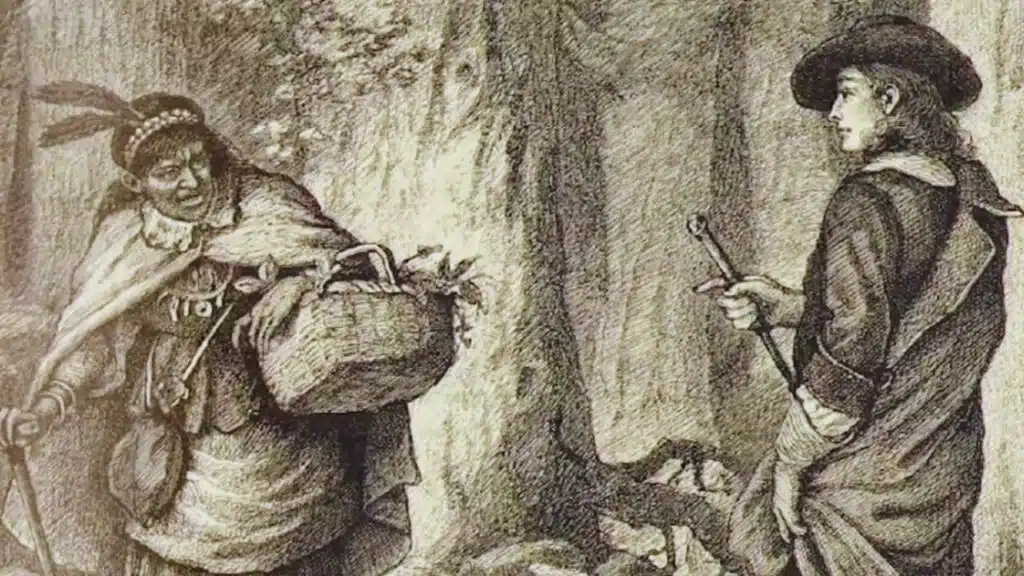
Tituba, an enslaved woman of African or Indigenous background, stood at the center of the Salem Witch Trials in 1692. She worked for Samuel Parris in Salem, Massachusetts. Girls living with Parris, including Elizabeth Parris and Abigail Williams, began having strange fits.
People thought they were cursed by witchcraft. Tituba was one of the first accused. Under pressure, she confessed to meeting with the devil and even claimed to see other women like Sarah Good and Sarah Osborne practicing witchcraft too.
Her confession set off a wildfire of fear across Salem. It fueled the hysteria that led to more than 200 people being accused during these salem witch trials; about twenty lost their lives after being found guilty or jailed under harsh conditions.
Myths from books like “Malleus Maleficarum” made matters worse by saying witches did terrible things such as stealing men’s body parts or casting evil spells. Because Tituba was an outsider and enslaved woman, her story showed how easy it was for society to blame those without power during times of panic and suspicion.
Who was Agnes Waterhouse and what led to her execution?
Agnes Waterhouse lived in 16th-century England. People called her one of the first women executed for witchcraft. In 1566, judges tried her under the new Witchcraft Act signed by Henry VIII back in 1542.
That law made making pacts with the Devil a crime that could lead to death. Neighbors claimed she cursed people and even sent a cat named “Satan” to harm others. Gossips and fear spread quickly, as folks still trusted old stories about witches.
Women like Agnes, often poor or older, stood out in their towns and were easy targets during witch hunts. Courts used hanging as punishment instead of burning at the stake like on the mainland of Europe.
Only about a quarter of those accused ever faced death, but rumors counted for more than hard facts at these trials. Most judges wanted to expose tricksters rather than real witches because many doubted magic was real anyway; yet panic won out this time, and Agnes met her end on the gallows after being found guilty based on little more than whispers and suspicion during those wild days of English witch hysteria influenced by books like Malleus Maleficarum.
What happened to Alice Kyteler, the wealthy Irish woman accused of witchcraft?
Alice Kyteler was a rich woman from Ireland. In 1324, she faced serious accusations of witchcraft. People claimed she made pacts with the Devil and used potions for evil purposes. These charges shocked many because they usually targeted the poor, not wealthy women.
Her trial showed that money did not always protect someone from being labeled a witch.
The local authorities took her to court in Kilkenny. They wanted to punish her for her supposed crimes. The Catholic Church also played a role in this case, but its influence was less than many think.
Alice managed to escape before any harsh punishment could be given; some say she fled to England. Her case set important rules for future witch trials in both Ireland and Britain, revealing deep fears about women’s power and independence at that time.
What was Malin Matsdotter’s story in Sweden’s witch trials?
Malin Matsdotter was a key figure in Sweden’s witch trials. She became a victim during the broader wave of witch hunts that swept across Europe from 1427 to 1782. In this time, many accused women faced terrible fates.
Matsdotter’s story shows how society often blamed women for misfortunes, like harm to children or livestock. Her case exemplified the fear and anxiety of changing roles for women at that time.
Matsdotter’s trial involved torture and public spectacle, which was common during these trials. Many believed she used magic to cause pain or mischief in her community. Sadly, she was executed as part of this brutal campaign against perceived witches in Scandinavia.
The number of executions ranged between 30,000 and 60,000 across Europe during these years; each represented someone like Malin who suffered injustice in a climate fueled by fear and hysteria surrounding witchcraft accusations.
Katharina Kepler’s background and witchcraft accusations
Katharina Kepler was a healer and the mother of famous astronomer Johannes Kepler. In her time, many thought she used magic to cure people. People accused her of witchcraft during a period of fear and suspicion.
Her son tried hard to defend her in court, saying she did nothing wrong. The strange ideas about women made it easy for folks to label her as a witch. Curious about how this all played out? Read on!
What role did Katharina Kepler’s son play in her trial?
Johannes Kepler, Katharina’s son, played a key role in her trial. He was a famous astronomer. His reputation helped challenge the witchcraft accusations against his mother. Most accused women were poor and alone during these trials.
But Johannes stood by Katharina’s side. He argued that the charges were false.
His advocacy was rare for that time. Family members rarely defended those accused of witchcraft. Johannes used scientific reasoning to expose the unfairness of the trial process, bringing attention to its injustice.
This case changed how people viewed witch trials in German-speaking regions, showing that support could make a difference even in tough times like these.
How did Katharina Kepler defend herself against the accusations?
Katharina Kepler stood strong against the witchcraft accusations. She denied all claims of being a witch. Katharina focused on facts rather than emotions. She challenged the lack of evidence and pointed out that people relied too much on superstition.
Her Christian faith and good character helped her case.
Under pressure, she refused to confess to any wrongdoing. Katharina skilled in arguing used logical reasons for her defense. Even during long imprisonment and tough questioning, she did not incriminate herself.
The legal loopholes worked in her favor, leading to an unusual acquittal that set an example for future trials.
Who was Anna Göldi and why is she known as Europe’s last executed witch?
Anna Göldi lived in Switzerland in the late 1700s. She was accused of witchcraft and executed in 1782. Her case is famous because it marked the end of major witch trials in Europe.
The trial had many wild accusations, but no real proof of magic.
Göldi’s execution showed that superstitions still lingered even during the Age of Enlightenment. Many later saw her trial as unfair. Anna was cleared of all wrongdoing after her death, highlighting how justice can change over time.
Her story reminds us to question old beliefs and seek fairness for everyone.
What is the history of Bridget Bishop in the Salem witch executions?
Bridget Bishop was the first person executed for witchcraft during the Salem Witch Trials in 1692. She faced accusations because of her bold personality and past claims of witchcraft.
The trials were marked by hysteria, with fear spreading through Salem, Massachusetts. People quickly turned against each other due to religious fervor and social tensions.
Bishop was tried for her supposed crimes against good people. After a swift trial, she was hanged on June 10, 1692. Her execution set off a wave of trials and deaths, leading to 19 executions in total.
Today, Bridget Bishop’s story reminds us about the dangers of mass hysteria and injustice in history’s dark chapters like the witch hunts.
How was Helen Duncan labeled a witch in 20th century Britain?
Helen Duncan was one of the last people charged under Britain’s 1735 Witchcraft Act. Her trial took place during World War II. This made her case quite rare for the 20th century.
She claimed to be a medium, able to speak with spirits. People accused her of fraud, not traditional witchcraft practices like casting spells. The law at that time prohibited anyone from claiming magical powers or summoning spirits.
Despite this, Duncan faced serious charges.
Public interest in her trial grew rapidly. The media focused on it as fear and superstition about magic still lingered in British society. Many saw she was being unfairly treated for simply practicing what she believed to be spiritual work.
This case became a symbol of outdated laws against witchcraft in modern times. It eventually helped lead to the repeal of the Witchcraft Act in 1951. Helen Duncan’s story shows how fears about witches persisted even into the late 20th century.
Takeaways
These nine women faced significant injustices. They were labeled witches, but they often did not deserve such tags. History misjudged them, casting shadows on their true worth. Each story illustrates how society perceived strong women as threats.
Let’s honor these women and learn from their struggles.
FAQs
1. Why were women called witches during witchcraft accusations and witch trials?
People feared what they did not understand. Women who acted differently, or even just annoyed their neighbors, often faced witchcraft accusations during times of hysteria. The Malleus Maleficarum and the Inquisition fueled these fears, making it easy for anyone, from Sarah Good in Salem to Grace Sherwood in Virginia, to get labeled a witch.
2. What happened at the Salem Witch Trials in Salem, Massachusetts?
In 1692, panic swept through Salem, Massachusetts. Abigail Williams pointed fingers; soon others joined her chorus. Many women like Bridget Bishop stood trial on shaky evidence, sometimes nothing more than odd behavior or gossip, leading to tragic outcomes.
3. How did books like Malleus Maleficarum and Summis Desiderantes Affectibus shape witch hunts?
The printing press spread wild ideas fast. Books such as Hexenhammer (the Latin name for Malleus Maleficarum), written by Henricum Institoris and Jacob Sprenger with support from Innocent VIII, gave so-called experts fuel to justify cruel acts against accused witches across Europe.
4. Who was Anna Goldi and why is she remembered among persecuted women?
Anna Goldi’s story echoes many others’. She lived in Switzerland centuries after most European witch persecutions had faded but still faced harsh punishment following old patterns set by earlier inquisitorial courts and the long shadow of King James I’s own crusade against “witches.”
5. Were medical terms like hysterics or rest cure connected to these accusations?
Yes, doctors once blamed problems on things like “hystera” (the womb). They prescribed treatments such as pessaries or S. Weir Mitchell’s rest cure for supposed hysterical symptoms in women, terms that linked mental health issues with suspicion of magic or madness.
6. Do modern groups like Wiccans see themselves connected to those labeled as witches before?
Many Wiccans look back at figures from history, including biblical characters like the Witch of Endor, as misunderstood rather than evil people targeted by misogynists during historic witch-craze periods led by people such as Heinrich Kramer or Thomas Aquinas’ followers during scholastic disputation sessions.