

Microsoft has reported blockbuster earnings for the quarter ending June 30, 2025, fueled by soaring demand for artificial intelligence (AI) and cloud computing services. With significant year-on-year growth, the tech giant continues to cement its position as a global leader in enterprise technology and digital transformation.
Record-Breaking Profit and Revenue Driven by AI and Cloud
Microsoft posted a net profit of $27.2 billion, significantly exceeding analyst expectations. Total revenue reached $76.4 billion, supported heavily by growth in the Intelligent Cloud business, which alone contributed $29.9 billion—nearly 40% of the total revenue.
This performance reflects the growing dependence of global industries on Microsoft’s cloud and AI solutions. Businesses in sectors ranging from finance and healthcare to manufacturing and retail are increasingly adopting cloud platforms and AI-powered tools to optimize operations and improve productivity.
CEO Satya Nadella Attributes Growth to AI-Led Transformation
In the official earnings release, CEO Satya Nadella emphasized how Microsoft’s AI-first approach is driving transformation across industries:
“Cloud and AI is the driving force of business transformation across every industry and sector. We’re innovating across the tech stack to help customers adapt and grow in this new era,” Nadella stated.
Microsoft’s focus is on providing a comprehensive stack—from infrastructure to applications—enhanced with AI. This strategy is resonating with enterprise customers seeking scalable, intelligent solutions.
Azure Cloud Grows by 34% in a Year
Microsoft’s Azure cloud platform has emerged as the primary revenue engine for the company. In the fiscal year that ended on June 30, Azure generated over $75 billion, representing a 34% increase from the previous year.
Azure’s rapid growth is attributed to:
- Rising enterprise demand for cloud-based infrastructure
- Integration of OpenAI’s GPT models into Azure services
- The expansion of industry-specific cloud solutions
- A growing portfolio of AI tools for developers and data scientists
Azure is now competing aggressively with Amazon Web Services (AWS) and Google Cloud in global cloud infrastructure markets.
Wall Street Reacts: Microsoft Stock Surges 7% After Hours
The financial markets responded positively to the report. Following the release of earnings, Microsoft’s stock price surged by around 7% in after-market trading.
Tech analyst Dan Ives of Wedbush Securities called it a “slam-dunk quarter” and noted that Microsoft is capitalizing on what he describes as the “AI revolution.”
According to Ives, “This was a transformational quarter with cloud and AI driving significant business change across every sector and industry. Microsoft is now at the center of the global AI arms race.”
AI Integration: Microsoft Continues to Expand Its Ecosystem
Microsoft has rapidly embedded generative AI and machine learning tools across its products and services. These include:
| Product | AI Integration |
| Microsoft 365 (Word, Excel, Outlook) | Copilot assistants that write, summarize, and analyze content |
| Azure AI Services | Pre-built and customizable models for enterprises |
| GitHub Copilot | AI assistant for software developers |
| Microsoft Security Copilot | AI-powered security analysis and alerts |
| Bing Search & Edge Browser | ChatGPT-powered answers and content creation |
These tools are helping businesses automate workflows, boost productivity, and innovate at scale.
Infrastructure Investment Hits $80 Billion in a Single Year
To sustain its AI expansion, Microsoft revealed that it is on track to invest approximately $80 billion in capital expenditures and infrastructure during the current fiscal year.
This massive investment is focused on:
- Building new data centers optimized for AI workloads
- Procuring high-performance GPUs and AI accelerators
- Expanding global network capacity
- Securing sustainable power sources to fuel compute-intensive AI processes
Nadella highlighted that finding sufficient energy for AI data centers is a growing challenge, and Microsoft is actively exploring renewable energy partnerships and custom silicon development to address this.
Strategic Layoffs as Part of AI-Focused Restructuring
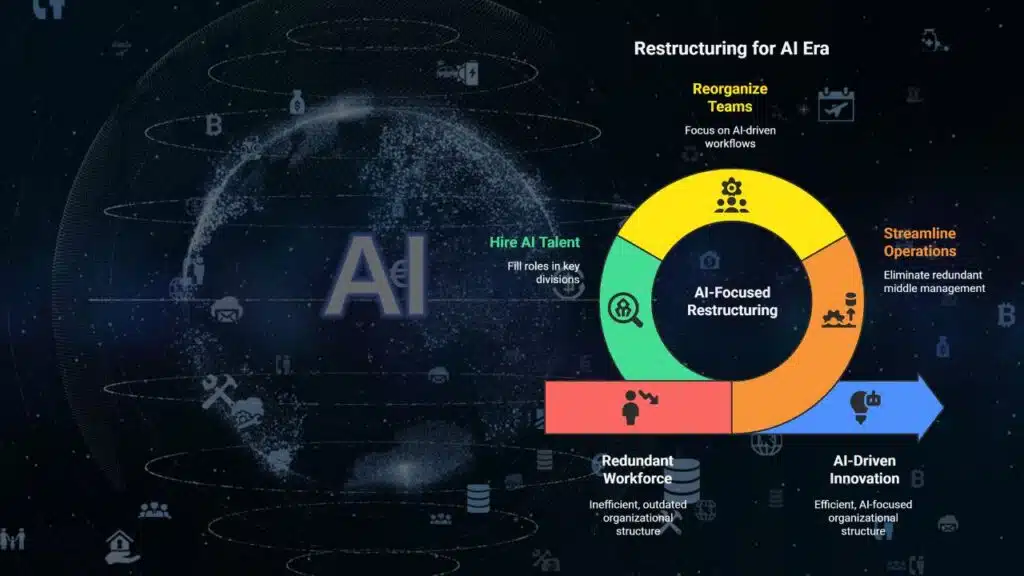
In early July 2025, Microsoft cut nearly 4% of its global workforce, part of a broader strategy to restructure for the AI era. This came after a previous round of layoffs in May, where around 6,000 employees were let go.
The company said the aim is to streamline operations, eliminate redundant middle management, and reorganize teams to focus on AI-driven workflows and innovation.
A Microsoft spokesperson stated:
“We continue to implement organizational changes necessary to best position the company and teams for success in a dynamic marketplace.”
Despite these job cuts, Microsoft continues to hire in AI and cloud divisions, especially for roles in machine learning, data science, and infrastructure.
Empowering Employees with AI Tools
Alongside cost-cutting, Microsoft is also working to empower remaining employees by automating repetitive tasks using AI. This approach enables team members to focus on more meaningful, strategic work.
The goal is to enhance workforce productivity using tools like Microsoft 365 Copilot, which helps with drafting emails, analyzing spreadsheets, creating presentations, and summarizing meetings—all with AI.
The Bigger Picture: Microsoft Leads the Enterprise AI Race
Since partnering with OpenAI and investing billions into the development of ChatGPT, Microsoft has maintained a leading position in enterprise AI adoption. By integrating AI into its entire ecosystem—from cloud to desktop—Microsoft has built a future-proof platform.
The company’s early and aggressive investments in AI infrastructure, tools, and partnerships are now translating into measurable financial gains. As global demand for AI increases, Microsoft is well positioned to grow even faster in coming quarters.
Challenges Remain: Infrastructure and Regulation
Despite the positive outlook, Microsoft faces challenges:
- Power and cooling needs for AI data centers are escalating
- Global regulations on AI usage and data privacy are tightening
- Competitors like Google, AWS, NVIDIA, and Meta are racing to gain AI market share
- Customer concerns over cost-efficiency of large language model integration persist
Still, Microsoft appears prepared. The company is investing in sustainable solutions, actively engaging with regulators, and refining its AI cost models to make adoption scalable for businesses of all sizes.
Microsoft’s Vision Is Becoming Reality
Microsoft’s Q4 2025 results prove that the company’s early bets on AI and cloud are not only paying off—but accelerating. With surging revenue, booming cloud growth, and dominant AI integration, Microsoft is emerging as the leading force in enterprise transformation in the age of artificial intelligence.
From reshaping productivity to building intelligent infrastructure, Microsoft’s strategic vision is becoming a global reality—one AI-powered product at a time.
The Information is Collected from NYTimes and MSN.