Your home is supposed to be the place that steadies you, not the thing that drains you. Yet for many of us, every countertop, chair, and spare corner has quietly turned into storage. Learning how to organize your home like a pro is less about perfection and more about reclaiming that everyday ease we keep postponing.
Instead of chasing picture-perfect rooms, the focus now is on simple decluttering tips that work in real life: small, repeatable steps that clear surfaces, cut visual noise, and make it easier to find what you own. When you treat your space as something to be edited rather than stuffed, your home starts to feel lighter—without a single color-coded label in sight.
Set Your Strategy: How to Organize Your Home Like a Pro
Learning how to organize your home like a pro is not only about lining up boxes and labels. It is about reducing the background noise that makes your brain work harder than it needs to. People who declutter often report that once surfaces are clear and rooms are edited, they feel less “on edge” at home and more able to rest.
Pros rarely walk into a home and start randomly filling boxes. They choose a method, a route, and a timeline. Doing the same at home gives structure to your effort and stops you from burning out halfway through the first cupboard.

Decide what “organized” means for your life, not Instagram
An “organized home” looks different for a family with young children, a couple working from home, or a single person in a studio. Before you start, set a simple definition for yourself:
- I can find what I need in under one minute.
- Most surfaces are clear enough to use.
- Every item has a logical “home” where it returns.
These private rules matter more than any picture-perfect pantry. They keep your decisions grounded in how you live, not how a staged photo looks.
Choose a framework: 80/20 spaces, 5/7 rule, or clutter-free countdown
Several popular methods appear again and again in organizing and decluttering coverage. You do not need all of them. Choose one or two as your main framework.
1. The 80/20 organizing method
The 80/20 rule suggests you only actively use about 20% of what you own. Professional organizers apply a version of that to storage: fill only 80% of any drawer, shelf, or cupboard and leave 20% deliberately empty.
That empty buffer makes your home feel calmer, prevents overstuffing, and gives new items somewhere to go. When a shelf hits the 80% mark, you edit, not stretch it.
2. The 5/7 rule for everyday surfaces
A more recent strategy, popular in kitchen organizing, is the 5/7 rule. You keep only the things you use at least five days out of seven on open countertops; everything else lives in cupboards or drawers.
It is a simple filter that keeps surfaces clear without making daily life inconvenient. You can apply it to bathroom counters, bedside tables, or even your desk.
3. The “clutter-free countdown”
If you struggle with massive projects, the clutter-free countdown breaks organizing into very small, time-boxed sessions – 15 to 30 minutes on one micro-area at a time (a drawer, a shelf, a single category).
Instead of trying to “fix the whole house this weekend,” you schedule frequent mini-sessions. Over a few weeks, the changes add up.
Pick one of these as your core method. For example: 80/20 for overall storage, the 5/7 rule for surfaces, and a clutter-free countdown schedule to actually get it done.
Create a realistic decluttering timeline (not a weekend punishment)
Many room-by-room guides suggest you can declutter a home in a day or a weekend, but they also stress the importance of realistic goals.
Break your home into zones and give each a time budget:
- Bathroom cabinet – 20–30 minutes
- Kitchen junk drawer – 15 minutes
- One wardrobe rail – 30–45 minutes
- Paper pile on the desk – 20–30 minutes
Put these sessions into your calendar like appointments. You are more likely to follow through if the time is specific and limited.
Simple Decluttering Tips You Can Use in Any Room
This is where simple decluttering tips matter. Before you tackle each room, adopt a handful of basic moves used by professionals.
Start small and visible to build momentum
Many decluttering articles for beginners suggest starting with an easy, high-impact area to reduce overwhelm – a small surface or a single drawer.
Choose something you see often: the coffee table, bathroom counter, or bedside table. When one spot looks tangibly better, it becomes proof that the process works. That feeling keeps you going when you reach the harder areas.
The edit-and-reset method: empty, evaluate, only then return
Room-by-room checklists from home-organizing sites follow a similar pattern: remove everything from the space, sort, then put back what deserves a spot.
In practice, that means:
- Empty the area. Take everything out of the drawer, cupboard, or shelf.
- Sort by broad categories. Keep, donate, recycle, trash.
- Edit ruthlessly. Ask: Do I use this? Do I love it? Would I buy it again?
- Reset the space. Only the “keep” pile earns its way back in – and only up to 80% full.
You avoid the common trap of pushing things around without really deciding. Also, know how to organize your home like a pro.
Use boundaries, not giant bins: containers as limits, not dumping grounds
Big bins can become black holes. Professionals often use smaller, clear containers, shelf dividers, and drawer inserts to set visible boundaries.
Decide on a container, then treat it as a limit:
- One bin for kids’ art supplies.
- One shallow tray for remotes and small tech.
- One small basket for everyday skincare.
When a container overflows, something exits before anything new enters.
One-in, one-out: the maintenance rule professionals lean on
A simple rule keeps clutter from creeping back: for every new item that comes in, one similar item goes out.
- New T-shirt? One old T-shirt is left.
- New mug? A chipped or unused mug goes.
This keeps your home at a steady volume. It is easier to preserve an organized home than to rescue it repeatedly.
Room-by-Room Home Organization Tips (Professional Organizer Style)
Once you have a strategy and know how to organize your home, pro tips you can use anywhere, go room by room. Major home-organizing sites use the same logic: tackle bathrooms, then bedrooms and closets, then living areas, then storage spaces.
Bathroom: clear surfaces, strict expiry dates, small-item control
Bathrooms are usually small but busy. That makes them an ideal starting point when you want to declutter your home quickly.
- Empty the medicine cabinet and drawers. Discard expired medication and old skincare. Many guides advise regular checks here, both for safety and space.
- Keep only daily-use items at eye level. Use the 5/7 rule on your bathroom counter. Anything you do not use most days lives in a drawer or caddy.
- Contain tiny items. Use small trays, cups, or drawer inserts for cotton pads, hair ties, razors, and travel sizes.
- Use vertical space. Over-the-door hooks and slim shelves handle towels and extra supplies without crowding surfaces.
A bathroom that takes two minutes to reset after the morning rush is a strong start.
Kitchen: counters, cabinets, and the “work triangle”
The kitchen is both a nerve centre and a clutter magnet. Room-by-room decluttering guides warn that without a plan, you end up storing rarely used gadgets while daily tools get buried.
Work in layers:
Clear counters using the 5/7 rule. Only leave out appliances used almost every day – kettle, coffee machine, toaster. Everything else gets a “home” in a cupboard.
- Check food storage. Empty one shelf at a time. Discard expired items. Group foods by type (baking, snacks, grains) and store in bins or baskets so you pull out a category instead of knocking things over.
- Use the “work triangle”. Position everyday tools close to the stove, sink, and prep area. Pans near the cooker, knives and chopping boards near the prep space, dishware near the dishwasher or drying rack.
- Reserve prime real estate. Eye-level cupboards and top drawers should hold the things you touch daily, not party platters you use once a year.
Think of the kitchen as a workspace. Organize for flow, not for display.
Living room: zones for lounging, tech, and kids’ stuff
The living room often has to do too many jobs at once. Without some structure, it becomes a dumping ground.
- Define zones. A reading chair with a small table and lamp; a media area around the TV; a play corner with a rug and a toy bin. Clear boundaries make it easier to return things where they belong.
- Control surfaces. Coffee tables and side tables attract clutter. Use a tray for remotes and small items. Decide how many decorative objects you want out at once and remove the rest.
- Limit entertainment items. Games, books, and devices should have specific shelves or baskets. When they overflow, review and donate.
If you have children, accept a certain level of visible “life.” The aim is not a showroom; it is a room where things have homes and can be put away quickly.
Bedroom and closet: edit your wardrobe, then plan storage
Many decluttering checklists highlight wardrobes and bedroom surfaces as top sources of daily frustration.
Start with the wardrobe:
- Pull out one category at a time. All T-shirts, all jeans, all shoes.
- Try the “would I buy this again?” question. It cuts through guilt faster than “could I wear this again?”
- Sort into keep, tailor, donate, and recycle.
Plan storage only after editing. You may discover you need fewer hangers, not more boxes, and organize your home like a pro.
In the bedroom itself:
- Keep bedside tables clear except for a lamp, current book, and a small dish or tray.
- Store out-of-season clothing in labeled containers under the bed or on higher shelves, leaving everyday items easy to reach.
- Avoid turning chairs into permanent clothes racks. Use hooks for “in-between” clothing (worn once, still clean).
A calmer bedroom supports better sleep and sets the tone for the rest of the home.
Entryway and home office: managing daily drop zones and paper
The entryway and home office setup are classic “drop-zones” where clutter accumulates fast.
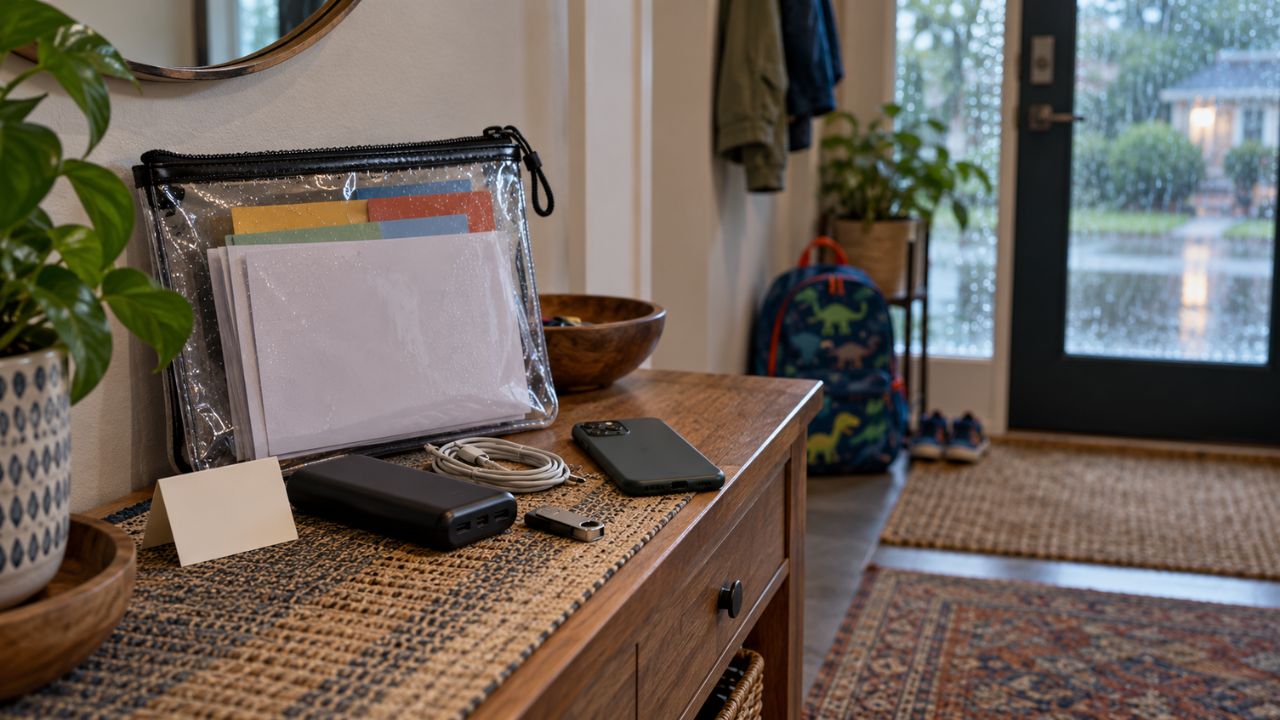
Entryway
- Assign one hook per person for coats and bags.
- Use a shallow tray or small bowl for keys and wallets – nothing else.
- Place a narrow bench or shoe rack so footwear has a destination, not a pile.
Keep a small, attractive basket or folder for incoming mail and flyers. Go through it at least once a week.
Home office or desk area
Paper, chargers, and little gadgets are some of the hardest things to tame. A room-by-room approach suggests tackling paper as its own project.
- Create three folders or vertical files: Action, To file, To shred/recycle.
- Set a weekly time to clear the desk, file what matters, and discard the rest.
- Use cable clips and a small tech box for chargers, headphones, and adaptors.
The goal is not a perpetually empty desk, but a space where you can clear everything in under 10 minutes.
Final Thought: How to Organize Your Home
Learning how to organize your home like a pro is not about copying a single method or buying more storage. It is about combining simple decluttering tips, smart frameworks like the 80/20 rule, and realistic routines that match the way you live.
Start with one visible area. Apply edit-and-reset. Use boundaries and clear limits. Choose room-by-room projects and protect what you have achieved with a daily reset, a weekly power hour, and seasonal reviews.
Over time, those decisions stack up. You walk through the front door and see fewer unfinished tasks and more space you can actually use. That is what an organized home feels like in practice: not flawless, but functional, calm, and very much yours.