Jojo Malhutra– not his real name – is a 38-year-old software professional who has lived in the United States with his wife and daughter for over a decade. Earlier this month, he traveled to Nagpur, India, to take part in a family ritual commemorating the anniversary of his late father’s death. What was supposed to be a deeply personal trip turned into a financial and emotional ordeal.
On 20 September 2025, Mehta found himself spending over $8,000 (about £5,900) in a frantic, eight-hour window to book and rebook multiple return flights to the U.S. He eventually boarded a Virgin Atlantic flight from Mumbai to New York’s John F. Kennedy International Airport. “I was terrified I wouldn’t make it back in time,” he explained. “Even a short flight delay could have cost me the chance to re-enter before the rule changed.”
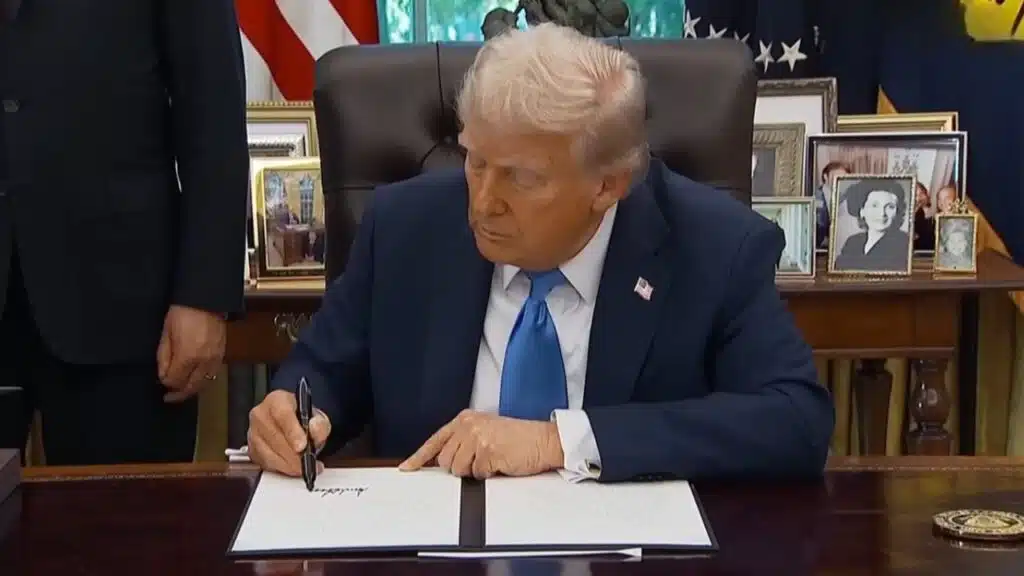
His fear was triggered by an executive order signed by President Donald Trump on 19 September, introducing an unprecedented $100,000 fee for new applicants under the H-1B visa program. Employers sponsoring skilled foreign workers would have to pay this amount starting 21 September 2025, more than 60 times higher than the current filing fees.
What the H-1B program means for Indian workers
The H-1B visa allows U.S. companies to hire foreign professionals in highly skilled fields such as technology, engineering, medicine, and finance. According to official U.S. immigration data, 70% of the 85,000 H-1B visas issued annually go to Indian workers, reflecting the country’s dominance in IT and software services.
Companies such as Amazon, Tata Consultancy Services, Microsoft, Meta, Apple, and Google are among the biggest beneficiaries of the program. For these firms, the availability of skilled foreign labor is essential for filling technical roles that the U.S. labor market struggles to supply. For workers like Mehta, the H-1B is not just a job ticket; it is the foundation of their lives in America, allowing them to raise families, buy homes, and pursue permanent residency.
Confusion after Trump’s order
The announcement of the $100,000 fee caused widespread panic among H-1B visa holders abroad. Immigration lawyers and corporate HR teams rushed to advise employees. Many told workers to return to the U.S. immediately to avoid being locked out.
Jojo Malhutra was among those who reacted instantly. “I have given the prime years of my life working in the U.S., but after this, I feel unwanted,” he said. “My daughter has only ever known America as home. The thought of uprooting our lives overnight is unbearable.”
Others, traveling in Europe or Asia for personal or professional reasons, also booked expensive last-minute flights. Several who spoke anonymously to the media admitted they feared being stranded outside the U.S. or facing massive financial hurdles if they reapplied under the new fee structure.
White House clarification comes too late for many
The White House Press Secretary, Karoline Leavitt, issued a clarification on 21 September. She explained that:
- The $100,000 charge applies only to new H-1B visa petitions filed after 21 September.
- It will be a one-time filing fee, not a recurring annual cost.
- Current H-1B holders, their dependents, and renewal applicants are not affected.
- Visa holders abroad can continue to re-enter the U.S. with valid visas as usual, without paying the new fee.
While this removed uncertainty for many, the clarification came after panic had already spread worldwide. For people like Mehta, who had already cut short personal obligations and drained thousands of dollars, the reassurance was bittersweet. “The past few days have been traumatic. If my wife and daughter had been with me in India, the chaos would have been worse,” he admitted.
Industry reaction
The sudden announcement has rattled both companies and foreign workers.
- Tech employers: Large corporations like Amazon and Microsoft, who sponsor thousands of H-1B workers every year, are expected to feel the immediate cost implications. Smaller firms may find the $100,000 fee prohibitive, potentially cutting off access to specialized talent.
- Immigration attorneys: Many criticized the government for creating unnecessary panic by not clarifying sooner. Several firms advised clients to avoid overseas travel until the situation stabilized.
- Indian IT industry: The National Association of Software and Service Companies (Nasscom), India’s powerful tech industry body, welcomed the clarification but warned that the order still creates uncertainty for future applicants.
Broader implications
The H-1B program has long been a political flashpoint in the U.S. Critics argue that some firms misuse it to replace American workers with cheaper foreign labor. Supporters stress that the program is vital for maintaining U.S. leadership in innovation and technology.
Trump’s new executive order is framed as a way to protect American jobs and ensure H-1B visas are used only for “highly paid, highly skilled” roles. However, analysts warn that the $100,000 fee could reshape the program entirely:
- Large corporations may absorb the cost, but smaller tech firms, universities, and research labs could struggle.
- Foreign workers may see fewer job offers as employers become selective due to the high upfront cost.
- India, the biggest supplier of H-1B workers, could see a slowdown in placements abroad, affecting its multi-billion-dollar IT outsourcing industry.
Human toll: fear and uncertainty
For individuals like Jojo Malhutra, the ordeal is not only financial but deeply personal. “I’m regretting choices I made years ago. I built a life in America, but now I feel like I don’t belong,” he said quietly.
Many H-1B families live in limbo, tied to their employers and uncertain about their path to permanent residency. Sudden policy shifts like this magnify that insecurity. For children who have grown up entirely in the U.S., the thought of relocation feels like exile.
The Trump administration’s new $100,000 H-1B fee has created a wave of anxiety, confusion, and hurried decisions among skilled immigrant workers. While clarifications confirm that existing visa holders and renewals are exempt, the sudden announcement left many scrambling unnecessarily, with some spending thousands to return to the U.S. in time.
The episode underscores the precarious reality of America’s skilled immigration system: lives and livelihoods can be disrupted overnight by a single policy shift.
The Information is Collected from BBC and Yahoo.