As the European Union moves into the full implementation phase of the Markets in Crypto-Assets (MiCAR) regulation in early 2026, the Irish capital has emerged as the clear frontrunner for global firms seeking a foothold in the bloc. Dublin’s rise is no longer just a trend; it is a fundamental shift driven by a combination of regulatory clarity, institutional support, and a world-class Dublin Fintech Ecosystem. For major players like Coinbase, Gemini, and most recently CoinJar, Ireland offers a unique blend of “bank-grade” supervision and a pro-innovation culture that is rare among global financial centres.
By positioning itself as the gateway to 450 million European consumers, Dublin is not just hosting the future of finance—it is actively regulating it into existence.
Our Selection Methodology
To identify the primary drivers behind Dublin’s emergence as a crypto regulatory hub, we analysed several key metrics as of March 2026. This includes the volume of Virtual Asset Service Provider (VASP) to Crypto-Asset Service Provider (CASP) transitions, the level of direct government investment through IDA Ireland, and the city’s proximity to global technology headquarters. We also examined the Central Bank of Ireland’s (CBI) recent engagement protocols and the impact of Ireland’s upcoming EU Council Presidency in late 2026. Each of these ten reasons reflects a core strength that makes the Dublin Fintech Ecosystem an irresistible proposition for regulated digital asset firms.
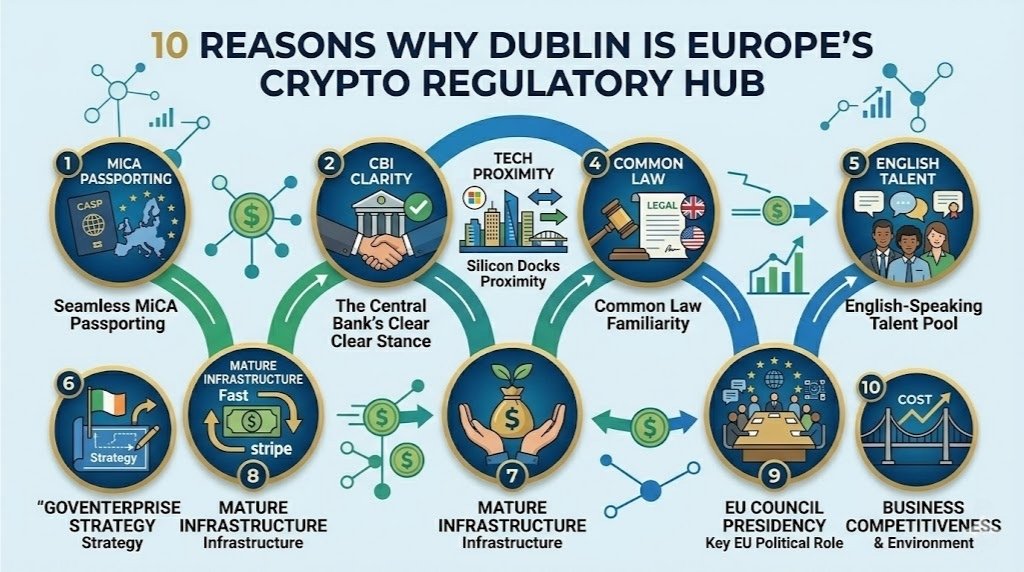
10 Reasons Why Dublin Is Becoming Europe’s Crypto Regulatory Hub
The following points illustrate how a small island nation has built a massive regulatory moat around its digital finance sector. From the legal certainty of common law to the sheer density of talent in the “Silicon Docks”, Dublin is offering a blueprint for how a legacy financial hub can successfully pivot to accommodate tokenised assets.
1. Seamless MiCA Passporting And EU Market Access
Under the now-active MiCA framework, a CASP licence issued by the Central Bank of Ireland serves as a single passport to operate across all 27 EU member states. Firms established in Dublin avoid the fragmented “patchwork” of national regulations that previously slowed expansion, allowing them to scale from a single base into a market of nearly half a billion people.
Best for: Global exchanges and liquidity providers seeking rapid, compliant EU expansion.
Why:
● It provides immediate legal certainty across the world’s largest single trading bloc.
● It eliminates the need for 27 separate applications, drastically reducing legal overhead.
Things to consider: Firms must maintain a physical presence and “effective management” within Ireland to retain these passporting rights.
2. The Central Bank Of Ireland’s Robust But Clear Stance
The Central Bank of Ireland (CBI) has earned a reputation as a “tough but fair” regulator. While the authorisation process is rigorous, firms find the CBI’s communication style more predictable and structured than many other jurisdictions. The CBI’s 2026 engagement meetings allow firms to align their business models with supervisory expectations before a formal application is even submitted.
Best for: Institutional-grade firms that prioritise long-term regulatory stability over “quick” but vague approvals.
Why:
● The CBI’s rigour adds instant credibility to any firm that passes its scrutiny.
● A clear, two-phase application process reduces the likelihood of unexpected rejections.
Things to consider: The process is resource-intensive and requires high standards of anti-money laundering (AML) and consumer protection protocols.
3. Proximity To The Silicon Docks Tech Giants
Dublin is home to the European headquarters of Google, Meta, Microsoft, and Stripe. This “Silicon Docks” environment creates a symbiotic relationship where fintech firms can easily integrate with the platforms and cloud infrastructures that power modern finance. The presence of these giants ensures that the underlying digital infrastructure is always world-class.
Best for: Crypto startups looking to leverage embedded finance and API-driven growth.
Why:
● It creates an unparalleled density of tech talent and networking opportunities.
● It facilitates faster adoption of AI and DLT through proximity to the world’s leading cloud providers.
Things to consider: Competition for office space in the Docklands remains extremely high despite the rise of remote work.
4. Familiarity Of The Common Law Legal System
Ireland is the only English-speaking, common law jurisdiction remaining in the European Union. This is a critical advantage for US and UK firms, as most international financial contracts are based on common law principles. It makes the legal transition into the EU significantly easier for compliance teams accustomed to the London or New York systems.
Best for: North American and British crypto firms seeking their primary EU hub.
Why:
● It offers a familiar legal framework for drafting smart contracts and investor agreements.
● It reduces the “legal translation” gap often found in civil law jurisdictions.
Things to consider: While the legal principles are familiar, the regulatory reporting standards are strictly EU-specific.
5. A High-Density, English-Speaking Talent Pool
Ireland’s education system consistently produces graduates with high proficiency in financial services and computer science. Dublin’s ability to attract international talent is further bolstered by its status as a vibrant, English-speaking capital. In 2026, the Dublin Fintech Ecosystem is powered by a workforce that is natively “digital-first” and globally connected.
Best for: Scale-ups needing to hire local compliance, legal, and engineering teams rapidly.
Why:
● It removes language barriers for international firms and their global client bases.
● Dublin has one of the highest concentrations of fintech professionals per capita in Europe.
Things to consider: High living costs in Dublin can make talent retention a challenge for smaller, un-backed startups.
6. The “Ireland For Finance” Strategic Roadmap
The Irish government’s “Ireland for Finance” strategy is a multi-year plan dedicated to making the country a top-tier global financial hub. The 2026 update to this strategy explicitly prioritises digital assets, tokenisation, and green finance, ensuring that public policy and infrastructure are constantly evolving to meet the needs of crypto firms.
Best for: Firms seeking a jurisdiction where the government is actively pro-fintech.
Why:
● It ensures long-term political commitment to the digital finance sector.
● It provides a clear roadmap for future legislative support beyond the MiCA implementation.
Things to consider: Policy priorities can shift with government cycles, though the commitment to financial services has remained a cross-party constant.
7. Direct Support From IDA Ireland And Enterprise Ireland
State agencies like IDA Ireland provide significant support for international firms landing in Dublin, from grant funding to site selection. For indigenous firms, Enterprise Ireland is one of the world’s most active seed investors. This level of state-sponsored “concierge” service is a major differentiator for firms like CoinJar, which recently announced a €5 million investment in Dublin.
Best for: International firms seeking “soft landing” support and indigenous startups seeking seed capital.
Why:
● It provides a direct line to government ministers and policy makers.
● IDA Ireland’s track record in MedTech and Big Tech is now being successfully applied to Web3.
Things to consider: Access to certain grants is contingent on job creation targets and R&D commitments.
8. Mature Infrastructure And The Stripe Effect
The success of Stripe, founded by Irish brothers and maintaining a dual HQ in Dublin, has “de-risked” Ireland in the eyes of global investors. The infrastructure built to support Stripe—including fast payment rails and advanced KYC/AML service providers—is now available to the wider crypto community, creating a highly efficient ecosystem.
Best for: Payments-focused crypto firms and DeFi-to-TradFi bridges.
Why:
● Stripe’s presence has attracted a massive supporting industry of fintech legal and audit firms.
● It proves that multi-billion dollar financial infrastructure can be scaled successfully from Dublin.
Things to consider: Being in the “Stripe shadow” means expectations for operational excellence and compliance are high.
9. Strategic Role In The Digital Euro And FIDA
As Ireland prepares to take over the EU Council Presidency in the second half of 2026, Dublin is becoming a key site for discussions on the Digital Euro and the Financial Data Access (FIDA) regulation. Firms located in Dublin have a front-row seat to these negotiations, allowing them to adapt their business models before new rules are finalised.
Best for: Firms involved in central bank digital currencies (CBDCs) and open finance.
Why:
● It offers a significant geopolitical advantage during a critical year for EU financial policy.
● It allows Dublin-based firms to participate in official sandboxes and pilot programs.
Things to consider: Policy influence is indirect, as final decisions are made at the EU level in Brussels and Frankfurt.
10. Competitive Business Environment And Connectivity
While Ireland’s corporate tax rate has seen adjustments for the largest multinationals, it remains highly competitive for the mid-market and startup firms that dominate the crypto sector. Coupled with Dublin’s excellent connectivity to both the US and mainland Europe, the city serves as a perfect trans-Atlantic bridge for digital commerce.
Best for: Firms managing international operations across multiple time zones.
Why:
● It provides the most efficient “Atlantic Bridge” for US firms entering the EU.
● The overall pro-business environment makes setting up a legal entity fast and predictable.
Things to consider: The 15% minimum tax rate for large firms (Pillar Two) may apply to the largest global crypto exchanges.
Strategic Analysis
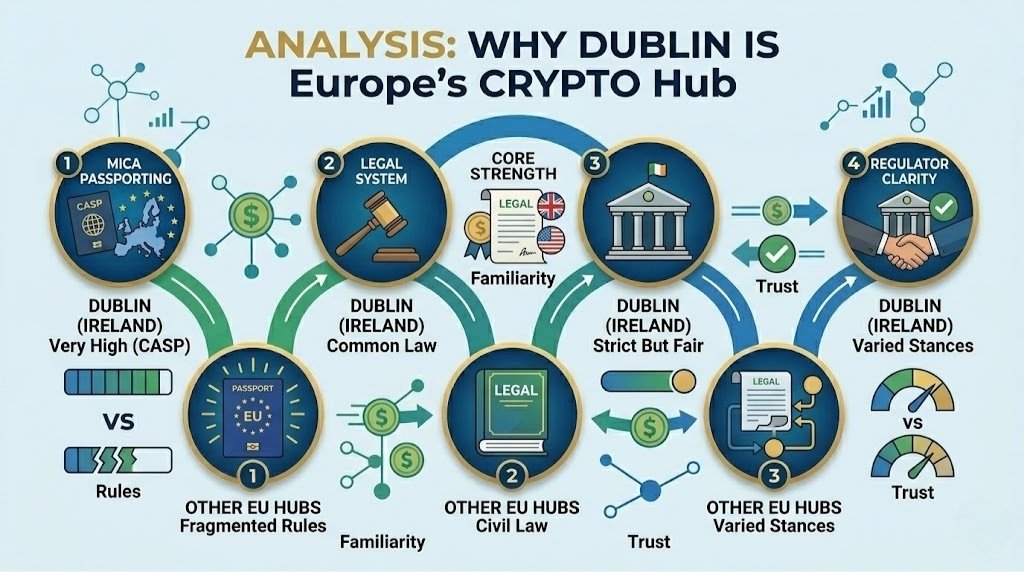
To better understand how Dublin compares to other major European hubs as a regulatory destination, we have outlined the core strengths that firms consider when making their relocation decisions.
The following table compares Dublin’s regulatory and business environment against other leading European cities.
Our Top 3 Picks?
While all ten reasons contribute to Dublin’s success, these three are the primary catalysts that are currently driving the largest firms to choose the Irish capital over its rivals.
-
Seamless MiCA Passporting: In 2026, the ability to serve the entire EU from one regulated office is the single most valuable asset for any crypto firm.
-
Common Law Legal System: For the US and UK firms that dominate the crypto market, the legal comfort of Ireland is a decisive factor.
-
The CBI’s Robust Stance: In a post-FTX world, having a regulator that is known for being strict and thorough is a badge of honour that attracts institutional capital.
Preparation Checklist
If you are a firm considering a move to the Dublin Fintech Ecosystem, ensure you have checked the following 2026 compliance boxes before beginning your application.
● CASP Transition: If you are an existing VASP, have you scheduled your CASP engagement meeting with the Central Bank?
● Local Management: Do you have a plan to hire or relocate a resident director and a Head of Compliance to Dublin?
● DORA Compliance: Ensure your ICT systems are ready for the Digital Operational Resilience Act (DORA) reporting starting in Q1 2026.
● Document Audit: Collate all original “long-form” company documents and proof of capital for the CBI’s review.
Leading The EU’s Digital Frontier
Dublin’s transformation from a local financial centre to a global crypto regulatory hub is a testament to Ireland’s ability to move at the speed of technology. By successfully implementing MiCA and fostering a world-class Dublin Fintech Ecosystem, the city has created a safe harbour for innovation. As the “Silicon Docks” continue to expand and the Central Bank refines its digital oversight, Dublin is not just a place to do business—it is the destination where the standards for the future of the global digital economy are being written.