Everyone in India knows the name ‘Netaji’ Subhas Chandra Bose. He is a titan of the freedom struggle. His name evokes images of daring escapes, a powerful army, and a fiery demand for complete independence. He is one of the brightest stars in the sky of India’s history.
But every star has a force that helped shape it. Every great leader has a teacher who saw their potential first.
For Subhas Chandra Bose, that teacher was Chittaranjan Das.
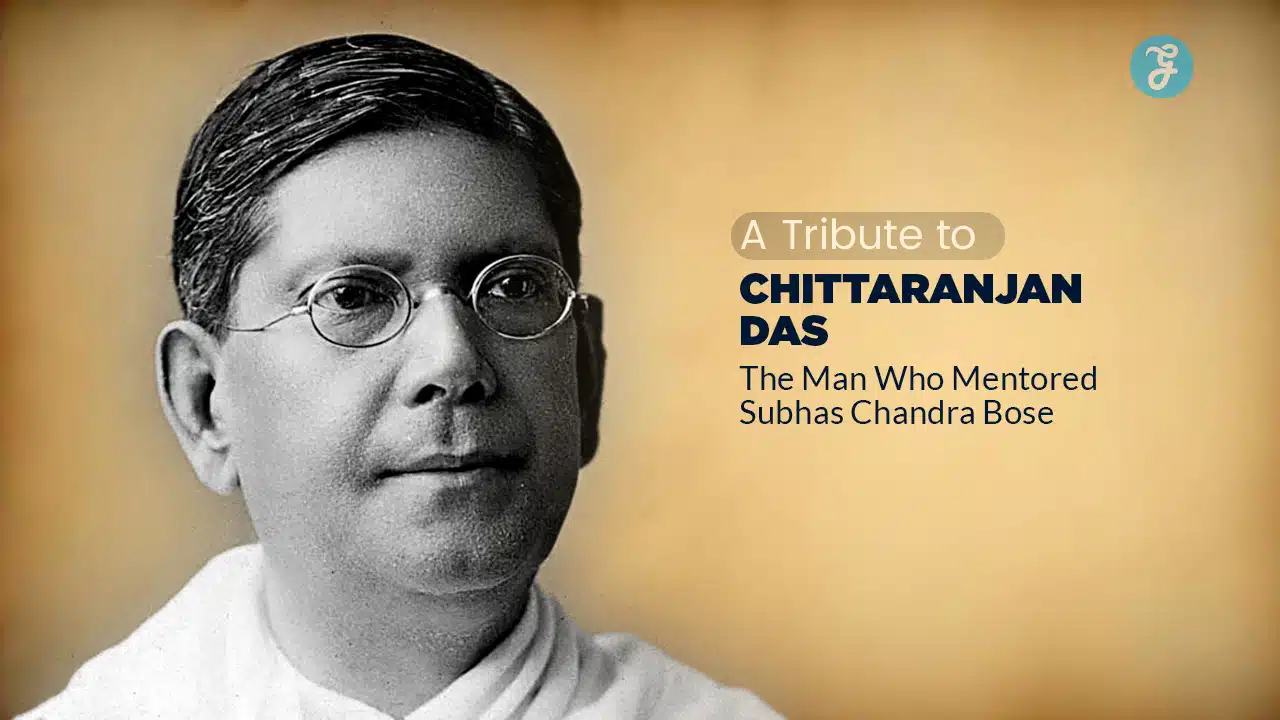
Many know him by the title “Deshbandhu,” which means “Friend of the Nation.” But his most lasting legacy may be his role as the political guru of Subhas Chandra Bose. This is not just a tribute to Chittaranjan Das. It is the story of one of the most important mentorships in India’s history. It is the story of Chittaranjan Das mentor of Subhas Chandra Bose, a relationship that shows how a ‘Deshbandhu’ helped create a ‘Netaji’.
Who Was Chittaranjan Das? The Making of a ‘Deshbandhu’
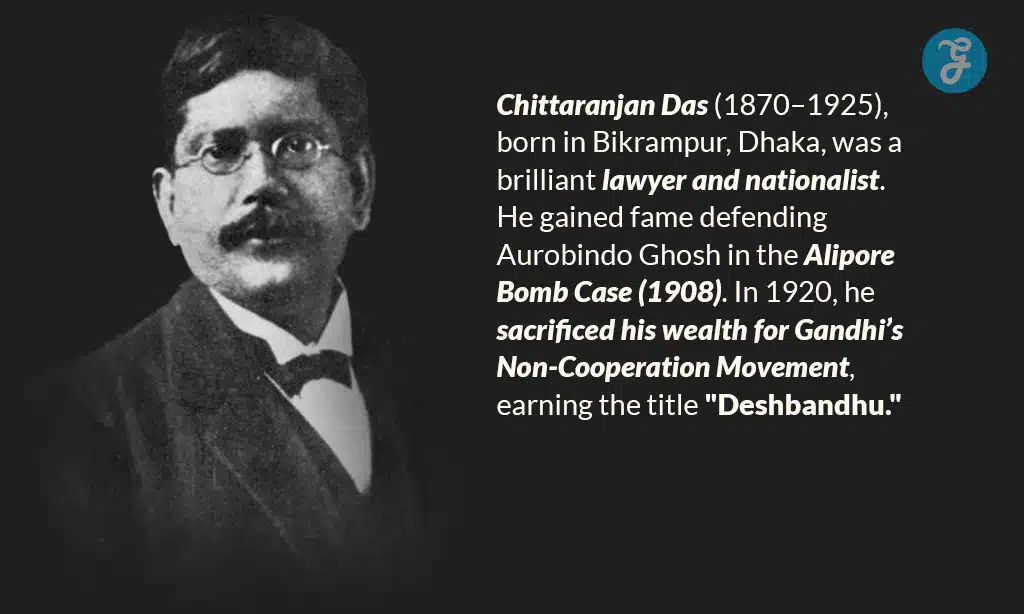
Before he was a mentor, Chittaranjan Das was a giant in his own right. He was born on November 5, 1870, in Bikrampur, Dhaka, which is now in Bangladesh. His family was well-known and part of the Brahmo Samaj, a reformist movement in Hinduism. His father, Bhuban Mohan Das, was a journalist and a lawyer. From a young age, C.R. Das was surrounded by ideas of social reform and nationalism.
The Barrister Who Became a Hero
He studied at Presidency College in Calcutta (now Kolkata). Like many bright young men of his time, he went to England to study law. He joined the Inner Temple in London. He tried for the Indian Civil Service (ICS) but did not pass. This was perhaps fate, as it set him on a different path.
He returned to India in 1893 and began practicing at the Calcutta High Court. His early years were a struggle. But soon, his brilliant legal mind and powerful way of speaking made him famous. He became one of the most successful—and wealthiest—lawyers in all of India. He built a huge mansion and lived a life of luxury.
But his heart was in the freedom movement. His true calling came in 1908. He took on a case that would change his life and make him a national hero: the Alipore Bomb Case.
In this case, Aurobindo Ghosh (later Sri Aurobindo) and many other young revolutionaries were accused of plotting to kill British officials. The case was weak, but the government wanted a conviction. C.R. Das took up Aurobindo’s defense.
He argued the case for free, putting his own massive income on hold for months. His closing argument became a legend. It lasted for nine days. He did not just argue law; he argued for the very idea of nationalism. He famously said:
“My appeal to you is this: that long after this controversy is hushed in silence, long after this turmoil, this agitation, ceases, long after he is dead and gone, he will be looked upon as the poet of patriotism, as the prophet of nationalism and the lover of humanity. Long after he is dead and gone, his words will be echoed and re-echo1ed…”
His brilliant defense worked. Aurobindo Ghosh was acquitted. C.R. Das was no longer just a lawyer. He was a hero of the people.
The Great Sacrifice
For years, Das was a leading voice in the Indian National Congress. But his biggest moment came with the Non-Cooperation Movement in 1920. Mahatma Gandhi called on all Indians to boycott British goods, courts, and schools.
For C.R. Das, this was not just a political slogan. It was a call to action.
In a single, stunning act, he gave up everything.
- He quit his legal practice, which was earning him a fortune (some say 50,000 rupees a month, an astronomical sum at the time).
- He gave away his enormous wealth and his luxurious mansion to the nation (it became a hospital for women, the ‘Chittaranjan Seva Sadan’).
- He led his family in burning their expensive, foreign-made clothes in a public bonfire, choosing to wear simple, hand-spun khadi.
This was a sacrifice on a scale India had never seen. It was this act that earned him the loving title “Deshbandhu” or “Friend of the Nation.” He was no longer just a leader; he was a symbol of sacrifice.
| Quick Facts: C.R. Das (Before Mentorship) | |
| Full Name | Chittaranjan Das |
| Title | Deshbandhu (Friend of the Nation) |
| Born | November 5, 1870 (Bikrampur, Dhaka) |
| Famous Case | Alipore Bomb Case (1908) – Defended Aurobindo Ghosh |
| Key Action | Gave up his entire legal fortune for the Non-Cooperation Movement (1920) |
| Political Party | Indian National Congress; later, Swaraj Party |
Chittaranjan Das: Mentor of Subhas Chandra Bose – A Bond is Forged
In 1920, a young Subhas Chandra Bose was in England. He had just done the unthinkable: he had passed the Indian Civil Service (ICS) exam, placing fourth. This was the most powerful job an Indian could dream of. It promised a life of wealth, power, and prestige.
But Bose’s mind was in turmoil. He wrote long letters to his brother, Sarat Chandra Bose. How could he serve the very empire he wanted to destroy? How could he pledge loyalty to the British King?
After months of mental struggle, he made his choice. In 1921, Subhas Chandra Bose resigned from the ICS. It was a shocking act of defiance. He gave up a golden future to jump into the uncertainty of the freedom struggle.
He sailed back to India, arriving in Bombay on July 16, 1921. He had a clear goal: to find a leader.
He went to meet Mahatma Gandhi first. He respected Gandhi immensely. But he was a pragmatist. He had questions. He asked Gandhi for a clear plan of action, a roadmap for how non-cooperation would lead to “Swaraj” (self-rule). He did not get the clear, strategic answers he was looking for.
He was then advised to go to Calcutta and meet Chittaranjan Das.
Bose went to the home of C.R. Das. He found a man who was the heart of the movement in Bengal. But he also found a strategist. Das was not a mystic. He was a brilliant lawyer, a practical politician, and a passionate nationalist.
Bose asked him the same hard questions he had asked Gandhi. Das gave him clear, confident answers. He laid out his plan for Bengal and for India.
The impact was immediate. Bose felt he had found his leader. He wrote later that he felt he “had come to the right place.” He knew he had found his political guru.
For C.R. Das, the feeling was mutual. He saw in this 24-year-old rebel a fiery spirit, a sharp intellect, and a shared dedication to action. The mentorship began almost the very day they met.
| Timeline: Bose Finds His Guru | |
| 1920 | Subhas Chandra Bose passes the Indian Civil Service (ICS) exam in England. |
| April 1921 | Bose resigns from the ICS, calling it the “height of immorality” to serve the British. |
| July 16, 1921 | Bose arrives in Bombay and meets Mahatma Gandhi. |
| July 1921 | Bose travels to Calcutta and has his first meeting with Chittaranjan Das. |
| Outcome | Bose immediately pledges his service to C.R. Das, who becomes his political mentor. |
Forging a Leader: How C.R. Das Mentored Subhas Chandra Bose
The meeting between Chittaranjan Das and Subhas Chandra Bose was not just a meeting of minds; it was the beginning of an intense, four-year apprenticeship. Das was a leader who believed in action, not just theory. He did not ask his new, 24-year-old follower to simply observe. He immediately threw him into the very center of the storm.
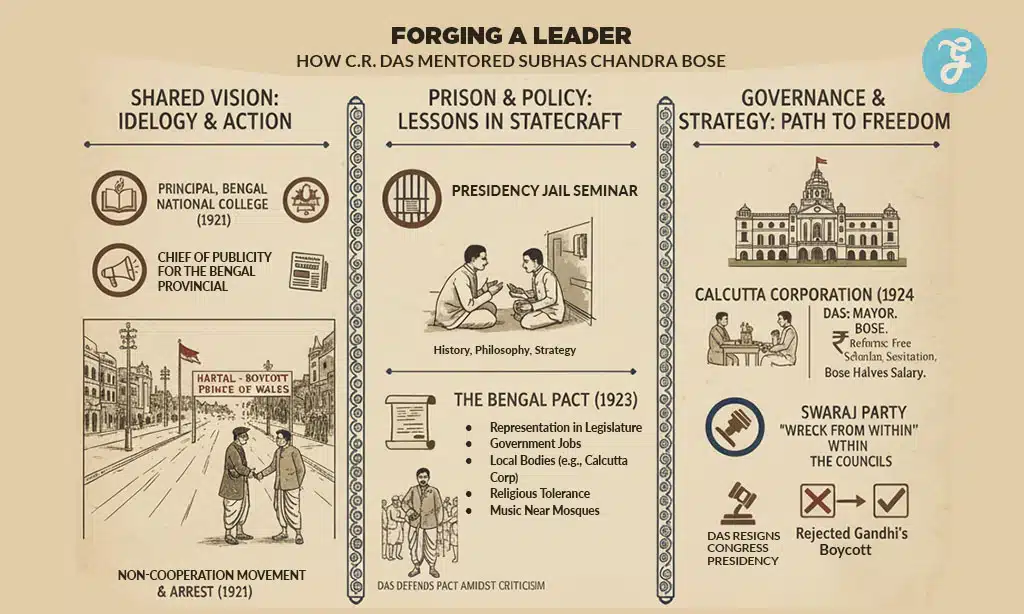
This mentorship can be broken down into three distinct, powerful phases: learning through ideological action, learning through practical governance, and learning through political strategy.
From the moment Bose agreed to follow him, Das gave him real, high-stakes responsibilities. This was not a test; it was an act of immediate and complete trust. This trust was the foundation of the Chittaranjan Das mentor of Subhas Chandra Bose relationship.
Das’s first two appointments for Bose were:
- Principal of the Bengal National College: The Bangiya Jatiya Bidyalaya was set up for students who had answered the call to boycott British-run educational institutions. Das put Bose, barely out of university himself, in charge of this new college. Here, Bose learned to be a leader of youth, an administrator, and an educator, shaping a curriculum built on nationalist ideals.
- Chief of Publicity for the Bengal Provincial Congress: Das understood Bose’s power with the pen and his fiery passion. He put him in charge of communications, managing the party’s message, and organizing volunteers.
These roles immediately made Bose a key player. He was not just a follower; he was Das’s chief lieutenant.
The Fire of the Non-Cooperation Movement
Together, they dove into the Non-Cooperation Movement in Bengal. Das was the undisputed king of the movement in the province, and Bose was his most energetic organizer. Their greatest test came in late 1921.
The British government announced that the Prince of Wales would visit Calcutta in December. The Congress, led by Das and Bose, declared a hartal (a total strike and boycott). The British banned all volunteer organizations. Das and Bose defied the ban. They led from the front, and the boycott was a massive, stunning success. The streets of Calcutta were deserted when the Prince arrived.
The colonial government was furious. On December 10, 1921, they arrested Subhas Chandra Bose. A few days later, they arrested his guru, C.R. Das.
Prison as a Classroom
This arrest was, perhaps, the most important part of Bose’s education. Mentor and mentee were imprisoned together in Presidency Jail in Calcutta for over six months.
This was not just time spent in a cell. It was an extended, non-stop seminar with his political guru.
- They shared a cell, cooked their own food, and spent all day and night in deep discussion.
- They discussed history, philosophy, economics, and the future of India.
- They analyzed political strategy. Bose got to understand Das’s mind—why he supported non-cooperation but also had doubts about some of its parts.
- They debated respectfully. Bose, always practical, questioned parts of Gandhi’s strategy. Das, also a pragmatist, listened and shared his own views.
Bose emerged from this prison term not just as a follower, but as a leader with a fully-formed political ideology, shaped and sharpened by his mentor.
The Bengal Pact: A Masterclass in Secularism
The most profound ideological lesson Das taught Bose was about Hindu-Muslim unity. For Das, this was not just a political slogan; it was the single most important condition for a free India.
After their release, Das saw the growing divide between the two communities. He decided to fix it with a bold, practical, and controversial step: The Bengal Pact of 1923.
This was a historic agreement Das signed with Muslim leaders in Bengal. It was not just words; it was a concrete plan for sharing power.
| Key Terms of the Bengal Pact (1923) | What it Meant |
| Representation in Legislature | Muslims (who were a majority in Bengal) would get 60% of the seats in the future Bengal legislature. |
| Government Jobs | 55% of all new government posts would be reserved for Muslims until their share in the population was reflected in public service. |
| Local Bodies (e.g., Calcutta Corp) | 60% of seats would go to the majority community (Hindus in Calcutta, Muslims in rural districts). |
| Religious Tolerance | No law affecting a religion could be passed without the consent of 75% of that religion’s elected members. |
| Music Near Mosques | Das even addressed the sensitive issue of playing music during Hindu processions near mosques, calling for mutual respect. |
This pact was political dynamite. C.R. Das was attacked from all sides by many conservative Hindu leaders within his own party. They accused him of “pandering” and “giving away” Hindu rights.
Das stood his ground like a rock. He faced the backlash and defended the pact with all his strength. He believed it was the only honest way to build trust.
For Subhas Chandra Bose, who watched all this, it was a life-changing lesson. He saw his guru risk his entire political career for a principle. This principle—that true unity comes from sharing power fairly, not just from sweet talk—became Bose’s own core belief. It was this exact lesson he would later use to build his Indian National Army (INA), a perfect model of Hindu-Muslim-Sikh unity.
Practical Politics: The Calcutta Corporation
Das’s mentorship was not limited to ideology. He wanted Bose to learn how to govern. His next move was perhaps his most brilliant.
After forming the Swaraj Party, Das’s party won a stunning victory in the 1924 elections for the Calcutta Municipal Corporation. It was the first time the corporation would be run by Indians, not the British.
C.R. Das was elected Mayor of Calcutta.
And his very first act? He appointed his 27-year-old protégé, Subhas Chandra Bose, as the Chief Executive Officer (CEO).
This was a political masterstroke and an incredible show of faith. The CEO was the most powerful administrative post in the city, the person in charge of all day-to-day operations, staff, and budget. It was a job always reserved for a senior, white British official from the ICS. This was the Chittaranjan Das mentor of Subhas Chandra Bose dynamic in action: one providing the vision, the other executing it flawlessly.
By placing Bose in this seat, Das was making a powerful statement: Indians are ready and able to govern themselves.
This was Bose’s apprenticeship in statecraft.
- Das was the political leader and visionary (the Mayor).
- Bose was the non-stop, hands-on administrator (the CEO).
Together, they turned the corporation from a colonial relic into a public service machine. Bose was a whirlwind of energy. He worked 12-hour days, cut his own salary in half (from Rs. 3,000 to Rs. 1,500), and often refused to even use the official car.
They brought revolutionary changes to the city, all designed to help the common citizen.
| Reforms by Das-Bose at Calcutta Corporation (1924) | Impact on the People |
| New Public Services | Opened 70 new free primary schools for the poor, as well as free health dispensaries and clinics in slums. |
| Sanitation & Water | Vastly improved drainage and the water supply, which were huge problems for the city’s poor. |
| Nationalist Culture | Changed British street names to honor Indian heroes. Khadi (hand-spun cloth) was made the official uniform for all corporation staff. |
| Transparency | Started the Calcutta Municipal Gazette, a newspaper to tell citizens exactly what their corporation was doing and where their money was going. |
| Indianisation | For the first time, civic receptions were held to honor national heroes and freedom fighters, not just British Viceroys. |
This experience was priceless. Das was teaching Bose, in a real-world setting, how to run a government. Bose learned about budgets, public works, sanitation, bureaucracy, and dealing with a hostile colonial administration that tried to block him at every turn.
When Bose formed the Provisional Government of Free India in Singapore in 1943, he was not just a general. He was a Head of State with a cabinet and a plan for a free India. That confidence, that administrative skill, was born in 1924, in the offices of the Calcutta Corporation, under the watchful eye of his mentor, C.R. Das.
The Swaraj Party: A New Path to Freedom
The final pillar of Bose’s training was in pragmatic political strategy. This came from the birth of the Swaraj Party.
In 1922, Mahatma Gandhi called off the Non-Cooperation Movement after the Chauri Chaura incident. The entire movement was demoralized. At the Congress session in Gaya in 1922, the party was split.
- The “No-Changers”: Led by C. Rajagopalachari and other Gandhi loyalists. They believed they must stick to Gandhi’s plan of boycotting everything, including elections.
- The “Pro-Changers”: Led by C.R. Das (who was the Congress President at the time) and Motilal Nehru.
Das proposed a new, radical idea. He argued that boycotting the new legislative councils was a mistake. It just let weak, pro-British politicians walk in and make laws. Das said, “Let us enter the councils.”
The plan was not to cooperate. The plan was, in his words, to “wreck the councils from within.” They would obstruct every law, block every budget, and use the council chambers as a platform to demand independence.
The “No-Changers” were horrified. They saw this as a betrayal of Gandhi. At the Gaya session, Das’s proposal was defeated in a vote.
What did Das do? In a move that shocked the country, he resigned as President of the Congress.
On January 1, 1923, he and Motilal Nehru formed the Congress-Khilafat Swaraj Party.
Subhas Chandra Bose was 100% with his mentor. He became a key figure in the new party. Das gave him another huge responsibility: he made Bose the manager of the party’s new daily newspaper, Forward.
Forward was not just a party pamphlet. It was a professional, English-language newspaper designed to compete with British-owned papers. Bose, as manager, was in charge of operations. It became a huge success and a powerful voice for the nationalist cause.
This whole episode taught Bose two final, crucial lessons:
- It’s okay to disagree with Gandhi: Das showed Bose that one could deeply respect Gandhi but also disagree with him on strategy. This gave Bose the intellectual confidence to forge his own path later in his career.
- Be a Pragmatic Radical: Das taught Bose that you must be flexible. If one path (non-cooperation) is blocked, you must be smart enough to build a new one (council-entry). The goal is Swaraj, and you must use every tool and every arena—the streets, the city hall, or the enemy’s legislature—to achieve it.
This flexible, “any means necessary” approach to freedom was the final gift C.R. Das gave to his protégé. The four-year mentorship was complete. Das had taken a passionate young rebel and forged him into a seasoned politician, a skilled administrator, a pragmatic strategist, and a leader of men.
An Unbreakable Bond: Beyond Politics
The relationship between Das and Bose was not just political. It was deeply personal. It was like the bond between a father and a son.
Bose had rebelled against his own father’s wishes to give up the ICS. In C.R. Das, he found a political father who not only understood his sacrifice but celebrated it.
Das, in turn, loved Bose like his own son. He defended him fiercely.
In 1924, the British government was terrified of Bose’s success as CEO. They could not find any fault with his work, so they used a harsh law to arrest him on false charges of “terrorism.” There was no trial. They just locked him up and sent him to a remote, disease-ridden prison in Mandalay, Burma.
C.R. Das was heartbroken and furious. His own health was failing, but he fought like a lion for Bose. He gave powerful speeches in the legislature, demanding his release. He said:
“All that I want to say is that Subhas Chandra Bose is no more a revolutionary than I am. If Subhas Chandra Bose is a criminal, then I am a criminal… He is a man who has earned my affection and my trust.”
Bose, in prison, heard about his mentor’s failing health. He worried constantly.
In 1925, C.R. Das’s body, worn out by years of overwork, sacrifice, and struggle, finally gave out. He went to Darjeeling to try and recover his health.
On June 16, 1925, Chittaranjan Das died. He was only 54 years old.
The news reached Subhas Chandra Bose in his cell in Mandalay. He was shattered. He later wrote that he felt “orphaned” and “desolate.” His guide, his leader, his political father, was gone.
The man who had taken him by the hand, who had trusted him with everything, and who had trained him to be a leader, was no more. Bose felt the loss for the rest of his life.
The Enduring Legacy: How Das’s Mentorship Shaped Bose’s Future
When Chittaranjan Das passed away in 1925, the direct, personal mentorship that had so completely shaped Subhas Chandra Bose came to a sudden and tragic end. The four-year apprenticeship was over. Bose was no longer the protégé; he was now the inheritor of a powerful legacy.
But the true measure of a great mentor isn’t just what the student learns, but what they build with those lessons. Das’s influence did not end with his death; it simply entered a new phase. It became the compass that guided Bose through the complex, difficult, and often lonely political battles that lay ahead.
Das had provided the essential blueprints. He had forged the steel of Bose’s leadership. Now, it was up to Bose to build the rest of his career using those tools. As Bose stepped out from under his guru’s shadow and onto the national stage, the principles Das had instilled in him—unyielding secularism, strategic pragmatism, and a total commitment to action—became the defining hallmarks of his own journey. Every major decision Bose made from that point forward can be traced back to the foundational lessons learned at the side of his ‘Deshbandhu.
Here is how those lessons manifested:
- The Foundation of Secularism: The Bengal Pact was Das’s blueprint. The Indian National Army (INA) was Bose’s masterpiece. In the INA, Hindus, Muslims, and Sikhs ate together, fought together, and died together. There were no religious divisions. This direct line from one to the other is the clearest proof of the impact of Chittaranjan Das mentor of Subhas Chandra Bose.
- Pragmatism and Strategy: Das taught Bose to be a pragmatist, not a dogmatist. The Swaraj Party’s “wreck from within” strategy showed Bose that you must be flexible. This is why Bose was later willing to seek help from Germany and Japan. He was not driven by their ideology; he was driven by the one goal his mentor had taught him: India’s freedom, by any means necessary.
- The “Forward” Legacy: It is no coincidence that when Subhas Chandra Bose resigned from the Congress in 1939, he named his new party the Forward Bloc. This was a direct, loving tribute to the newspaper Forward that he had run for C.R. Das.
- The Experience of Governance: When Bose formed the Provisional Government of Free India (Arzi Hukumat-e-Azad Hind), he was not just a general. He was a Head of State. He had a cabinet, a civil code, and a plan for a free India. This confidence to govern, to be an administrator, was born in 1924, when C.R. Das made him the CEO of Calcutta.
| Das’s Influence on Bose’s Later Career | |
| His Action: Bengal Pact (1923) | Bose’s Action: Indian National Army (INA) (1943) – A model of perfect religious unity. |
| His Action: Swaraj Party (1923) | Bose’s Action: Seeking Axis help (1941) – A pragmatic, non-dogmatic move to achieve freedom. |
| His Action: Forward Newspaper | Bose’s Action: Forward Bloc (1939) – Named his party in his mentor’s honor. |
| His Action: Mayor of Calcutta | Bose’s Action: Provisional Govt. of Free India – Used his administrative skills learned as CEO. |
The Legacy of Chittaranjan Das, Mentor of Subhas Chandra Bose
Chittaranjan Das was a true “Deshbandhu.” He gave his wealth, his health, and his life to his country. He was a brilliant lawyer, a canny politician, and a leader of millions.
But perhaps his single greatest contribution to the future of India was an act of mentorship. It was his wisdom to see the spark in a 24-year-old rebel who had just thrown away his career. It was his faith to give that young man immense power and responsibility. C.R. Das did not just build a party or win an election. He helped build a nation-builder. The story of ‘Netaji’ can never be complete without the story of Chittaranjan Das, mentor of Subhas Chandra Bose. His legacy is not just in what he did, but in who he inspired.