
Have you ever chased a bug that only shows up when you run your code? You mix up a number and a word, and the app just crashes. That can waste hours and leave you frustrated.
TypeScript adds a type system to JavaScript. It uses static typing and type inference. It spots mistakes early. We cover the Best TypeScript Features Every Developer Should Use like union types, generic classes, type guards, utility types, optional chaining and nullish coalescing.
You write more maintainable code, boost code reuse, and catch errors early. Keep reading.
Key Takeaways
- Use static typing and type inference to catch errors early. For example, a function that expects a string fails at compile time if you pass a number.
- Define interfaces and type aliases to shape objects and unions. You can write interface Repository with items and methods to build reusable code.
- Write generic functions like function func(arg: T): T and use conditional types (for example, type ReturnTypeOfPromise = T extends Promise ? R : never) to make flexible components.
- Apply type guards (for example, function isString(value: unknown): value is string) and discriminated unions (tag status: ‘success’ | ‘error’) to narrow types and avoid runtime errors.
- Use utility types such as Partial, Readonly, Pick, and leverage ES2020 features optional chaining (user?.profile?.age) with nullish coalescing (value ?? “default”) for cleaner, safer code.
Static Typing for Error Prevention

Developers add explicit type declarations for variables, function parameters, and return values in TypeScript. The compiler runs a type checker at compile time, so it finds mismatches in primitive types early.
A function that expects a string will fail the build if it gets a boolean. This static typing stops many common JavaScript runtime errors before they ever reach production. This type checking builds safe code from day one.
Visual Studio Code flags type errors as you type, with red squiggles under wrong calls. You catch a bad argument or wrong return value fast. The built-in type system forces clear contracts across modules.
Type inference steps in when you skip a type declaration, it guesses types from your code. This blend of inference and explicit types makes code more reliable and helps teams write maintainable code.
Interfaces and Type Aliases for Structured Code
Interfaces define how objects look and behave. Type aliases assign names to complex structures, like unions of string or number. Building a generic repository, you might write interface Repository with items and methods.
Declaration Merging adds new fields to an interface across files. This pattern helps achieve loose coupling and maintainable code. Static typing and type inference catch mistakes before runtime.
IDE extensions highlight mismatches, thanks to the compiler in the background. Code remains safe when you use type declarations for objects or functions in the javascript language.
Teams can mix union types and type aliases to express a boolean type check or union of strings, similar to c# patterns. Generic classes flex in object-oriented programming to handle many data shapes.
Dependency injection setups rely on these type-system contracts to reduce tightly coupled modules. The compiler flags errors during transpilation, and it speeds up debugging in the console or editor.
Using these patterns makes code clear and safe across project dependencies.
Generics for Reusable and Flexible Components
Generic functions let developers write one block for many types. function func(args: T): T returns the passed in value, with an inferred type. TypeScript picks T at compile time, based on type inference rules.
This approach catches type mismatches early, boosting type safety and static typing. You can build generic classes that work with various supertypes in a library and leverage constructor signatures.
Conditional types act like traffic controllers, guiding the generic class to pick correct types. That trick sharpens union types or complex type declarations with no extra code. A simple component class ties state and props in object oriented programming.
In a design, reflections let you inspect type metadata at runtime, but generics lock in type safety at compile time. Code editors highlight errors as you type, so you keep code maintainable, and spot any constructor or type inference slip.
Union and Intersection Types for Complex Type Management
Union types let a variable hold string or number. The TypeScript compiler flags an error if you pass true to func. A call to func(“Hello”) or func(42) works fine. This approach boosts static typing and type inference.
Editors like Visual Studio Code underline wrong type usage early.
Intersection types merge multiple type declarations into one object. You can model a HealthyBody type by combining MentalWellness & PhysicalWellness & Productivity. Models like these thrive in object-oriented programming languages that use classes and inheritance.
Discriminated unions link type guards to handle union types under a shared property. Optional conditional types can add branching logic for precise inferred type checks. Such combinations deliver maintainable code and decoupling across generic classes and custom structures.
Type Guards and Discriminated Unions for Safer Runtime Checks
Type guards narrow types inside if blocks for safer runtime checks. They run at runtime and back static typing with explicit type declarations. You write a function like function isString(value: unknown): value is string.
It returns true or false. TypeScript then knows value holds a string type after the check. You code with safe casts.
Discriminated unions pack a shared discriminant property into each variant. You tag each type with a common field, like status: ‘success’ or status: ‘error’. TypeScript uses that tag to narrow union types.
Conditional types let you select type shapes based on conditions. For example type MessageType = T extends “success” ? string : number. You see type inference with infer to pull subtypes.
Write type ReturnTypeOfPromise = T extends Promise ? R : never. This yields an inferred type for the result. Such patterns boost maintainable code. These checks fit into generic classes too; developers test code in a compiler or code editor.
Utility Types for Simplified Type Manipulation
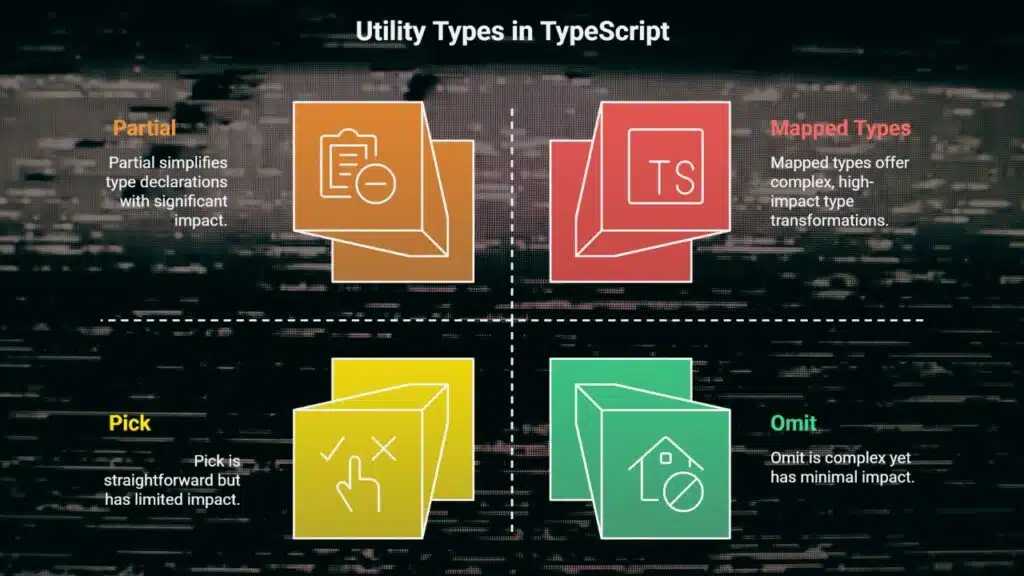
Utility types like Partial let you tweak type declarations fast in TypeScript. Readonly freezes properties so you avoid accidental changes. Pick grabs only the fields you need.
Omit strips out properties you do not want. Record maps keys to values in one line. VS Code and tsc catch mismatches as you edit. These tools lean on type inference, conditional types, and union types to boost maintainable code.
Mapped types change all fields in one shot. You can write type ReadOnly = { readonly [P in keyof T]: T[P]; } This example shows how an inferred type emerges without manual work.
These helpers plug right into generic classes or standard interfaces, mixing with static typing for solid apps.
Optional Chaining and Nullish Coalescing for Cleaner Code
Developers use optional chaining to skip null checks and access nested properties safely. A snippet like user?profile?age returns undefined instead of throwing an error. Type inference still works on the accessed value, so you keep strong type declaration.
This feature cuts boilerplate and boosts maintainable code in large codebases. It fits well with union types, conditional types, and generic classes.
Nullish coalescing returns default values for null or undefined data. The expression value ?? “default” yields “default” when value equals null or undefined. This operator avoids using || which would treat empty strings or zeros as falsy.
TypeScript added this operator in ES2020 and your IDE highlights correct usage. It helps maintain clean code when handling API responses and optional fields. Static typing stays intact, so developers catch errors at compile time.
Takeaways
Seven top TypeScript features can sharpen your code. Interfaces, union types, and type inference catch mistakes early, like a guard dog at the gate. Generics and Utility Types help you build flexible parts.
Type guards work with the config file and the TypeScript Compiler for safer runs. Try these tips in Visual Studio Code, and write code that feels solid and fun.
FAQs
1. What are conditional types and union types in typescripts?
Conditional types pick a type, when a check passes. Union types let one variable hold more than one type. Together, they shape your code at compile time; they are like a choose-your-own path game, for types.
2. How does type inference create an inferred type?
Type inference watches your code and picks types for you. It forms an inferred type, without extra notes. This cuts errors and saves time. It also makes code easier to read.
3. Why use generic classes for maintainable code?
Generic classes act like molds, they let you reuse the same logic with different types. You write code once, then plug in types as needed. This pattern keeps code tidy, and makes maintainable code solid. It stops you from copy-paste mania.
4. How do static typing and type declaration benefit TypeScript projects?
Static typing locks types at compile time, so errors pop up early. Type declaration spells out shapes for your data, like a blueprint. The duo catches bugs before you hit run. Editors then give you smarter hints, as you type.