A borrower can have steady income and a record of paying regular bills yet still have little information in a conventional credit file. Fintech lenders may look beyond that file to understand whether the person can manage another payment. Alternative data for credit scoring can include bank transactions, rent payments, utility records, and other information that does not usually appear in a standard credit report.
These sources are not equally useful. Cash flow and payment history relate directly to a borrower’s finances. Education or professional details are more indirect, while digital activity raises sharper questions about privacy and fairness. The Federal Reserve describes both financial and nonfinancial data as alternative sources, and notes that financial data is generally more closely tied to a consumer’s finances.
Here are eight sources lenders may consider—and what they should be careful not to infer from them.
1. Bank Transactions and Cash Flow
With an applicant’s permission, a lender may review account transactions to estimate income, expenses, and the money left after recurring bills. This can give a clearer view of repayment capacity when a credit report contains few loans or cards.
The useful signal is a pattern, not an isolated deposit. A transfer between the borrower’s accounts, a gift, and a paycheck can look similar in a transaction list but mean very different things. Irregular income also needs a longer view. A lender should explain what account data it wants, limit access to what is relevant, and give applicants a way to correct errors.
Used carefully, this is one of the more direct forms of alternative data for credit scoring because it can show how money moves through a person’s account. The Federal Reserve lists transaction-level account information among the financial data lenders may use.
2. Account Balances and Deposit Patterns
Some lenders use summary details instead of examining every purchase. Average balances, account age, direct-deposit frequency, and overdrafts may help show whether income is consistent and whether the borrower usually keeps a buffer.
A low balance should not be treated as a character test. It may reflect high housing costs, a recent emergency, or the timing of a paycheck and automatic bills. These account summaries can add context to transaction data, but they are not a substitute for understanding the borrower’s actual income and obligations. This kind of alternative data for credit scoring is most useful when it explains a pattern rather than producing a simplistic “good” or “bad” label.
3. Rent-payment History
Rent is a major recurring expense for many households, but rent payments have not always appeared in mainstream credit files. A reported history of on-time payments may help a renter with a thin file demonstrate that they have managed a substantial monthly obligation.
Coverage is uneven. Some landlords or property managers report payment records; many do not. Informal rental arrangements may leave no digital record at all. A late payment could also reflect a reporting error or a dispute. The CFPB’s rental-payment research describes records that may include payments, leases, inquiries, and collections—details that can change the meaning of a simple “late” mark.
So rent data can help, but missing data should not be treated as negative evidence. It is a useful form of alternative data for credit scoring only when the lender knows how the record was collected and what it leaves out.
4. Utility, Phone, and Internet Bills
Electricity, water, mobile, cable, and internet bills may show a borrower’s record of meeting recurring obligations. Yet reporting is inconsistent. In the United States, the CFPB says most utility companies do not send regular payment histories to the major credit bureaus. Unpaid bills sent to collections may appear, and a specialty reporting company may hold some telecom and utility account information. Practices differ by country and provider.
That imbalance matters: a lender may see a collection without seeing years of timely payments. Shared accounts, prepaid services, or bills in another person’s name can further complicate the record. Before using this alternative data for credit scoring, a lender should check whether it has a complete payment history or only a partial one.
5. Payroll and Employment Records
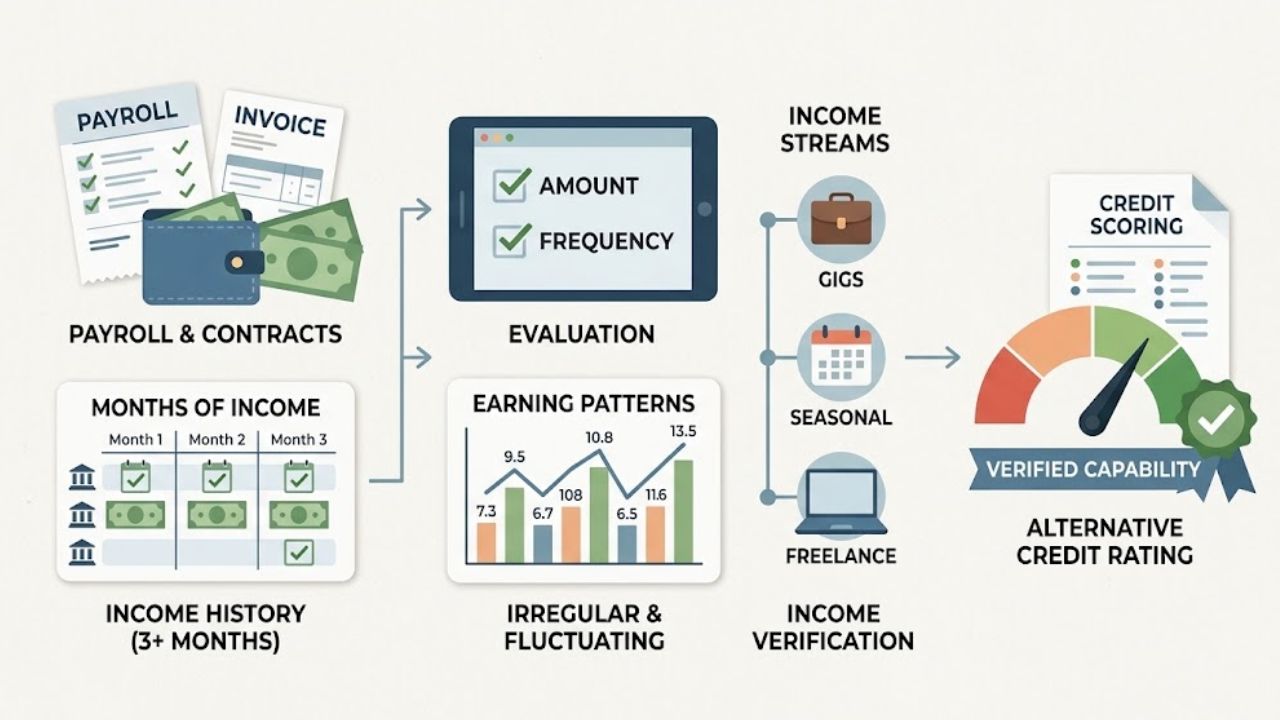
Payroll records or employer verification can help confirm the amount and frequency of an applicant’s income. A history over several months may be more informative than a single payslip, especially when earnings fluctuate.
Employment history alone is a weak proxy for repayment ability. People change jobs, work seasonally, freelance, or combine several income sources. A short tenure does not mean a borrower cannot afford a loan. Lenders should allow applicants to document income that does not arrive through a conventional payroll system.
A 2026 study examined one anonymized U.S. fintech platform whose underwriting model used education, employment, and other nontraditional variables. It offers evidence about that platform’s approach, not a guarantee that the same model or results apply to other lenders. In alternative data for credit scoring, income verification is easier to justify than broad assumptions about someone’s career prospects.
6. Gig-work and Marketplace Earnings
Ride-hailing, delivery, freelance, and marketplace platforms may keep records of earnings and payout frequency. Those records can help lenders assess workers whose income does not arrive as one monthly salary.
But gross platform revenue is not take-home income. Fees, refunds, fuel, supplies, and taxes reduce what remains. A busy month may not represent a worker’s typical earnings, either. Lenders should review a suitable time period and consider income from more than one platform when applicants can document it. For alternative data for credit scoring, a payout history is more informative when it reflects net, recurring income—not just transaction volume.
7. Small-business Sales and Payment Records
Payment processors may record sales, refunds, chargebacks, and payout timing. Combined with business-account information, those records can help a lender assess a business with limited borrowing history.
The common mistake is equating sales with profit. A strong month may still leave little after payroll, rent, inventory, processor fees, and taxes. Seasonal businesses can also look very different in peak and quiet periods. The Federal Reserve lists small-business sales, expenses, and monthly net cash flow as examples of financial alternative data.
This alternative data for credit scoring is most useful when lenders account for operating costs and seasonality instead of basing a decision on sales volume alone.
8. Education and Professional Information
Some lenders may consider credentials, field of study, or professional background when a borrower has a limited credit record. In certain cases, these details may provide context about likely earnings. They do not show whether an applicant can afford a specific loan.
This is the least direct source in the list. Access to education and credentials is unequal, and their relationship to future income varies by occupation, institution, and region. The Federal Reserve has cautioned that some nonfinancial data may lack a clearly established connection to creditworthiness or may correlate with protected characteristics. Lenders using this alternative data for credit scoring should be able to explain why it matters and test whether it creates unfair outcomes.
What Lenders Should Check
More data does not automatically make a decision better. Before adding a source, a fintech company should ask whether it is relevant, accurate, current, and understandable to the applicant. It should also check whether the model works for different income patterns and whether people can challenge incorrect records.
Rules vary across countries and products. U.S. federal banking agencies have encouraged responsible use of alternative data while emphasizing consumer-protection and compliance risks. International lenders need to review the requirements in each market where they operate.
Final Thoughts
The strongest use of alternative data for credit scoring is to fill a specific information gap. Permissioned cash-flow records may clarify income and expenses; rent or utility records may add evidence of recurring payments. Neither should become an opaque shortcut to a yes-or-no decision.
Fintech companies should begin with a clear purpose, collect only relevant information, and give applicants a practical way to correct errors. Borrowers should be able to understand what is being considered. A fuller file can support a sounder assessment only when the lender can explain what the data shows—and what it cannot.
Frequently Asked Questions (FAQs) About Alternative Data for Credit Scoring
Does alternative data replace a traditional credit score?
Usually, it supplements conventional credit information. It may help lenders assess applicants with limited credit histories, but it does not remove the need to evaluate repayment capacity or follow applicable rules.
Is rent history always included in a credit report?
No. Reporting depends on the landlord, service, and market. The CFPB has studied rental-payment data in some U.S. consumer-reporting records, but coverage is not universal.
Digital footprints are discussed as a possible form of nonfinancial data, but that does not mean every lender uses social media. Its relevance, privacy impact, and potential for unfair outcomes need scrutiny.