
Modernizing a legacy insurance technology stack can feel overwhelming, especially when outdated systems support critical operations like policy administration, claims processing, and customer management. However, replacing everything at once isn’t always necessary. A phased modernization approach helps insurance companies reduce risks, control costs, improve system performance, and adopt new technologies without disrupting daily operations.
By assessing existing systems, prioritizing business needs, and upgrading one component at a time, insurers can build a more secure, flexible, and scalable technology infrastructure for the future.
What Are Legacy Insurance Systems and Why Do They Become a Problem
Legacy insurance systems are outdated software platforms, often built decades ago on mainframe or proprietary architecture, that still run core insurance functions like policy administration, billing, and claims. They become a problem because they cannot support real-time data, modern APIs, or the digital customer experience policyholders now expect.
Most carriers did not choose to fall behind. They built custom mainframe applications in the 1980s and 1990s when no commercial alternative existed, and those systems became so deeply tied to daily operations that replacing them felt riskier than keeping them. Over time, the code aged, the original developers retired, and the system itself became the biggest obstacle to growth.
Examples of Legacy Insurance Systems
Common examples include COBOL-based policy administration systems, batch-processing claims engines, green-screen underwriting terminals, and proprietary billing modules built in-house before cloud computing existed. Many insurers also run legacy CRM tools that do not sync with newer policy or claims platforms.
- Mainframe policy administration systems that process transactions overnight in batch runs instead of real time.
- Proprietary underwriting engines with no documented APIs, making integration with modern rating tools nearly impossible.
- Standalone claims systems that require manual data entry because they lack connectors to CRM or document management tools.
- Legacy billing platforms that cannot support usage-based or IoT-driven pricing models popular in auto and commercial lines.
What Problems Do Outdated Insurance Systems Cause Today
Outdated insurance systems create slow claims processing, poor customer experience, higher operational costs, and compliance exposure. According to Roland Berger’s 2026 industry analysis, outdated core insurance systems actively block insurers from deploying AI-enabled underwriting and claims tools, because the data these systems hold is fragmented, poorly structured, and hard to access in real time.
Other common issues include:
- Long release cycles that stretch simple product changes into multi-month projects.
- High downtime risk during nightly batch jobs or system maintenance windows.
- Manual workflows that duplicate data entry across claims, billing, and policy systems.
- Security gaps from unpatched, end-of-life software that vendors no longer support.
What Does Legacy Modernization in Insurance Actually Mean
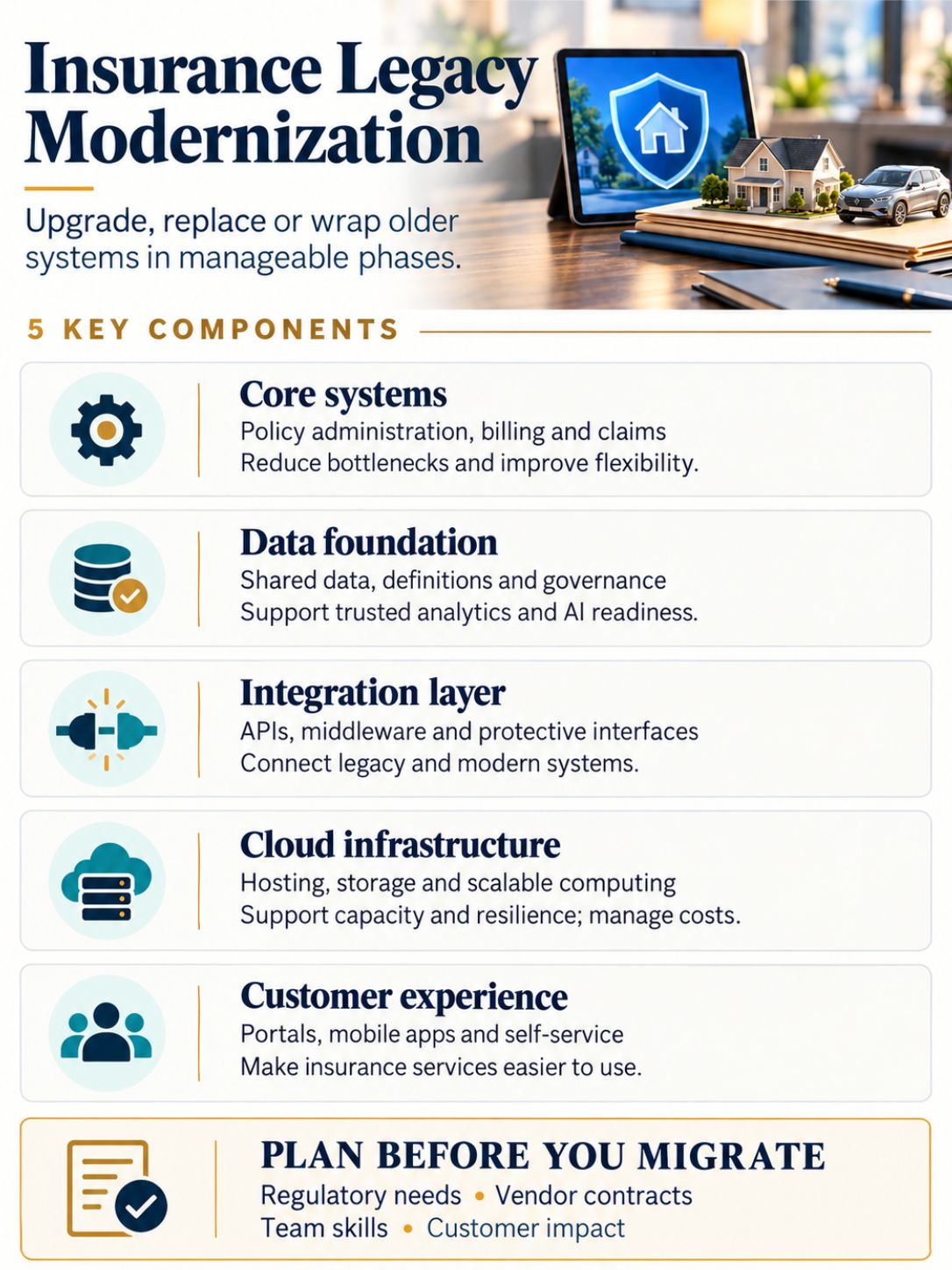
Legacy modernization in insurance means systematically upgrading, replacing, or wrapping outdated core systems so carriers can run on modern, cloud-based infrastructure with real-time data and open integration. It is not a single software upgrade; it is a structured, multi-year transformation program touching policy administration, claims, billing, and data architecture.
Key Components of Modernization
A complete legacy modernization insurance program typically includes:
| Component | What it involves | Why it matters |
|---|---|---|
| Core system replacement or wrap | Policy administration, billing, claims engines | Removes the biggest bottleneck to speed and flexibility |
| Data foundation | Data lake, semantic layer, governance rules | Enables real-time analytics and AI readiness |
| Integration layer | APIs, middleware, anti-corruption layers | Connects legacy and modern systems during transition |
| Cloud infrastructure | Hosting, storage, scalable compute | Cuts infrastructure costs and improves uptime |
| Customer-facing digital layer | Portals, mobile apps, self-service tools | Improves customer engagement and retention |
Aspects to Consider in Insurance Legacy Modernization
Insurers should weigh regulatory requirements, existing vendor contracts, internal skill gaps, and customer impact before choosing a modernization path. A regional carrier with simple personal lines products will face a very different scope than a national commercial insurer with dozens of integrated rating engines.
When Should You Modernize a Legacy Insurance System for Your Company
Insurers should modernize when release cycles, integration limits, downtime risk, manual workarounds, or security gaps start costing more than the modernization project itself. Waiting too long often costs more than acting early, since legacy maintenance spend and specialist staffing costs both climb year over year.
Five warning signs tend to show up together:
- Long release cycles, Simple product or rate changes take months instead of weeks because the core system requires manual code changes for every update.
- Integration issues, New tools, CRM platforms, or partner APIs cannot connect to the legacy core without custom, brittle middleware.
- High downtime risk, Nightly batch processing or planned outages regularly disrupt claims and policy services.
- Manual workflows, Staff re-key data between systems because no integration exists, increasing error rates and operational costs.
- Security gaps, Vendors no longer patch the underlying mainframe or proprietary software, leaving the insurer exposed to compliance violations.
How to Modernize a Legacy Insurance Technology Stack Step by Step
Modernizing a legacy insurance technology stack works best as a six-step phased process: define objectives, audit the current system, pick a strategy, prioritize workflows, integrate gradually, and manage change at scale. This sequence matches what Infosys and Roland Berger both recommend: start with data, move to core processes, then add AI-ready linkages on top.
Step 1. Define Modernization Objectives
Set specific, measurable goals before touching any code. Decide whether the priority is faster claims processing, lower operational costs, better compliance, or improved customer experience, because each goal points to a different starting point.
Step 2. Conduct System Audit and Assess Readiness
Map every legacy system, integration point, and data source currently in use. Document which modules are stable, which are fragile, and which vendors still support the underlying technology before deciding what to keep, wrap, or replace.
Step 3. Choose the Right Modernization Strategy
Pick between rebuilding, replatforming, wrapping with APIs, or a hybrid coexistence model. A September 2026 academic study on insurance policy administration systems proposed keeping the incumbent PAS as the system of record while routing new digital servicing through a modern platform, reducing friction and speeding up endorsements during the transition period.
Step 4. Prioritize High-Impact Workflows
Start with the workflows that generate the most customer complaints or operational drag, such as claims intake or policy issuance, rather than trying to modernize everything simultaneously.
Step 5. Implement Integration and Enable a Gradual Transition
Build an anti-corruption layer that lets new, modern platforms talk to the legacy core without breaking existing processes. Route new products and channels through the modern platform first, then migrate existing functionality in controlled waves.
Step 6. Manage Change and Scale Modernization
Train staff, update support documentation, and expand the modernized scope only after each phase proves stable. Scaling too fast before a phase is validated is one of the most common causes of project failure.
What Problems Do You Run Into When Modernizing Legacy Insurance Systems, and How Do You Avoid Them
The four most common issues in legacy insurance system modernization are data loss during migration, downtime and service disruption, compliance violations, and budget overruns. Each has a known, preventable cause.
- Data loss during migration, Happens when data mapping between legacy and modern schemas is incomplete. Avoid it by running parallel validation cycles before cutover and reconciling record counts at every stage.
- Downtime and service disruption, Happens when insurers attempt a single cutover instead of a phased rollout. Avoid it with coexistence patterns that keep the legacy system running as a fallback.
- Compliance violations, Happens when regulatory rules embedded in old code are not carried over to the new system. Avoid it by including compliance teams in every phase, not just the final review.
- Budget overruns, Happens when scope expands mid-project without re-estimating cost. Avoid it by locking scope per phase and treating each phase as its own budget line.
A common mistake worth calling out on its own: treating modernization as a cloud environment only initiative. Moving legacy workloads to the cloud without redesigning data structures or integration logic just moves old problems to new infrastructure.
How Much Does It Cost to Modernize a Legacy Insurance Technology Stack
Costs for modernizing a legacy insurance technology stack typically range from a few hundred thousand dollars for a single module upgrade to tens of millions of dollars for full core platform replacement at a large carrier. Mid-tier property and casualty insurers with 500 million to 5 billion in gross written premium usually budget for multi-phase programs spread across several fiscal years rather than one large capital expense.
Key cost drivers include:
- Scope: wrapping an existing core versus replacing it outright.
- Data volume: decades of policy and claims history take longer and cost more to migrate cleanly.
- Integration complexity: the number of third-party systems, rating engines, and partner APIs involved.
- Compliance requirements: multi-state or multi-country regulatory review adds legal and testing costs.
- Staffing model: internal teams versus an external technology partner with insurance-specific experience.
How Long Does It Take to Modernize a Legacy Insurance Technology Stack
Most mid-size insurers complete a phased legacy system modernization program in 18 to 36 months using a strangler fig coexistence approach, versus 12 to 18 months for a simpler, higher-risk big-bang migration. Timelines depend heavily on data complexity, regulatory scope, and how many legacy systems must be replaced versus wrapped.
A realistic phased timeline often looks like this:
- Months 1 to 3: Objective setting, system audit, and strategy selection.
- Months 4 to 9: Data foundation build-out and initial integration layer.
- Months 10 to 18: First high-impact workflow migrated and validated.
- Months 18 to 36: Remaining workflows migrated in waves, legacy system retired gradually.
Cloud Migration for Old Insurance Systems
Cloud migration moves legacy insurance workloads from on-premises mainframes to scalable cloud infrastructure, cutting hosting costs and improving uptime, but it only delivers real value when paired with data and process modernization. A cloud environment alone does not fix fragmented data or manual workflows; it just changes where the old problems live.
The Unlimited, a South African insurer, worked with Cygnet.One on a phased, cloud-native modernization program built on Microsoft Azure, moving core insurance workloads off legacy infrastructure in stages rather than a single lift-and-shift event. This kind of phased cloud migration lets insurers validate each workload before retiring the legacy environment entirely, reducing downtime risk across the transition.
Can You Modernize Insurance Legacy Systems Without Replacing Everything
Yes. Insurers can modernize legacy insurance systems without a full replacement by using coexistence patterns like the strangler fig approach, which wraps the legacy core with an integration layer and gradually shifts functionality to modern platforms. This is the dominant pattern used across the insurance industry today specifically because it limits risk compared to big-bang replacement.
In practice, this means:
- New products and sales channels launch on the modern platform immediately.
- Existing policies stay on the legacy system until their natural renewal or migration wave.
- APIs and middleware connect both systems so customer data stays consistent regardless of which platform handles a given policy.
Insurance Tech Modernization Tools and Platforms
Insurers modernizing legacy technology stacks typically combine cloud infrastructure providers, low-code policy administration platforms, API management tools, and data integration software rather than relying on one single vendor. No single tool replaces a full modernization strategy, but the right combination accelerates it significantly.
Commonly used categories include:
- Cloud infrastructure: Microsoft Azure, AWS, and Google Cloud for hosting and scalable compute.
- Policy administration systems: modern SaaS PAS platforms that replace mainframe cores.
- API management and integration middleware: tools that connect legacy and modern systems during coexistence periods.
- Data platforms: cloud data lakes and semantic layers that unify fragmented legacy data sources.
- Low-code development platforms: tools that speed up building customer-facing portals without full custom builds.
Which Insurance Companies Have Successfully Modernized Their Tech
Insurers that succeed at modernization typically follow a phased, data-first approach rather than attempting a single large cutover. The Unlimited’s phased Azure-based migration with Cygnet.One is one documented example, where core insurance workloads moved to cloud infrastructure in stages while existing operations kept running.
Across the insurance industry, the pattern among successful programs is consistent: start with core system stabilization, build a real data foundation, then expand modern capabilities workflow by workflow. Carriers that skip the data foundation step tend to stall when they later try to add AI or advanced analytics, because the underlying data still lives in fragmented legacy formats.
How to Choose Between Rebuilding vs Modernizing Insurance Systems
Choose to rebuild when the legacy core is end-of-life, unsupported, and blocking new product launches; choose to modernize incrementally when the core is stable but surrounding workflows, data access, or customer tools are outdated. Build versus modernize decisions should be based on system stability, not just system age.
| Factor | Favor rebuilding | Favor incremental modernization |
|---|---|---|
| Vendor support | No vendor support left | Vendor still maintains the core |
| Compliance risk | Core blocks regulatory reporting | Core meets current compliance needs |
| Integration | No API layer possible | APIs can be added via middleware |
| Budget | Capital available for multi-year project | Budget limited to phased spending |
| Business urgency | New products blocked entirely | New products launch, just slowly |
Insurance Modernization ROI & Business Benefits
Insurance modernization delivers return on investment through lower operational costs, faster claims processing, improved compliance, and stronger customer engagement. The exact payback period varies, but insurers consistently report that phased programs reach measurable gains faster than long, single-initiative roadmaps because each phase delivers value independently.
Concrete benefits carriers report after legacy system transformation include:
- Faster claims processing through real-time data access instead of overnight batch runs.
- Lower operational costs from reduced manual workflows and fewer duplicate data entry steps.
- Better compliance tracking because modern systems log and report data automatically.
- Improved customer engagement through self-service portals and faster policy issuance.
Challenges to customer engagement remain even after modernization if the underlying data quality was never fixed, which is why data foundation work matters as much as the platform change itself.
What Skills Do You Need to Modernize Insurance Technology
Insurers need a mix of insurance domain expertise, cloud architecture skills, data engineering, API integration experience, and change management capability to modernize legacy technology successfully. Few internal IT teams have all five skill sets in-house, which is why most carriers bring in outside specialists for at least part of the program.
Core skill areas include:
- Cloud and infrastructure architecture for designing scalable, secure environments.
- Data engineering for building the semantic layers and governance rules modern analytics depend on.
- Integration and API development for connecting legacy and modern systems during coexistence.
- Insurance domain knowledge covering policy administration, claims, and regulatory compliance.
- Change management to train staff and manage the human side of a multi-year transformation.
Working with a technology services development services provider that has handled insurance core platform migrations before shortens the learning curve considerably compared to building every skill internally from scratch.
How Cleveroad Helps Insurance Companies Modernize Legacy Systems
Cleveroad supports insurers through full-cycle legacy insurance system modernization, covering system audits, data migration, API integration, and custom software development for policy administration, claims, and billing platforms. The approach follows the same phased logic outlined throughout this guide: stabilize the core, build the data foundation, then expand modern capabilities in controlled stages.
For insurance companies weighing whether to modernize internally or bring in outside support, a technology partner helps by contributing insurance-specific development experience, proven integration patterns, and QA processes built around compliance requirements. This reduces the two biggest risks in any modernization insurance program: data loss during migration and unplanned downtime during the transition.
Final Thoughts
Modernizing a legacy insurance technology stack is a multi-year, multi-phase effort, not a single software project. Carriers that succeed treat it as a sequence: stabilize the core, build a real data foundation, then expand modern platforms, APIs, and customer-facing tools in controlled waves. Carriers that fail usually tried to do too much at once, skipped the data foundation step, or underestimated compliance and integration work.
Insurance executives and IT leaders starting this process should begin with a system audit, set clear objectives tied to business outcomes, and choose a coexistence strategy that keeps operations running during the transition. From there, prioritize the workflows causing the most customer and operational pain, and scale only after each phase proves stable. Insurers that follow this phased path consistently report lower operational costs, faster claims processing, and stronger customer engagement, without the downtime risk that comes with a single, disruptive cutover.
Frequently Asked Questions
How to modernize legacy systems?
Modernize legacy systems by defining clear objectives, auditing the current architecture, choosing a coexistence or replacement strategy, then migrating high-impact workflows first in controlled phases. Avoid a single big-bang cutover. Most successful programs wrap the legacy core with an integration layer and shift functionality gradually over 18 to 36 months.
What are the key technology trends for the insurance industry in 2026?
In 2026, insurance technology trends center on real-time data access, AI-ready data foundations, cloud-native core platforms, and coexistence architectures that let insurers modernize without disruptive cutovers. Insurers are also prioritizing short, iterative modernization initiatives measured in months rather than multi-year roadmap items that move too slowly to stay competitive.
What tool accelerates legacy modernization?
No single tool fully accelerates legacy modernization; a combination of cloud infrastructure, API management middleware, and data integration platforms works together to speed up transitions. Anti-corruption layers and strangler fig integration patterns specifically help insurers connect legacy and modern systems without rebuilding everything at once.
How to modernize legacy code?
Modernize legacy code by first documenting what the existing code does, then wrapping it with APIs so new systems can access its functionality without rewriting it immediately. Replace or refactor code module by module, starting with the most fragile or highest-risk components, rather than attempting a full rewrite in one pass.