
A screenshot can save a disputed post and still leave you unable to explain who published it, what it answered, or when it appeared. To preserve social media evidence, save the relevant content together with its source and context, keep the collected files unchanged, and record how they were obtained and handled.
For material you are lawfully entitled to collect, an immediate capture is usually a sensible first step. The harder decision is whether that capture is enough or whether the dispute calls for an account export, specialist collection, or a formal platform request.
Good preservation makes later examination possible. Authorship, truthfulness, and admissibility remain separate questions, governed in part by the rules of the relevant jurisdiction.
How to Preserve Social Media Evidence Before It Changes
Do not spend the first hour designing a filing system while the relevant post remains uncaptured. Save the visible material, its direct link where available, the account name, and the displayed date and time. Include enough of the surrounding exchange to make it understandable.
For online abuse, preserve accessible evidence before reporting or blocking when it is safe and lawful to do so. Removal or loss of access can make later collection harder. Immediate safety takes priority. If material may be illegal to possess, particularly child sexual abuse material, record its location and contact the appropriate authority instead of downloading it.
Alongside the capture, make a short collection note containing:
- The platform, content URL, account handle, and profile link.
- A description of the item: post, message thread, image, or video.
- The collector’s name and collection date, time, and time zone.
- The method used and any obvious missing material.
If someone sends you a screenshot, retain the received file and ask who captured it, when, and how. Label it as supplied material. That distinction matters: receiving an image is different from observing and capturing the live page yourself.
Set the Scope and Confirm Lawful Access
Before collecting an account history, identify the issue, relevant people, date range, and content types. “Messages concerning the disputed delivery during March” is a more workable starting point than “everything this person has ever posted.”
Possessing a password or an unlocked phone does not settle whether you may collect connected cloud data. Establish the authority for the collection and document its limits. Permission to examine a device should not be assumed to cover records held by a cloud provider.
Do not assume that an investigation permits bypassing access controls, impersonation, or deceptive contact requests. Obtain legal and professional guidance before any covert access method.
For organizations, collection scope also affects privacy compliance. UK data protection guidance, for example, requires personal data to be adequate, relevant, and limited to the purpose. Collecting too little can distort the record; collecting unrelated personal histories creates separate problems.
If broader collection becomes necessary, record why. A defined scope should guide collection without excluding inconvenient material.
Choose the Capture Method Around the Dispute
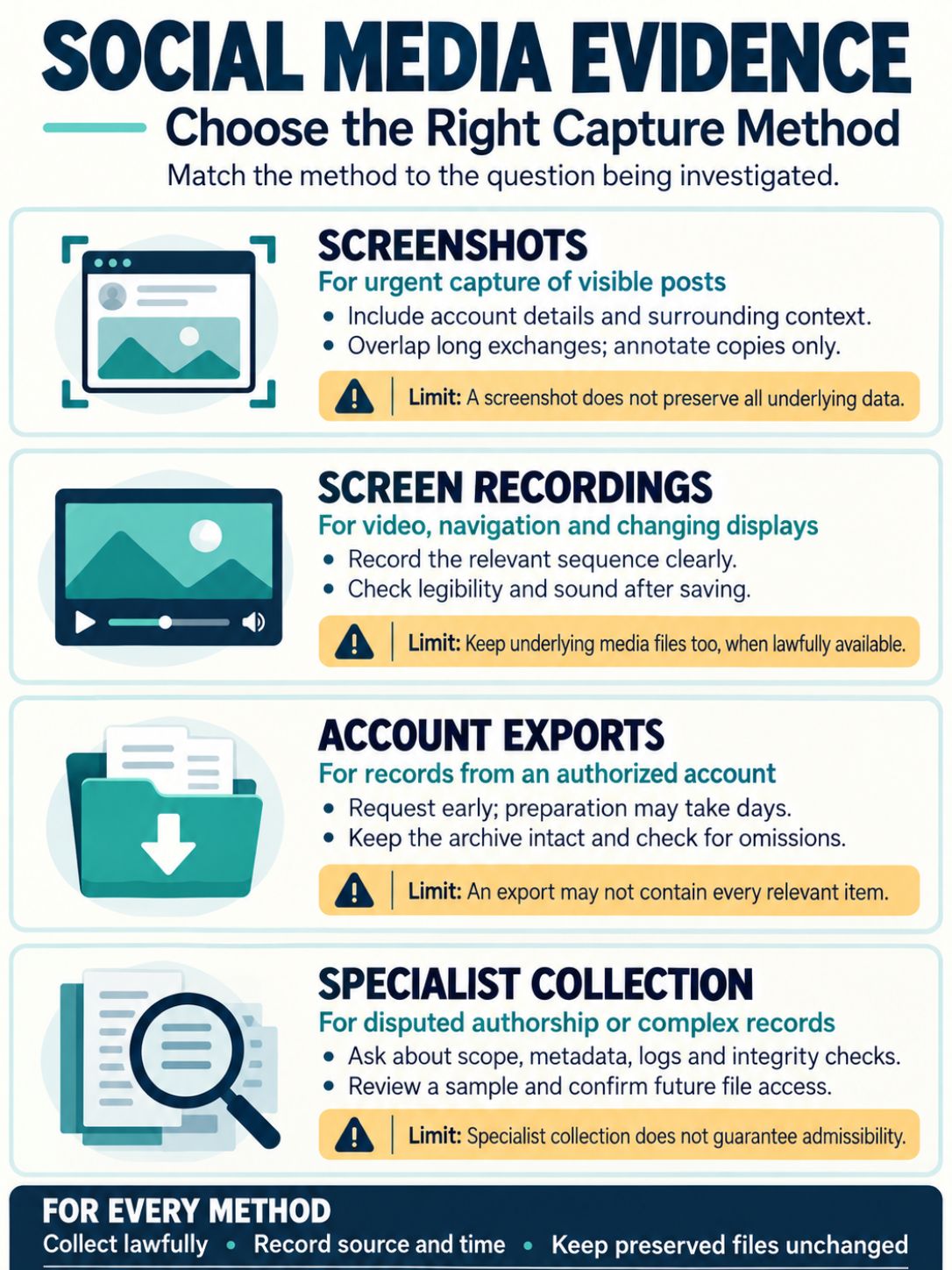
For a few visible posts at immediate risk of disappearing, screenshots are a practical starting point. For a long conversation or a dispute about account activity, plan for more. The method should answer the question being investigated, not merely produce an attractive PDF.
Start with screenshots, but understand their limits
Capture readable text with identifying details visible. For a long exchange, use overlapping images so a reviewer can follow the sequence. Keep the original screenshots; place highlights, arrows, or redactions on separate copies.
An image of “I agree” says little without the proposal above it. Where fuller collection is warranted, preserve the page’s underlying HTML where applicable and available, alongside a full-page capture and relevant media. Inspect the saved result: a page image alone does not preserve all underlying data.
Use recordings for content that needs to be seen in sequence
A screen recording can supplement still images when evidence involves video, changing displays, or several connected screens. Plan a short route through the relevant content and check the saved recording for legibility and sound.
Treat the recording as a record of what appeared during capture. It is not a substitute for the underlying media file where that file can lawfully be obtained.
Request account exports early
For an account you control, or one covered by appropriate authority, investigate its official export function. X’s current help documentation describes archives in HTML and JSON, with posts, direct messages, and attached media among the listed contents. Preparation may take several days. Request the export early, but capture urgent visible material while waiting.
Record the request date, selected options, and download date. Retain the delivered archive intact and inspect an extracted working copy.
Do not assume a completed download contains every relevant item. Compare it with known posts or messages and record omissions. An account export may be less complete than records obtained from the provider through legal process.
Use specialist collection when the gaps matter
Specialist help is worth considering when authorship is disputed, content is extensive, attachments are missing, or repeatable technical documentation is required.
Before commissioning work, ask:
- What exact content and metadata will be collected?
- Which material cannot be accessed or exported?
- What logs and integrity checks will accompany the files?
- Can the collector explain the method and its limitations?
Before paying for a large collection, request a sample output using non-sensitive material. Check that messages remain in order and attachments match their parent posts. Agree who retains the collection logs and whether the delivered files can be reviewed without an ongoing subscription to the collector’s software. These details matter more than the appearance of the report.
Capture the Exchange, Not Just the Useful Sentence
Suppose a supplier posts, “We received payment,” and later argues that it concerned another customer. Preserving the sentence alone leaves an avoidable ambiguity.
The direct post link, preceding question, relevant replies, and an attachment identifying the transaction could help resolve that ambiguity. If they do not, the collection report should leave the uncertainty visible.
For each important item, consider preserving:
- The full visible text, including expanded sections.
- The parent post or message being answered.
- Relevant replies and attached media.
- Available post or account identifiers.
- The collector’s access conditions, such as logged-in access.
- Any visible notice that material was edited or unavailable.
Record the capture tool and version, relevant settings, and any failed steps. A later reviewer needs to understand how the collection was produced.
Describe the collection as precisely as the evidence allows. “Captured the replies visible during collection” tells a reviewer something useful. “Captured every reply” makes a stronger claim that needs its own support.
Distinguish the event time, posting time, and collection time. Keep displayed timestamps and their known time zones. If a page shows only “2h,” record that label rather than inventing an exact posting time. Document any later conversion to UTC.
A downloaded file’s creation timestamp can reflect downloading or copying rather than the original content’s creation. Keep the timestamp as received and document its meaning before using it in a timeline.
Keep Preservation Copies Unchanged
Designate the first retained capture or received export as the preservation copy. Describe it accurately as a screenshot, exported archive, downloaded media file, or provider production. This avoids confusing the file as collected with the platform’s underlying records or the legal meaning of an “original.”
Review, transcribe, translate, and annotate working copies. Give each altered version a clear label and link it to the preserved source file.
A cryptographic hash, such as SHA-256, can be recalculated to check whether file contents match a recorded baseline. Generate hashes close to collection and protect the hash record against alteration. A file-content hash does not, by itself, verify external details such as its folder location or filesystem timestamps.
A matching hash cannot establish who wrote a post or whether a screenshot was manipulated before the baseline was created. It supports a narrower claim: the compared file contents match.
For practical organization, assign an evidence identifier such as SM-014. Connect its screenshot, downloaded attachment, source URL, and collection notes through that identifier. Avoid filenames that present an allegation as a finding, such as “proof of fraud.”
When converting a file for review, retain the collected version and document the conversion. A readable exhibit is useful, but it should remain traceable to the material from which it was made.
Build a Chain of Custody Someone Else Can Follow
Chain of custody is the record of who controlled or handled the evidence and what happened to it. Write entries as work occurs; a later reconstruction from memory leaves avoidable questions.
An entry should identify the item, person releasing it, person receiving it, date and time, purpose, and relevant verification. A transfer receipt saying only “files received” is weaker than one listing the delivered items.
For SM-014, for example, the log should show the named sender and recipient, the full transfer date and time zone, the purpose, the transfer method, and the result of any hash comparison. Identify whether the recipient received a working copy or took custody of the preserved file.
Record later conversions, transfers, and other significant handling. Keep review copies clearly distinguished from the preserved files.
Use controlled storage, restricted access, and a separate backup. Periodically check that files remain retrievable and integrity checks still match, and document significant storage migrations. Preservation continues for as long as the material must be retained.
Understand Holds, Platform Requests, and Deleted Material
There are two separate tasks here: preventing loss of relevant information under your control and seeking preservation of records held by a platform.
Within an organization, a hold should identify the people responsible for relevant information, the accounts involved, and applicable deletion or retention settings. Coordinate changes with the responsible legal and technical teams, and confirm implementation. Preserve relevant material even when it weakens your position; do not select only favorable exchanges.
In U.S. federal civil litigation, Rule 37(e) addresses certain losses of electronically stored information that should have been preserved for anticipated or ongoing litigation. The rule concerns loss caused by a failure to take reasonable preservation steps when the information cannot be restored or replaced through additional discovery. Measures to cure prejudice differ from its most severe listed sanctions, which require intent to deprive another party of the information’s use. Those requirements apply in the U.S. federal civil context; other jurisdictions have their own rules.
Platform preservation generally concerns retaining available records pending the appropriate legal process. It does not itself provide those records.
For example, X’s current law enforcement guidance describes preserving a temporary snapshot of relevant account records for 90 days pending valid legal process. This is a specific provider procedure for qualifying requests, not an assurance available to every private litigant. Check current requirements and any extension deadline.
If content becomes inaccessible, document the URL, collection attempt, and displayed error or notice. Unavailability alone does not establish that the account holder deleted it. Identify other lawful sources, such as a recipient’s retained conversation or an existing account export. Do not promise recovery: a request cannot guarantee that the provider still holds the material.
Prepare for Authentication and Legal Review
To preserve social media evidence effectively, prepare for questions beyond whether the files changed. Identify who can explain the collection and what connects the account to the alleged author. A displayed name alone does not resolve account control. Review the supporting dates and surrounding conversation, keeping observed facts separate from inferences.
In U.S. federal proceedings, Rule 901 requires sufficient evidence to support that an item is what its proponent claims. Rules 902(13) and 902(14) provide certification routes for certain electronic records and copied data, subject to their requirements, including notice. They do not make every social media export automatically admissible. Relevance, hearsay, and other objections remain separate questions.
Other courts may require different foundations, declarations, or procedures.
A useful handover package includes the retained captures, an item index, collection notes, available metadata, hash records, custody documentation, and clearly marked review copies. Add a short limitations statement covering missing content, failed exports, uncertain timestamps, and any transformations.
For example, write “The attachment was visible in the conversation but could not be downloaded.” An explicit gap gives the reviewer a chance to pursue another source; a silent omission does not.
Before delivery, ask a colleague unfamiliar with the collection to locate one item and trace it back to its source. Difficulty doing so often reveals an indexing or documentation problem worth fixing.
Final Thoughts
If you need to preserve social media evidence now, start with the relevant material you can lawfully capture and write down where, when, and how you collected it. Then identify the question that capture cannot answer: authorship, missing context, an unavailable attachment, or the completeness of the record.
Use that gap to decide the next step. Request an authorized account export, arrange specialist collection, or seek the appropriate legal process. The useful result is a record another person can examine and understand without having to take the collector’s word for what happened.
Frequently Asked Questions
Is bookmarking a post enough to preserve it as evidence?
No. A bookmark helps you return to a location; it does not preserve the content as it appeared. Keep the direct URL, but also capture the relevant material and record when you collected it. If the page later changes or becomes unavailable, the bookmark alone will not show its earlier contents.
How should evidence in another language be handled?
Retain the content in its original language and keep any translation as a separate, clearly labelled working document. Record who or what produced the translation and link it to the source item. Where wording is disputed, arrange appropriate language review rather than relying solely on an automated translation. Check the receiving court’s requirements before submitting it.
What if a post changes after it has been captured?
Make a new, dated capture and retain the earlier version. Record the differences you can observe, such as altered wording or a missing attachment. Do not overwrite the first capture or assume you know who made the change. Each version should remain linked to its own collection notes.
There is no single retention period for every dispute. Applicable law, court directions, preservation obligations, and organizational policies determine the relevant requirements. Appeals may also affect how long material is needed. Confirm that retention obligations have ended before authorizing deletion; closing an internal case file is not, by itself, a reliable disposal trigger.