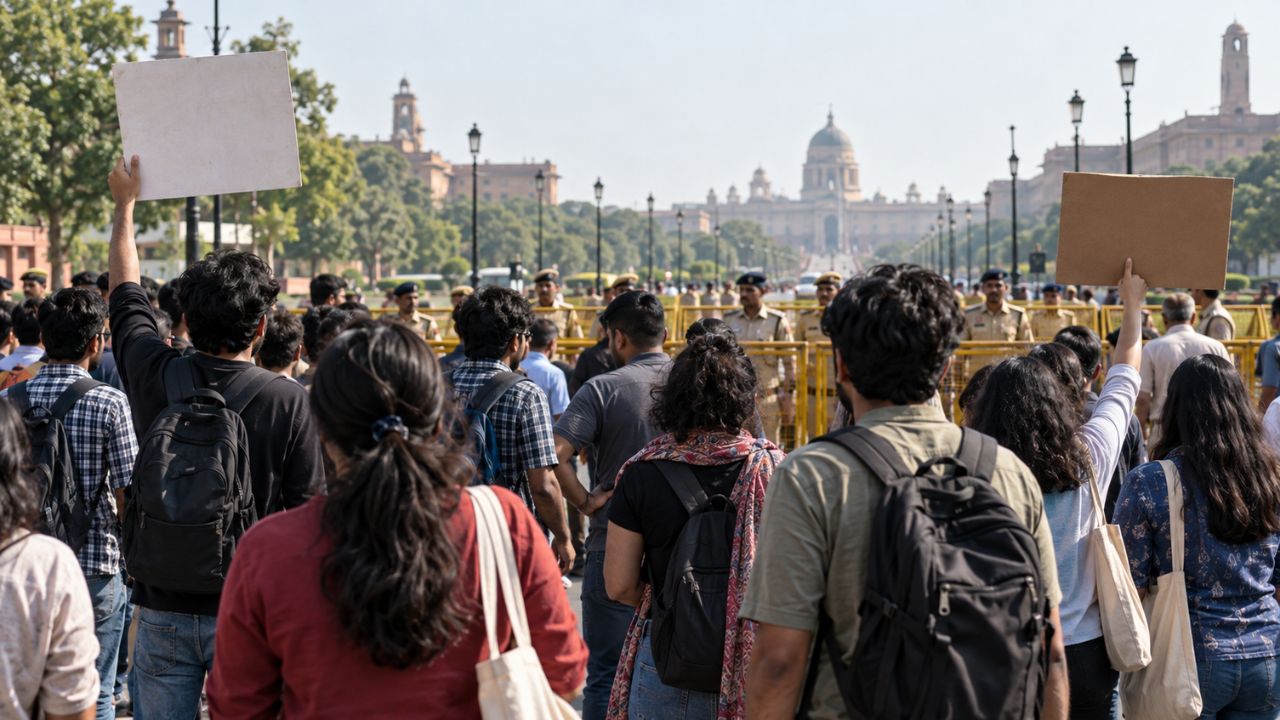
India’s youth protest movement has shifted from a disputed medical entrance exam to the rules that determine who can vote. The argument now turns on whether the Election Commission can demonstrate that its voter roll revision is accurate, fair, and open to correction.
India student protests in 2026 began with anger over a leaked medical entrance exam. This month, students and other young demonstrators have joined a much larger dispute over electoral rolls. In New Delhi, they have demanded the resignation of Chief Election Commissioner Gyanesh Kumar and a halt to the Special Intensive Revision, or SIR, of voter lists.
The two issues may seem far apart. For many protesters, they raise a similar concern: what happens when an institution controlling a consequential opportunity gets the process wrong? An exam can determine who enters medical school. An electoral roll determines who can cast a ballot. A voter identification card alone cannot make up for a missing name: the Election Commission says a person can vote only if their name appears on the roll.
That does not settle the central allegation of the current protests. Opposition leaders say the revision could exclude eligible voters and benefit the ruling Bharatiya Janata Party (BJP). The Election Commission denies favouring any party and says it is removing outdated and duplicate entries. The available figures establish the scale of the revision, but they do not establish a nationwide partisan pattern of wrongful exclusion. That is why the demands for an audit, accessible records and effective remedies matter.
How did an exam protest become a voter roll protest?
The youth movement at the centre of the demonstrations calls itself the Cockroach Janta Party, or CJP. Despite its name, it began as a satirical online campaign rather than an established electoral party.
Its founder, Abhijeet Dipke, said the name was a response to remarks by Chief Justice Surya Kant that he interpreted as comparing unemployed young people to cockroaches. Kant later clarified that he was referring to people with fake or bogus degrees, not unemployed youth generally. The joke found an audience among young Indians frustrated by unemployment and recurring exam paper leaks.
A leak in the May 2026 National Eligibility cum Entrance Test, the medical entrance exam known as NEET, gave that frustration an immediate focus. The exam taken by about two million students was cancelled and held again in June. After weeks of protests demanding accountability, Education Minister Dharmendra Pradhan resigned on 25 July. Protest organizers also sought support for families affected by the crisis and action over allegations of police mistreatment.
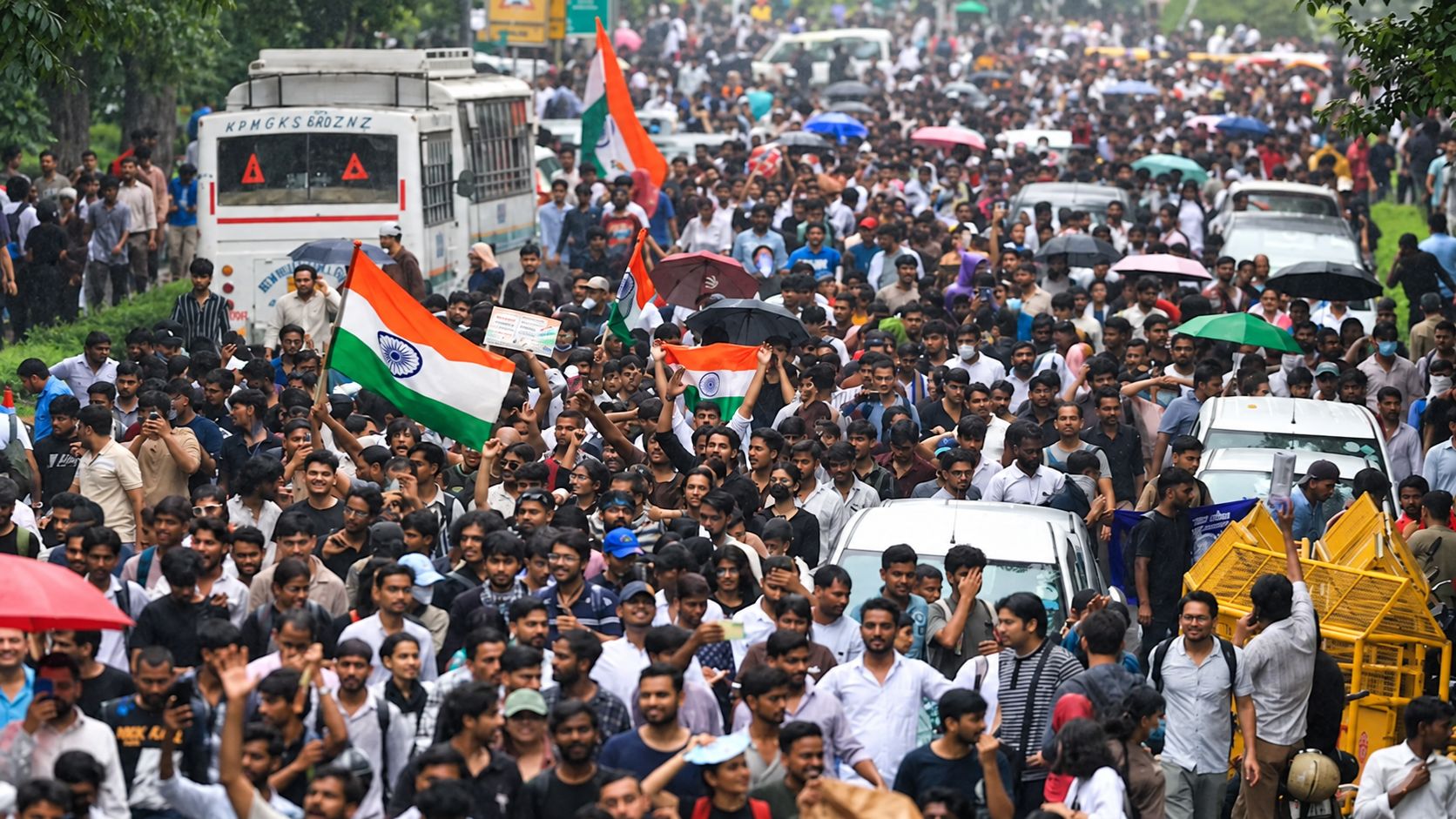
The October demonstrations concern a different institution and a different set of decisions. Still, the earlier campaign gave CJP an audience and experience organising beyond social media. Student organisations, including the All India Students’ Association and the Students’ Federation of India, have joined the voter roll protests. Their participation is visible beyond Delhi: students at Panjab University marched against the SIR in Chandigarh on 12 October.
This is not one uniform student movement with one set of politics. CJP organizers, campus groups and opposition parties overlap in the streets, but their demands and reasons for taking part are not identical.
Read about Nepal’s Gen Z protest here.
What is the Special Intensive Revision?
The SIR is the Election Commission’s extensive review of electoral rolls. It began in Bihar in 2025 and expanded to other states and Union Territories. Election staff checked existing entries, sought forms and supporting information from voters, and classified people who appeared to have died, moved, become untraceable, or been listed more than once.
The Commission argues that accurate rolls protect elections too. Keeping a deceased person or a duplicate entry on a list creates its own integrity problem. Few critics dispute the need to update voter records. The dispute is over how people are classified, whether they receive adequate notice, and how readily an eligible voter can correct an error.
Those details have immediate consequences. A person temporarily away from home may be difficult to find during a visit. Someone whose details do not match an older roll may need to provide further documents. If a name is left off, that person must learn about the omission and complete the required steps in time to regain their place on the list.
What do the figures show, and what do they leave unanswered?
By September, approximately 13.37 crore names had been left out of draft rolls across the revision’s phases, according to figures compiled from Election Commission data. The Commission subsequently said approximately 13.39 crore electors had been classified as absent or untraceable, permanently shifted, deceased, duplicate, or in other categories.
Those are enormous numbers, but a draft omission is not proof that every person was eligible or permanently denied a vote. Some entries represent deaths, duplicate registrations, or genuine moves. Conversely, putting a name in one of those categories does not, by itself, prove that every classification was correct.
Punjab’s final roll, published on 12 October, shows why the stages must be kept distinct. Its draft listed about 1.94 crore voters. The final list rose to 2.01 crore, while remaining about 13.6 lakh below the count before the revision. The increase between draft and final includes new enrolments as well as other changes; it cannot simply be read as the number of previously omitted voters restored.
A smaller case in Goa illustrates the concern behind the national totals. An investigation by The Indian Express identified 97 people left off a final roll despite local efforts to address their cases. The Election Commission later said 81 of the 97 had submitted Form 6 applications for inclusion. Submission is an available remedy, but it is not the same as confirmation that a name has been restored.
The question is therefore more precise than whether 13 crore voters “lost their votes.” It is how many eligible people were wrongly left out, how they were informed, how many regained their places, and whether the remaining cases can be resolved before voting.
Read about the Madagascar Gen Z protest here.
What safeguards does the Election Commission offer?
The Commission says affected voters can file claims and objections during the revision and seek enrolment through Form 6. It has directed officials to help people whose names were left out, including through home visits and special enrolment efforts. Lists of people classified as absent, shifted, dead, or duplicate have been made available locally and shared with political parties’ booth-level representatives.
Those steps are significant. A draft roll is intended to allow corrections, and Punjab’s higher final count demonstrates that the list can change. The Commission has also announced a review of its ECINet software involving an independent technical expert.
The test is whether the safeguards work for the person affected. Were they told why their name was missing? Could they see the relevant record? Did an official with the proper authority consider their documents? Was a decision made soon enough to matter? Aggregate figures cannot answer those questions on their own.
Why are the Election Commission’s internal decisions under scrutiny?
The protests gained another focus after The Indian Express reported that Election Commissioners Sukhbir Singh Sandhu and Vivek Joshi had recorded at least 14 objections over ten months concerning voter registration, deletions, digital systems and how decisions were made. The Election Commission has said differences of view are normal in deliberations and that its decisions were unanimous. It has also announced measures for circulating meeting agendas in advance and issuing minutes.
The legal framework makes the dispute consequential. Under the 2023 law governing the Commission, its business should be conducted unanimously as far as possible; when commissioners differ, a majority decides. That is why opposition petitioners have asked to examine agendas, minutes, internal notes and files rather than rely on competing public accounts.
Reported objections warrant scrutiny. They are not, by themselves, a judicial finding that Kumar acted unlawfully or that voter records were manipulated. The documents, the software review and any judicial examination will be more useful than slogans for establishing what happened.
Read about the East Timor student protest here.
What are the protesters demanding?
CJP leaders and participating student groups have called for Kumar’s resignation, a pause in the SIR and an independent inquiry. Some organizers have gone further, seeking criminal proceedings, restoration of an earlier voter list and changes to the way election commissioners are appointed. CJP representatives have said their campaign would continue even if Kumar resigned, because they view the problem as institutional.
Opposition parties have pursued a related but distinct route through the Supreme Court. Their petition seeks an independent audit of roll deletions and changes, booth-level information on removals, notice and a hearing before an eligible voter is removed, access to Commission records, and an interim suspension of the continuing revision.
The petition does not ask the Court to reopen its decision that the Commission has the power to conduct an SIR. It challenges decisions and safeguards in its implementation. That distinction matters: the legality of conducting a revision and the fairness of each step within it are separate questions.
Read about the Ladakh Gen Z protest here.
How have police responded to the demonstrations?
Delhi authorities refused permission for CJP’s planned 10 October gathering at Jantar Mantar, citing procedural and public order concerns. Police detained more than 2,000 people during the weekend’s restrictions, including movement leaders; many were later released. On 12 October, thousands of opposition supporters and students marched through Delhi toward the Supreme Court, where opposition leaders filed their petition. That march took place amid heavy security and transport restrictions.
The handling of protesters and reporters has become part of the story. Journalists covering the demonstrations were detained for hours, including a Reuters reporter. Several detainees have alleged police assaults; medical records reviewed by The Indian Express document injuries in some cases. The records establish the injuries, not who caused each one. A senior police official said no formal complaint about those allegations had been received and that action would follow if one was filed.
Police have a responsibility to manage public safety during a large gathering. Their restrictions and treatment of detainees also require scrutiny. A protest over public confidence in an institution cannot be fully understood without examining how people were allowed to demonstrate and report on it.
What has the Supreme Court decided so far?
In May, the Supreme Court upheld the Bihar SIR, finding that the Election Commission had the authority to carry out that revision. That ruling should not be described as a judgment approving every later operational decision across the country.
A separate dispute concerns a modified Form 6 used during the revision. On 12 October, the Court clarified that it had neither approved nor disapproved that modification. Related petitions are listed for 27 October.
The opposition’s newly filed petition had not received a hearing as of the morning of 13 October. The Supreme Court registry had flagged 14 filing defects, including missing documents and authorisations and a shortfall in court fees. Those are procedural objections, not a ruling for or against the petition’s claims.
India Student Protests: What is at stake now?
The BJP argues that opposition parties are discrediting a legitimate effort to clean up voter lists for political gain. Opposition leaders argue that the scale of omissions and questions about the Commission’s process demand independent scrutiny. Neither political argument can replace a check of individual records and decisions.
For the youth movement, there is a second test. CJP’s rapid rise online and its role in the NEET campaign showed its ability to gather attention. Sustaining a campaign over electoral administration will require organizers to help people check their status, document errors and pursue corrections, work less visible than a major rally but directly relevant to the issue they have raised.
For the Election Commission, the strongest response will be evidence the public can examine: clear reasons for removals, reliable counts of successful claims, accessible local records and the findings of its software review. For the courts, the pending questions concern both the Commission’s internal decision-making and the remedies available to voters.
The next meaningful measure of this controversy is not the size of a march or a single national deletion figure. It is whether eligible people missing from the rolls are identified, heard, and restored in time, and whether the process can be shown to have treated them fairly.