
AI credit scoring uses artificial intelligence or machine learning to help lenders assess loan applications and estimate the likelihood of repayment. It may analyze credit history, application details, and other financial information the lender is allowed to use.
The model can flag risk or suggest loan terms, but it does not always make the final decision; lenders may also apply affordability checks, their own rules, or human review.
For borrowers, the key questions are practical: What information was used? Is it accurate? How can you challenge an error or find out why an application was rejected? The answers depend on the lender and country, since data practices and borrower protections vary. Before assuming every automated decision follows the same process, ask the lender what shaped its assessment and check the consumer-credit rules that apply where you live.
What AI Credit Scoring Means
Credit scoring estimates how likely a borrower is to repay debt. Traditional scores often draw on details such as payment history, debt balances, and the length of a person’s credit history. Lenders may use a credit bureau score, their own model, or both.
An AI or machine learning model looks for patterns in data that may be associated with repayment. It might estimate risk, flag an application for review, or help determine loan terms. It does not necessarily make the final decision.
“AI” covers different techniques. Some models are easier to interpret than others. The label alone does not tell you how much of a lending decision was automated, or whether the process was more accurate or fair.
How the Process Typically Works
The details vary by lender, but an assessment may include these steps:
- Information is collected. This may include application details, credit reports, and information the borrower provides.
- The data is checked. A system may flag missing details, mismatches, unusual activity, or possible fraud.
- A model estimates risk. It compares the application with patterns in available data and produces a score or recommendation.
- The lender applies its criteria. These may include affordability, income, loan size, and product requirements.
- The lender makes a decision. It may approve, reject, change the amount or terms, or request more information. Some applications may receive additional review.
These stages can use separate systems. A fraud alert is different from an assessment of whether a borrower can afford repayments. A favorable model result does not guarantee approval if the application fails another requirement.
What Data Might a Model Consider?
Inputs vary by lender, product, and country. A model may use information in a credit report, such as payment history, debt balances, and account age. It may also consider application details, including income or employment information.
Some lenders explore alternative data—information outside conventional credit files. Depending on the lender and local rules, this could include cash-flow information from a bank account or records of regular payments. That information might help assess someone with a thin credit file, but it can also reveal sensitive details about their finances.
Do not assume what a lender uses based only on an “AI-powered” claim. Ask what data it considers, where it comes from, whether sharing it is optional, and how to correct errors. If you agree to connect an account, read the permission terms before authorizing access.
Why Lenders Use These Systems
AI models can process large volumes of information and may identify patterns that simpler methods miss. For applicants with little conventional credit history, alternative data may give a lender more information to consider.
The CFPB has described wider credit access as a possible benefit of alternative data. It has also noted that new variables can create discrimination risks when they are closely related to legally protected characteristics. These are potential outcomes, not guarantees about what any one lender’s system will do.
More data does not automatically mean a better decision. The information must be accurate and relevant, and lenders still need to examine how their systems affect applicants.
Where AI Credit Scoring Can Go Wrong
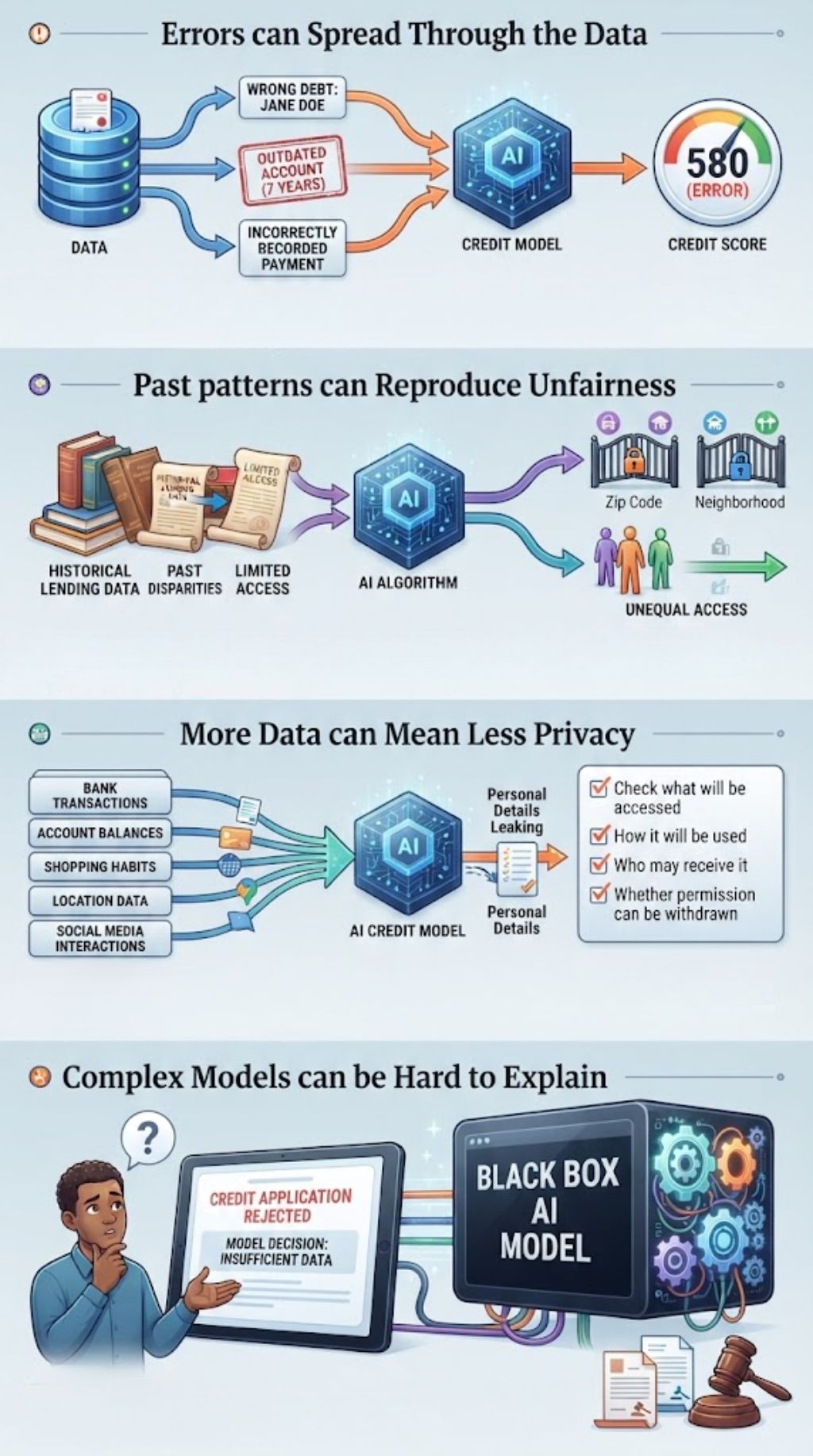
Errors can Spread Through the Data
A model may process a debt that belongs to someone else, an outdated account, or a payment recorded incorrectly. Its output can look precise while reflecting bad information.
Past patterns can Reproduce Unfairness
Models learn from historical data. If that data reflects unequal access to credit or other disparities, a model may repeat those patterns. Removing a protected characteristic does not necessarily prevent this; other variables may be related to it.
More Data can Mean Less Privacy
Bank account information may help describe a borrower’s finances, but it can reveal more than the borrower expects. Before connecting an account, check what will be accessed, how it will be used, who may receive it, and whether permission can be withdrawn.
Complex Models can be Hard to Explain
A short rejection notice may not show every detail of how a model worked. Still, the reasons provided should meet the requirements that apply where the borrower lives. Those requirements differ by jurisdiction.
What Borrowers Can Do Before and After Applying
A few checks can help determine whether a lender uses AI, a traditional score, or both:
- Review your credit records: Check account details, balances, payment history, and personal information. Use the reporting provider’s dispute process if something is wrong.
- Read data permissions carefully: If an application requests bank account access, find out what information will be shared and for how long.
- Keep a record of the application: Save the lender’s name, application date, consent terms, and decision notice.
- Read the reasons for a rejection: Look for the main reasons and instructions for requesting more information.
- Compare the full loan cost: Check the interest rate, fees, repayment schedule, and total amount due. Approval alone does not show whether a loan is affordable.
If an AI credit scoring decision seems to rely on wrong information, identify the bureau or data provider that supplied it and use its correction process. You can also ask the lender whether it accepts additional documents or offers a review.
Borrower Rights Depend on Where You Live
There is no single worldwide rulebook for credit decisions made with AI. Rights to access data, challenge a credit report, or receive an explanation vary by country and sometimes by product.
In the United States, Regulation B requires creditors to give applicants specific reasons—or information on how to obtain them—when taking adverse action. The reasons must accurately relate to factors the creditor actually considered. If a credit report contributed to a denial, additional Fair Credit Reporting Act notices may apply. These can include the score used, key factors affecting it, the reporting company’s contact information, and information about obtaining a free report within 60 days.
In the European Union, the AI Act classifies systems used to evaluate a person’s creditworthiness or establish their credit score as a high-risk use, except systems used to detect financial fraud. The relevant Annex III rules are scheduled to apply from December 2, 2027.
Check your local financial or consumer-protection regulator for the rules and complaint channels available where you live.
Questions to Ask a Lender
If you want to understand how an application was assessed, ask:
- Did you use a credit bureau report or score?
- Did you use information from my bank account or another data provider?
- Which information mainly affected the decision?
- How can I correct information that appears wrong?
- Can I request a review or provide additional documents?
- What complaint process applies in my country?
A lender may not disclose the full design of a proprietary model. You can still ask what information affected the decision and how to challenge inaccurate data.
Final Thoughts
AI credit scoring may help lenders assess applications and could give some people with limited credit histories another way to be evaluated. It can also magnify bad data or make decisions harder to understand.
Start by checking your records and reading the decision notice. If information is wrong, challenge it with the provider. If the terms are unclear, ask the lender to explain them before accepting an offer.
Frequently Asked Questions (FAQs) About AI Credit Scoring
Does AI replace a traditional credit score?
Not necessarily. A lender may use a bureau score, an AI model, both, or other underwriting rules. The phrase describes no single universal system.
Can it help someone with no credit history?
It may help if a lender uses relevant information beyond a conventional credit file. It does not guarantee approval.
Can I ask why a lender rejected my application?
In some places, lenders must provide reasons or explain how to request them. Read the notice and check the rules where you live.
First check what the lender will access, how it will use the information, and whether sharing is optional. Ask for clarification before granting access if anything is unclear.