Co-play vs independent play is a question of what a child needs in the moment. When an adult joins, they can offer a new word, a useful clue, or comfort when something feels hard. When the adult steps back, the child gets room to make choices, test ideas, and try again. Both can support learning. The skill for parents is noticing when their involvement helps and when the child is ready to carry on.
I have watched that shift with my nephew Fariz. When he began using letter activities at around three, he recognized uppercase letters but needed help with much of what came next. Over time, he could use familiar activities independently and began recognizing lowercase letters and letter sounds. Seeing that change made me pay closer attention to the adult’s role in play: sometimes joining opens a door; sometimes leaving space lets a child walk through it.
What is the difference between co-play and independent play?
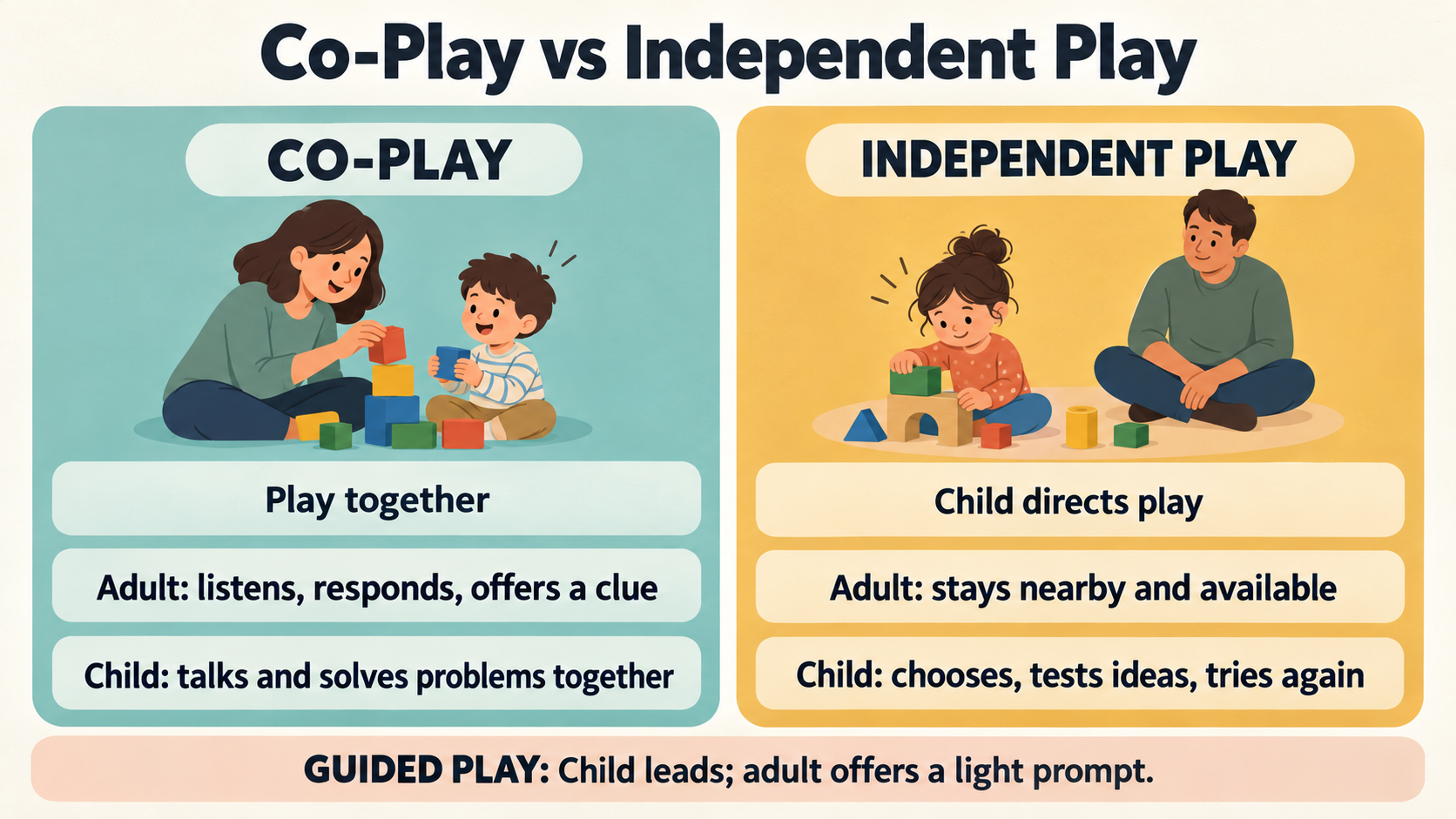
Co-play: It means an adult and child take part in an activity together. They might build a tower, make up a story, look through a book, or explore a game. The adult responds to the child and may add an idea, but the exchange still feels like play.
Independent play: It means the child carries the activity without an adult actively directing it. A parent may be nearby and available. The child decides what to make, which role to pretend to be, or how to solve a problem.
| During play | The adult’s role | What the child gets to practice |
| Co-play | Join, listen, respond, and offer help when useful | Conversation, shared attention, new ideas, and asking for help |
| Independent play | Provide a suitable space, stay available, and let the child lead | Choosing, experimenting, concentrating, and working through small setbacks |
There is also guided play, which often happens during co-play. The child keeps the lead while the adult offers a light prompt or sets out materials with a learning goal in mind. If a child is arranging blocks, for example, an adult might ask what could make a bridge steadier. The child still decides what to build and what to try.
These terms describe different aspects of an activity. A child can lead while playing with an adult, and free play can happen with friends rather than alone. Independent play does not mean leaving a young child without appropriate supervision. The National Association for the Education of Young Children describes play along a continuum from child-directed exploration to adult instruction, with guided play between them.
What does a child gain when a parent joins in?
A responsive adult can help a child notice something they might have missed. A conversation over a picture book can give a name to an unfamiliar object. Playing with toy animals can turn into talk about where they live or what they need. If a child’s plan falls apart, an adult can help them pause and think of another way.
The exchange matters more than the number of questions asked. Harvard’s Center on the Developing Child describes the value of “serve and return”: a young child makes a sound, gesture, or comment, and a caring adult responds. That back-and-forth helps support early language and social development. In play, it can be as simple as listening to a child’s idea and building on it.
There is research on how that help may carry forward. In a 2026 study, 72 parents and their children, ages three to six, explored unfamiliar toys together. Parents’ questions and guidance as children tested how the toys worked were associated with better learning, including during a later period when the children explored different toys independently. The sessions were brief and took place in a lab, so they do not prescribe how every family should play at home. They do show why the kind of help an adult gives deserves attention.
I find it useful to think of co-play as a conversation with the child’s activity. If they have turned a cardboard box into a bus, I can ask where it is going. I do not need to take over as the driver or turn the game into a lesson about vehicles.
Why does independent play matter for learning?
When children direct play, they make decisions that an adult might otherwise make for them. They choose which piece fits, change the rules of a pretend game, or discover that their first idea did not work. That time gives them a chance to stay with a problem before someone supplies the answer.
A longitudinal Australian study followed 2,213 children and found that more time in unstructured quiet play during the toddler and preschool years was associated with stronger self-regulation later. The study examined free play, which is not necessarily solitary play, and an association cannot show that play alone caused the later difference. It does, however, support making room for child-directed activity in a busy day.
Adult instruction has its place, particularly when a child needs to learn how something works or how to use it safely. Yet showing every solution can narrow what a child explores. In a study using an unfamiliar toy, preschoolers who received direct instruction about one function spent less time discovering its other functions than children in comparison conditions. That finding comes from a specific toy experiment, but it captures a familiar possibility: once I demonstrate “the right way,” a child may stop looking for other ways.
Independent play also gives adults a chance to observe. A child who repeats the same building attempt may be working through an idea, even if the result looks unchanged to me. If I wait a little, I can better judge whether they need help.
Guided play offers a useful middle ground
Parents do not have to choose between directing every move and saying nothing. Guided play keeps the child’s choices at the center while an adult adds a little support.
Imagine a child making a road for toy cars. An adult could place a few blocks nearby, wonder aloud how a car might cross a gap, and then watch what the child does. The adult has offered a problem and some language without building the road for them.
A 2022 systematic review examined 39 studies of guided play; 17 contributed to its combined analyses. Compared with direct instruction, guided play showed advantages on some measures of early math, shape knowledge, and task switching. Compared with free play, it showed an advantage on a measure of spatial vocabulary. The researchers did not find a clear advantage across every outcome they examined, including several literacy and social measures. The useful lesson for home is modest: a well-timed hint can support a particular goal while preserving a child’s chance to explore.
When should a parent join, help, or step back?
I would look at the child before looking at the clock. Their invitation, frustration, and attention offer better clues than a fixed rule about how much co-play is enough.
| What you notice | A useful response |
| The child invites you into a game or wants to show you something | Join and follow their idea. Let them assign you a role if they want to. |
| A new activity is confusing from the start | Show one step or explain the rule briefly, then give the activity back. |
| The child is struggling but still trying different approaches | Allow a little time. If needed, offer a small clue instead of completing it. |
| The child is absorbed and making choices | Stay available and let the play continue. |
| Frustration has become distress, or the activity is unsafe | Step in directly, offer comfort, and make the situation safe. |
Stepping back is a decision about direction, not safety. A young child still needs an age-appropriate space and supervision. The more an activity involves hazards, the less sense it makes to treat “independence” as physical distance.
Sometimes I might join briefly and then leave the child to continue. At other times, a child wants company throughout. A parent can respond to both without measuring the success of play by how long the child stays alone.
How does this change as children grow?
Babies and young toddlers rely heavily on responsive interaction. Their exploration may look simple to an adult, but a shared smile, a repeated sound, or a game of hiding and finding an object gives them someone to respond to. They can also have short moments to explore suitable objects while a caregiver remains close.
As toddlers grow, familiar materials can offer more chances to choose and repeat an activity. Playing beside another child is part of social development too. The CDC lists playing next to other children, and sometimes with them, among its milestones by 30 months. By three, many children notice others and join their play. By four, pretend roles and seeking out playmates become more prominent in its milestone guidance. These are broad markers, not a schedule that every child must follow on the same day.
For preschoolers, I would offer materials that can be used in more than one way: blocks, drawing supplies, dress-up items, or objects for sorting and pretending. A child who is new to an activity may want me beside them. The same child may later wave me away because they have a plan.
Temperament, familiarity, and the day itself matter. A child who usually plays independently may want more company when tired or unsettled. There is no useful daily target for “minutes of independent play” that fits every child. If a child loses skills they previously had or you have a broader developmental concern, the CDC advises raising it with a healthcare professional.
Does the same approach work with learning apps?
An app adds a twist. A child may operate it independently, but the choices available are still set by its design. Adult involvement can help connect an activity on the screen to something the child understands elsewhere.
Disclosure: Alphabet Magic Trace & Phonics and 123 Magic Number Fun: Math Kid were built by our team at Editorialge. I mention them because I have observed children using them, not as proof that either app produces a particular learning outcome.
My nephew Fariz began using Alphabet Magic Trace at around three. At first, he recognized uppercase letters and needed help with the activities. Over roughly a year and a half, I saw him become more independent with the app. I also saw him distinguish uppercase and lowercase letters, work with letter sounds and tracing, and recognize letters in books outside the app.
That last observation mattered to me because the letters were no longer confined to a game. He was also learning through books, toys, preschool, and growing older; I cannot assign that progress to one app. Alphabet Magic’s current listing describes uppercase and lowercase tracing, letter matching, sounds, and spelling activities.
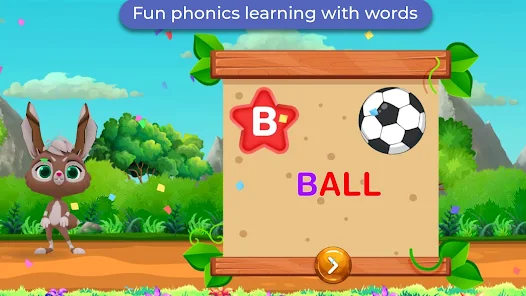
I have also observed about a dozen children, mostly ages three and four, using our learning apps over roughly six months, some for longer. Many needed help at first and later managed familiar activities on their own. I noticed progress with letters among some of them, including recognition in books. These were informal observations, with other learning experiences happening alongside app use.
I have tried the number tracing, matching, counting, and puzzle activities in 123 Magic Number Fun. Its current Google Play listing also says it contains ads and in-app purchases, which parents should check before giving a child access.
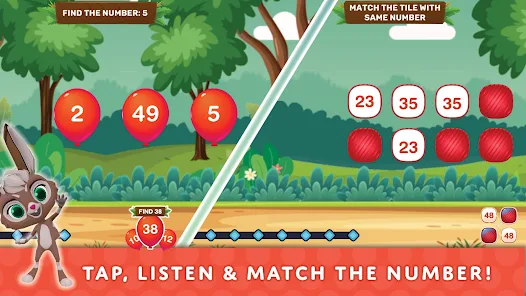
My practical approach is to learn an app with the child when it is new, talk about an activity if there is something worth discussing, and let them try familiar parts themselves. Then I look for a related opportunity away from the screen.
How can you tell whether learning carries beyond play?
A correct answer during a game tells me what a child did in that game. I become more interested when the idea appears in another setting.
A child might spot a letter in a book, count actual toys while putting them away, use a new word in pretend play, or explain how they made a structure stand. Those moments can arise naturally. They do not need to become a test after every activity.
If a child can complete a game but has trouble recognizing the same idea elsewhere, I would spend time with real objects, conversation, or a shared book. Co-play can help make the connection; independent play gives the child another chance to use it in their own way.
Stay Close, Then Let Them Lead
Watching Fariz, I paid attention to two changes: he needed less help with familiar activities, and he began noticing letters in books. Those changes remind me to stay curious about what a child is doing. I can join when my presence gives them something useful, then make room for the choices they are ready to make themselves.
Frequently Asked Questions on Co-Play vs Independent Play
1. Is independent play the same as playing alone?
Not always. A child may direct their own activity while a parent is nearby, or take part in free play with other children. “Independent” describes how much an adult directs the activity. It does not mean a young child must be left unsupervised.
2. How long should a toddler play independently?
There is no single duration to aim for. Start with a familiar, suitable activity and remain available. Pay attention to whether the child is engaged or needs support, rather than treating a set number of minutes as a developmental test.
3. Should I help as soon as my child gets frustrated?
Pause long enough to see whether they are still trying. If they are experimenting, a little space may help. If frustration is building or they ask for help, offer a clue, do one step together, or take a break.
4. Does co-play mean I have to teach throughout the game?
No. Listening, taking a pretend role, or responding to an idea all count. A useful comment or question can enrich play; a steady stream of instructions can make it harder for a child to follow their own plan.
5. Can an educational app replace hands-on independent play?
An app can offer practice with a particular activity, and a child may learn to use parts of it independently. Hands-on play offers different choices: moving objects, inventing rules, and changing course freely. I would make room for both when screens are part of family life and watch what the child can do beyond the app.