Modern workplace productivity trends are moving away from adding extra apps and toward fixing broken systems. Most teams struggle with fragmented priorities, endless meetings, and scattered info—not a lack of effort.
True efficiency comes from changing how work gets done: streamlining workflows, protecting focus time, recording decisions clearly, and adopting smart AI integrations and hybrid setups. By supporting employee well-being and eliminating daily friction before rolling out complex technology, organizations build sustainable, high-performing environments.
What Most Productivity Lists Get Wrong
Productivity is often treated as a personal habit when the larger problem belongs to the organization. A time-management course cannot repair a six-step approval chain, and a flexible schedule will disappoint if every decision requires a live meeting.
Before adopting any trend, name the constraint. Is work waiting for approval? Are people starting too many projects? Is essential knowledge hard to find? The answer should determine the intervention and the metric used to judge it.
10 Workplace Productivity Trends Worth Watching
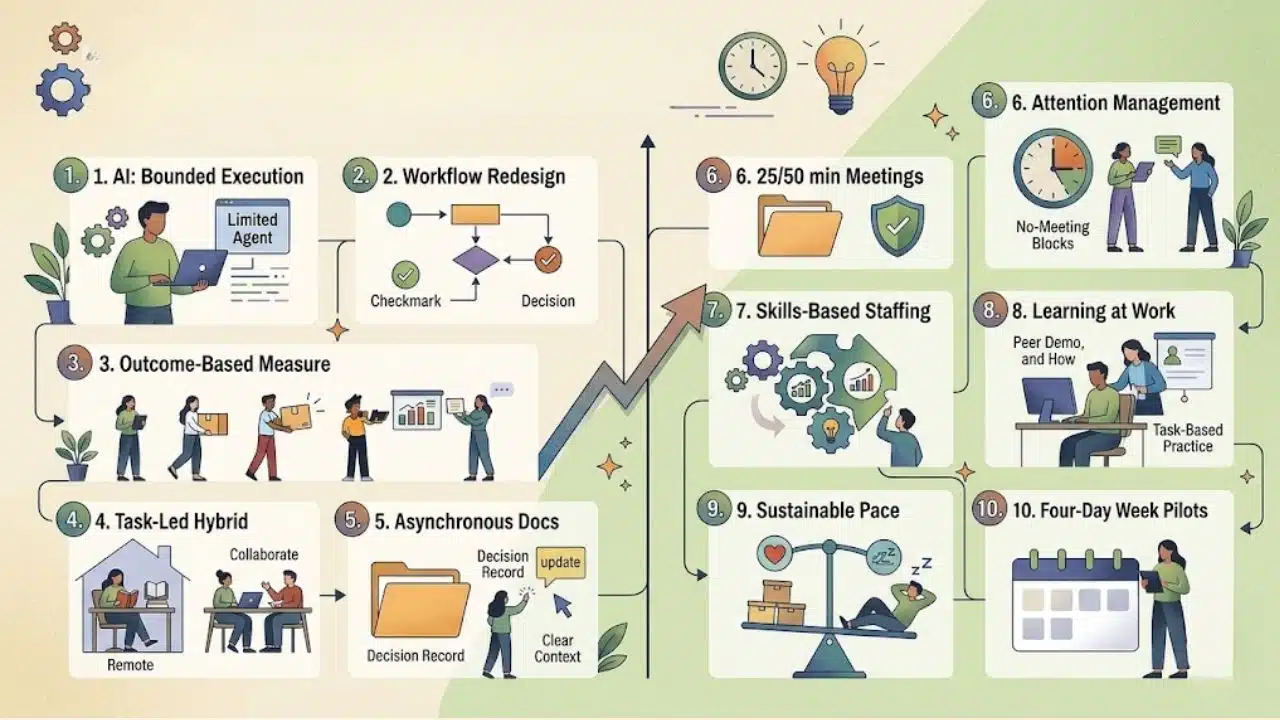
These workplace productivity trends matter because they address how work is planned, measured, documented, and improved. Some can help almost any team; others require careful testing. The following ten shifts are ordered by practical reach, organizational impact, and implementation difficulty.
1. AI Is Moving From Assistance to Bounded Execution
Generative AI use often starts with drafting, summaries, and search. Agents go further: they gather approved inputs, update records, prepare routine reports, or route exceptions. Microsoft reported 15-fold year-over-year growth in active agents within Microsoft 365 through March 2026. That signals movement within one large platform, not a market-wide adoption rate.
Start with a repetitive process whose outcome is reversible. Give the agent limited permissions, approved data sources, a quality threshold, and a named human owner. Hiring, financial, legal, security, and customer commitments need tighter control. Without ownership, automation simply lets an error travel farther.
2. Workflow Redesign Matters More Than Individual AI Use
Among workplace productivity trends, workflow redesign best tests whether an AI investment is useful or merely fashionable. A product brief may be drafted in minutes and still wait through four approvals and two status meetings. Mapping the process exposes the real delay.
Decide where AI may retrieve, classify, draft, or check; where a person must decide; and how uncertain cases are escalated. Measure cycle time, errors, rework, and quality. Prompt counts and purchased licenses reveal little about improvement.
3. Outcomes Are Gaining Ground Over Visible Activity
Hybrid work exposed an old management weakness: visibility is not contribution. Keystrokes, status lights, message counts, and hours online are easy to collect but poor substitutes for useful work delivered well.
Measures should fit the role. A support team might examine resolution quality and repeat contacts; a product team may care about adoption, defects, and delivery predictability. Do not force one score across unlike jobs.
Monitoring creates legal and practical friction. Requirements vary by jurisdiction. Before deploying intrusive software, obtain local guidance and explain what is collected, why, how long it is retained, and whether it affects pay or performance decisions.
4. Hybrid Work Is Becoming Task-Led
The useful question is which setting suits the task. Shared days can support planning, mentoring, difficult conversations, and workshops. Remote days can protect analysis, writing, and production time.
A six-month randomized trial involving 1,612 graduate employees at Trip.com in Shanghai tested two home-working days per week. Researchers found no evidence of harm to performance grades or promotion rates, while quit rates fell by one-third. The finding is meaningful but narrow: one company, particular professional roles, and a structured schedule. It does not settle the question for factories, laboratories, frontline services, or fully remote organizations.
Predictability matters. Employees should know when the team gathers and what that time should accomplish.
5. Asynchronous Documentation Is Becoming Operational Infrastructure
When chat becomes company memory, decisions vanish into threads and colleagues in other time zones lack context. A short decision record or clear project brief prevents repeated explanations.
Keep the record light: decision, owner, deadline, assumptions, and supporting material. Document recurring processes and choices others will revisit. An essay after every conversation creates administration, not knowledge.
Attention management is among the workplace productivity trends requiring no new software. Microsoft’s 2025 telemetry estimated an interruption every two minutes during core hours for the top 20% of Microsoft 365 users by ping volume. That high-activity subset is not the average workforce, but it shows why personal focus techniques have limits.
A team can reduce the pressure by changing a few defaults:
- Shorten standard meetings to 25 or 50 minutes.
- Reserve blocks when internal meetings cannot be booked.
- Require recurring meetings to have an owner, a decision purpose, and a review date.
Written pre-reads and smaller invitation lists also help. A meeting that only distributes updates is usually an asynchronous note in disguise.
7. Skills-Based Staffing Is Challenging Fixed Job Boundaries
Job titles do not always reveal who can solve a problem. The World Economic Forum’s 2025 employer survey found strong planned emphasis on upskilling and skills-first approaches, although plans are not completed change.
Skills-based staffing needs evidence. Recent work samples, completed projects, observed capability, and relevant certifications are more useful than self-declared proficiency. Repeatedly borrowing the same capable employee creates hidden overload; priorities and capacity must move with the person.
8. Learning Is Moving Closer to the Work
Annual courses struggle to match changes in AI, cybersecurity, analytics, and product tools. Short cycles are often more useful: a guided task, a peer demonstration, a reviewed first attempt, and a reusable example stored beside the process.
Generic training is overrated when employees cannot apply it to real work or approved data. Give them a relevant task and scheduled practice time. A course added to a full workload may produce completion records without usable skill.
9. Sustainable Pace Is Becoming an Operating Constraint
Among workplace productivity trends, sustainable pace matters because it affects errors, rework, absence, and retention—not just morale. Long hours may be necessary in an emergency, but they are a poor default. Joint WHO and ILO estimates linked working at least 55 hours per week with higher risks of stroke and death from ischemic heart disease than working 35–40 hours.
The response is concrete: realistic staffing, capacity limits, recovery after peaks, predictable schedules, escalation routes, and clear disconnection norms. A wellness subscription cannot compensate for routine overcapacity.
Watch for rising rework, unused leave, repeated after-hours activity, and tasks aging in queues. Output may remain high while the system becomes less reliable.
10. Four-Day Workweeks Are Becoming Serious Experiments
The four-day week is the most demanding experiment here, and it fails when five days of work are squeezed into four.
A 2025 study followed 2,896 employees across 141 organizations in six countries after work reorganization and a six-month, income-preserving trial. Participants reported improvements in burnout, job satisfaction, and mental and physical health not seen in 12 control companies. Its strongest evidence concerns well-being; it does not prove every organization will maintain objective productivity.
Coverage is the practical obstacle. Support, healthcare, retail, and global operations may need staggered days off rather than a shared closure. Before a pilot, define service levels, output, quality, overtime, well-being, and customer impact. Without baselines, the result is difficult to judge.
Final Thoughts
The strongest workplace productivity trends remove friction before asking for more effort. Choose one recognized constraint, establish a baseline, and run a focused four-to-six-week change: retire a recurring meeting, document a common decision, protect a focus block, or redesign one AI-assisted workflow.
Review quality, cycle time, workload, and unintended effects—not just speed. Keep a change that makes useful work easier. Drop one that creates another layer to manage.
Frequently Asked Questions (FAQs)
How can a team measure productivity without monitoring every employee action?
Use measures tied to the role, such as quality, cycle time, customer impact, predictable delivery, and rework. Review them together instead of turning one number into a universal score. Team trends usually beat minute-by-minute surveillance.
Are AI agents suitable for high-stakes workplace decisions?
They can prepare information and perform controlled checks. Consequential decisions still need limited access, audit records, escalation rules, and an accountable human reviewer. Legal requirements vary by task and jurisdiction.
Is a four-day week the same as working 40 hours in four days?
No. That is usually a compressed schedule. Many reduced-time trials cut hours without cutting pay and reorganize work beforehand; employers should state the model being tested.