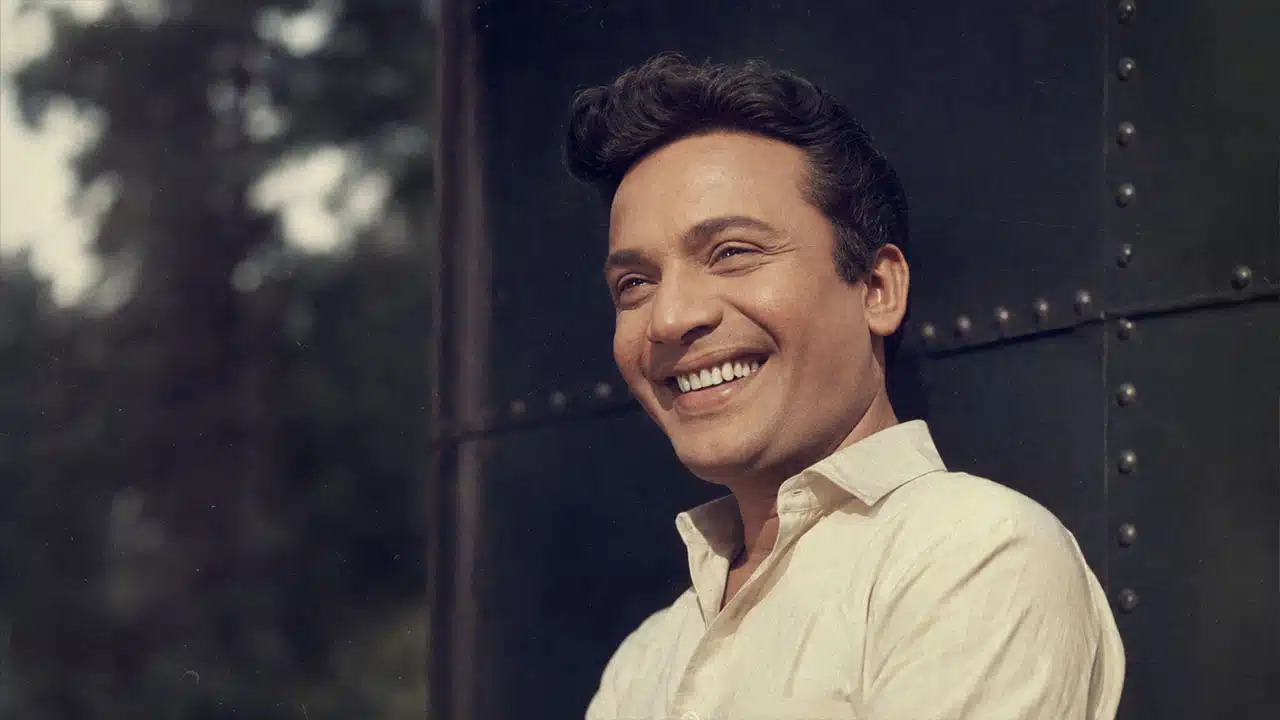
It doesn’t take long for the humid, crowded corridors of a film studio to smell failure. It is in the hesitant, almost apologetic way a struggling actor walks through the door. It’s in the endless, humiliating waits outside makeup rooms, the distracted gaze of a busy assistant, and the way a producer deliberately looks the other way when you pass. Everything in that ecosystem telegraphs a brutal, unspoken truth: you are not needed here.
Yet, when that exact same marginalized man evolves—within a span of just a few grueling years—into a name whose mere presence secures massive film financing, guarantees sold-out theaters on opening week, and lets nervous distributors finally sleep in peace, his story ceases to be a personal triumph. It becomes the living, breathing story of an entire industry’s rebirth.
To simply remember Uttam Kumar as ‘Mahanayak’ (The Great Hero) on his centenary is to severely shortchange his remarkable journey. ‘Mahanayak’ was the glorious destination, the myth he eventually became. But the beginning was painfully ordinary: a middle-class boy from North Calcutta named Arun Kumar Chatterjee. Heavily burdened by family responsibilities in a tough economic climate, he dropped out of college and took a secure, respectable clerical job at the Calcutta Port Trust. By day, he balanced ledgers; by night, he nursed a burning passion for amateur theater while enduring a relentless string of cinematic rejections.
The Crucible of the ‘Flop Master’
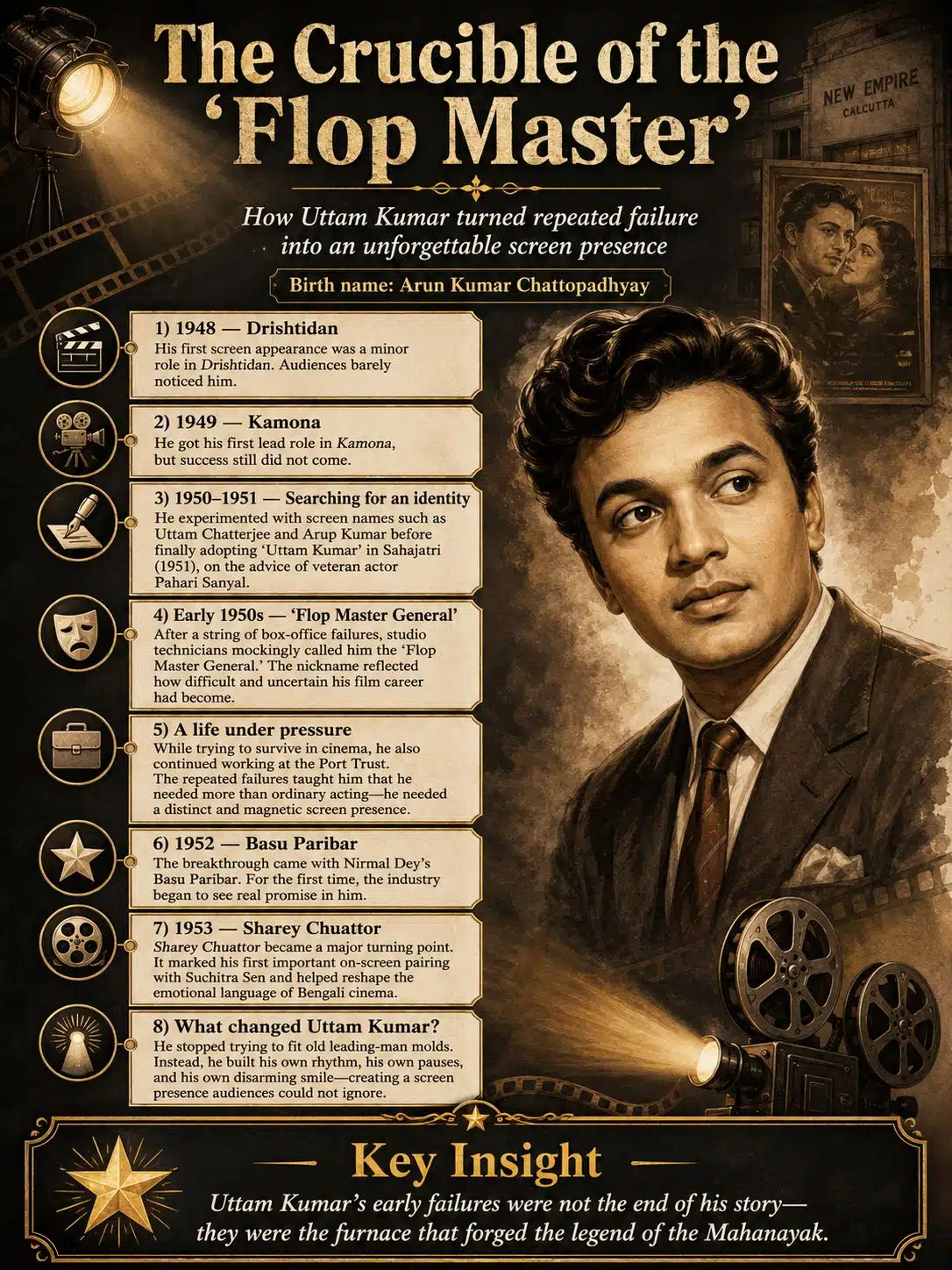
When his first film, Dristidan, released in 1948, Arun Kumar’s minor appearance barely registered with audiences. The following year brought a lead role in Kamana, but commercial success remained bitterly elusive. Desperate to crack the code, he shuffled through a series of screen names—Arun, Uttam Chatterjee, Arup—before finally settling on “Uttam Kumar” during the 1951 film Sahajatri, taking the advice of veteran actor Pahari Sanyal.
But changing his name didn’t immediately change his luck. His streak of box-office disasters grew so absurdly long that the studio mechanics and light boys cruelly dubbed him the “Flop Master General.”
Today, we can smile at this moniker as charming trivia because we know the triumphant ending. But in the early 1950s, it was a professional death sentence. A repeatedly failing actor doesn’t just lose his own confidence; the entire financial ecosystem stops investing in him. For Uttam, the pressure was suffocating. If cinema failed, he would be a port clerk forever, trapped behind a desk. This agonizing dual life taught him a crucial, survivalist lesson: merely acting out a script wasn’t enough. He had to carve out a distinct, utterly irreplaceable screen presence that audiences couldn’t look away from.
The breakthrough finally arrived with Nirmal Dey’s Basu Paribar in 1952. The very face that producers deemed a financial liability yesterday suddenly held a magnetic promise. Then came the legendary Sharey Chuattor in 1953, a brilliant ensemble comedy that marked his first on-screen pairing with Suchitra Sen. It planted the seeds of a romantic pairing that would permanently redraw the emotional map of Bengali cinema. Uttam stopped trying to fit into the existing molds of leading men; he found his own rhythm, his own deliberate pauses, and his own uniquely disarming smile.
When the Camera Whispered
The true explosion of this transformation was Agni Pariksha (1954), fatefully released on his birthday. The Uttam-Suchitra magic reached unprecedented heights, capturing the imagination of a generation. But labeling it mere “romantic chemistry” entirely overlooks the absolute revolution he brought to the mechanics of Bengali acting.
Before Uttam Kumar, Bengali cinema was heavily burdened by its theatrical heritage. Actors utilized booming stage voices, exaggerated facial expressions, and grand physical gestures meant to reach the back row of an auditorium. Giants of the era, like Chhabi Biswas and Pahari Sanyal, commanded the screen, but their style fundamentally belonged to the stage.
Uttam recognized a profound truth: the movie camera sits agonizingly close to the face. It captures the slightest flicker of the eyes, the trembling of a lip, and the quietest hesitation in a breath.
He drastically dialed down the melodrama, bringing a startling, quiet naturalism to the screen. He delivered dialogues as if the thought had just occurred to him in that exact moment. He looked at his co-stars in a way that pulled the audience directly into the intimate, private space of the scene. With Suchitra Sen, this subtlety became a high art form. She brought wounded dignity and a quiet, unyielding strength; he countered with a confident masculine charm that thinly masked a deep, highly relatable vulnerability. Their romance wasn’t just about singing under trees; it was built on pregnant pauses, lingering glances, and beautifully unfinished sentences.
Years later, the legendary Satyajit Ray capitalized on this layered, complex persona in Nayak (1966). Playing Arindam Mukherjee, a matinee idol grappling with his fading moral compass on a claustrophobic train journey, Uttam masterfully blurred the lines between his cinematic character and his own reality. Ray used the actor’s real-life mega-stardom as raw material, allowing Uttam to peel back his polished, million-dollar smile to reveal the fear, guilt, and haunting memories of early failure hidden just beneath the surface.
Rewriting the Industry’s Financial Grammar
Being a star is one thing; becoming a one-man institution is entirely different. By the mid-1950s, Uttam Kumar’s name on a movie poster wasn’t just a magnet for eager audiences—it was literal collateral. Producers used his name to secure bank loans, and distributors demanded his presence as a financial guarantee. In the wake of India’s partition, as the old, rigid studio system was collapsing under economic strain, Uttam single-handedly stabilized the Bengali film economy, ushering in the era of independent, star-driven packaging.
He quickly evolved from a contracted employee to an active, powerful stakeholder. Establishing himself as a producer under banners like “Uttam Kumar Films,” he began taking massive creative risks. He championed projects like Harano Sur, Saptapadi, and Uttar Falguni (which won the National Award for Best Feature Film in Bengali). He even stepped confidently into directing and music composition.
This wasn’t mere superstar vanity; it was a highly strategic move to gain total control over his cinematic narrative. He knew he was the industry’s rarest market guarantee, and he leveraged that financial power to push creative boundaries. He shifted seamlessly from swoon-worthy romantic leads to weary, flawed, and deeply complex men in films like Chiriyakhana (which won him a National Award for Best Actor) and the massive hit Amanush.
The Living Vocabulary of a Legend
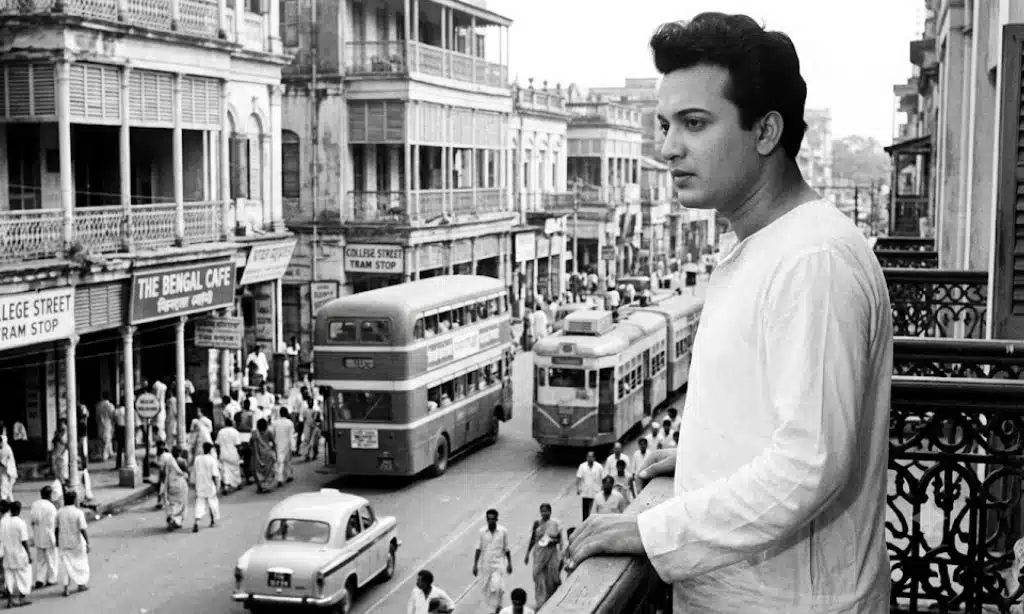
When Uttam Kumar suffered a massive heart attack and died on July 24, 1980, at the tragically young age of 53, the city of Calcutta effectively shut down. Millions poured into the streets, mourning a loss that felt intensely personal. It wasn’t merely the passing of a popular actor; it was the sudden absence of a cultural titan.
But is his enduring legacy purely a product of nostalgia? Middle-class Bengalis certainly project their longing for a gentler, more romantic, lost Calcutta onto the timeless black-and-white frames of Uttam and Suchitra. Yet, nostalgia alone cannot sustain a performance’s relevance for a century. When a modern viewer, decades removed from that era, still feels the palpable, agonizing helplessness of amnesia in Harano Sur or the toxic, layered arrogance in Nayak, it proves the existence of a formidable, timeless acting technique.
His greatest superpower was his relentless work ethic—he never allowed his astronomical stardom to become the enemy of his craft. ‘Mahanayak’ is not just a hollow metric of box-office hits or hysterical, fainting fandom. It signifies the man who actively softened the rigid, patriarchal archetype of the Bengali male, bravely injecting fragility, hesitation, and emotional openness into the traditional hero’s persona. He became a cultural anchor for a traumatized post-partition society that was desperately looking for its footing in a rapidly changing world.
Ultimately, Arun Kumar Chatterjee’s greatest, most consuming masterpiece was creating the larger-than-life character of “Uttam Kumar,” and then spending the rest of his life brilliantly slipping in and out of it for the camera. The audience came, and still comes, for that immortal smile. But he remains eternal because beneath that charm lay rigorous discipline, the haunting, never-forgotten memory of being the “Flop Master,” and the sheer audacity to revolutionize an entire art form.